
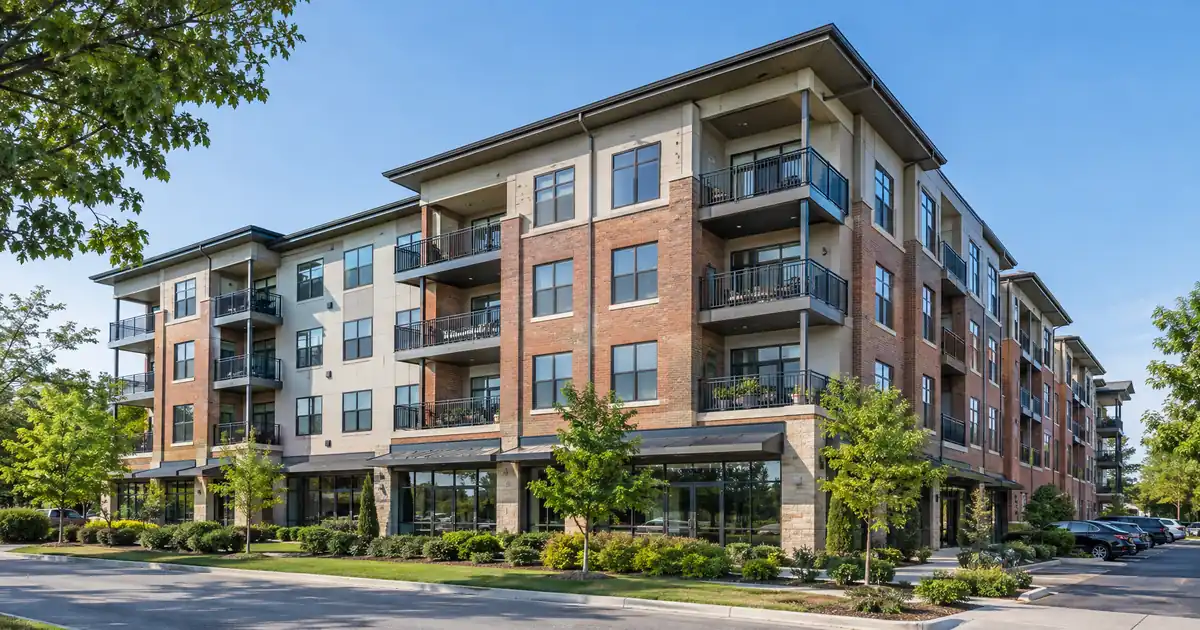
Two Redfin readings, six months apart, show what Schaumburg investors should be watching over the next 6 to 18 months. The median sale price showed $348K in one month, up 13.0 percent year over year. A later monthly reading, via Rocket Homes, came in at $308K, up just 2.3 percent. Meanwhile, the Village of Schaumburg counts over 80,000 jobs inside a village of 77,099 residents, per City-Data. Demand is anchored by the office parks. Prices bounce around month to month. Underwrite on the trend, not the spike.
That combination shapes how a DSCR cash-out refinance works here. You’re not counting on a price surge to pull equity out. You’re counting on rent that holds up and a value that an appraiser can defend with thin comps. Lendmire, a DSCR-focused mortgage broker, sees this play out in suburbs like this one, and the rest of this piece walks through where the coverage math works and where it doesn’t.
DSCR Cash-Out Calculator
Run the cash-out numbers in Schaumburg, IL
Rate source: Freddie Mac 30-yr average via FRED® — Federal Reserve Bank of St. Louis · effective Sep 24, 2026
Prefilled with starting assumptions — enter your property’s value, balance, taxes, and insurance for a more accurate picture.
Program parameters update from Lendmire’s centralized guideline source. Taxes and insurance are editable estimates.
As of Sep 24, 2026 · General Freddie Mac market benchmark, not a Lendmire loan offer. Property value, balance, taxes, and insurance are editable estimates. Maximum loan-to-value varies by lender, program, property type, and seasoning. Not a Loan Estimate, approval, or commitment to lend. Program availability and eligibility are subject to lender guidelines, credit approval, property review, and underwriting.
The Quick Read:
A DSCR cash-out refinance on a Schaumburg, Illinois rental starts with confirming ownership seasoning and a rent-supported appraisal, then sizing the loan under the 75 percent LTV ceiling, and finally documenting rent against the full monthly obligation, with reserves verified before the file goes to a wholesale lender for review.
- Over 80,000 local jobs against 77,099 residents, per the Village of Schaumburg and City-Data.
- Attached units average $277,810 versus $485,462 for detached houses, per City-Data.
- Zillow’s smoothed typical value is up only 1.5 percent, so the play is not appreciation.
- Detached rentals model below 1.00 including taxes and insurance; townhomes clear it.
- Two-to-four unit stock is scarce, so appraisal comps run thin.
Schaumburg Market Snapshot
A quick read on the Schaumburg investor landscape — figures come from the cited sources below. Confirm current property-level numbers before underwriting.
| Metric | Detail |
|---|---|
| Home prices | $299,945 median list (Altos Market Report) |
| Typical rents | Rent $1,870 (City-Data) |
| Cap rates | 6.4% cap (Cook County Assessor) |
| Employment | Over 80,000 jobs (Village of Schaumburg) |
| Vacancy | 5% (Cook County Assessor) |
Slow Equity, Steady Rents
Schaumburg is a stable-equity market, not a speculative one. Zillow’s smoothed index puts the typical home value at $298,317, up 1.5 percent over the past year. Redfin’s price per square foot reads $254, up 6.7 percent. Days on market crept up to 49 from 43 a year earlier, per the Rocket Homes/Redfin data. Altos characterized the market as a seller’s market as of its May read, so the picture is mixed rather than soft.
Pick one number and stick with it. For this article, the typical value is the Zillow figure. The Redfin monthly readings are useful only as a warning: an appraiser can anchor on very different comps depending on which month the sales landed. Ask the lender which valuation window applies before you count proceeds.
What does that mean for a refinance? If you bought years ago, your equity came from timing and from whatever you did to the property. If you bought recently, expect modest movement. Either way, the proceeds are governed by the 75 percent LTV ceiling on cash-out, subject to lender guidelines, not by a forecast of where prices go. A thesis that works here relies on rent-driven value and forced equity from renovation. Pure appreciation won’t carry it.
Rents are firm, not hot. RentCafe shows an average apartment rent of $1,942, up 1.64 percent year over year. Zumper reports a $2,300 average, up 2 percent. That gap is a methodology difference: Yardi’s large-building data sits lower, and listing-based sources sit higher. Treat them as a range.
Attached Product Is the Cash-Out Sweet Spot
Townhomes and condos are where Schaumburg’s coverage math works best. City-Data puts the mean attached price at $277,810 against $485,462 for detached houses. Two- and three-bedroom rents run roughly $2,158 to $2,275 and $2,519 to $2,995, per Zumper and RentHop. Those are ranges from different sources, so use the conservative end.
Run the numbers on a modeled townhome. Assume a value near $300,000, a cash-out at 75 percent LTV, and a monthly rent between $2,200 and $2,800. These are modeled assumptions, not sourced deal data. Measured against full PITIA, including taxes and insurance but before any HOA dues, coverage lands from about 1.0 at the low end of that rent band to roughly 1.25 at the top. That’s a workable range, though it’s not a wide cushion.
Here’s the catch: HOA dues sit inside the debt-service line and pull the number down. So do any HOA rental restrictions that limit who can lease the unit. Both are property-specific, and both can turn a 1.20 file into a 1.05 file. Ask for the HOA budget and the rental provisions early.
The tenant side has an interesting wrinkle. RentCafe reports the average apartment building is about 41 years old, only 10 percent of it built since 2000, and 1-bedrooms make up 52 percent of the stock. A renovated 2 or 3 bedroom unit competes against dated garden-style product and against a market dominated by small floor plans. Family-sized, updated units can hold pricing near the top of the range above. That’s the play for a rehab-minded owner: renovate, re-lease, and refinance on the new rent.
Detached Houses: Skip Them for Cash Flow
The math on detached single-family is weak. A $485,462 mean price needs a rent near $3,000 just to approach break-even, and it doesn’t quite get there.
Model a detached house valued near that mean at 75 percent LTV, with a rent around $2,995, the top of the 3-bedroom range. Full PITIA including taxes and insurance puts coverage in the mid-to-high 0.8s. That’s below the 1.00 benchmark most standard programs are built around.
Sub-1.00 files are not automatically dead. Select lenders in the network may review them, and the options usually look like this:
- A sub-1.00 program
- Lower leverage, meaning less cash pulled out
- An interest-only structure
- Stronger credit and deeper reserves
Each one changes the return model, and every one of them is subject to lender guidelines, credit approval, and property review. If you already own a detached house in Schaumburg and want cash out, plan for a smaller number than the LTV cap suggests. If you’re deciding what to buy next with the proceeds, don’t buy another one.
Small Multifamily: Best on Paper, Scarce in Practice
Duplexes, triplexes, and fourplexes have the strongest rent-to-value on paper. City-Data’s mean price for a 3-to-4 unit structure is $237,820, about 49 percent of the detached mean. When you divide that across units and compare it to $2,100 to $3,000 rents on 2 to 3 bedroom apartments, the math should favor multi-unit stacking. That is an inference from the price gap, not a sourced cap rate.
The problem is supply. A local agent’s neighborhood guide says two-to-four unit buildings are less common here than in Chicago proper, typically near the Metra corridor or along commercial streets. The same agent page cites median pricing of $290,000 to $380,000, well above City-Data’s mean. It’s a marketing page, so treat it as an agent’s view. Both numbers are directional, and the gap between them is a reminder that a thin market gives you noisy data.
Thin supply also means thin comps. With roughly 58 to 75 sales a month across all property types, per the Redfin data above, a 2-to-4 unit subject may have few close comparables inside the village. Expect the appraiser to pull from outside Schaumburg, which raises the risk of a conservative value and a smaller cash-out. Build in a cushion. If your file depends on squeezing the last point of LTV, this is the property type where it tends to break.
Large-building vacancy gives some context, though it doesn’t apply to small properties. A Cook County Assessor valuation report put large multifamily in Schaumburg Township at 5 percent average vacancy and a 6.4 percent cap rate. It’s an older report on large buildings only. I’d read it as a rough ceiling for how healthy the rental base is, not as a comp for a fourplex.
Who Rents Here, and Why
Schaumburg is a daytime-employment city, and renters are a large share of it. City-Data shows a daytime population swing of +21,144, or +27.0 percent, from commuting. Roughly 37 percent of households rent (11,729 renter-occupied against 19,926 owner-occupied). The village’s own profile counts nearly 5,000 businesses.
Tenant demand follows the employers. A 2025 Draper and Kramer article says more than 2,600 people work at Zurich North America’s corporate campus, and about 1,300 at OptumRx. Motorola Solutions was described by the Daily Herald as the fourth-largest employer, and Woodfield Mall as the leader, though that ranking is several years old. Insurance and financial services, technology, retail, and healthcare are the key industries.
Median household income is $104,062. That supports family-sized rents near the top of the range. Higher education isn’t a demand driver here. Harper College serves the area from nearby Palatine, but this is a corporate, white-collar renter base.
New supply won’t flood it. The village’s first office-to-residential conversion, a 98-unit project called Woodfield Heights, was approved and then hadn’t started work 15 months later, per the Daily Herald. It’s a small and delayed pipeline, so it’s no threat to small-property rents right now.
Corridors Worth Knowing
The research doesn’t support neighborhood-level prices or rents, so this is character, not comps.
Woodfield and the Golf Road corridor. This is where the big corporate campuses cluster, near the I-90 and I-290 interchange. Expect apartment and corporate-renter demand. It’s the strongest tenant-pull area, and it’s more apartment-heavy than small-property-friendly.
Meacham and Algonquin Roads, the International Village area. It was among the village’s first residential areas that wasn’t entirely single-family, and it sits beside the Motorola campus. Older attached stock near a major employer is worth a look for a value-add cash-out.
Weathersfield. According to Northwest Quarterly, this is the first large subdivision, with several thousand single-family homes built in 22 stages. That’s workforce single-family stock, and the detached math above applies. Skip it for coverage, unless you bought well below today’s values.
Metra corridor and Olde Schaumburg Centre. The Milwaukee District/West line has a station in the village. That’s where the agent guide says the scarce 2-to-4 unit buildings tend to sit. If you find one, don’t let it go without running the numbers.
Named apartment pockets. Apartments.com lists Lexington Green among the more affordable areas and The Lakes and Autumn Ridge among the more expensive. It lists Park Meadows in both groups, so lean on the names only.
How the Cash-Out Gets Structured
The program parameters are straightforward. On most files, cash-out LTV tops out at 75 percent. Seasoning runs about six months of ownership, measured from title recording. Minimum DSCR is 1.00, meaning rent used for lender review covers PITIA. Credit tiers run from a 620 floor up through 660, 680, and 700. Reserves are about six months of PITIA, closer to nine above $1,500,000. Loan amounts go up to $3,000,000 on standard programs, with smaller balances routed through select lenders. All of that is subject to lender guidelines, and none of it is a commitment to lend. Investors can read the guide “What Is a DSCR Loan” and a comparison of DSCR and conventional loans for the basics, and the cash-out qualification details for the full framework.
Working DSCR brokers see a recurring pattern in job-heavy suburbs with thin comp pools: the coverage ratio looks fine, but the appraisal comes back conservative and shrinks the loan. The stronger files usually pull recent attached comps early, model the cash-out at a lower value than the seller-side listings imply, and keep reserves above the minimum. Underwrite to the low case and treat anything above it as upside.
DSCR vs. conventional financing
Two common ways to finance an investment property in Schaumburg, IL. They qualify you differently — here’s how investors weigh them.
Why investors choose it
- Qualifies on the property’s rental income — no personal tax returns, W-2s, or pay stubs needed to document income.
- No personal debt-to-income ceiling to clear, so existing mortgages and obligations don’t cap your borrowing the same way.
- Can be closed in an LLC, keeping the property inside a business entity.
- Built for scaling — not held to the limit on number of financed properties that conventional financing applies.
- Underwriting centers on the deal: generally qualifies when the rent covers the payment, a 1.00x coverage ratio being a common baseline (confirmed in underwriting).
- Designed specifically for investment property, including long-term and, where the program allows, short-term rentals.
Where it’s strong
- Often the lowest ongoing financing cost for a buyer who fully qualifies on personal income — a fit for a first property or a cost-first purchase.
Trade-offs for investors
- Requires full personal income documentation and must fit within a debt-to-income limit — salary, existing debts, and other mortgages all count.
- Typically held in your personal name rather than a business entity.
- Caps how many financed properties you can carry, which can become a ceiling as a portfolio grows.
- Evaluates you as a borrower as much as the property, which usually means more paperwork.
How investors usually choose: a first or single property often optimizes for the lowest financing cost; portfolio builders often optimize for leverage, vesting in an LLC, and scaling past conventional caps. The right answer depends on your goals, the property, and current guidelines — both paths run through select lenders in Lendmire’s wholesale network, with eligibility and terms confirmed in underwriting.
This one’s a toss-up for some borrowers. The coverage math favors townhomes, but the comp depth favors the property type with the most sales. A townhome in a large complex often appraises more cleanly than a fourplex with better rent-to-value.
What Happens to the Proceeds
Consider a scenario. Say you own a Schaumburg townhome bought at a lower basis, now valued near the typical local range, with an existing balance at 55 percent of value. A cash-out to the 75 percent cap frees roughly 20 points of value, before costs and subject to appraisal. If the appraisal comes in a few percent lower than you hoped, the freed equity shrinks in proportion. The calculator turns those percentages into dollars. The prose can’t.
The smart use is to redeploy into product that the market rewards. That means either another attached unit or, if you can find one, a small multifamily near the Metra line. Don’t put proceeds into a detached house at the mean price; the math above says it won’t cover. Lendmire outlines its refinance programs in more detail.
Investors who hold in an LLC should confirm that the entity qualifies, depending on program guidelines. Verify current local rental rules, taxes, HOA rental caps, and insurance with qualified local professionals before you underwrite. To talk through a specific file, call 828-256-2183 or get a DSCR quote. The state hub page, Illinois DSCR investor loans, covers the rest.
Frequently Asked Questions
How much cash can I pull from a Schaumburg townhome I’ve owned for a year?
It depends on the appraised value, your existing balance, and the 75 percent LTV ceiling for cash-out. A townhome that has been held for more than six months typically clears seasoning. Because monthly sale prices in Schaumburg swing between readings, the appraisal window matters. Treat any equity estimate as a range, not a promise.
Will a duplex or fourplex appraise well enough in Schaumburg?
Often it won’t, at least not cleanly. Two-to-four unit buildings are scarce here, and total sales run only about 58 to 75 a month across all property types. The appraiser may pull comps from outside the village and land conservative. Build in a buffer on the loan size.
Does a detached house in Schaumburg meet the 1.00 DSCR minimum?
Exact terms depend on the lender’s guidelines, property type, leverage, and a full review of the borrower’s file.
Usually not at the mean price. With rent near the top of the 3-bedroom range, modeled coverage including taxes and insurance lands below 1.00. Some lenders review sub-1.00 files with lower leverage or an interest-only structure, but that’s a different deal with different terms.
Do I need to own the property for six months before a cash-out?
Yes, on most files, seasoning is about six months of ownership measured from title recording. Lender programs vary, so confirm the window before you list your timeline.
Which rent number should I use, Zumper, RentHop, or RentCafe?
Use the lowest credible number. RentCafe’s large-building data sits lowest for 2-bedrooms at $2,158, and the listing sources run $2,212 to $2,275. The lender will rely on an appraiser’s rent schedule or the lease, not a listing average.
For current guidelines and terms, see Lendmire’s DSCR loan programs page.
Schaumburg Against the Usual Suspects
Schaumburg’s math favors attached product and thin-margin patience. Against a detached-heavy suburb like Naperville, Schaumburg is the better cash-out bet right now, because 37 percent of households rent and attached units trade far below the detached mean.
About Lendmire
Lendmire (NMLS# 2371349), a non-QM mortgage broker serving investors in 41 markets including Washington, D.C., helps structure DSCR scenarios commonly evaluated around a property’s rental income rather than personal income paperwork, subject to lender guidelines. A Scotsman Guide Top Mortgage Workplace, recognized by Scotsman Guide in 2025 and a top-ranked workplace in 2026, Lendmire places loans through wholesale investor lenders and is not a direct lender.
Get Started
Ready to find the right loan for you?
In about 30 seconds you can review financing options available for your investment property. No commitment required.
Informational only. Not a Loan Estimate, approval, or commitment to lend. Program availability and eligibility are subject to lender guidelines, credit approval, property review, and underwriting.
References
1. Redfin
3. City-Data
5. Cook County Assessor valuation report
7. RentCafe
8. Zumper
9. RentHop
10. RentCafe reports
12. Harper College
13. Daily Herald
15. Apartments.com
16. recognized by Scotsman Guide in 2025
17. Scotsman Guide — Top Workplaces 2026
This article is part of Lendmire’s investment property cash-out refinance program — full qualification details, guidelines, and scenarios live on the program page.
Related reading: Cash Out Refinance Investment Property Schaumburg Illinois · DSCR Cash Out Refinance DeKalb Illinois · Cash Out Refinance Investment Property in Moline, Illinois: The Duplex Equity Math on John Deere Road
Guides: Investment Property Cash-Out Refinance in Schaumburg, IL · Investment Property Cash-Out Refinance in Illinois
Brandon Miller
Founder & CEO, Mortgage Loan Originator, Lendmire LLC
- Mortgage Loan Originator · NMLS# 1129696 · Verify on NMLS Consumer Access
- North Carolina Real Estate Broker · License# 343312 · Verify on NCREC
- North Carolina Insurance Producer · License# 19053198 · Property, Casualty, Life, Health · Verify on NAIC SBS
- Lendmire LLC · Firm NMLS# 2371349 · Verify firm licensure
Compliance and disclosures. Lendmire (NMLS# 2371349) is a licensed mortgage broker and is not a direct lender, depository institution, financial advisor, or tax professional. Content in this article is general market analysis and educational information — not financial, legal, or tax advice for any specific situation. Lendmire does not guarantee loan approval; every transaction is subject to underwriting by the funding lender. Mortgage pricing and loan program guidelines are subject to change at any time without notice and vary by borrower characteristics, property type, and state regulations. Lendmire complies with Equal Housing Opportunity. Licensure verification: NMLS Consumer Access.