
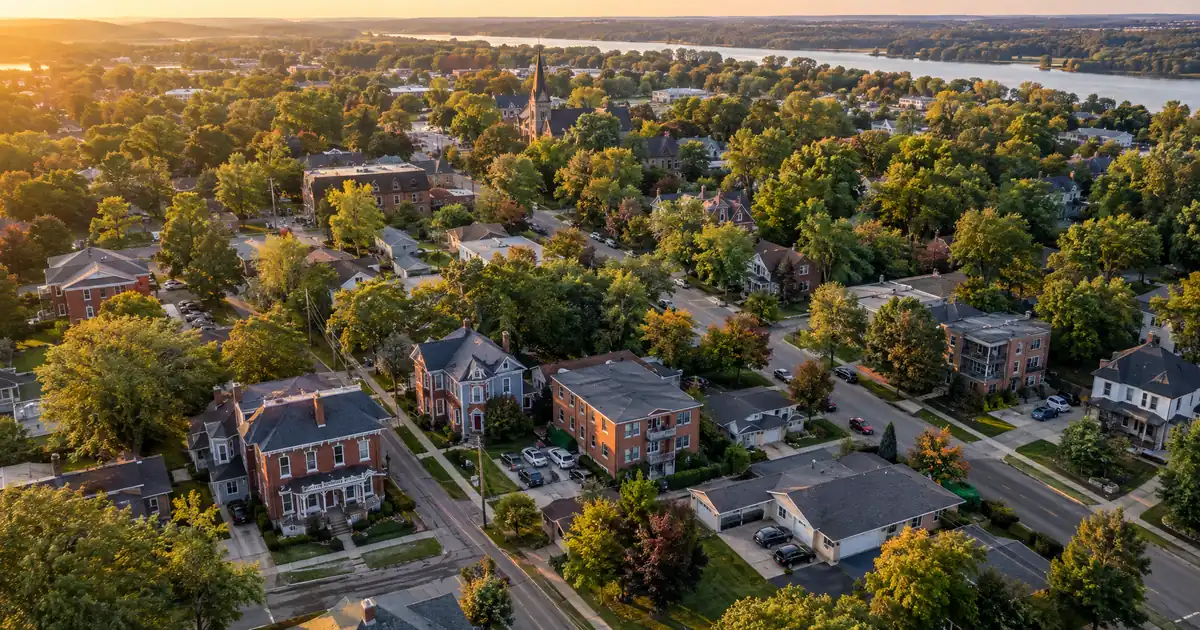
The South Sievers Road corridor on Vincennes’ south side shows how thin this equity market is. Redfin’s Vincennes page lists recent sales there and nearby on Ramona Drive and Ritterskamp Avenue: a three-bed at $144,000, a two-bed at $120,000 and another three-bed at $129,900. That spread is narrow enough that condition probably does more of the work than the street. For an investor pulling equity out of a rental already owned, that changes the analysis. Equity here comes mostly from basis and rehab, not from market drift, and the appraiser decides how much of it becomes usable capital.
DSCR Cash-Out Calculator
Run the cash-out numbers in Vincennes, IN
Rate source: Freddie Mac 30-yr average via FRED® — Federal Reserve Bank of St. Louis · effective Sep 24, 2026
Prefilled with starting assumptions — enter your property’s value, balance, taxes, and insurance for a more accurate picture.
Program parameters update from Lendmire’s centralized guideline source. Taxes and insurance are editable estimates.
As of Sep 24, 2026 · General Freddie Mac market benchmark, not a Lendmire loan offer. Property value, balance, taxes, and insurance are editable estimates. Maximum loan-to-value varies by lender, program, property type, and seasoning. Not a Loan Estimate, approval, or commitment to lend. Program availability and eligibility are subject to lender guidelines, credit approval, property review, and underwriting.
Key Takeaways:
A DSCR cash-out refinance in Vincennes, Indiana is underwritten primarily on the property’s rental income measured against its full monthly obligation, so the binding constraint is the appraised value of an older, low-priced house, with sale medians near $134,000 according to City-Stats.
- Sale prices cluster around $125,000 to $135,000, while Movoto list medians run near $175,000.
- Cash-out is capped at 75 percent LTV after roughly six months of ownership from title recording.
- Census median rent sits near $800 to $825, and modeled coverage at that rent runs about 1.0x. Vincennes University’s campus enrolls 2,481 students, not 19,795. Good Samaritan employs roughly 1,800 to 1,900 people and anchors south side demand.
Vincennes Market Snapshot
A quick read on the Vincennes investor landscape — figures come from the cited sources below. Confirm current property-level numbers before underwriting.
| Metric | Detail |
|---|---|
| Home prices | 10 sales (Redfin) |
| University enrollment | 19,795 total (College Tuition Compare) |
| Employment | ~1,800 employees (AHA) |
The Appraisal Is the Whole Game in Vincennes
Cash-out proceeds in Vincennes are capped by appraised value, and appraised value is the soft spot. Sale medians sit around $132,000 to $134,000 while list medians run near $175,000, and monthly sales counts are tiny. Appraisers work with few comps, so size the loan on the sale band, not the asking band.
The February snapshot on Redfin showed a median of $132,000, up 7.1 percent year over year, with homes averaging 81 days on market. That was a ten-sale sample, so read it as directional at best. City-Stats, drawing on Redfin data, puts the current median sale price at $134,000, with 27 median days on market, 2.5 months of supply and $121 per square foot. Movoto shows a median list price of $175,000 (down 7 percent year over year) and 57 days on market. Those are asking prices, not sale prices. The gap between list and sale medians runs roughly 25 to 30 percent, which is the number that matters at the appraisal table.
Long-run appreciation is real but slow. City-Data estimates the median house or condo value at $124,540, roughly double the $61,100 recorded in 2000. No reliable single recent appreciation figure exists, so the honest description is flat to modestly positive and volatile because of low volume. Indiana’s statewide median sale price is $283,978 per Redfin’s state page, so Vincennes trades at less than half the state level.
The practical read: an investor who bought at distressed pricing and renovated has real equity to extract. An investor who paid retail and did nothing probably has very little. At a 75 percent LTV ceiling, appreciation has to be measured against the original basis, not against a hoped-for list price.
What the Rent Evidence Says (and Doesn’t)
Vincennes rent data is messy, and a cash-out file lives or dies on which number the appraiser’s rent schedule lands on. Census-based medians cluster around $792 to $824, Zumper shows houses near $923, and current asking rents for three-bedrooms run well above that.
Here is the spread. The Census-derived median gross rent is $824 per City-Data. Zumper’s June data shows apartments at $800 and houses at $923, and rents down 5 percent year over year on limited data. On the asking side, ApartmentHomeLiving lists three-bedroom homes from $1,295 to $2,200, and Rent.com shows a three-bed/two-bath at $1,395. Together, those readings frame the range an appraiser’s rent schedule is likely to draw from.
Against a $130,000 value, the arithmetic looks like this (a modeled comparison, not a sourced ratio). Census median rent implies roughly 0.6 percent gross monthly rent to price. A $1,295 to $1,395 asking rent implies roughly 1.0 to 1.1 percent. Asking rents are not achieved rents, and the gap between those two readings is the whole uncertainty band. Don’t assume the top of it. Use the appraiser’s rent schedule, and treat listing rents as a sanity check only.
Coverage Math at the 75 Percent Ceiling
At 75 percent LTV on a $130,000 value, a Vincennes rental clears the 1.00x baseline at rents near $800 and builds cushion quickly above $1,000. The table below is modeled, not sourced. Each row divides an assumed rent by full PITIA (principal, interest, taxes and insurance) and rounds the ratio down.
| Assumed rent | Modeled coverage (full PITIA) |
|---|---|
| $800 | About 1.0x |
| $925 | About 1.15x |
| $1,050 | About 1.3x |
| $1,395 | About 1.8x |
These bands assume a $130,000 appraised value and a single-family or half-duplex unit. Lower the value and the ratio tightens, because taxes and insurance don’t shrink in proportion to price. Most standard DSCR programs are built around a 1.00x benchmark because rent covers the obligation at that level. Some lenders review lower-ratio scenarios, but those usually mean reduced leverage, stronger credit or additional reserves. Interest-only structuring or a sub-1.00 program may be options for a property that lands under the line, subject to lender guidelines, credit approval and property review. Small balances at this price point also route through select lenders in the network, so confirm loan-size fit before assuming the file works. For the mechanics behind the ratio, see the DSCR fundamentals.
DSCR files in markets like this one typically look the same. Coverage clears comfortably on paper, and the drag comes from value. A low-priced, older house with few comps is the type of file where the appraisal, not the borrower profile, sets how much equity actually comes out. The stronger files usually arrive with a documented renovation history, a signed lease near the appraiser’s rent estimate and a clear insurance quote in hand before submission.
South Side, Downtown, Campus: Three Reads
The south side pencils best for cash-out because it has the deepest employment base behind it. Downtown has momentum but a supply complication. The campus fringe is the weakest of the three for equity extraction.
South side (hospital district). Good Samaritan is a 158-bed county-owned teaching hospital with Indiana University School of Medicine residencies, and it is the largest employer in Knox County with an annual payroll above $115 million. The AHA case study puts headcount near 1,800, and the Knox County Development Corporation says over 1,900. The campus sits along Willow Street and Sixth Street. No source quantifies how many staff rent nearby, so treat that as plausible demand, not measured demand. Still, a rental within reach of the largest employer in the county has stable, long-lease tenant logic behind it. The Sievers Road corridor comps above sit in the $120,000 to $144,000 band, which is where the core opportunity in this city lives.
Downtown and the riverfront. The area near the River Walk, the farmers market and the George Rogers Clark park is described as seeing a revitalization push. The complication is RiverView Vincennes, 44 newly built income-restricted units (22 three-bedrooms and 22 one-bedrooms). It’s a small project, but income-restricted supply sets a ceiling on nearby three-bedroom rents, and appraisers notice. Older downtown stock can work, but confirm the rent schedule against this competitor before sizing the loan.
Vincennes University campus fringe. Skip this one for cash-out unless the numbers are unusually clean. The system-wide enrollment of 19,795 reported by Data USA includes 14,152 students under 18, per College Tuition Compare, mostly dual-credit high schoolers. The number that matters is Vincennes campus enrollment: 2,481 in the fall, up 5 percent per VU’s own release. That is a stabilizer, not a growth engine, and no lender should underwrite rents as if 20,000 students lived here.
Beyond the campus and the hospital, the resident job base is diversified for a city this size. Data USA counts 1,735 residents in manufacturing, 1,229 in retail and 1,172 in health care and social assistance, and Futaba Indiana of America supplies the Toyota plant in Princeton. That supply-chain link gives manufacturing employment that doesn’t hinge on a single local factory. The city’s economic development office handles site selection, industrial expansion and workforce development.
Duplex or Single-Family? A Genuine Toss-Up
For pure coverage, a duplex should beat a single-family house at the same value band. For appraisal certainty and exit liquidity, the single-family house probably wins. That makes this a real toss-up, and unverified duplex comps keep it one.
RentCafe shows 48 percent of Vincennes housing rented, with 56 percent of apartments in smaller complexes and 33 percent single-family rentals, so the stock leans small. Rent.com shows a two-bed/one-bath duplex unit at $1,050. If a duplex trades in the same $125,000 to $175,000 range as single-family houses, two units at $850 to $1,050 each would materially improve coverage. No sourced duplex sale bands exist, so pull sold comps before assuming that. If they support it, a duplex refinance at the same LTV would carry far more cushion for the reserves and the next acquisition.
The counterweight is age. The median build year is 1959 per City-Stats, across 8,401 housing units. Condition drives appraisal outcomes on this stock, and a deferred-maintenance duplex can appraise below a clean single-family house.
Seasoning, Reserves and Where the Proceeds Go
The refinance itself is straightforward: about six months of ownership measured from title recording, a 75 percent LTV ceiling, a 1.00 minimum DSCR, credit tiers starting at a 620 floor and about six months of PITIA in reserves. Those are typical guidelines, not commitments. Exact eligibility depends on lender guidelines, credit profile, property review and state overlays. Vesting in an LLC works on many files, subject to lender program eligibility. Manufactured homes, log homes and barndominiums fall outside these programs entirely, which matters in a county where some rural stock fits those descriptions.
The recycling math is what makes small-basis markets interesting. Take a hypothetical investor who buys at a $100,000 all-in basis (purchase plus renovation), with a rent schedule supporting a $130,000 as-is value. At 75 percent LTV, the new loan sits at roughly 97 percent of the original basis. Nearly all invested capital returns, before closing costs and any existing payoff, and the property stays rented. That capital funds the next acquisition in the same $100,000 to $145,000 band, where the process repeats. This is pulling equity with a DSCR cash-out in its simplest form. For borrowers comparing paths, investor refinance options cover the rate-and-term alternative, and the guide “Where DSCR and Conventional Diverge” explains why the income documentation differs. Indiana-specific program context is on the hub page for DSCR loans in Indiana.
Investors who want to see how the proceeds would size on a specific Vincennes property can pull a DSCR quote or call Lendmire at 828-256-2183.
Where the Cash-Out Math Breaks
The math breaks in four places, and each one is specific to Vincennes.
Thin value evidence. Ten sales in a month means one distressed comp can drag a whole neighborhood’s value. A one-bedroom sold for $35,000, an outlier, but appraisers see outliers too.
Shrinking demand pool. Population sits around 16,676, down roughly 10 percent over 14 years. The county count is 36,282 per the last Census, with a lower recent estimate, per Wikipedia. The pitch here is low entry price and stable institutional employers, not growth. Don’t underwrite rent increases.
Flat-to-falling rents. Zumper shows a 5 percent decline. If the rent schedule comes in low, coverage compresses and so does proceeds.
Low-end ceilings. Median household income is $53,638. That caps what a tenant can pay, no matter what a listing asks.
Investors should confirm current local rental rules, taxes and insurance with qualified local professionals before sizing any refinance.
Frequently Asked Questions
How do you qualify for a DSCR cash-out refinance in Vincennes, Indiana?
Qualification centers on the property’s rent versus its full monthly obligation, plus ownership seasoning, credit and reserves. Typical guidelines include about six months of ownership from title recording, a credit floor of 620, a 1.00 DSCR baseline and about six months of PITIA in reserves. Cash-out is capped at 75 percent LTV. All of it is subject to lender guidelines, credit approval and property review.
DSCR vs. conventional financing
Two common ways to finance an investment property in Vincennes, IN. They qualify you differently — here’s how investors weigh them.
Why investors choose it
- Qualifies on the property’s rental income — no personal tax returns, W-2s, or pay stubs needed to document income.
- No personal debt-to-income ceiling to clear, so existing mortgages and obligations don’t cap your borrowing the same way.
- Can be closed in an LLC, keeping the property inside a business entity.
- Built for scaling — not held to the limit on number of financed properties that conventional financing applies.
- Underwriting centers on the deal: generally qualifies when the rent covers the payment, a 1.00x coverage ratio being a common baseline (confirmed in underwriting).
- Designed specifically for investment property, including long-term and, where the program allows, short-term rentals.
Where it’s strong
- Often the lowest ongoing financing cost for a buyer who fully qualifies on personal income — a fit for a first property or a cost-first purchase.
Trade-offs for investors
- Requires full personal income documentation and must fit within a debt-to-income limit — salary, existing debts, and other mortgages all count.
- Typically held in your personal name rather than a business entity.
- Caps how many financed properties you can carry, which can become a ceiling as a portfolio grows.
- Evaluates you as a borrower as much as the property, which usually means more paperwork.
How investors usually choose: a first or single property often optimizes for the lowest financing cost; portfolio builders often optimize for leverage, vesting in an LLC, and scaling past conventional caps. The right answer depends on your goals, the property, and current guidelines — both paths run through select lenders in Lendmire’s wholesale network, with eligibility and terms confirmed in underwriting.
What are the requirements for an investment property loan in Vincennes, Indiana?
Loan amounts go up to $3,000,000 on standard programs, with smaller balances routed through select lenders in the network. Manufactured homes, log homes and barndominiums are not eligible. Requirements vary by lender, borrower and property.
Will thin comps hurt a Vincennes appraisal?
They can. With sale medians near $134,000 and list medians near $175,000, the appraiser has to bridge a large gap using few sales. Size the loan on the sale band, document renovations and bring a lease that supports the rent schedule.
Can I count Vincennes University’s 19,795 enrollment as rental demand?
No. That figure includes over 14,000 students under 18, mostly dual-credit. The Vincennes campus itself enrolls 2,481. Treat student demand as a modest stabilizer.
How does DSCR lender review differ from a bank’s approach in Vincennes?
For current guidelines and terms, see Lendmire’s DSCR loan programs page.
The Local Read
Buy a clean three-bed near the hospital at a real discount and it will appraise. Buy the same house at list and it won’t. The equity in Vincennes is made at the purchase table and the paint aisle, so a cash-out file works when the basis was low to begin with.
About Lendmire
Lendmire (NMLS# 2371349), a non-QM mortgage broker serving investors in 41 markets including Washington, D.C., helps structure DSCR scenarios commonly evaluated around a property’s rental income rather than personal income paperwork, subject to lender guidelines. As a Scotsman Guide Top Mortgage Workplace, recognized by Scotsman Guide in 2025 and a top-ranked workplace in 2026, Lendmire places loans through wholesale investor lenders and is not a direct lender.
Get Started
Ready to find the right loan for you?
In about 30 seconds you can review financing options available for your investment property. No commitment required.
Informational only. Not a Loan Estimate, approval, or commitment to lend. Program availability and eligibility are subject to lender guidelines, credit approval, property review, and underwriting.
References
2. City-Stats
3. Movoto
8. City-Data
10. Zumper
12. Rent.com
13. Knox County Development Corporation
15. Data USA
16. Data USA
17. vincennes.org — Economic Development
18. RentCafe
19. Wikipedia
20. recognized by Scotsman Guide in 2025
21. Scotsman Guide — Top Workplaces 2026
This article is part of Lendmire’s investment property cash-out refinance program — full qualification details, guidelines, and scenarios live on the program page.
Related reading: Cash Out Refinance Investment Property Vincennes Indiana · DSCR Cash Out Refinance Noblesville Indiana · Cash Out Refinance Investment Property Zionsville Indiana
Guides: Investment Property Cash-Out Refinance in Indiana
Brandon Miller
Founder & CEO, Mortgage Loan Originator, Lendmire LLC
- Mortgage Loan Originator · NMLS# 1129696 · Verify on NMLS Consumer Access
- North Carolina Real Estate Broker · License# 343312 · Verify on NCREC
- North Carolina Insurance Producer · License# 19053198 · Property, Casualty, Life, Health · Verify on NAIC SBS
- Lendmire LLC · Firm NMLS# 2371349 · Verify firm licensure
Disclosure information. Lendmire is a state-licensed mortgage brokerage under NMLS# 2371349. Lendmire is not a depository institution, direct lender, or financial advisor — all loans referenced are placed through wholesale lender partners and are subject to each lender's underwriting standards. This article is provided for general informational purposes and is not a commitment to lend, nor does it constitute financial, legal, or tax advice. Loan programs, terms, rates, and qualification standards change without notice and depend on borrower profile, property type, and the state in which the subject property is located. Equal Housing Opportunity provider. NMLS Consumer Access: nmlsconsumeraccess.org.