
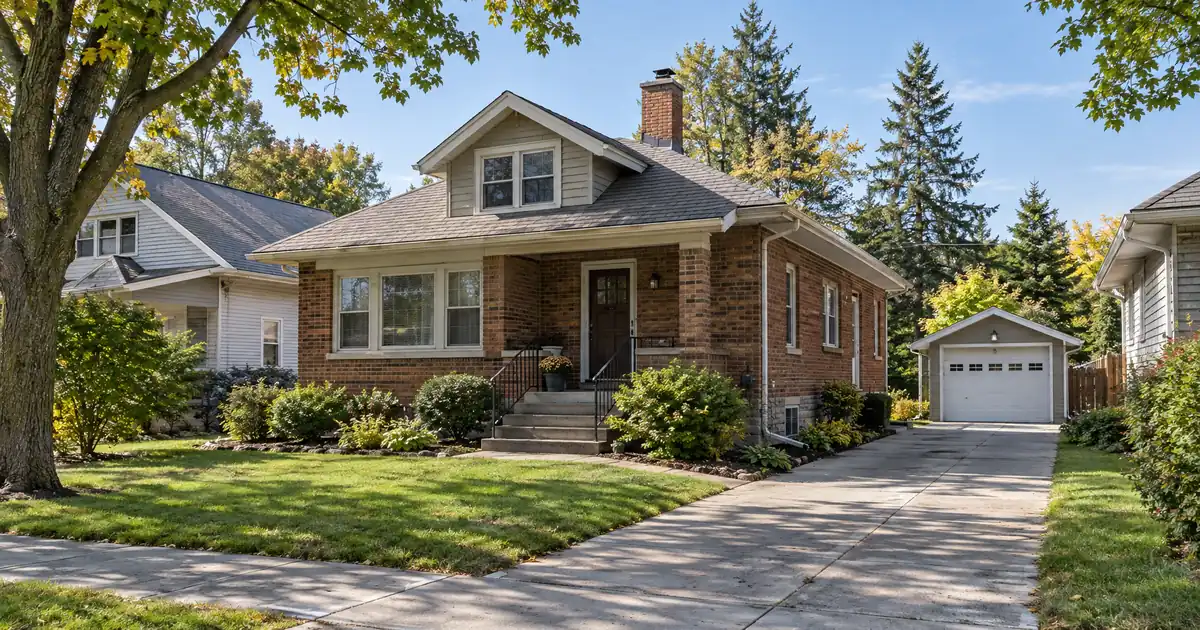
Two investors in West Bend each hold a rental appraised near the $325,000 closed-sale median Resideline reports across 268 recent sales. One owns a single-family house renting around $2,025, per Homes.com. The other owns a duplex. In a cash-out refinance on an investment property, the duplex owner has the better file, and the gap is wider than most owners expect.
The Quick Read: A DSCR cash-out refinance in West Bend, Wisconsin is underwritten primarily on the property’s rental income measured against its full monthly obligation, so the process runs from appraisal and rent schedule, through a lender’s review of the 75% LTV ceiling and six-month seasoning, to reserves and proceeds that can be redeployed into the next acquisition.
DSCR Cash-Out Calculator
Run the cash-out numbers in West Bend, WI
Rate source: Freddie Mac 30-yr average via FRED® — Federal Reserve Bank of St. Louis · effective Sep 24, 2026
Prefilled with starting assumptions — enter your property’s value, balance, taxes, and insurance for a more accurate picture.
Program parameters update from Lendmire’s centralized guideline source. Taxes and insurance are editable estimates.
As of Sep 24, 2026 · General Freddie Mac market benchmark, not a Lendmire loan offer. Property value, balance, taxes, and insurance are editable estimates. Maximum loan-to-value varies by lender, program, property type, and seasoning. Not a Loan Estimate, approval, or commitment to lend. Program availability and eligibility are subject to lender guidelines, credit approval, property review, and underwriting.
- Rental vacancy sits near 1%, per the City of West Bend housing study.
- A median-priced single-family rental models just under 1.00x coverage, taxes and insurance included.
- Duplexes and entry-tier houses have better odds of clearing 1.00x than median-priced houses.
- Flat prices mean equity comes from low basis and value-add work, not market lift.
West Bend, Wisconsin is one of the 41 markets — 40 states plus Washington, D.C. — where Lendmire places DSCR loans for investment-property borrowers. Lendmire is a DSCR-focused mortgage broker (NMLS# 2371349), and this report covers only the equity-extraction side: what a West Bend owner can pull out, what limits it, and what the proceeds can do. Purchase-side mechanics are a separate topic. The data below comes from city documents, Census-based aggregators, and listing sources that often disagree, and the article says so where they do.
West Bend Market Snapshot
A quick read on the West Bend investor landscape — figures come from the cited sources below. Confirm current property-level numbers before underwriting.
| Metric | Detail |
|---|---|
| Employment | Over 3,000 employees combined (wbachamber.org — Economic Development) |
| Vacancy | Rental near 1% (City of West Bend) |
The Equity Won’t Come From Market Lift
West Bend prices are flat to slightly down, so cash-out proceeds here depend on how an owner bought and improved the property. Appreciation is not the engine. Investors who bought below market, renovated, or hold a low payoff balance have room. Investors counting on rising comps do not.
Start with the price evidence. Resideline puts the median at $325,000, with the middle half of sales closing between $241,500 and $405,000. Redfin reports a lower median of $300,000, down 4.5% year over year, though median price per square foot rose 0.8% to $187 and homes sold in 36 days versus 59 the year before. The two medians reflect different time windows and methodologies. This article uses Resideline’s $325,000 as the working figure and treats Redfin’s as the cautious read. The takeaway is stable either way: no multi-year appreciation trend is supported by reliable data, and a wide price spread means the appraiser’s comps matter more than any citywide average.
The cash-out mechanics run in a short sequence:
1. Value. The appraisal sets the base, and it is the number an owner controls least.
2. Ceiling. Cash-out refinances on these programs cap at a maximum loan-to-value that sits lower than the purchase ceiling, and no one gets to borrow the purchase figure on a refinance.
3. Payoff. Subtract the existing balance from the maximum allowed share of value. The remainder is the gross equity room.
4. Coverage. The new loan still has to pass the rent test, with rent used for lender review divided by the full monthly obligation (principal, interest, taxes, insurance, and any HOA dues). A 1.00 ratio is the standard floor, and it means rent just covers the obligation. Some lenders review lower ratios with compensating factors, such as lower leverage or more reserves, but that is a lender-by-lender call.
5. Reserves. Expect a reserve requirement measured in months of the full obligation, with credit tiers that begin at a minimum score set by each lender. Eligibility varies by borrower, property, and lender guidelines.
Seasoning is the last gate: roughly six months of ownership. An owner who closed in the spring can look at a refinance by fall. Proceeds are never a guaranteed figure, since they depend on appraised value, rent, reserves, and that 75% ceiling. The cash-out refinance walkthrough covers the general mechanism.
Consider an owner whose payoff sits near 55% of appraised value. The room between 55% and the 75% ceiling is twenty points of value, before reserves. An owner at 70% has five points. Same market, very different file.
Three Properties, One 75% Ceiling
The modeled coverage below shows why property type matters more than address in West Bend. The $325,000 price is Resideline’s median and the $2,025 single-family rent is Homes.com’s figure. The duplex and entry-tier rents are modeled assumptions, not sourced market data. Every ratio is rent divided by full monthly obligation including taxes and insurance, at 75% LTV, rounded down. Every figure here varies by lender and program — guidelines, property type, leverage, and credit profile all apply.
| Property | Rent basis | Modeled coverage |
|---|---|---|
| Median single-family, $325K | $2,025 | Just under 1.00x |
| Duplex valued at $325K | Two units at $1,300 (modeled) | About 1.2x |
| Entry-tier house, $240K | $1,700 (modeled) | About 1.05x |
The single-family line is the uncomfortable one. A $2,025 rent against a $325,000 value works out to roughly 0.62% a month, well under the 1% rule of thumb. Coverage lands in the mid-0.9s, below the baseline. Sub-1.00 files are not dead ends. A lender may review a sub-1.00 program, an interest-only structure, or a lower-leverage request with added reserves, and each comes with its own pricing and cash-out limits. Eligibility review depends on lender guidelines, credit approval, and property review.
The duplex works because two income streams sit against one obligation. Rentcafe puts average West Bend rent at $1,269, so two average units total $2,538, more than the single-family figure. Apartments.com lists a $1,219 average and $1,570 for a three-bedroom. Those are listing averages and they disagree with one another, so an appraiser’s market rent schedule is what actually drives the file.
Honestly, the entry-tier house is a closer call than the table suggests. The lower price helps the ratio, but the rent input is the weakest assumption in the model, and a $100 miss on rent moves coverage noticeably. The duplex has more cushion if the rent assumption slips.
Where the Coverage Holds Up (and Where It Doesn’t)
The submarket evidence in West Bend is qualitative. No reliable rent-by-neighborhood or price-by-neighborhood figures turned up, so this section names the areas and what they signal, without inventing numbers. Compare comps by address before committing to a refinance.
Downtown and the Milwaukee River corridor is the historic core. Visit West Bend describes a historic downtown with museums, including the Museum of Wisconsin Art on the river. Older small-scale stock here, including duplexes, is the profile the coverage table favors, though the city does not publish a block-level rent study.
North Meadow and Granville Station are the two areas Homes.com names as popular for renting a home. That signals rental depth. It does not give a price or rent level, so treat it as a place to pull comps rather than a thesis.
The Pleasant Valley Road corridor hosts the Froedtert West Bend Hospital campus. A hospital anchor is a reasonable demand node for long-term rentals nearby, but that is an inference, not a measured rent premium.
New construction matters for appraisals. Creek’s Edge is a new single-family subdivision, and the city’s housing materials describe 11 market-rate lots in the first phase and 18 in the addition. Separately, the proposed Silver Creek Community would bring 96 single-family homes, 73 ranch-style duplexes, and 140 townhomes, per BizTimes. Some units would be price-capped at $340,000, $360,000, or $420,000 depending on type. It remains a proposal. If built, it adds new-construction comps in that band and owner-occupied duplex comps that could support appraisals of existing duplexes. It also adds for-sale supply that could flatten appreciation. Don’t count on price growth to fund a cash-out.
The south side carries the larger supply question. BizTimes reports a proposed 391-unit multifamily complex on 64 acres along South River Road, planned as 253 units and then 138 in a second phase. Newer, amenity-heavy apartments would be the competitors most affected. Older small-scale stock is less exposed than garden-style product. Underwrite rents at current levels and skip any growth assumption.
What Holds Tenants in Place
Renter demand in West Bend rests on manufacturing, insurance, and health care rather than a campus. The local employer base is broad enough that no single layoff defines the rent roll, but it is not a student or tourist market.
Per Census Bureau QuickFacts, West Bend has 32,030 residents across 15.6 square miles, a median age of 41, and a mean commute of 25.9 minutes, a commuter and exurban profile within the Milwaukee metro. Data USA shows the largest resident employment sectors are manufacturing (3,878 people), retail trade (2,582), and health care and social assistance (2,224). The West Bend Area Chamber of Commerce says West Bend Mutual Insurance, Manitou Americas, Serigraph, Epic Creative, Badger Packaging, Matenaer, Metalcraft, and Regal Ware are headquartered locally and together employ over 3,000 people. The City of West Bend lists West Bend Mutual, Froedtert Health, and Serigraph among its largest employers.
Higher education is thin. Moraine Park Technical College runs a West Bend campus with an Advanced Manufacturing Center, and its college-wide headcount rose to 3,887, per GM Today. That count covers the whole college, not only West Bend. WPR reported that UW-Milwaukee at Washington County enrollment fell from a peak of 1,117 to 332, with a merger proposed. Student housing is not the play. Verify the campus’s current status before relying on it at all.
Median household income is $74,076 per Point2Homes, which also puts renters at 34.2% of households. The renter pool splits between apartment renters and house renters, and the rent gap between the two is large. For coverage, a property’s unit type matters more than its location.
What Does a 1% Vacancy Rate Actually Prove?
Near-1% vacancy proves demand is deep and the rent roll is unlikely to sit empty during seasoning. It does not prove that every rental clears 1.00x coverage. Occupancy and rent level are separate variables.
The occupancy case is solid. The city’s housing study, summarized by the City of West Bend, found a significant shortage of rental and for-sale housing with rental vacancy near 1%. Citizen Portal’s coverage of the council presentation puts countywide stabilized vacancy around 1.0% and West Bend’s stabilized developments at about 1.4%, against 3.1% for the Milwaukee region. The consultant said the county could absorb roughly 725 units a year. A separate consultant study, the Tracy Cross & Associates residential market analysis for the city’s NextGen housing effort, concluded the area has a significant opportunity for mainstream and workforce housing. The gap is in workforce-priced product, which favors workforce single-family and small multifamily over luxury positioning.
The rent level is where the evidence splits, and this is the practical problem. Zumper reports an average of $1,349 and a 9% drop from a year earlier. Rentcafe’s 50-plus-unit series shows $1,424 and a 13.91% rise over the prior period, but that series covers only larger, newer buildings. Homes.com’s median is $1,449. Rent growth is contradicted by the sources, so no single trend belongs in an underwriting model. Use the appraiser’s rent schedule, not asking rents, and don’t assume growth.
What Lendmire’s Deal Desk Tends to See
In tight, mid-size Midwestern markets like this one, the common friction point is not occupancy but the rent input. Files that lean on asking rents from listing aggregators often come back lower once the appraiser’s rent schedule lands, and coverage follows it down. The cleaner files tend to arrive with existing leases, a recent rent schedule, and reserves already seasoned in the account. Lendmire’s team generally suggests pressure-testing coverage at the lower end of the local rent range before an appraisal is ordered, so a surprise doesn’t shrink the proceeds.
Turning Proceeds Into the Next Deal
The proceeds are only useful if the next acquisition covers itself. A West Bend owner with unused equity in a duplex has a more interesting choice than an owner with a thin-coverage single-family house.
DSCR vs. conventional financing
There are two common ways to finance an investment property in West Bend, WI, and they qualify you differently — here’s how investors weigh them.
Why investors choose it
- Qualifies on the property’s rental income — no personal tax returns, W-2s, or pay stubs needed to document income.
- No personal debt-to-income ceiling to clear, so existing mortgages and obligations don’t cap your borrowing the same way.
- Can be closed in an LLC, keeping the property inside a business entity.
- Built for scaling — not held to the limit on number of financed properties that conventional financing applies.
- Underwriting centers on the deal: generally qualifies when the rent covers the payment, a 1.00x coverage ratio being a common baseline (confirmed in underwriting).
- Designed specifically for investment property, including long-term and, where the program allows, short-term rentals.
Where it’s strong
- Often the lowest ongoing financing cost for a buyer who fully qualifies on personal income — a fit for a first property or a cost-first purchase.
Trade-offs for investors
- Requires full personal income documentation and must fit within a debt-to-income limit — salary, existing debts, and other mortgages all count.
- Typically held in your personal name rather than a business entity.
- Caps how many financed properties you can carry, which can become a ceiling as a portfolio grows.
- Evaluates you as a borrower as much as the property, which usually means more paperwork.
How investors usually choose: a first or single property often optimizes for the lowest financing cost; portfolio builders often optimize for leverage, vesting in an LLC, and scaling past conventional caps. The right answer depends on your goals, the property, and current guidelines — both paths run through select lenders in Lendmire’s wholesale network, with eligibility and terms confirmed in underwriting.
Redeploying the capital follows the same logic as the table. Small multifamily stacks income against one obligation. Workforce-priced houses below the $325,000 median have better ratios than median-priced ones. A refinance on one property can also fund down payments on others, which is how portfolios scale past conventional financed-property limits. Loan sizes run up to $3,000,000 on standard programs, and smaller balances route through select lenders in the network. The refinance side of the site covers rate-and-term versus cash-out distinctions, and the DSCR fundamentals explain the coverage test. Lendmire’s side-by-side comparison of DSCR and conventional loans covers the two loan types in more depth.
Entity structure matters here. LLC-held rentals are common in this space, subject to lender program eligibility, and owners who title a property in a personal name before an LLC should ask about that up front. The general statewide picture sits on the Wisconsin DSCR financing page. Owners who want a file reviewed can start your quote or call 828-256-2183. Verify current local rental rules, taxes, and insurance with qualified local professionals before committing to any acquisition.
Frequently Asked Questions
How much equity can a West Bend owner realistically pull out?
It depends on the appraisal, the existing payoff, and the 75% LTV ceiling, and it is never a guaranteed figure. With prices flat to slightly down, owners who bought below market or added value have the most room. Owners who bought near the current median have very little. Final terms depend on lender guidelines, property type, leverage, and the borrower’s complete credit picture.
Does near-1% vacancy mean any West Bend rental will pass the coverage test?
No. Vacancy measures occupancy, while coverage measures rent against the full monthly obligation. A median-priced single-family rental models just under 1.00x with taxes and insurance included, even in a market where units rarely sit empty.
Could the proposed apartment projects hurt a cash-out appraisal?
Possibly, at the margin. The 391-unit South River Road proposal could cap rent growth for newer, amenity-heavy units, while older small-scale stock is less exposed. Proposed owner-occupied duplex and townhome comps under the Silver Creek plan could help appraisals if they are built.
Which property type fits a West Bend cash-out best?
Duplexes and small multifamily, because two units stack income against one obligation. Entry-tier houses near the lower price quartile come next. Data on triplex and fourplex stock in West Bend was not found, so plan on duplexes.
How long must an owner hold a property before a cash-out refinance?
Roughly six months of seasoning is a common benchmark, though lender requirements vary by program. Owners often assume the clock starts at the title-recording date on the original purchase. Some lenders do measure it that way, while others count from a different point, so confirm with the lender how seasoning is measured before planning a refinance.
West Bend Versus the Milwaukee Region
Against a Milwaukee region carrying 3.1% stabilized vacancy, West Bend’s occupancy math wins today; its price momentum does not, which is why equity pulls here belong to owners who already bought right.
About Lendmire
Lendmire is a DSCR-focused mortgage brokerage, NMLS# 2371349, placing investor loans across 41 markets, including Washington, D.C. DSCR eligibility is generally reviewed by the lender on a property’s rental income rather than personal income documentation, which fits LLC-held rentals, self-employed investors, and portfolios scaling past conventional financed-property limits. The team is recognized as a 2026 Scotsman Guide Top Workplace and a 2025 Scotsman Guide Top Mortgage Workplace.
Get Started
Ready to find the right loan for you?
In about 30 seconds you can review financing options available for your investment property. No commitment required.
Informational only. Not a Loan Estimate, approval, or commitment to lend. Program availability and eligibility are subject to lender guidelines, credit approval, property review, and underwriting.
References
1. Resideline, West Bend housing market
2. Homes.com
3. City of West Bend, Housing and Development
4. West Bend Area Chamber of Commerce
5. Redfin, West Bend housing market
6. Rentcafe
9. BizTimes, owner-occupied housing project
12. City of West Bend, Business Growth
13. Moraine Park Technical College
14. GM Today
15. WPR
16. Point2Homes
17. Citizen Portal’s
18. Zumper
19. a 2026 Scotsman Guide Top Workplace
20. a 2025 Scotsman Guide Top Mortgage Workplace
This article is part of Lendmire’s investment property cash-out refinance program — full qualification details, guidelines, and scenarios live on the program page.
Related reading: DSCR Cash Out Refinance in Racine, Wisconsin: Pulling Duplex Equity Out of West Racine · DSCR Cash Out Refinance in Oshkosh, Wisconsin: Turning Older Duplex Equity Into Capital · DSCR Cash Out Refinance in Sheboygan, Wisconsin: The 2026 DSCR Financing Guide to North Avenue
Guides: Investment Property Cash-Out Refinance in Wisconsin
Brandon Miller
Founder & CEO, Mortgage Loan Originator, Lendmire LLC
- Mortgage Loan Originator · NMLS# 1129696 · Verify on NMLS Consumer Access
- North Carolina Real Estate Broker · License# 343312 · Verify on NCREC
- North Carolina Insurance Producer · License# 19053198 · Property, Casualty, Life, Health · Verify on NAIC SBS
- Lendmire LLC · Firm NMLS# 2371349 · Verify firm licensure
Disclosures. The information presented in this article is general market commentary, not financial, legal, or tax advice. Lendmire is a mortgage brokerage (NMLS# 2371349) — not a direct lender or depository institution — and loan placement is subject to lender underwriting. Nothing in this content represents a commitment to lend. Loan terms, pricing, and program availability vary based on borrower qualifications, property characteristics, and state of subject property, and are subject to change at any time. Lendmire complies with Equal Housing Opportunity requirements. Consumer access: nmlsconsumeraccess.org.