
The Quick Read: A DSCR HELOC on a condo unit in a high-rise with a commercial floor has to clear two separate gates: the rent must cover the stress payment on the whole line, and the building must pass the lender’s project review for commercial space, investor mix, insurance and litigation. Through select programs in Lendmire’s wholesale network, a residential unit above retail can be eligible, subject to underwriting. A commercial unit, a live-work unit or a whole mixed-use building is not.
- A DSCR HELOC is a standalone second lien behind the first mortgage you keep, or a standalone first lien on a rental with no mortgage.
- Minimum coverage is 1.10x on a stress payment across the entire credit limit. Strong rent cannot rescue a building that fails project review.
- A second lien is offered up to 70% combined loan-to-value at a 720 score or better, on lines up to $500,000. A declining-market flag lowers that ceiling by 5 points.
- The program is offered in 15 of Lendmire’s 16 licensed states, every licensed state except Tennessee.
- The commercial floor is a project-review item, and the unit itself must be a residential condominium. A building the lender classifies as mixed-use falls outside the program.
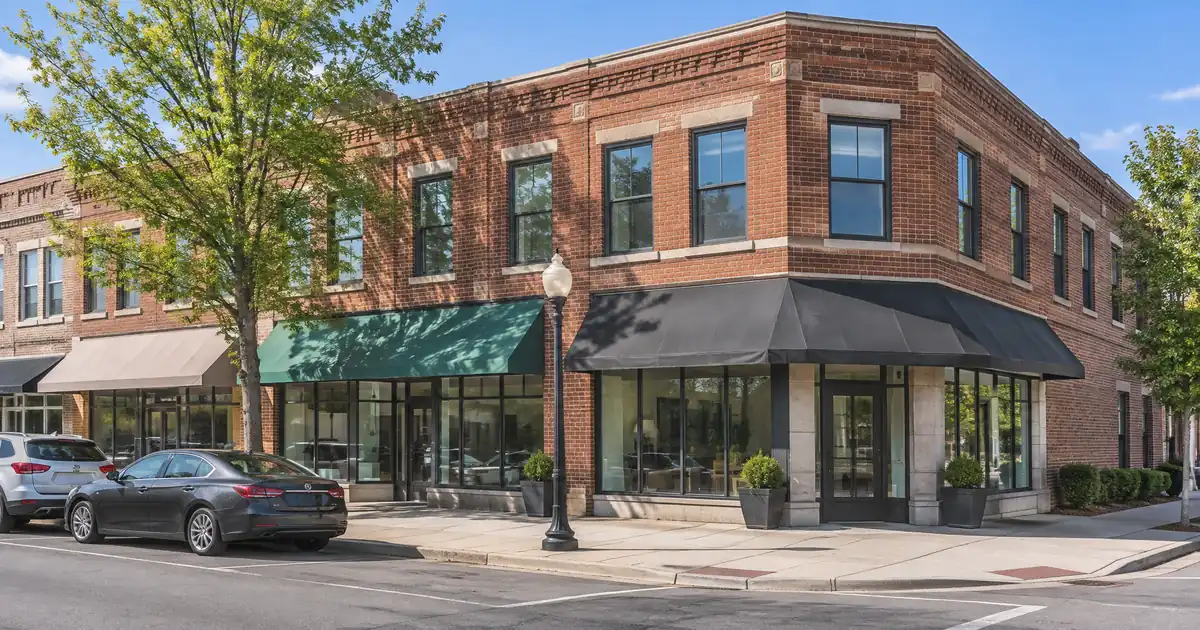
An owner of a rental condo in a tower with a retail podium usually asks one question: does the commercial floor kill the line? The picture here is a multi-story residential condominium tower, with apartments on the upper floors and shops or offices at the base. It is not a low-rise commercial building. The unit is the collateral, but the building around it is part of the file. This article walks through the requirements in the order a lender reads them.
Key Terms Defined
DSCR (debt service coverage ratio): Gross monthly rent divided by the qualifying payment. On this program, the minimum is 1.10x.
DSCR HELOC: A revolving line of credit on a non-owner-occupied one-to-four-unit rental, qualified on the property’s rent instead of the owner’s personal income. The label is a market nickname, so confirm what a given program actually is before comparing.
Second lien: A loan recorded behind the first mortgage. The first mortgage stays in place and the line sits behind it.
Warrantable and non-warrantable condo: Warrantable means the project meets agency (Fannie Mae and Freddie Mac) project standards. Non-warrantable means it fails at least one of them. This program lists both as eligible property types, subject to the lender’s own review.
Commercial floor: Non-residential space in the same building or project, such as ground-floor retail, office or a podium of shops.
Condo questionnaire: A form the HOA completes about the project. It covers ownership mix, litigation, dues delinquency, insurance, reserves and commercial space.
Combined loan-to-value (CLTV): The first mortgage balance plus the new line, divided by the property’s value.
What Does the Program Require?
The program asks for rent coverage, a credit tier, a valuation and a clean collateral type. It does not ask for tax returns, W-2s, pay stubs or a debt-to-income ratio. It qualifies primarily on property-level rental income covering the payment, subject to lender guidelines. The figures below are ceilings and floors on select wholesale-network programs, subject to underwriting. They are not offers.
| Item | Second lien | First lien |
|---|---|---|
| Lien position | Behind your first mortgage | Rental with no mortgage |
| Max leverage | 70% CLTV at 720+ | 75% LTV at 740+; 70% at 700-739 |
| Line size | $50,000 to $500,000 | To $500,000, then to $1,000,000 |
| Large lines | Not offered above $500,000 | 65% LTV at 720+ above $500,000 |
| Minimum score | 720 | 700 |
Other parameters apply on both liens. The rate is variable. A 5-year interest-only draw period is followed by a 25-year repayment period, with a 30-year maturity. At least 80% of the line is drawn at closing, and the closing draw is never less than $50,000. Later draws are at least $5,000 each. A declining-market flag on the property lowers the leverage ceiling by 5 points.
The mortgage history rules are simple. There can be no 30-day late on a mortgage in the last 12 months. At least 48 months must have passed since a bankruptcy, foreclosure, short sale or deed-in-lieu. The program allows at most 5 loans or $2,500,000 per borrower. US citizens, permanent residents and non-permanent residents with a Social Security number can borrow. Foreign nationals and ITIN borrowers cannot.
An LLC can hold title on an investment property, subject to program terms. The members sign as guarantors. A title holder who is not a borrower signs a non-borrowing owner acknowledgment and the security instrument.
For the full picture of how this fits among investor loans, see the complete DSCR loans guide.
Gate One: The Rent Test
Coverage is measured on the line’s limit, not on what you draw. The qualifying payment is a fully amortizing principal-and-interest payment on the entire credit limit at the start rate plus 2 percentage points. Taxes and insurance are not part of that payment. Gross monthly rent divided by that stress payment has to reach 1.10x.
The consequence is easy to miss. An owner who draws the minimum 80% still gets tested as if the whole limit were outstanding. A large line on a unit with modest rent can fail even when the drawn balance looks light.
A lease in place is required. Rent is the lesser of the appraisal’s market rent and the lease, unless three months of receipts support a lease above market. The appraiser’s market rent comes from Form 1007, the rent schedule.
On a second lien, the first mortgage payment is a separate question. The lender’s own calculation governs, and any worked arithmetic here is illustrative.
HOA dues work the same way. Towers with shared amenities tend to carry larger dues, and dues can pull on the unit’s cash flow. Ask how the lender treats them in coverage before you commit to a line size.
Gate Two: The Building
A tower condo is judged as a project first and as a borrower second. Rent coverage and building review are independent. Strong rent cannot fix a project the lender will not accept.
The lender orders the condo questionnaire, the budget, the master insurance certificate and the declaration. A mortgage insurer’s explainer on what makes a condominium non-warrantable lists excessive commercial space, high investor or single-entity ownership and litigation as common triggers. It also notes that non-warrantable status can narrow the buyer pool and weigh on resale value.
This table maps each questionnaire topic to its effect on the file.
| Questionnaire topic | Why it matters | What a bad answer does |
|---|---|---|
| Commercial space share | Shows how much of the project is non-residential | Can push the file to project exception or decline |
| Investor concentration | Shows how many units are rented | Can trigger non-warrantable review |
| Pending litigation | Signals financial or structural risk | Can stop the file |
| Delinquent dues | Signals budget stress | Can raise reserves questions |
| Master insurance | Confirms the building is covered | Gaps can stall the file |
| Short-term rental activity | Flags hotel-like operation | Can move the building toward condotel status |
Condotels are excluded from this program. A tower with an on-site rental office, a managed-rental pool or heavy short-term-rental use can start to look like one, so read that questionnaire answer closely. Short-term rental rules can vary by city, county, HOA, and property type, so investors should confirm local rules before relying on projected rental income.
How Does the Commercial Floor Fit?
The commercial floor affects the file in two ways. It enters the project review, and it shapes how the lender classifies the property.
The collateral rule is plain. This line is for one-to-four-unit residential rental property. Mixed-use and commercial property are excluded. The program’s property list does include non-warrantable condominiums, so a commercial floor is a review item rather than a stated automatic exclusion. Where the line falls between a residential unit in a mixed-use tower and mixed-use property is the lender’s call on the file. Settle that classification before you pay for a valuation.
| What you own | Eligibility on this program |
|---|---|
| Residential unit above a commercial floor | Possible, subject to project review |
| Live-work unit | Falls on the mixed-use side; not eligible |
| Commercial unit or whole mixed-use building | Not eligible; commercial financing instead |
The percentage of commercial space is a measured number, not a label. A condo inspection resource explains that the commercial space ratio is fixed in the building’s declaration, and that the measurement matters more than the words mixed use. Check the declaration before you spend money on a valuation. The calculation divides non-residential square footage by total square footage. Ask which areas count, including below-grade space and separately owned commercial condos.
Here is the agency contrast. The Fannie Mae Selling Guide caps commercial or mixed-use space at 35% of a project for agency eligibility, and it excludes certain space from the calculation. That cap governs agency loans. It is not a DSCR HELOC rule. Across the wholesale network, project standards differ by lender, and some are stricter than the agency test while others are looser. Do not treat 35% as a pass line or a fail line for this product. Ask the lender for its project standard on your specific building.
Valuation on a Tower Unit
Valuation is a real risk point in a mixed-use tower, because comparable condo sales can be thin. The program offers two paths, and appraisal waivers are not accepted.
Lines up to $400,000 can use an automated valuation (confidence score of 85 or better) with a property inspection report, or a full interior appraisal. Lines above $400,000 require a full interior appraisal, on Form 1004, 1073 or 1025. For a single condo unit that is Form 1073.
If the automated valuation does not return the confidence score, a full interior appraisal is the fallback. Ask the appraiser to use sales from within the same building and from comparable towers, so a retail podium does not distort the comparison. If the number comes in light, an appraisal reconsideration request with recent in-building sales is a normal step.
Title follows the lien. A full title policy is required on a first lien and on second liens above $400,000. An owner-and-encumbrance report applies to smaller second liens. Hazard insurance must cover both liens, with flood coverage where required. A tower’s master policy and the unit’s own policy both need to be on hand early.
Seasoning: What Are the Two Clocks?
A rental bought or refinanced inside the last 6 months is not eligible (that clock runs from the last note date to the new note date), and the owner must have held title for 6 months (settlement date to note date).
The settlement statement documents the purchase date. For a recent refinance, the prior note date is what matters. An owner who just bought a tower unit and wants to pull equity for the next deal needs to plan around these dates before the file is opened. A property listed for sale in the prior 2 months is also outside the program, and so is one with a solar lien.
HELOC or Cash-Out Refinance for This Building?
The choice turns on what you are keeping. A HELOC is an open-end revolving line, and when a first mortgage exists it sits behind that mortgage as a second lien, as the CFPB’s HELOC explainer describes. That explainer is written for owner-occupied homes, so it frames the basics and not rental-specific rules. A DSCR cash-out refinance replaces the first mortgage with a new, larger one.
| Factor | DSCR HELOC | DSCR cash-out refinance |
|---|---|---|
| Existing first mortgage | Stays in place | Replaced |
| Structure | Revolving line | Single new loan |
| Qualifying test | Stress payment on full limit | That program’s own test |
| Reserves | None on this program | Set by the cash-out program |
| Best fit | Keep first mortgage, draw equity | Reset the whole loan |
The comparison is between two structures. A cash-out refinance follows its own program’s rules, not the figures on this page. A HELOC is the cleaner choice when you want to leave a first mortgage untouched. A cash-out refinance can make more sense when the first mortgage itself needs to change. That program is a different one, with its own rules.
File Prep Steps
Build the file in this order. It puts the building questions ahead of the borrower questions, which is where the real friction sits.
1. Pull the declaration and read the commercial share. Find the measured percentage and which spaces are counted. Note whether the building is described as mixed-use anywhere in the documents.
2. Request the condo questionnaire and budget from the HOA. Ask early, since these documents come from a third party and set the pace for the file. Check investor concentration, litigation, delinquent dues and short-term rental activity as soon as the questionnaire arrives.
3. Confirm the collateral type with the lender. Ask whether the unit is treated as a residential condo or as mixed-use. Do this before paying for a valuation.
4. Gather the lease and rent evidence. A lease in place is required. If the lease runs above market, assemble three months of rent receipts.
5. Pull the first mortgage statement and title evidence. Confirm seasoning dates from the settlement statement. Confirm the LLC documents if the unit is vested in an entity, subject to program terms.
6. Choose the line size against the coverage test. Size the line against the stress payment on the whole limit, not on the planned draw.
7. Order the valuation. Use the automated valuation path only when the line is $400,000 or less and the lender allows it. Otherwise order the full interior appraisal on Form 1073.
If the Building Fails
A failed project review does not end the conversation. It narrows the options.
A different lender’s project standard may accept the same building, since standards vary across the wholesale network. A cash-out refinance under a different program is another route, though it has its own project review. A unit in a different building may fit this line cleanly. For a commercial unit or whole mixed-use building, commercial financing is the right track, not this one.
If the unit fails because of investor concentration or litigation, the building is the problem, not the borrower. Those items change slowly, so plan around them. Lendmire’s piece Top HELOC Providers on a High-Rise Condo With a Commercial Floor covers the wider set of options.
Frequently Asked Questions
Can a condo unit in a high-rise with a commercial floor qualify for a DSCR HELOC?
It can, subject to underwriting. The unit is the collateral, and the program lists warrantable and non-warrantable condominiums as eligible property types. The lender reviews the commercial floor as part of the project. Classification as mixed-use would take the property out of the program, so ask how the lender classifies your building.
Is a non-warrantable condo a dead end?
No. Non-warrantable means the project fails at least one agency test. This program lists non-warrantable condominiums as eligible, but the lender still reviews the building on its own standards. Leverage tiers do not change by property type, though a declining-market flag lowers the ceiling.
Does the 35% commercial-space figure apply?
No. That figure comes from the Fannie Mae Selling Guide and governs agency loans. Project standards on a DSCR HELOC are the lender’s own, and they differ across programs. Ask for the standard that applies to your building, then compare it to the measured share in your declaration.
How long must I own the property before opening the line?
Two six-month clocks apply: the line is not available on a rental bought or refinanced in the last 6 months (last note date to new note date), and title must have been held for 6 months (settlement date to note date). Keep the settlement statement and any prior note on hand so the dates can be confirmed.
Can an LLC hold the property?
Yes, subject to program terms. The LLC’s members sign as guarantors, and a title holder who is not a borrower signs a non-borrowing owner acknowledgment.
If you are considering a home equity line on a rental property and want to see how the numbers work, Lendmire can help you compare DSCR HELOC options based on the property, the rent, the equity available, credit profile, combined leverage, and your goals.
About Lendmire
Lendmire (NMLS# 2371349) is a mortgage broker licensed for consumer lending in 16 states. DSCR home equity lines of credit — revolving lines on non-owner-occupied one-to-four-unit rentals, qualified on the property’s rent instead of the owner’s personal income — are arranged through wholesale lenders in 15 of those 16 states (every licensed state except Tennessee), and every line is underwritten by the lender under its program guidelines. Scotsman Guide named Lendmire a Top Mortgage Workplace in both 2025 and 2026.
Get Started
Ready to find the right loan for you?
See your offer in seconds. No credit pull, no obligation.
Informational only. Not a Loan Estimate, approval, or commitment to lend. Program availability and eligibility are subject to lender guidelines, credit approval, property review, and underwriting.
References
1. Enact: What makes a condominium non-warrantable
2. National Condo Inspections: Commercial space ratio
3. Fannie Mae Selling Guide B4-2.1-03
This article is part of Lendmire’s DSCR HELOC program — full qualification details, guidelines, and scenarios live on the program page.
Related reading: DSCR HELOC Requirements With Irregular Deposits · DSCR HELOC Requirements to Pay for an Investment Property · DSCR HELOC Requirements for a Rental Property in Philadelphia
Brandon Miller
Founder & CEO, Mortgage Loan Originator, Lendmire LLC
- Mortgage Loan Originator · NMLS# 1129696 · Verify on NMLS Consumer Access
- North Carolina Real Estate Broker · License# 343312 · Verify on NCREC
- North Carolina Insurance Producer · License# 19053198 · Property, Casualty, Life, Health · Verify on NAIC SBS
- Lendmire LLC · Firm NMLS# 2371349 · Verify firm licensure
Required disclosures. Lendmire (NMLS# 2371349) operates as a licensed mortgage broker, not a direct lender or depository. The discussion in this article is general in nature and should not be relied upon as financial, legal, or tax advice — every investment scenario is unique and should be reviewed by a qualified professional. Any loan inquiry is subject to lender underwriting, and this article is not a commitment to lend or a guarantee of approval. Mortgage rates, loan terms, and program guidelines vary by borrower, property, and state, and may change without notice. Equal Housing Opportunity. Verify licensure at NMLS Consumer Access.