
The Quick Read: HOA dues on a PUD with a pool and gate go into the payment side of the DSCR ratio, never against the rent, so richer amenity dues raise the monthly obligation dollar for dollar and pull coverage down until you adjust the loan size, the down payment, or the property. That full obligation is called PITIA: principal, interest, taxes, insurance, and association dues.
- Mandatory dues sit in the denominator with the rest of PITIA. Nothing is subtracted from rent.
- A gate by itself does not make a PUD. Mandatory HOA membership and HOA-owned common property do.
- Pool, gate, and clubhouse upkeep drive the dues, and the dues drive your coverage number.
- Special assessments, stacked associations, and quarterly billing each change the math, and treatment varies by program.
- Clearing the ratio is not the same as positive cash flow.
What Makes a Pool-and-Gate Community a PUD?
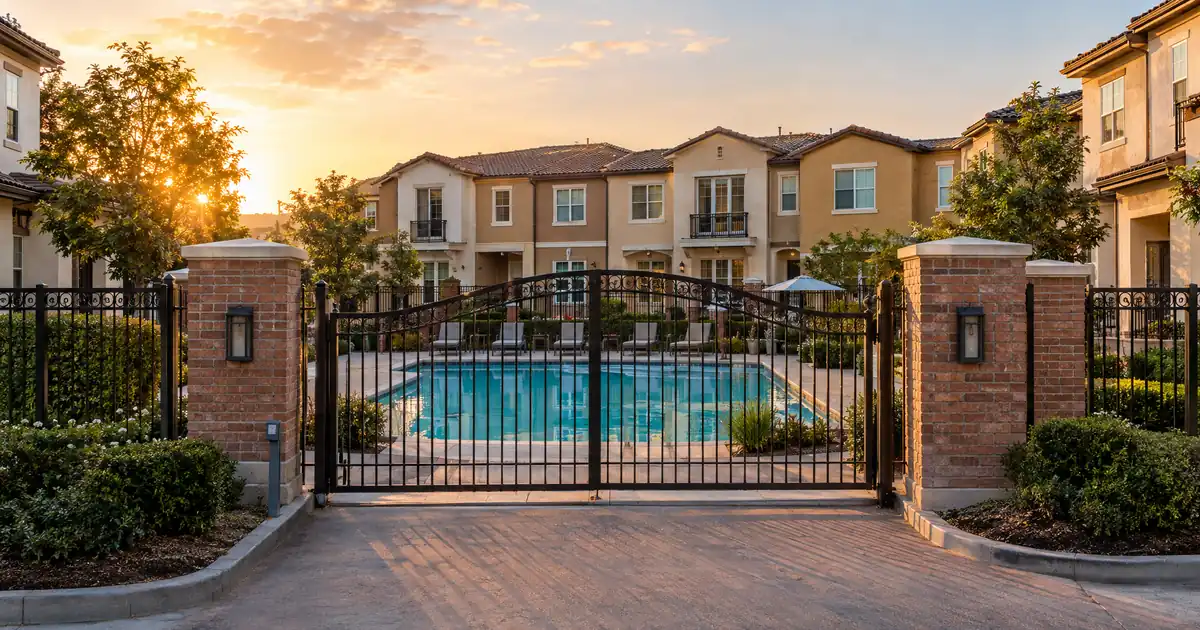
A PUD, or planned unit development, is a community where you own your lot and house but belong to an association that owns and runs the shared parts. The pool, the entrance gate, the private roads, and the clubhouse are typical shared parts. Membership is automatic when you buy, and the dues are mandatory.
DSCR Calculator
Run the numbers in your market
Rate source: Freddie Mac 30-yr average via FRED® — Federal Reserve Bank of St. Louis · effective Oct 15, 2026
Prefilled with starting assumptions — enter your own rent or nightly figures, taxes, insurance, and HOA for a more accurate picture.
Program parameters update from Lendmire’s centralized guideline source. Taxes and insurance are editable estimates.
As of Oct 15, 2026 · General Freddie Mac market benchmark, not a Lendmire loan offer. Rent, nightly rate, occupancy, taxes, and insurance are editable estimates. Short-term rental figures are estimates only and vary significantly by season, property type, management approach, and local short-term-rental rules — confirm local regulations before relying on them. Qualifying income for short-term rentals varies by program — some use appraisal market rent, others use documented STR history or projections — and is confirmed in underwriting. Not a Loan Estimate, approval, or commitment to lend. Program availability and eligibility are subject to lender guidelines, credit approval, property review, and underwriting.
NAR notes that an HOA typically maintains amenities such as pools and roads. It also says fees can run quite high depending on the amenities offered. That is the whole story of your dues line: the more the HOA maintains, the more it bills.
Here is the three-part test most lenders apply in practice:
1. Membership in the association comes with the property and cannot be declined.
2. Assessments are mandatory.
3. The association owns and maintains the common property.
A gate alone proves nothing. A subdivision can have a gate and a guard shack and still be a loose group of houses with no mandatory association. Likewise, a “PUD” zoning label on a county map does not make a property a PUD for lending purposes. The structure of the association decides it.
If the HOA owns the pool and the gate, you cannot opt out of paying for them. That is why the dues belong in the ratio.
DSCR HOA Dues Rules for a PUD: How the Ratio Treats Them
The rule is simple: the lender divides rent by the full monthly obligation, and mandatory HOA dues are part of that obligation. Across the wholesale network Lendmire works with, this is how select lenders treat a PUD. Dues are an expense on the debt side. They are never netted against rent.
Here is the sequence a file follows, step by step.
1. Collect the real dues figure. Use the HOA’s own budget or dues statement, not the listing. The listing is often stale or rounded.
2. Convert it to a monthly number. Quarterly or annual dues get divided down to monthly before they enter PITIA.
3. Set the rent. The numerator is the rent the lender uses. On a single-family PUD that usually comes from the appraiser’s market rent schedule (Form 1007). On a 2-4 unit property it comes from the small-income form (Form 1025). Some programs use the lower of the lease and the market rent.
4. Divide. DSCR equals that rent divided by principal, interest, taxes, insurance, and dues.
5. Compare to the program floor. Coverage of 1.00 is where many select programs start. A separate select-lender path takes coverage below 1.00, with leverage and terms adjusted. Stronger ratios open better pricing and leverage.
6. Check the rental rules. The lender will typically confirm the HOA’s governing documents allow rentals. Look for rental caps and minimum lease terms.
DSCR loans are designed for non-owner-occupied investment properties. Because they are business-purpose investor loans, they are reviewed differently from a standard owner-occupied mortgage. That is why no personal debt-to-income ratio appears anywhere in this math. The file qualifies primarily on property-level rental income covering the payment, subject to lender guidelines.
For the bigger picture on how the ratio works, see Lendmire’s complete DSCR loans guide.
What the Pool and Gate Actually Do to Your Number
Pools and gates raise dues through three budget lines: maintenance, insurance, and reserves. A pool needs chemicals, repairs, staffing, and liability coverage. A gate needs electronics, motors, and sometimes a guard. The association also has to save for replacing both.
Most of that cost reaches you as one monthly figure. A few items hide inside it:
- Master insurance pass-through. The association’s policy on the common property is paid from dues.
- Reserve contributions. The HOA’s savings for big repairs are part of the bill.
- Optional extras. A golf, tennis, or club membership you can decline is not mandatory dues. Underwriters may exclude it. Get it in writing from the HOA that the extra is truly optional.
A richer amenity package can also support a higher market rent. That only helps if the appraiser’s rent number rises by more than the dues do. Ask for rent comparables from similarly equipped communities. A plain house two streets over with no dues is not a fair comp.
One common reason a deal looks fine on paper and then falls short at submission: online calculators often leave the dues box at zero. Many investors run the ratio before they have the HOA statement. Run it with the real figure.
Worked Example: Same Rent, With and Without Dues
Run the numbers on a modeled PUD with a pool and gate. These are assumptions for illustration, not market data. I use percentages and ratios so you can see the effect without dollar figures.
Assume the rent covers the payment without dues at 1.15x. Then assume mandatory dues add about 10% to the monthly obligation.
| Scenario | Obligation (index) | Coverage |
|---|---|---|
| No dues counted | 100 | 1.15x |
| Dues add about 10% | 110 | about 1.05x |
| Dues add about 15% | 115 | 1.00x |
| Dues add about 20% | 120 | about 0.96x |
Rent stayed identical in every row. Only the dues moved. The same PUD that looks comfortable at 1.15x lands near 1.05x once the dues are counted, and it hits the 1.00x line when dues reach about 15% of the rest of the payment.
You can run the reverse check yourself before making an offer. Divide your expected coverage without dues by the program floor you are aiming for. Subtract one. The result is the most the dues can add, as a share of the rest of the payment. At 1.15x coverage and a 1.00x floor, that is 15%. At a stronger 1.20x starting point, the same floor leaves room for dues of about 20%.
At the lower end of that table, coverage falls under 1.00x. Select lenders in the network will review sub-1.00 files, with leverage and terms adjusted, but qualification stays subject to lender guidelines, credit approval, and property review.
Special Assessments and Unusual Billing
Special assessments are the least settled part of this topic. Treatment varies by program, and nothing in the market sets a single standard. Some programs convert a recurring assessment into a monthly figure. Others treat a one-time lump sum as a reserves or cash-to-close question instead of a ratio question.
Here is a decision table for the usual cases.
| Situation | Typical treatment |
|---|---|
| Regular dues, billed monthly | Enter as billed |
| Quarterly or annual dues | Divide to a monthly figure |
| Recurring special assessment | Often added to monthly obligation |
| One-time lump-sum assessment | Often a reserves or cash question |
| Approved but not yet billed | Disclose it; program treatment varies |
| Master plus sub-association | Both count if both are mandatory |
| Optional club or amenity membership | Often excluded if truly optional |
The right move is to ask the broker how the specific program treats each item before you sign a contract. The answer changes by lender, not by rumor.
Two billing quirks deserve a closer look. First, stacked associations: a large community can have a master association for the gate and main amenities plus a smaller neighborhood association for a pocket of homes. Both sets of dues can apply. Second, a project can look like a PUD yet be legally a condo, which triggers condo-style project review with a questionnaire, reserve checks, and litigation screening. Confirm which structure you are buying.
PUD, Condo, or Plain House?
Each structure gets a different review. Mixing them up is how investors import the wrong rules.
| Factor | Plain house | PUD | Condo |
|---|---|---|---|
| You own | House and lot | House and lot | Interior unit |
| HOA membership | None | Mandatory | Mandatory |
| Dues in the ratio | None | Yes | Yes |
| Project review | None | Usually light | Condo-style review |
Conventional lending has its own PUD rulebook. The Fannie Mae Selling Guide defines a PUD with the same elements described above: automatic membership, mandatory assessments, HOA-owned common property, and a unit that is not part of a condo or co-op. That is useful vocabulary. It is also where the overlap ends. On a conventional loan, dues feed into the borrower’s debt-to-income ratio. A DSCR loan has no debt-to-income test, and DSCR loans are not agency products. Select lenders in the network set their own review, so do not carry conventional condo or PUD rules into a DSCR file.
Three property types never make it into this comparison at all. Manufactured homes, log homes, and barndominiums are not offered through the network’s DSCR programs, even inside a gated community.
Documents to Pull Before You Offer
Get the HOA paperwork before you pay for an appraisal. A bad surprise costs far less at this stage than later in the file. Ask for:
- The current-year budget and the most recent financial statement
- A dues statement showing the billing frequency and any pending assessments
- The governing documents (the CC&Rs), including rental rules
- A summary of the master insurance policy
- Any notice of planned assessments, litigation, or major repairs
- A fee schedule that lists transfer fees and capital contributions
Fortune Builders points out that lenders scrutinize the financial health of a PUD’s HOA. It names poorly kept amenities and a budget strained by vacancies as problems. Those are exactly the issues that surface in the budget and the statement. Read those two documents first.
DSCR vs. conventional financing
There are two common ways to finance an investment property, and they qualify you differently — here’s how investors weigh them.
Why investors choose it
- Qualifies on the property’s rental income — no personal tax returns, W-2s, or pay stubs needed to document income.
- No personal debt-to-income ceiling to clear, so existing mortgages and obligations don’t cap your borrowing the same way.
- Can be closed in an LLC, keeping the property inside a business entity.
- Built for scaling — not held to the limit on number of financed properties that conventional financing applies.
- Underwriting centers on the deal: generally qualifies when the rent covers the payment, a 1.00x coverage ratio being a common baseline (confirmed in underwriting).
- Designed specifically for investment property, including long-term and, where the program allows, short-term rentals.
Where it’s strong
- Often the lowest ongoing financing cost for a buyer who fully qualifies on personal income — a fit for a first property or a cost-first purchase.
Trade-offs for investors
- Requires full personal income documentation and must fit within a debt-to-income limit — salary, existing debts, and other mortgages all count.
- Typically held in your personal name rather than a business entity.
- Caps how many financed properties you can carry, which can become a ceiling as a portfolio grows.
- Evaluates you as a borrower as much as the property, which usually means more paperwork.
How investors usually choose: a first or single property often optimizes for the lowest financing cost; portfolio builders often optimize for leverage, vesting in an LLC, and scaling past conventional caps. The right answer depends on your goals, the property, and current guidelines — both paths run through select lenders in Lendmire’s wholesale network, with eligibility and terms confirmed in underwriting.
Red Flags in the Paperwork
Pools and gates are expensive to keep up, so they leave fingerprints in the documents. Watch for:
- Thin reserves. A pool pump and a gate operator both fail on a schedule. If the reserve fund is small, a special assessment may be coming.
- Deferred maintenance. Closed amenities, a broken gate, or meeting minutes full of postponed repairs signal trouble.
- Rental caps or long minimum leases. A cap on how many homes can be rented can block your plan entirely. Short-term rental rules can vary by city, county, HOA, and property type, so investors should confirm local rules before relying on projected rental income.
- Pending litigation. A lawsuit against the developer or the association can complicate a file.
- High investor concentration. If most homes in the community are rentals, expect more scrutiny.
- Budget strained by unpaid dues. Many delinquent owners mean the remaining owners may absorb the shortfall.
Any one flag is not an automatic stop. A pattern of them should change your offer or end it.
What If the Dues Sink the Ratio?
When mandatory dues push coverage below the program floor, you have four levers. Each trades something.
1. Lower the loan amount. A larger down payment cuts principal and interest and can lift the ratio. On an investment-property purchase, most files land at 75%-80% LTV, and select high-leverage programs reach 85% LTV with roughly a 700+ score. Going lower on leverage gives the ratio more room.
2. Choose a different term structure. The spine is the 30-year fixed. Extended terms and interest-only periods are available through select lenders in the network, and ARM structures exist for investors who want them. These can change the payment profile, though terms vary by lender.
3. Support a stronger rent. Better comparables from similar amenity communities may raise the appraiser’s market rent. They may not. The appraiser decides.
4. Pick a different property. A PUD with fewer amenities may carry lower dues and a better ratio.
A larger down payment never erases the other requirements. Credit floors still apply: a 620 floor exists in parts of the network, most programs want around 660, and 700+ unlocks the strongest leverage tiers. Reserves vary by lender, leverage, loan size, and transaction type. They commonly run around 6 months of PITIA, and loans above $1,500,000 typically step up to about 9 months. The strongest files clear both tests: enough equity and enough rental coverage.
Remember that dues can climb after you buy. A rate of increase in the HOA budget affects every future refinance and every future ratio test. Cash-out refinances top out around 75% LTV across most of the network, with about 6 months of seasoning as the common expectation, so a lower ratio later can shrink your options when you want to pull equity out. Final terms depend on the lender’s guidelines, the property type, and the borrower’s complete credit picture.
Common Mistakes
Subtracting dues from rent. Dues belong in the payment side of the ratio. Subtracting them from rent gives a different and misleading number.
Assuming a PUD has no HOA line. Mandatory dues are the defining feature of a PUD.
Treating a gate as the test. Mandatory membership and HOA-owned common property decide PUD status. The gate does not.
Assuming no project review. DSCR files still look at the HOA’s finances and rules. The review is usually lighter than a condo review, though not absent.
Reading 1.00x as positive cash flow. DSCR compares rent to PITIA only. Repairs, vacancy, management, utilities, and capital expenses sit outside the calculation. A pool-and-gate community can generate plenty of those costs outside the ratio.
Ignoring how the HOA bills. Quarterly and annual bills hide the true monthly figure. Convert them first.
Tax treatment varies by how funds are used and how the property is held, so consult a qualified professional before relying on any deduction.
Key Terms Defined
PUD (planned unit development): A community where you own your house and lot, belong to a mandatory association, and share common property the association owns.
PITIA: The full monthly obligation of principal, interest, taxes, insurance, and association dues.
Special assessment: An extra charge the HOA levies on owners, usually to cover a large repair or a shortfall.
Master policy: The association’s insurance on the common property, paid for out of dues.
CC&Rs: The covenants, conditions, and restrictions that set a community’s rules, including rental limits.
Market rent schedule: The appraiser’s estimate of what the property should rent for, which becomes the numerator in the ratio.
Frequently Asked Questions
Do HOA dues count against my rental income or in my payment?
They count in the payment. The lender divides rent by PITIA, and PITIA includes mandatory association dues. Nothing is subtracted from the rent itself, so higher dues lower the ratio without touching the rent figure.
Does the pool or gate change whether a PUD is eligible?
Not by itself. Eligibility turns on the association structure and the program’s property rules, not on amenities. The amenities matter because they drive the dues figure and the HOA’s financial health, both of which the lender may review.
What happens if the HOA charges a special assessment after I buy?
Treatment varies by program. A recurring assessment may be added to the monthly obligation, while a one-time lump sum often becomes a reserves or cash question. Ask your broker how the specific program treats pending and recurring assessments before you commit.
Can I leave out optional club memberships from the ratio?
Often, yes, if the membership is truly optional and you can decline it. Mandatory dues stay in. Get written confirmation from the HOA about which charges are mandatory so the file is clean.
Does clearing the ratio mean the property will cash flow?
No. The ratio compares rent to PITIA only. Vacancy, repairs, management, utilities, and capital expenses sit outside it, and a community with a pool and gate can generate plenty of those. Clearing 1.00x means rent covers the payment on paper, nothing more.
Next Step
If you are buying or refinancing a rental property and want to see how the numbers work, Lendmire can help you compare DSCR loan options based on the property income, credit profile, leverage, and investor goals. Lendmire is a broker arranging financing through select lenders in its wholesale network, across 41 markets including Washington, D.C. Qualification is subject to lender guidelines, and none of this is a commitment to lend. For a related walk-through of the dollar effect, see Lendmire’s article How Much HOA Dues Reduce a DSCR Loan on a Gated PUD With a Pool.
About Lendmire
Lendmire — NMLS# 2371349 — is a mortgage brokerage specializing in DSCR investor loans, helping arrange financing across 41 markets, including Washington, D.C., through wholesale and investor-lending channels. The model centers on property-level rental income reviewed by the lender rather than W-2 documentation, subject to lender guidelines, suiting entity-owned and multi-property investors. Lendmire holds Scotsman Guide Top Mortgage Workplace recognition for 2025 and 2026.
Get Started
Ready to find the right loan for you?
In about 30 seconds you can review financing options available for your investment property. No commitment required.
Informational only. Not a Loan Estimate, approval, or commitment to lend. Program availability and eligibility are subject to lender guidelines, credit approval, property review, and underwriting.
References
1. NAR – Planned Unit Developments
2. Fannie Mae Selling Guide B4-2.3-01
3. Fortune Builders – PUD explainer
This article is part of Lendmire’s DSCR loan program — full qualification details, guidelines, and scenarios live on the program page.
Related reading: DSCR HOA Dues and Special Assessment Rules for Condos and PUDs · DSCR Rent Rules for an Airbnb Switching to Long-Term Rental · How to Request a Reconsideration of Value on a DSCR Appraisal
Brandon Miller
Founder & CEO, Mortgage Loan Originator, Lendmire LLC
- Mortgage Loan Originator · NMLS# 1129696 · Verify on NMLS Consumer Access
- North Carolina Real Estate Broker · License# 343312 · Verify on NCREC
- North Carolina Insurance Producer · License# 19053198 · Property, Casualty, Life, Health · Verify on NAIC SBS
- Lendmire LLC · Firm NMLS# 2371349 · Verify firm licensure
Important disclosures. Lendmire (NMLS# 2371349) is a licensed mortgage brokerage. Lendmire is not a direct lender, depository institution, or financial advisor. All loan inquiries are subject to lender underwriting; this article does not constitute a commitment to lend. Rates, terms, and program guidelines are subject to change without notice and vary by borrower profile, property type, and state. Information in this article is general in nature and is not financial, legal, or tax advice. Equal Housing Opportunity. NMLS Consumer Access: nmlsconsumeraccess.org.