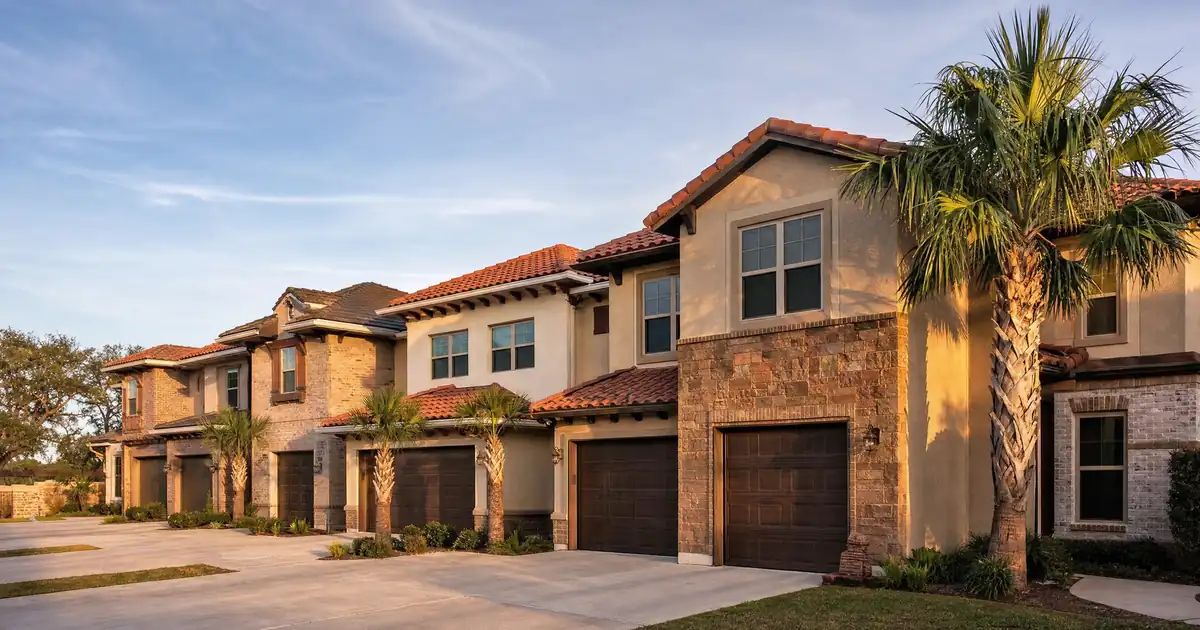
Zillow’s live rental feed for Port Aransas shows something odd: a small handful of long-term rental listings against a market saturated with short-term rental listings, an imbalance that doesn’t show up in comparable Texas coastal towns (Zillow long-term rentals; Zillow short-term rentals). That split isn’t a data quirk. It’s the whole market, in one picture. Port Aransas has built its housing stock almost entirely for vacation turnover, and the town’s actual full-time renters — restaurant staff, marina crews, retail workers, a small cluster of university researchers — are competing for a sliver of inventory that barely exists on paper.
That imbalance is the starting point for any purchase-side DSCR conversation here, because it changes what “the number” even measures. In a typical Texas metro, the debt coverage ratio tests a property against a deep, liquid long-term rental comp set. In Port Aransas, an investor underwriting a true long-term rental is often working against thin, sometimes contradictory data — which means the deal that clears coverage cleanly is worth more here than the same ratio would be worth in Corpus Christi or San Antonio.
DSCR Calculator
Run the numbers in Port Aransas, TX
Rate source: Freddie Mac 30-yr average via FRED® — Federal Reserve Bank of St. Louis · effective Jul 2, 2026
Prefilled with local estimates — enter your own rent or nightly figures, taxes, insurance, and HOA for a more accurate picture.
As of Jul 2, 2026 · General Freddie Mac market benchmark, not a Lendmire loan offer. Rent, nightly rate, occupancy, taxes, and insurance are editable estimates. Short-term rental figures are estimates only and vary significantly by season, property type, management approach, and local short-term-rental rules — confirm local regulations before relying on them. Qualifying income for short-term rentals varies by program — some use appraisal market rent, others use documented STR history or projections — and is confirmed in underwriting. Not a Loan Estimate, approval, or commitment to lend. Program availability and eligibility are subject to lender guidelines, credit approval, property review, and underwriting.
At a Glance: Investment property loans in Port Aransas, Texas are underwritten primarily on the subject property’s actual or market rental income measured against its full monthly obligation, not the borrower’s W-2 or tax return income, with structure shaped heavily by whether a unit competes in the resort short-term-rental pool or the scarce long-term core.
- Zillow’s rental listings skew overwhelmingly toward short-term vacation stays, with only a handful of true long-term rental listings townwide (Zillow)
- Palladium, the town’s only true LTR apartment comp, rents modestly priced one-to-three-bedroom units well below the blended averages other rental aggregators report for the market (ApartmentRatings)
- Multi-family inventory (2-4 unit) is genuinely thin, with only a handful of listings townwide that tend to linger on the market far longer than typical single-family homes (Homes.com)
- Attached/duplex product represents only a small sliver of the town’s overall housing stock (Point2Homes)
- Median resident age runs well above the surrounding metro’s typical figure — a retiree-and-second-home renter base, not a young workforce pool (Census Reporter)
Port Aransas Market Snapshot
A quick read on the Port Aransas investor landscape — figures come from the cited sources below. Confirm current property-level numbers before underwriting.
| Metric | Detail |
|---|---|
| Home prices | $670K median sale (Redfin Housing Market) |
| University enrollment | 35 graduate students (Wikipedia) |
| Population | 3,268 population (Census Reporter (ACS 2024 5-yr)) |
The In-Town Core Is the Cash-Flow Trade, Not the Beach
The strongest coverage math in Port Aransas isn’t on the beach at all — it’s in the older, in-town neighborhoods near Cotter Avenue and 11th Street, where housing stock predates the resort boom and tenants are actual year-round residents. This is a fragment worth sitting with: the beach doesn’t cash flow. The core does.
Here’s why. Post-Hurricane Harvey, the town lost most of its older, low-cost workforce housing and never fully rebuilt it — reporting from Next City documents that the storm wiped out the housing stock the town’s own service and hospitality workforce depended on, while the higher end of the market kept growing for retirees. That created a structural, non-seasonal shortage that has nothing to do with tourism cycles. Restaurant staff, marina hands, and Port Aransas Independent School District employees still need somewhere to live twelve months a year, and there’s very little product built specifically for them.
The only large-scale evidence of what that segment actually rents for is Palladium Port Aransas, a LIHTC apartment community built in recent years, where one-, two-, and three-bedroom floor plans lease at levels well below what other rental aggregators report for the market (ApartmentFinder; rent range per ApartmentRatings). That’s a useful anchor comp precisely because it’s real long-term housing, not a vacation listing dressed up as an annual lease — a gap best explained by the fact that blended averages elsewhere get skewed by furnished, vacation-adjacent “long-term” inventory. City records tied to the project (Port Aransas South Jetty) show it took a large public-private capital stack — combining a private loan, low-income housing tax credit financing, and a public grant — to deliver those units at all. That tells an investor something important: private-market long-term rental economics here don’t naturally produce that kind of product on their own. Individual DSCR investors working the in-town core are filling a gap the subsidized market only partially covers.
Does a Fourplex Actually Clear Coverage Here?
Run the numbers on a fourplex-type asset, since that’s the property type where in-town economics have the best shot at clearing standard coverage thresholds. Homes.com currently lists only a handful of multi-family properties townwide, spanning a wide price range, including a fourplex near the shoreline with two one-bedroom units and two-bedroom units — exactly the kind of mixed unit stack that can layer multiple rent streams against a single note (Homes.com).
Model it this way, purely as a hypothetical: a fourplex priced toward the upper end of that multi-family range, financed at a typical purchase-money leverage level, with rents anchored to Palladium’s range across two one-bedroom and two-bedroom units. That combination generates enough gross rent to land the coverage ratio just above the coverage threshold that select DSCR programs use as their minimum — thin by the standards of a Dallas or Houston workforce submarket, but sufficient to clear underwriting under the right program design.
Compare that against a single detached SFR modeled the same way: a purchase price in the upper end of the town’s more modest single-family tier, financed at a somewhat lower leverage level, with a single long-term two-bedroom unit renting somewhere within the wide, anecdotal in-town listing spread found in local classifieds. That scenario lands well under the coverage threshold on rent alone. A single-family long-term rental at typical in-town pricing simply doesn’t generate enough rent to clear standard coverage on its own here. That’s the honest math, not a hedge.
This is where the property-type mismatch matters most. Attached product — duplexes, triplexes, fourplexes — makes up only a small sliver of Port Aransas’s overall housing stock (Point2Homes), so the inventory that actually clears coverage cleanly is scarce, and listings that fit the profile tend to sit on the market far longer than typical single-family homes. The stronger play might genuinely be a fourplex over a beach cottage for cash flow — though an investor buying purely for appreciation could reasonably argue the beach cottage wins on a longer horizon.
For an SFR that lands under the coverage threshold on long-term rent alone, the paths worth reviewing with a lender include a larger down payment to reduce leverage, a program built for below-floor coverage where guidelines allow it, or blending in furnished/short-term rental income comps instead of pure long-term lease comps — all subject to lender guidelines, credit profile, and property review. Unlike programs that stretch leverage or eligibility meaningfully to accommodate thin coverage, Lendmire’s approach is to size the loan around what the property’s income actually supports, weighing tradeoffs on leverage and pricing rather than papering over a thin file.
| Submarket | Investment Thesis | Rent Anchor Used |
|---|---|---|
| In-town core (Cotter Ave/11th St) | Long-term cash flow | Palladium comps, modest and comparatively stable |
| Island Moorings (canal) | Cash flow, boater-tenant niche | Anecdotal listings, a wide range (directional only) |
| Cinnamon Shore / Palmilla Beach | Appreciation / equity | Pricing has moved well past its original launch level |
Island Moorings and the Boater-Tenant Niche
Island Moorings is a canal-front community built around boat access, not tourist foot traffic, and its tenant pull comes from year-round residents and retirees who want water access without paying resort-tier prices for it. Local listings describe it as one of the town’s more desirable waterfront neighborhoods for single-family homes, and demand there tracks the boating and fishing lifestyle rather than the summer visitor surge. Rent data for this specific pocket is thin — local classified listings show a wide, anecdotal range depending on unit size and canal proximity, but that’s directional color from individual listings, not a verified market average, and should be treated that way.
What Island Moorings offers a DSCR investor that Cinnamon Shore doesn’t is a tenant base that isn’t purely seasonal. Retirees and boat owners sign twelve-month leases. That makes the coverage math on a canal-front SFR here more comparable to the in-town core than to the resort communities, even though the price point often runs higher given the waterfront premium.
Cinnamon Shore, Palmilla Beach, and Sunflower Beach (The Equity Play)
These three master-planned communities — grouped locally as “The New Texas Coast” — are appreciation plays first and cash-flow plays a distant second, and an investor should walk in knowing that up front. Cinnamon Shore, established in 2007 as the first new-urbanist community on the Texas coast, priced modestly at launch and has since pushed its median home price well past the seven-figure mark, according to a neighborhood profile from Bluefin Realty. Palmilla Beach and Sunflower Beach follow a similar arc — golf-course and beachfront product marketed heavily toward furnished vacation-rental investment rather than traditional leasing.
At that price basis, long-term lease income can’t come close to covering the payment — no realistic 12-month tenant pool supports pricing at that level in a town where the strongest documented rent comp remains comparatively modest. Financing in these communities, where DSCR structures apply at all, is built around vacation-rental income analysis rather than long-term lease comps, and the buyer profile skews toward cash purchasers and second-home owners who are less sensitive to financing costs to begin with — a pattern the local market data bears out directly.
The One Institution That Doesn’t Care About Tourism Season
Port Aransas hosts something no other Texas coastal town its size has: the University of Texas Marine Science Institute, a UT Austin research campus founded in 1941 on a substantial stretch of beachfront acreage, supported by a modestly sized faculty and graduate research community and ongoing state legislative funding. UTMSI manages the Mission-Aransas National Estuarine Research Reserve, described by UT’s Field Stations Network as the largest reserve of its kind in the nation.
DSCR vs. conventional financing
Two common ways to finance an investment property in Port Aransas, TX. They qualify you differently — here’s how investors weigh them.
Why investors choose it
- Qualifies on the property’s rental income — no personal tax returns, W-2s, or pay stubs needed to document income.
- No personal debt-to-income ceiling to clear, so existing mortgages and obligations don’t cap your borrowing the same way.
- Can be closed in an LLC, keeping the property inside a business entity.
- Built for scaling — not held to the limit on number of financed properties that conventional financing applies.
- Underwriting centers on the deal: generally qualifies when the rent covers the payment, a 1.00x coverage ratio being a common baseline (confirmed in underwriting).
- Designed specifically for investment property, including long-term and, where the program allows, short-term rentals.
Where it’s strong
- Often the lowest ongoing financing cost for a buyer who fully qualifies on personal income — a fit for a first property or a cost-first purchase.
Trade-offs for investors
- Requires full personal income documentation and must fit within a debt-to-income limit — salary, existing debts, and other mortgages all count.
- Typically held in your personal name rather than a business entity.
- Caps how many financed properties you can carry, which can become a ceiling as a portfolio grows.
- Evaluates you as a borrower as much as the property, which usually means more paperwork.
How investors usually choose: a first or single property often optimizes for the lowest financing cost; portfolio builders often optimize for leverage, vesting in an LLC, and scaling past conventional caps. The right answer depends on your goals, the property, and current guidelines — both paths run through select lenders in Lendmire’s wholesale network, with eligibility and terms confirmed in underwriting.
That’s not a large renter pool. It’s a small one — but it’s a genuinely non-cyclical one, state-funded and completely uncorrelated with the summer tourist wave that swells the town’s population well beyond its off-season baseline, or with the winter lull that follows it. Faculty, staff, and graduate researchers need year-round housing near the Old Town core, the same submarket where workforce rentals already make the most sense. Layered on top of a median resident age that runs well above the Corpus Christi metro’s typical figure, Port Aransas reads less like one market than two running on different clocks: a tiny, aging, high-income year-round base underneath a massive seasonal tourism economy. That structure is genuinely unusual for a town this size, and it’s the reason blanket assumptions from bigger Texas metros don’t transfer cleanly here.
Notably, Port Aransas is also the only incorporated town on Mustang Island, meaning nearly all developable land access on the island runs through one municipal government, one school district, and one hotel-occupancy-tax authority. No comparably sized Texas coastal town concentrates that much single-jurisdiction control over an entire barrier island’s supply pipeline.
What Actually Qualifies for DSCR Financing Here
Lendmire, a non-QM mortgage broker holding NMLS# 2371349, arranges DSCR investor loans across 39 states plus Washington, D.C. — 40 markets total — and treats a market like this one as exactly the kind of two-speed underwriting problem the previous section describes. On a purchase, Lendmire’s DSCR programs generally run 75 to 80 percent LTV, with a high-leverage ceiling up to 85 percent reserved for the strongest files where guidelines allow, and a qualifying DSCR floor as low as 1.00 available under select programs — the point where rent covers the property’s full monthly obligation — though many standard programs are structured with more cushion above that floor. Reserve requirements typically run around six months of PITIA, stepping up to roughly nine months on loan amounts above $1.5 million, and standard program loan sizes go up to $3 million. Credit tiers span from a 620 floor up through 700-plus for high-leverage files. All figures are guideline ranges, not guarantees, and actual terms depend on lender review, credit profile, and property specifics — review details are subject to lender overlays.
Because Port Aransas rental comps are thin and inconsistent across data sources, the files that move most cleanly through underwriting tend to lean on the strongest, most defensible rent evidence available — a signed lease, a documented Palladium-style comp, or a clean trailing rental history — rather than a blended aggregator average pulled from vacation-adjacent listings. On files from resort or vacation-heavy markets structurally similar to this one, the common friction point tends to show up in the rent comp itself: an appraiser’s long-term rent schedule frequently comes in well below what a furnished unit could earn on the short-term market, and the cleanest files are the ones that settle on one rental methodology up front instead of trying to blend both.
For LLC-titled purchases, which are common among out-of-town investors buying vacation or workforce rental property, DSCR lender review generally proceeds on the property’s income rather than traditional personal-income documentation, depending on program guidelines. Lendmire’s site explains the underlying mechanics on its primer on DSCR loans, and investors weighing a DSCR loan against a conventional mortgage for a second-home-adjacent purchase can review the conventional-vs-DSCR tradeoffs before deciding which route fits the deal. Texas-based investors can also review Lendmire’s Texas DSCR platform for state-level program context, or the broader DSCR investor loan platform covering all 40 of Lendmire’s DSCR markets. Investors can reach Lendmire directly at 828-256-2183 to talk through how a specific fourplex, canal-front SFR, or resort-community unit is likely to underwrite.
Lendmire is a non-QM mortgage brokerage arranging DSCR investor loans; eligibility generally centers on the property’s rental income rather than the borrower’s personal income, subject to lender and program guidelines — a structure that tends to suit self-employed investors and LLC-owned portfolios. The firm was recognized by Scotsman Guide as a 2026 Top Workplace, a distinction covered in Lendmire’s 2026 Top Workplace announcement, following an earlier 2025 Top Mortgage Workplace honor.
Frequently Asked Questions
How do you qualify for a DSCR loan in Port Aransas, Texas?
Qualification generally centers on whether the subject property’s actual or market rental income covers its full monthly obligation, rather than the borrower’s personal income documentation. Because rent comps in Port Aransas are thin and split between short-term and long-term pools, the strongest files typically bring a signed lease, a documented comp like Palladium, or a clean trailing rental history, alongside standard credit, reserve, and leverage requirements — all subject to lender guidelines and property review.
What loan-to-value ratio can I expect on an investment property loan in Port Aransas?
Guideline ranges generally run 75 to 80 percent LTV on purchases, with a higher-leverage ceiling available for the strongest files where program guidelines allow. Actual leverage depends on credit profile, property type, and how defensible the rent comp is for that specific submarket.
Can short-term rental income be used to qualify for a DSCR loan in Port Aransas?
In resort-heavy submarkets like Cinnamon Shore or Palmilla Beach, some programs allow vacation-rental income analysis in place of long-term lease comps, subject to lender guidelines. In the in-town core, where twelve-month tenancy is the norm, long-term lease evidence is typically the stronger path — the right approach depends on the property and the program.
Does a fourplex qualify more easily than a single-family rental in Port Aransas?
Generally, yes, when rents are layered across multiple units — a fourplex-type property has a better shot at clearing a DSCR program’s coverage threshold than a single detached long-term rental at typical in-town pricing, where rent alone often falls short. That said, actual qualification always depends on the specific rents, leverage, and program guidelines involved.
What credit score is typically needed for a DSCR loan in Port Aransas?
Guideline credit tiers generally start around a 620 floor and extend up through 700-plus for files seeking higher leverage. Where a file lands within that range affects available leverage, reserve requirements, and program options, subject to lender review.
Investment property review
See how the DSCR math works for Port Aransas, Texas
Lendmire can review rent, leverage, property type, and DSCR fit before you get too far into the deal.
Informational only. Not a Loan Estimate, approval, or commitment to lend. Program availability and eligibility are subject to lender guidelines, credit approval, property review, and underwriting.
About Lendmire
Lendmire is a non-QM mortgage brokerage focused on DSCR investor loans, arranging financing across 40 markets nationwide — 39 states plus Washington, D.C. — under NMLS# 2371349. The company works with investors, LLCs, and self-employed borrowers whose deals are best evaluated on a property’s rental income rather than personal income documentation, a structure that suits resort and mixed-tenancy markets like Port Aransas where rent comps can be thin or inconsistent. Lendmire was named a 2026 Top Workplace by Scotsman Guide, following an earlier 2025 Top Mortgage Workplace recognition. All loan programs, terms, and eligibility are subject to lender guidelines, credit approval, and property underwriting; nothing here guarantees loan approval or specific program terms, and investors should confirm current details directly with Lendmire before making purchase decisions.
Port Aransas will keep swinging between sharply different monthly medians depending on the season, as long as luxury sales in Cinnamon Shore and Palmilla Beach keep skewing the mix — that volatility is priced into the market, not a warning sign. The investors who understand that the real opportunity sits in the scarce, overlooked in-town core and the fourplex-style properties nobody’s building anymore, rather than chasing the beachfront median, are the ones who’ll come out ahead.
Brandon Miller
Founder & CEO, Mortgage Loan Originator, Lendmire LLC
- Mortgage Loan Originator · NMLS# 1129696 · Verify on NMLS Consumer Access
- North Carolina Real Estate Broker · License# 343312 · Verify on NCREC
- North Carolina Insurance Producer · License# 19053198 · Property, Casualty, Life, Health · Verify on NAIC SBS
- Lendmire LLC · Firm NMLS# 2371349 · Verify firm licensure
Important disclosures. Lendmire (NMLS# 2371349) is a licensed mortgage brokerage. Lendmire is not a direct lender, depository institution, or financial advisor. All loan inquiries are subject to lender underwriting; this article does not constitute a commitment to lend. Rates, terms, and program guidelines are subject to change without notice and vary by borrower profile, property type, and state. Information in this article is general in nature and is not financial, legal, or tax advice. Equal Housing Opportunity. NMLS Consumer Access: nmlsconsumeraccess.org.