
How DSCR Lenders Read Guarantors On A Partnered Vacation Rental — The Quick Read: When two or more partners buy a short-term rental through an LLC, the DSCR loan still needs a human being on the hook, not just the entity. Lenders set an ownership threshold — often somewhere between 20% and 51% depending on the program — that decides who has to sign a personal guaranty. When more than one partner guarantees, most programs underwrite to the weaker credit profile, not an average of the two. That single mechanic can move pricing and leverage for the whole deal, no matter who put up more cash.
Does An LLC Actually Remove Personal Liability?
No. The entity holds title, but a person still stands behind the note. That is the structure on nearly every DSCR file closed in an LLC or partnership.
Short-Term Rental Calculator
Run the STR numbers in your market
Rate source: Freddie Mac 30-yr average via FRED® — Federal Reserve Bank of St. Louis · effective Sep 17, 2026
Prefilled with local estimates — enter your nightly rate, occupancy, taxes, and insurance for a more accurate picture.
Short-term rental income is documented with a 12-month history or a market data report. Program parameters update from Lendmire’s centralized guideline source.
As of Sep 17, 2026 · General Freddie Mac market benchmark, not a Lendmire loan offer. Nightly rate, occupancy, taxes, and insurance are editable estimates. Qualifying income for short-term rentals varies by program — some use appraisal market rent, others use documented STR history or projections — and is confirmed in underwriting. Not a Loan Estimate, approval, or commitment to lend. Program availability and eligibility are subject to lender guidelines, credit approval, property review, and underwriting.
DSCR loans are business-purpose loans, meaning they fund non-owner-occupied rental property rather than a home someone lives in. Because they’re business-purpose, they’re reviewed differently than a standard owner-occupied mortgage. That framing matters here because it explains why the loan doesn’t touch personal debt-to-income math at all — the file is built around the property’s income and the guarantor’s credit, not a borrower’s paycheck.
But business-purpose doesn’t mean liability-free. Across the wholesale network, closing packages for entity-vested DSCR loans list the LLC as the borrower on the note and mortgage, and attach a separate personal guaranty signed by the member or members who trigger the ownership rule. The LLC shields the guarantor from most tenant and property lawsuits. It does not shield them from the note itself. If the loan goes into default, the guaranty is what the lender collects against.
Who Has To Sign When There’s More Than One Partner?
Whoever crosses the ownership threshold on that specific program has to sign — and the threshold is not the same everywhere. Some programs set it around majority ownership (51%), others pull it down to 20-25% combined ownership. One partner at 30% can satisfy a 25% threshold alone. Three partners at 10% each usually all have to sign, because none of them clears the bar individually and their combined stake does.
This is the first place ownership structure becomes a financing decision, not just a legal one. Investors sometimes structure a cap table around who has the strongest file, specifically so a weaker-credit partner can stay under the guaranty trigger. That’s a legitimate lever — but it only works if the stronger partner is genuinely willing to carry personal liability for the loan alone.
What Happens When Two Guarantors Have Different Credit?
The file typically underwrites to the weaker of the two, not an average. That’s the single most important mechanic in this whole topic, and it surprises a lot of first-time partnership buyers.
Here’s how the number actually gets built. Lenders pull a three-bureau credit report for each guarantor — Equifax, Experian, and TransUnion — and throw out the highest and lowest score, qualifying off the middle one. When two guarantors are on the file, most programs then take the lower of the two middle scores and use that number to set pricing and maximum leverage for the entire loan. A guarantor sitting at 720 paired with one at 660 often gets treated like a 660 file across the board.
Credit doesn’t sit off to the side from the coverage math, either — the two interact. A property that clears its rental coverage comfortably gives the file more room to work with on a marginal credit score. A property sitting right around or just under a 1.00x coverage ratio puts more weight on that same credit number as an offsetting factor. On a partnered vacation rental, where income already runs through more documentation steps than a standard lease, a weak guarantor and thin coverage showing up on the same file is the combination that causes the most friction.
Across the wholesale network Lendmire works with, files above $3,000,000 generally need a 700 credit floor, rather than the 660 floor that applies below that size. So a partnership buying a larger coastal property should expect the bar to move as the loan amount climbs — it doesn’t stay fixed at entry-level minimums.
How Is Vacation Rental Income Different From A Regular Lease?
Short-term rental income doesn’t come from a signed lease — it comes from documented booking history, a market projection, or a conservative appraisal figure, and lenders generally take the lower number when two sources disagree. That’s a different — and more conservative — process than a long-term rental file, where a signed lease is usually taken at close to face value.
The standard appraisal forms used for long-term rentals — Form 1007 for single-family and Form 1025 for 2-4 unit properties — were built to compare monthly lease tenants, not nightly guests. Converting a strong summer nightly rate into a monthly figure and plugging it straight into that form is a known mistake, because it ignores vacancy, cleaning turnover, and platform fees. A beach house that earns well in July and August can show a much lower number on a straight lease-based appraisal than it actually produces as a booked rental.
Across Lendmire’s wholesale network, short-term-rental files need a coverage ratio of 1.00 or better and cap out at $2,000,000 in loan amount. Income gets calculated two ways: from twelve months of documented operating history on a refinance, or from the appraisal’s short-term-rent analysis on a purchase. Either way, lenders take 80% of gross — a built-in haircut against seasonality and platform variability. This program path is reserved for investors who’ve already owned income property within the last thirty-six months. First-time investors generally get routed to standard long-term-rent underwriting instead. Lendmire’s guide on how lenders run the coverage test on a vacation rental walks through that math in more depth.
Municipal permission to operate short-term is a separate requirement tied to that specific property. You must document it for that address — never assume it applies just because a city or state generally allows short-term rentals. Rules can vary by city, county, HOA, and property type. Investors should confirm local rules before relying on projected rental income.
What Do Guarantors Actually Have To Document?
Each guarantor on the file gets verified independently. That means a government-issued ID, a credit report, a background check, and proof of liquidity — typically the two most recent bank statements. On a partnered deal, that stack doubles or triples. Every guarantor who crosses the ownership threshold goes through the same checklist separately, not as a household.
Reserves matter more here than on a typical purchase. There’s no W-2 or tax return in the file to act as a backstop. Across the wholesale network, standard reserve requirements run around 6 months of the property’s monthly obligation. That includes principal, interest, taxes, insurance, and any HOA (or interest, taxes, insurance, and HOA on interest-only structures). First-time investors are generally expected to show closer to 12 months. On a partnered vacation rental, a stronger guarantor’s reserves can sometimes make up for a thinner coverage ratio or a weaker credit file from a co-owner. Liquidity is one of the few compensating factors left once income documentation gets stripped down to property-level cash flow.
Key Terms Defined
DSCR (debt service coverage ratio): a ratio comparing a property’s rental income to its full monthly housing payment; 1.00 means the rent covers the payment exactly.
Personal guaranty: a signed promise by an individual to be personally responsible for a business-purpose loan even though an LLC or partnership is the actual borrower on the note.
Business-purpose loan: financing for an investment property rather than a home the borrower lives in; because it’s not consumer credit for personal use, it’s reviewed under different rules than a typical owner-occupied mortgage, per CFPB Regulation Z.
Middle-score method: the underwriting practice of pulling three credit bureau scores, discarding the highest and lowest, and qualifying off the one in the middle.
Tri-merge report: a single credit report combining data from Equifax, Experian, and TransUnion.
Ownership threshold: the percentage of LLC or partnership ownership that triggers a requirement to personally guarantee the loan.
Why Partner Selection Is A Credit Decision, Not Just A Capital Decision
Bringing in a partner for their cash rather than their credit can quietly cost the whole deal leverage and pricing room, because the weaker guarantor’s file often governs the entire loan regardless of ownership split. If one partner is putting up most of the down payment but carries a materially lower score, and both partners cross the guaranty threshold, the file still prices off the weaker profile.
This is where structuring ownership around who signs — not just who funds — becomes a real lever. If one partner can legitimately take a majority stake and the other stays under the guaranty trigger, only the stronger file’s credit drives the loan. That’s a meaningful difference on a vacation rental purchase where coverage is already running through a haircut process rather than a clean signed lease.
DSCR vs. conventional financing
Two common ways to finance an investment property in this market. They qualify you differently — here’s how investors weigh them.
Why investors choose it
- Qualifies on the property’s rental income — no personal tax returns, W-2s, or pay stubs needed to document income.
- No personal debt-to-income ceiling to clear, so existing mortgages and obligations don’t cap your borrowing the same way.
- Can be closed in an LLC, keeping the property inside a business entity.
- Built for scaling — not held to the limit on number of financed properties that conventional financing applies.
- Underwriting centers on the deal: generally qualifies when the rent covers the payment, a 1.00x coverage ratio being a common baseline (confirmed in underwriting).
- Designed specifically for investment property, including long-term and, where the program allows, short-term rentals.
Where it’s strong
- Often the lowest ongoing financing cost for a buyer who fully qualifies on personal income — a fit for a first property or a cost-first purchase.
Trade-offs for investors
- Requires full personal income documentation and must fit within a debt-to-income limit — salary, existing debts, and other mortgages all count.
- Typically held in your personal name rather than a business entity.
- Caps how many financed properties you can carry, which can become a ceiling as a portfolio grows.
- Evaluates you as a borrower as much as the property, which usually means more paperwork.
How investors usually choose: a first or single property often optimizes for the lowest financing cost; portfolio builders often optimize for leverage, vesting in an LLC, and scaling past conventional caps. The right answer depends on your goals, the property, and current guidelines — both paths run through select lenders in Lendmire’s wholesale network, with eligibility and terms confirmed in underwriting.
The income side of a partnered short-term rental deal carries more built-in uncertainty than a long-term lease purchase for the same reason — the rent used for lender review isn’t a fixed number on a signed document, it’s a projection or a documented history run through a conservative discount. That’s part of why Lendmire’s wholesale network applies the 80%-of-gross treatment on STR income rather than taking bookings at face value.
We see this pattern a lot across the network. A partnership with one strong-credit majority owner and a smaller minority partner usually gets a cleaner outcome than a 50/50 split. Why? A 50/50 split usually pushes both partners over the guaranty threshold, no matter which program is used. That means both credit files land on the desk, regardless of how the cash was contributed.
A Practical Example (Modeled, Not A Quote)
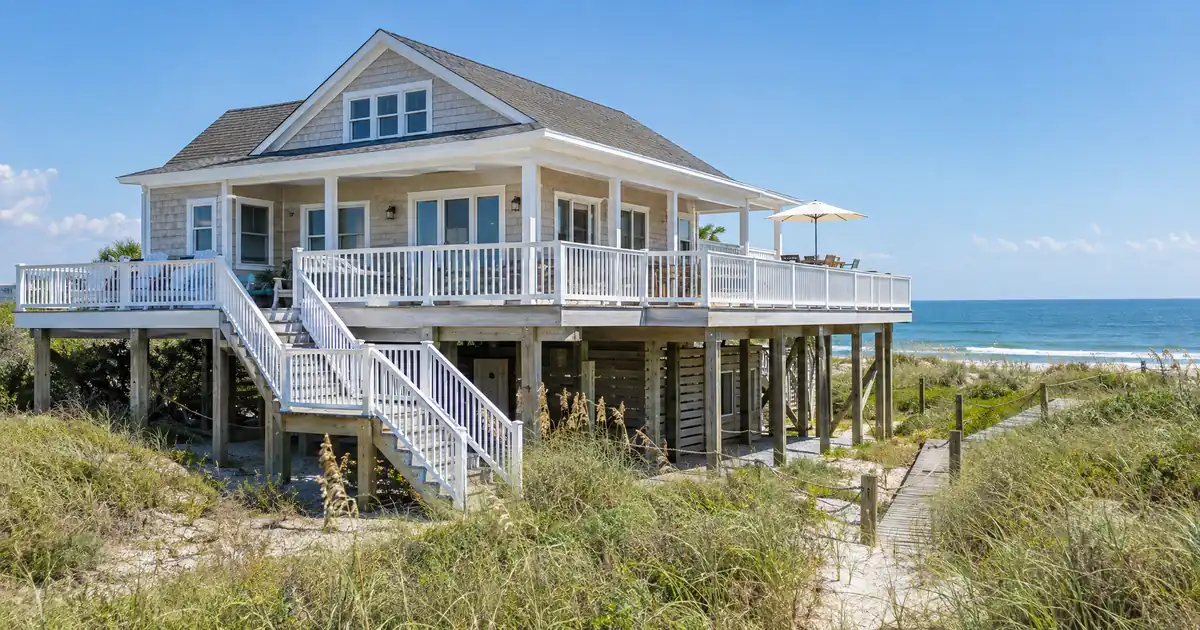
Picture two partners buying a coastal cottage together, each holding 50% of the LLC. Both cross a 25% ownership threshold, so both sign the guaranty. One partner’s middle credit score sits comfortably above the program’s floor; the other sits right at it. Because the file underwrites to the lower of the two, the whole loan gets treated at the weaker partner’s tier for pricing and maximum leverage — even though the stronger partner contributed more of the down payment.
If that same property’s coverage ratio clears comfortably above 1.00x on the appraisal’s short-term-rent analysis, the file has more room to absorb the weaker credit score as a compensating factor. If it’s sitting closer to 1.00x or just under, the credit gap carries more weight in the underwriting decision. That interaction — coverage strength offsetting credit weakness, and vice versa — is the core of how these files actually get read.
For investors weighing entity structure before they even shop lenders, Lendmire’s complete DSCR loans guide covers how vesting choices interact with guaranty requirements across different loan sizes.
What Investors Should Do Before Bringing In A Partner
Run credit for every likely guarantor before settling on ownership percentages. It’s a cheap check relative to what a weak middle score can cost in leverage on a $1,000,000+ vacation property. Decide early who is willing to sign personally — capital contribution and guaranty willingness aren’t always the same person, and that mismatch causes deal delays more than almost anything else on a partnered file.
Get a real short-term-rent analysis on the target property before you assume a number. A projection based on peak-season nightly rates rarely survives the 80%-of-gross treatment and the lower-of rule between appraisal and documented history. Build reserves as a partnership, not individually. A stronger guarantor’s liquidity can help the file, but it has to be verified and documented — not assumed.
For deeper background on the mechanics discussed here, see CFPB Regulation Z, §1026.43.
Frequently Asked Questions
Do both partners need equal credit if one owns more of the LLC?
Not necessarily equal — but if both cross the ownership threshold that triggers a guaranty, both credit files typically get pulled into the underwriting decision regardless of how ownership is split. Only structuring one partner below the threshold removes their credit from the equation entirely, subject to lender guidelines.
Can a brand-new LLC with no operating history still qualify?
Yes, generally. DSCR underwriting runs on the property’s income and the guarantor’s credit, not the entity’s track record, so a newly formed LLC or partnership typically qualifies the same way an established one would, subject to underwriting.
What if my partner’s credit is much weaker than mine?
The file will likely underwrite to their score if both of you cross the guaranty threshold on that program. Some investors respond by restructuring ownership so the stronger partner holds a clear majority and takes the sole guaranty, though that requires real agreement on liability, not just paperwork.
Does gross Airbnb revenue count as qualifying income?
No — gross bookings are not the coverage figure. Programs generally apply a discount to projected or documented short-term income (commonly around 80% of gross across Lendmire’s wholesale network) rather than crediit the full top-line figure, and a lower appraisal-based figure can still override a strong platform history.
Does an LLC keep the loan off my personal credit report?
Reporting practices vary by lender and servicer, so this isn’t a blanket guarantee — but many DSCR loans made through private, non-bank lenders don’t report ongoing payment history to the personal consumer credit bureaus the way a conventional mortgage would. That’s a lender-specific detail worth confirming on any given file.
Are you structuring a partnered vacation rental purchase? Do you want to see how guarantor credit, ownership split, and coverage ratio play out on the numbers? Lendmire can help. We’ll help you compare DSCR loan options based on the property’s income, the guarantors’ credit profiles, available leverage, and each partner’s goals for the deal.
Investors focused on short-term rentals can review DSCR loans for Airbnb and short-term rentals.
For current guidelines and terms, see Lendmire’s super jumbo DSCR loan programs page.
Self-employed borrowers can compare both super jumbo programs on Lendmire’s self-employed mortgages page.
About Lendmire
A non-QM mortgage broker (NMLS# 2371349), Lendmire arranges DSCR financing for real estate investors in 40 markets — 39 states plus Washington, D.C. Because deals are underwritten primarily on property cash flow rather than personal income documentation, the structure suits self-employed buyers and entity-owned portfolios. Lendmire places loans through wholesale investor lenders; it is not a direct lender. Scotsman Guide named Lendmire a Top Mortgage Workplace in both 2025 and 2026.
Get Started
Ready to find the right loan for you?
In about 30 seconds you can review financing options available for your home or investment property. No commitment required.
Informational only. Not a Loan Estimate, approval, or commitment to lend. Program availability and eligibility are subject to lender guidelines, credit approval, property review, and underwriting.
References
1. CFPB Regulation Z, §1026.3 Interp
2. CFPB Regulation Z, §1026.43
Brandon Miller
Founder & CEO, Mortgage Loan Originator, Lendmire LLC
- Mortgage Loan Originator · NMLS# 1129696 · Verify on NMLS Consumer Access
- North Carolina Real Estate Broker · License# 343312 · Verify on NCREC
- North Carolina Insurance Producer · License# 19053198 · Property, Casualty, Life, Health · Verify on NAIC SBS
- Lendmire LLC · Firm NMLS# 2371349 · Verify firm licensure
Legal disclosures. Lendmire (NMLS# 2371349) is a state-licensed mortgage brokerage that arranges financing through wholesale lender relationships. Lendmire is not a direct lender, depository institution, or registered financial advisor. The discussion above is general informational content about real estate financing — it is not financial, legal, or tax advice, and readers should consult licensed professionals for guidance on their individual circumstances. Loan inquiries are subject to lender underwriting; this article does not represent a commitment to lend. Loan terms, rates, and qualification standards vary by borrower, property, and state, and are subject to change at any time. Equal Housing Opportunity. NMLS Consumer Access: nmlsconsumeraccess.org.


