
The Quick Read: Yes, on a two- to four-unit building, the coverage test adds the rent from every unit and divides that total by the single payment on the whole building. The pooling happens inside one building; rent is combined across separate properties only under a pooled (blanket) loan. Otherwise, each property you finance is tested on its own rent and its own payment.
- One building, one note, one ratio: all unit rents go in the numerator.
- The denominator is the full PITIA (principal, interest, taxes, insurance, and any HOA dues) on that loan.
- The appraiser’s unit-level rent opinion often sets the figure each unit contributes.
- Other rentals you own are not pooled in, and a strong property cannot rescue a weak one.
- Clearing the ratio is not the same as positive cash flow.
How Does the Addition Actually Work?
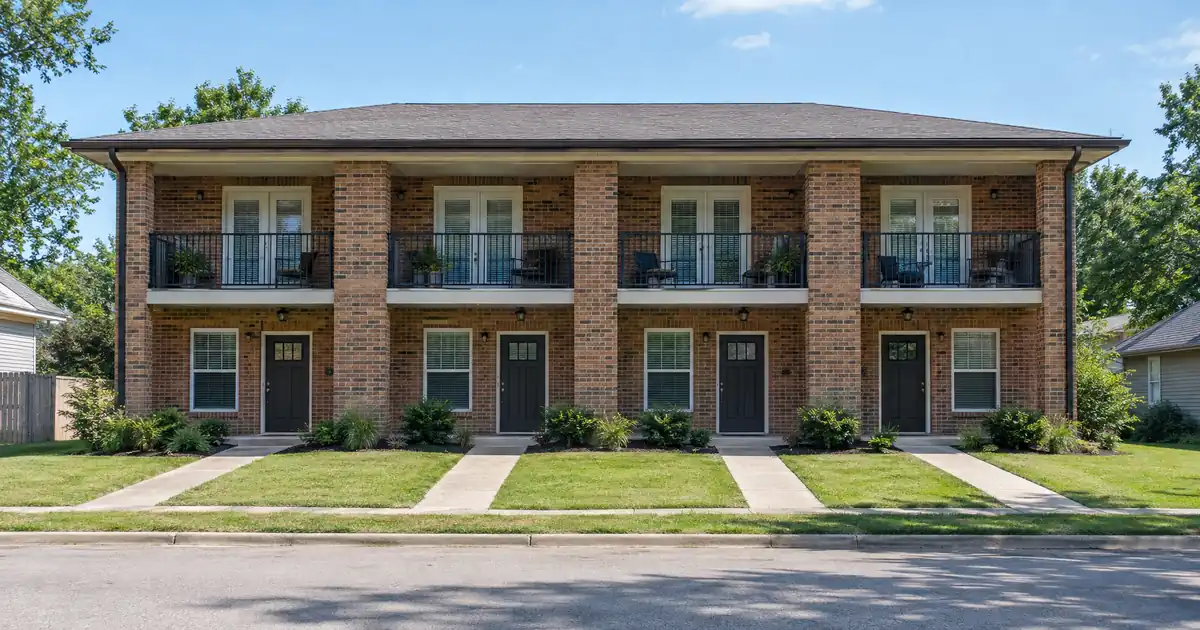
For a duplex, triplex, or fourplex, the lender treats the building as one piece of collateral with one loan. That is why the test is one pooled ratio and not a unit-by-unit check. Nobody asks whether Unit B can carry its own share of the payment. The question is whether the whole building’s rent covers the whole building’s payment.
DSCR Calculator
Run the numbers in your market
Rate source: Freddie Mac 30-yr average via FRED® — Federal Reserve Bank of St. Louis · effective Oct 29, 2026
Prefilled with starting assumptions — enter your own rent or nightly figures, taxes, insurance, and HOA for a more accurate picture.
Program parameters update from Lendmire’s centralized guideline source. Taxes and insurance are editable estimates.
As of Oct 29, 2026 · General Freddie Mac market benchmark, not a Lendmire loan offer. Rent, nightly rate, occupancy, taxes, and insurance are editable estimates. Short-term rental figures are estimates only and vary significantly by season, property type, management approach, and local short-term-rental rules — confirm local regulations before relying on them. Qualifying income for short-term rentals varies by program — some use appraisal market rent, others use documented STR history or projections — and is confirmed in underwriting. Not a Loan Estimate, approval, or commitment to lend. Program availability and eligibility are subject to lender guidelines, credit approval, property review, and underwriting.
The process runs in four steps:
1. Classify the property. Two to four units on one parcel follow the residential-style test. Larger buildings shift to a different method, covered below.
2. Assign one counted rent to each unit. That might be a lease figure, a market-rent opinion, or a blend of the two.
3. Add the counted rents into one gross monthly figure.
4. Divide by the full PITIA on the new loan and compare the result to the program’s minimum.
Most DSCR programs we place files with are built around a 1.00 starting point for standard rentals, because at that level rent covers the payment. Stronger ratios tend to open better pricing and more leverage. Coverage below 1.00 is a separate path, available through select lenders in the network, with leverage and terms adjusted. These are typical ranges, not promises, and every file is reviewed individually under lender guidelines.
If you want the full picture of how the coverage test fits into the loan, Lendmire’s complete DSCR loans guide walks through it.
What Does a Worked Example Look Like?
Run the numbers on a hypothetical fourplex. Suppose the units rent at similar but not identical levels, with two at the same figure and two slightly lower. Add all four. Now imagine the combined rent lands at about 1.3 times the building’s full PITIA. The coverage reads roughly 1.3x. That clears a 1.00 baseline with room to spare.
Now take the same building and remove one unit’s rent from the numerator, as if it were vacant and not credited. The ratio drops by roughly a quarter of the total in this even-rent case, landing near 1.0x. The cushion that looked comfortable shrinks fast. That is the sensitivity worth testing before you make an offer.
This illustration is a modeled assumption, not a market quote. Your real ratio depends on the actual rents accepted and the actual taxes and insurance on the building.
Which Rent Counts for Each Unit?
Each unit contributes one number, and the underwriter decides which one. A common approach is the lower of the in-place lease or the appraiser’s market rent, applied unit by unit. Programs differ, so treat the table as a pattern and not a rule.
| Unit situation | Rent typically counted | Supporting document |
|---|---|---|
| Leased at market | Lease or market rent | Lease, rent roll |
| Leased above market | Often capped at market | Appraisal rent opinion |
| Leased below market | Often the lease figure | Lease |
| Month-to-month | Varies by program | Rent roll, payment history |
| Vacant | Market rent on some programs, none on others | Appraisal rent schedule |
For a two- to four-unit property, the appraisal usually includes a unit-level rent opinion. Fannie Mae’s Selling Guide lists Form 1025 as the report for two- to four-unit properties, while the one-unit rent schedule is a different form. DSCR programs are not agency loans and set their own rules. The form names are simply the vocabulary appraisers use. One appraiser’s explanation notes that the 1025 captures rental income at the unit level, not as one blended number, which is exactly why a per-unit sum is possible.
Here is the catch. The appraiser’s rent conclusion is effectively your income figure. A thin or conservative opinion shrinks the qualifying loan, no matter how healthy your leases look.
What Happens When a Unit Is Vacant?
Vacancy is where pooling cuts both ways. Spreading the payment across several rent streams makes one soft unit less damaging than in a single-family rental, where a vacancy takes out all the rent. But in a duplex, a vacant side that earns no credit removes half the income.
Some programs credit market rent for a vacant unit. Others do not credit it at all. Lenders also differ on whether they apply any vacancy haircut to the gross rent. Many use gross rent without a deduction when units have current leases, and some apply one. That varies by program, so ask before you assume.
The ratio is set when the loan is reviewed. A tenant leaving after that point does not retroactively change the test, though it obviously changes your real cash flow. Lendmire’s own page on how a DSCR loan lends on a duplex is useful here, because the vacant side matters so much in a two-unit building. That is a quick sensitivity to run: take out one unit at a time and see where the ratio lands.
Is It One Building or Several Properties?
This is the question behind many searches for “add rents together.” The answer changes with the loan structure.
| Structure | What rents are added | Tested against | Can a strong unit rescue a weak one? |
|---|---|---|---|
| Duplex to fourplex, one loan | All units in that building | One building payment | Yes, within the building |
| Separate loans on separate properties | Only that property’s rents | That property’s payment | No |
| Pooled (blanket) loan | Rents across the pooled properties | One combined payment | Yes, across the group |
A single duplex or fourplex is one rental, not several. But if you own three separate duplexes financed separately, each gets its own test. Strong rents on one do not lift a weak one. Lendmire explains this in its piece How DSCR Is Calculated for Each Rental on Its Own Rent and Payment.
Only a pooled structure combines rent across properties.
Do Laundry, Parking, or Short-Term Rental Income Count?
Treatment varies by program, and the safest assumption is that only documented rent from the units counts. Ancillary income such as laundry or parking may or may not be credited, and it usually needs a track record to be considered. Commercial space on the ground floor generally stays outside the residential gross-rent figure. Only the residential units count.
Short-term rentals are their own category. The appraisal’s rent opinion measures monthly rent, so nightly-rate income needs a separate review. For short-term-rental collateral, the network’s programs run at lower leverage than standard rentals: purchase up to 75% LTV, refinance around 70%, and cash-out at 70%, with a 640+ score and about 12 months of hosting history typical. Short-term rental rules can vary by city, county, HOA, and property type, so investors should confirm local rules before relying on projected rental income. Terms depend on the lender’s guidelines, the property type, the leverage, and a full review of the credit profile.
Owner occupancy is another edge. DSCR loans are designed for non-owner-occupied investment properties. Because they are business-purpose investor loans, they are reviewed differently from a standard owner-occupied mortgage. Living in one unit of a duplex generally takes the property outside a standard DSCR file.
Where Does the Rule Change?
At five or more units, the formula typically shifts from gross rent over payment to a net-income measure, where operating costs come out before comparing to debt service. The same building can look quite different under each method. Some niche lenders will apply a residential-style test to small five- to ten-unit buildings, but that is the exception, not the norm. If you are buying in that range, confirm the method before you write an offer.
Property type matters, too. Manufactured homes (single- and double-wide), log homes, and barndominiums are not offered through the network’s DSCR programs, so a multi-unit structure of that kind falls outside these programs entirely.
DSCR vs. conventional financing
There are two common ways to finance an investment property, and they qualify you differently — here’s how investors weigh them.
Why investors choose it
- Qualifies on the property’s rental income — no personal tax returns, W-2s, or pay stubs needed to document income.
- No personal debt-to-income ceiling to clear, so existing mortgages and obligations don’t cap your borrowing the same way.
- Can be closed in an LLC, keeping the property inside a business entity.
- Built for scaling — not held to the limit on number of financed properties that conventional financing applies.
- Underwriting centers on the deal: generally qualifies when the rent covers the payment, a 1.00x coverage ratio being a common baseline (confirmed in underwriting).
- Designed specifically for investment property, including long-term and, where the program allows, short-term rentals.
Where it’s strong
- Often the lowest ongoing financing cost for a buyer who fully qualifies on personal income — a fit for a first property or a cost-first purchase.
Trade-offs for investors
- Requires full personal income documentation and must fit within a debt-to-income limit — salary, existing debts, and other mortgages all count.
- Typically held in your personal name rather than a business entity.
- Caps how many financed properties you can carry, which can become a ceiling as a portfolio grows.
- Evaluates you as a borrower as much as the property, which usually means more paperwork.
How investors usually choose: a first or single property often optimizes for the lowest financing cost; portfolio builders often optimize for leverage, vesting in an LLC, and scaling past conventional caps. The right answer depends on your goals, the property, and current guidelines — both paths run through select lenders in Lendmire’s wholesale network, with eligibility and terms confirmed in underwriting.
Does Passing the Test Mean the Deal Cash Flows?
No. DSCR compares rent to PITIA only. Repairs, vacancy, management, utilities, and capital expenses all sit outside the calculation. A building can clear 1.00 and still leave thin real margin.
| Measure | What it includes | What it leaves out |
|---|---|---|
| DSCR coverage | Rent vs. PITIA | Repairs, vacancy, management, capex |
| Real cash flow | All operating costs | Nothing |
An investor who treats a passing ratio as proof of profit is the one who gets surprised in year two. Build your own budget for the costs the lender ignores, and treat the coverage number as an entry ticket, not a forecast. Taxes and insurance deserve a close look as well, since they sit in the denominator and can move the ratio as much as rent does.
What Do Strong Multi-Unit Files Look Like?
Across our wholesale network, the cleanest two- to four-unit files tend to share a few traits. Leases for every unit are in place, a rent roll ties to those leases, and tax and insurance quotes reflect the whole building. Purchase files typically land at 75% to 80% LTV, with select high-leverage programs reaching 85% for stronger credit around 700+. Cash-out refinances top out near 75% LTV on standard rentals. Credit floors start at 620 in parts of the network, with most programs wanting around 660. Reserves commonly run about six months of PITIA, stepping up to about nine months on loans above $1,500,000. Standard programs reach up to $3,000,000.
A larger down payment can lift the ratio by lowering the payment, but it does not erase leverage caps, credit floors, reserve rules, or property eligibility. The strongest files clear both tests: enough equity and enough rental coverage.
Key Terms Defined
DSCR (debt service coverage ratio): The property’s counted rent divided by its monthly PITIA.
PITIA: Principal, interest, taxes, insurance, and any association dues on the loan.
Counted rent: The one monthly rent figure a lender credits for each unit.
Rent roll: A list of every unit with its tenant, lease terms, and rent.
Market rent: An appraiser’s opinion of what a unit should rent for today.
Pooled (blanket) loan: One loan secured by several properties, tested on combined rent and one payment.
Frequently Asked Questions
What if each unit rents for a different amount?
Add them as they are. The test does not need equal rents. Each unit contributes its own counted figure, the figures are totaled, and the total is divided by the building’s full payment. Uneven rents change the total, not the method.
Can a vacant unit’s market rent be included?
Sometimes. Some programs credit appraiser-opined market rent for a vacant unit, and others give it no credit. Ask before you rely on it, because the choice can swing the ratio considerably in a duplex or triplex.
Does one vacant unit sink the ratio?
It lowers it, but whether it sinks it depends on how much cushion you had. In a fourplex with even rents, losing one unit removes roughly a quarter of the income. Run the building with each unit removed in turn and see whether it still holds.
Do I add rents across several properties I own?
No, unless the properties sit under one pooled loan. Separately financed properties are each tested on their own rent and payment. Strong rents on one building do not lift a weaker one.
Is the unit I live in counted?
Generally no. DSCR programs are for non-owner-occupied investment property, so living in one unit typically moves the file outside a standard DSCR structure.
If you are buying or refinancing a rental property and want to see how the numbers work, Lendmire can help you compare DSCR loan options based on the property income, credit profile, leverage, and investor goals. Lendmire is a broker arranging financing through select lenders in its wholesale network, across 41 markets including Washington, D.C. Tax treatment varies; consult a qualified professional.
One last practical point: before you fall for a building, total the unit rents the way an underwriter would, then strip out the weakest unit and see what is left.
About Lendmire
Lendmire (NMLS# 2371349) is a mortgage brokerage built around DSCR investor lending, with programs available in 41 markets, including Washington, D.C. DSCR lenders commonly evaluate rental-income coverage instead of personal income paperwork — a practical fit for LLC-owned and multi-property investors. Terms vary by lender, property, leverage, and program. Scotsman Guide named Lendmire a Top Mortgage Workplace in both 2025 and 2026.
Get Started
Ready to find the right loan for you?
See your offer in seconds. No credit pull, no obligation.
Informational only. Not a Loan Estimate, approval, or commitment to lend. Program availability and eligibility are subject to lender guidelines, credit approval, property review, and underwriting.
References
1. Fannie Mae Selling Guide B4-1.2-01
This article is part of Lendmire’s DSCR loan program — full qualification details, guidelines, and scenarios live on the program page.
Related reading: How to Apply for a DSCR Loan on a Rental Property · How the DSCR Loan Process Works From Application to Closing · How the DSCR Test Works on a 15-Year Loan Payment
Brandon Miller
Founder & CEO, Mortgage Loan Originator, Lendmire LLC
- Mortgage Loan Originator · NMLS# 1129696 · Verify on NMLS Consumer Access
- North Carolina Real Estate Broker · License# 343312 · Verify on NCREC
- North Carolina Insurance Producer · License# 19053198 · Property, Casualty, Life, Health · Verify on NAIC SBS
- Lendmire LLC · Firm NMLS# 2371349 · Verify firm licensure
Compliance and disclosures. Lendmire (NMLS# 2371349) is a licensed mortgage broker and is not a direct lender, depository institution, financial advisor, or tax professional. Content in this article is general market analysis and educational information — not financial, legal, or tax advice for any specific situation. Lendmire does not guarantee loan approval; every transaction is subject to underwriting by the funding lender. Mortgage pricing and loan program guidelines are subject to change at any time without notice and vary by borrower characteristics, property type, and state regulations. Lendmire complies with Equal Housing Opportunity. Licensure verification: NMLS Consumer Access.