
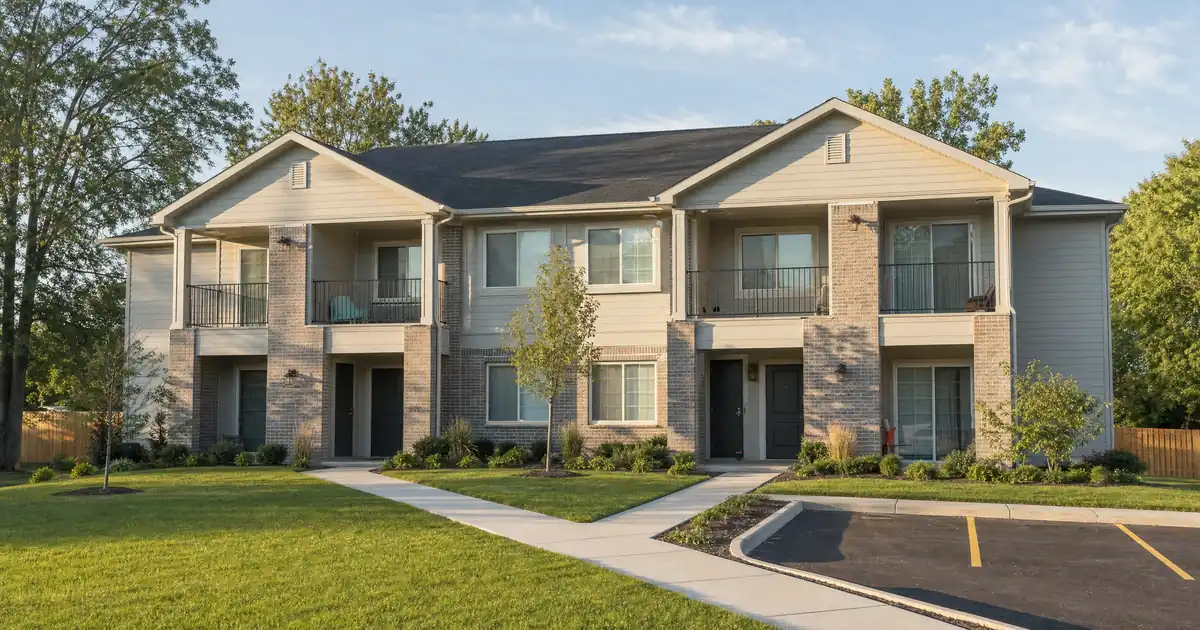
DSCR Loan for a Multifamily Investment Property: Complete Guide — The Quick Read: A DSCR loan lets an investor qualify a multifamily property on its rent. The investor doesn’t need traditional personal-income paperwork. But the underwriting method changes once a building crosses five units. Gross rent divided by payment becomes net operating income divided by debt service instead. Loan sizing follows a leverage ladder. That ladder steps down as the loan balance climbs — it’s not a flat rate across every deal. The property’s income decides how big the loan can get, not the borrower’s W-2.
Market Snapshot
Here’s a quick look at the investor landscape. The figures come from the sources cited below. Confirm current property-level numbers before underwriting.
DSCR Calculator
Run the numbers in your market
Rate source: Freddie Mac 30-yr average via FRED® — Federal Reserve Bank of St. Louis · effective Sep 3, 2026
Prefilled with local estimates — enter your own rent or nightly figures, taxes, insurance, and HOA for a more accurate picture.
Program parameters update from Lendmire’s centralized guideline source. Taxes and insurance are editable estimates.
As of Sep 3, 2026 · General Freddie Mac market benchmark, not a Lendmire loan offer. Rent, nightly rate, occupancy, taxes, and insurance are editable estimates. Short-term rental figures are estimates only and vary significantly by season, property type, management approach, and local short-term-rental rules — confirm local regulations before relying on them. Qualifying income for short-term rentals varies by program — some use appraisal market rent, others use documented STR history or projections — and is confirmed in underwriting. Not a Loan Estimate, approval, or commitment to lend. Program availability and eligibility are subject to lender guidelines, credit approval, property review, and underwriting.
| Metric | Detail |
|---|---|
| Typical rents | $1,390 median (Apartment List) |
| Vacancy | 7.1% (Aug 2026) (Apartment List) |
Key Takeaways
- DSCR lender review runs on property income. The calculation method shifts at the 5-unit line — from gross rent to net operating income.
- Leverage on multifamily DSCR loans steps down as loan size rises. Full leverage tiers exist up to $1,000,000. It tapers through $3,000,000, and again above $4,000,000.
- Sub-1.00 coverage and no-ratio paths exist through select lenders in the wholesale network. But leverage and terms adjust accordingly.
- Interest-only structuring, cash-out refinancing, and short-term-rental income can all factor into a multifamily DSCR file. Each one has its own size cap and documentation requirement.
- The single biggest failure point on marginal files is a rent roll priced to last year’s occupancy instead of today’s market rent.
What Counts as “Multifamily” for a DSCR Loan?
Anything from a duplex to a small apartment building can carry a DSCR loan. But the underwriting treatment isn’t the same across that range. A 2-4 unit building gets treated almost like a single-family rental. It gets one rent schedule, one gross-rent-versus-payment calculation, and one standardized appraisal form. A 5-plus unit building gets treated more like a small commercial asset. That means net operating income, expense deductions, and a different appraisal approach.
This split isn’t just lender preference. It’s built into how the secondary market handles the collateral. Non-QM DSCR loans on 1-4 unit properties get pooled and sold as residential mortgage-backed securities. Once a property hits five units, it typically falls out of that channel. It gets treated alongside larger multifamily and commercial real estate instead. That distinction shapes everything downstream: which appraisal form gets ordered, how income gets calculated, and how much documentation the file needs.
For an investor moving from a fourplex into a small apartment building, understanding this line matters more than any other fact in underwriting. It’s the difference between a simple rent-schedule file and one that behaves like a scaled-down commercial deal. Lendmire’s complete DSCR loans guide walks through the basics of the product, for readers who want the fundamentals before getting into multifamily specifics.
How Underwriting Actually Treats a Multifamily DSCR File, Step by Step
The process runs in a predictable order. Skipping a step is usually where a file gets stuck.
1. Classify the property by unit count. This decides whether the file runs on the simple residential-style formula, or the expense-loaded commercial-style method.
2. Order the correct rent evidence. A 1-4 unit property typically pulls a rent schedule off comparable rentals. A 5-plus unit building needs a documented operating statement. That means actual collected rents, not just a lease list.
3. Calculate the coverage ratio using the right method. Use gross rent over the full monthly housing payment for smaller buildings. Use net operating income over total debt service for larger ones.
4. Stress-test the income against market conditions. A trailing rent roll showing near-full occupancy in a soft rental market gets a second look. Underwriters lean on current market rent and vacancy assumptions. They don’t just trust the borrower’s most recent — and possibly optimistic — collection history.
5. Size the loan against the applicable leverage tier. Loan amount, coverage ratio, and credit profile together decide which rung of the leverage ladder the file lands on.
6. Document reserves and entity vesting. Multifamily files typically close in an LLC or similar entity. Reserve requirements scale with loan size and investor experience.
Each step builds on the last. A file that misclassifies the property at step one usually needs a full rework once the appraisal or income analysis comes back. That’s the single most common source of delay on a multifamily DSCR submission.
Key Terms Defined
DSCR (debt-service coverage ratio): the property’s income divided by its total monthly debt obligation. A ratio above 1.00 means the rent covers the payment, with room to spare.
NOI (net operating income): collected rental income after subtracting vacancy or collection loss, management fees, and operating expenses. This is the income figure used once a property crosses into 5-plus-unit territory.
PITIA: principal, interest, taxes, insurance, and association dues, if applicable. This is the full monthly obligation used in the coverage calculation.
LTV (loan-to-value): the loan amount, shown as a percentage of the property’s appraised value or purchase price — whichever is lower.
No-ratio loan: a program path where the file qualifies without a published minimum coverage number. It’s generally reserved for stronger credit and lower leverage.
The Unit-Count Eligibility Ladder
The income-calculation method, appraisal type, and documentation weight all shift as unit count rises. Knowing which tier a property falls into before shopping the file saves a round of rework later.
| Unit Count | Income Calc Method | Appraisal Approach | Documentation Emphasis |
|---|---|---|---|
| 1-4 units | Gross rent vs. full payment | Residential income form | Lease/rent schedule |
| 5-10 units | NOI vs. total debt service | Commercial-style income approach | Operating statement, rent roll |
| 11+ units | NOI, often case-by-case | Full commercial appraisal | Full financials, investor track record |
Loan size, not unit count alone, drives which leverage tier applies. A 6-unit building priced at $900,000 and an 18-unit building priced at $2.8 million both fall under the NOI method. But they land on different rungs of the leverage ladder.
A Full Worked Example: Rent Roll to Loan Sizing
Run a hypothetical small apartment building through both methods to see why the ratio moves. Assume the gross-rent-over-payment math on this property lands at roughly 1.30x. On paper, rent comfortably clears the payment.
Now move that same rent roll through the NOI method. First, deduct a market vacancy and collection factor. Then deduct a management fee and a maintenance/reserve allowance. Compare income to debt service after that, and the 1.30x ratio commonly settles into something closer to a 1.05x-1.15x range — on the exact same rents. Nothing about the building changed. Only the calculation method did.
That compressed ratio then drives loan sizing. A property clearing roughly 1.15x or higher on the NOI method typically supports full leverage at its size tier. One that dips into the high-0.90s doesn’t automatically fall out of contention. A sub-1.00 coverage path is available through select lenders in the wholesale network. Leverage and terms adjust to compensate, subject to underwriting. The lesson for an investor pricing a deal: run the NOI math first. Don’t assume the gross-rent number is what the lender will use.
Leverage, Credit, and Reserves by Loan Size
Leverage on multifamily DSCR loans doesn’t run flat. It steps down as the loan balance climbs, and credit requirements tighten right alongside it.
Pricing and available terms vary by lender, borrower profile, property type, and full underwriting review. Push past $1,000,000, and leverage typically settles at 75% through the $1,500,000, $2,000,000, and $3,000,000 bands. Credit expectations rise too — to 700, then 720, as the balance grows. Above $3,000,000, leverage drops again. It falls to roughly 65% through $4,000,000, and 60% through $6,000,000. Cash-out disappears entirely on those larger balances. Everything above $4,000,000 gets reviewed case by case before submission. It’s purchase or rate-and-term only — never a flat “up to” figure.
Cash-out on multifamily files tops out at $3,000,000 altogether. Leverage on cash-out steps down faster than on a purchase. It runs 75% on the smallest balances, 70% through $1,500,000, then 60% from $1,500,000 to $3,000,000. Proceeds run unlimited only at or below 60% LTV. Push the leverage higher, and proceeds cap at $1,500,000. Credit at 680 or below shuts out cash-out above $1,500,000 entirely. These specifics are subject to lender guidelines and a full review of property, leverage, and credit.
Reserves typically run six months of PITIA on the subject property. (That’s interest-only, taxes, insurance, and association dues, if the loan is structured interest-only.) That stretches to twelve months for a first-time investor. Above $2,000,000, most programs call for two independent appraisals instead of one. Investors sizing deals well above the standard $3,000,000 program cap — larger apartment buildings, high-value small multifamily assets — should look at Lendmire’s luxury investment property DSCR loan guide to see how the largest-balance tier of this ladder actually works.
DSCR vs. Conventional, Agency, and Traditional Commercial Financing
The differences between these four financing paths come down to one thing: whose income the lender actually underwrites.
| Factor | DSCR (Non-QM) | Conventional/Agency | Traditional Commercial |
|---|---|---|---|
| Income basis | Property rent or NOI | Borrower income + limited rent credit | Property NOI + sponsor financials |
| Typical unit range | 1-20+ (program-dependent) | 1-4 units | 5+ units, larger balances |
| Personal income docs | Not required — property-based | Required | Often required from sponsor |
| Entity vesting | Common | Uncommon for individual borrowers | Common |
An investor with strong traditional employment income and only one or two rental properties may still find it worth comparing conventional financing on overall cost. But once a portfolio grows past what personal debt-to-income can support, or the investor wants to close in an entity, the DSCR path becomes the practical route. Lendmire’s DSCR vs. conventional comparison covers that decision in more depth.
Structures and Variations Worth Knowing
Multifamily DSCR loans aren’t one fixed product. Several structural variations change how a marginal deal gets financed.
DSCR vs. conventional financing
Two common ways to finance an investment property in this market. They qualify you differently — here’s how investors weigh them.
Why investors choose it
- Qualifies on the property’s rental income — no personal tax returns, W-2s, or pay stubs needed to document income.
- No personal debt-to-income ceiling to clear, so existing mortgages and obligations don’t cap your borrowing the same way.
- Can be closed in an LLC, keeping the property inside a business entity.
- Built for scaling — not held to the limit on number of financed properties that conventional financing applies.
- Underwriting centers on the deal: generally qualifies when the rent covers the payment, a 1.00x coverage ratio being a common baseline (confirmed in underwriting).
- Designed specifically for investment property, including long-term and, where the program allows, short-term rentals.
Where it’s strong
- Often the lowest ongoing financing cost for a buyer who fully qualifies on personal income — a fit for a first property or a cost-first purchase.
Trade-offs for investors
- Requires full personal income documentation and must fit within a debt-to-income limit — salary, existing debts, and other mortgages all count.
- Typically held in your personal name rather than a business entity.
- Caps how many financed properties you can carry, which can become a ceiling as a portfolio grows.
- Evaluates you as a borrower as much as the property, which usually means more paperwork.
How investors usually choose: a first or single property often optimizes for the lowest financing cost; portfolio builders often optimize for leverage, vesting in an LLC, and scaling past conventional caps. The right answer depends on your goals, the property, and current guidelines — both paths run through select lenders in Lendmire’s wholesale network, with eligibility and terms confirmed in underwriting.
Interest-only. A 120-month interest-only period is available on 30- and 40-year terms, up to 75% LTV. It generally requires coverage of 0.75x or better, measured on the interest-only payment. This is often the lever that turns a borderline NOI ratio into a qualifying one. It works because it lowers the monthly obligation the rent has to cover.
Sub-1.00 and no-ratio paths. Coverage between roughly 0.75x and 0.99x is a genuine option through select lenders in the network. These files get priced with reduced leverage rather than declined outright, subject to underwriting. A no-ratio path — no published minimum coverage number at all — exists up to $2,000,000. It’s for borrowers with a seven-year clean housing history and no late payments in the trailing 24 months, again subject to underwriting. This path isn’t available with a sub-1.00 coverage stack, and it’s not offered on short-term-rental income.
Short-term-rental income inside a multifamily building. If units are rented nightly rather than by lease, income gets measured differently. A refinance relies on twelve months of documented operating history. A purchase relies on the appraisal’s short-term-rental analysis, generally discounted to around 80% of gross. This path is reserved for investors with at least twelve months of income-property ownership in the trailing 36 months. It isn’t available on the no-ratio path. Short-term rental rules can vary by city, county, HOA, and property type. So investors should confirm local rules before relying on projected nightly income — municipal permission gets documented per property, never assumed. Investors weighing this structure alongside a single-property STR purchase should also see Lendmire’s short-term rental HELOC guide for the equity-tapping side of that strategy.
Cash-out. Covered above by leverage tier. Worth repeating: it disappears above $3,000,000, regardless of how strong the coverage is.
DSCR loans are built for non-owner-occupied investment properties. Because they’re business-purpose investor loans, they get reviewed differently from a standard owner-occupied mortgage.
Where the General Rule Breaks: Edge Cases
The 4-to-5 unit cliff. A four-unit building and a five-unit building can sit on the same street with nearly identical rent rolls. Yet one gets underwritten on gross rent, and the other on NOI. Investors building a small portfolio one property at a time should treat that fifth unit as a financing-strategy decision, not just a size increment. It can change the ratio a lender sees on paper in a real way.
Mixed-use buildings. A multifamily property with ground-floor retail or office space brings in a second income stream. That income doesn’t behave like residential rent — it has different lease terms and different vacancy risk. It can push a file toward commercial-style treatment, even below the five-unit line.
The agency alternative most DSCR borrowers skip. HUD’s Section 207/223(f) program exists to insure the purchase or refinance of existing multifamily rental housing. Section 207 serves as the primary insurance vehicle behind that refinance program. It’s a real federally backed lane for larger multifamily deals. But it’s a document-heavy process, built for scale and institutional timelines. That’s exactly why private DSCR execution has become the default path for smaller multifamily acquisitions — deals that don’t fit that program’s size or documentation load.
Soft rental conditions compressing the safety margin. The national multifamily vacancy rate recently hit a record high near 7.3%, with rents down roughly 1% year-over-year, according to the National Association of Home Builders. CBRE’s market outlook expects rent growth to keep lagging pre-pandemic levels as new supply gets absorbed. A coverage ratio built on last year’s rent roll, instead of current market rent, is exactly the kind of assumption a lender’s independent rent and vacancy check is designed to catch.
Common Decline Reasons and How to Strengthen a Marginal File
The most frequent reason a multifamily DSCR file stalls isn’t credit. It’s a rent assumption the appraisal doesn’t support. Four patterns show up repeatedly:
- Rent priced above market. The borrower’s trailing rent roll reflects a legacy tenant paying below current rates. Or it reflects an optimistic pro forma that the appraisal’s rent schedule doesn’t confirm.
- Vacancy at closing. A unit or two sitting empty at the time of underwriting shrinks the trailing income the file can rely on.
- Reserves short of the requirement. Six months of PITIA on the subject property (twelve for a first-time investor) is a real line item, not a formality. Cash-out proceeds can’t be counted toward meeting it.
- Property condition mismatched to the program. DSCR programs are built for stabilized, income-producing properties. Heavy deferred maintenance, or units that aren’t currently rentable, usually needs to be resolved before the file works.
The fix in most of these cases is structural, not cosmetic. Layer in interest-only to improve the ratio. Resize the loan to a lower leverage tier. Document additional reserves. Or wait out a lease-up period before refinancing. The answer is rarely to inflate the rent assumption — that just moves the same problem to the appraisal desk.
Scaling a Multifamily Portfolio Over Time
Most investors don’t buy their first multifamily property with cash sitting idle. They pull equity from an existing rental to fund it. A single-family rental with meaningful appreciation can supply a down payment through a home-equity line, without touching the DSCR loan on the multifamily asset itself. Lendmire’s single-family investment property HELOC guide covers that mechanic in detail.
Once the multifamily property is stabilized and seasoned, a cash-out refinance can redeploy equity into the next acquisition. This is subject to the leverage and credit tiers above, and it never goes above the $3,000,000 cash-out ceiling. Lendmire’s investment property refinance playbook walks through that refinance-to-acquire cycle, for investors building a portfolio one property at a time. Entity vesting keeps each acquisition separate for liability purposes. Up to 20 financed properties is generally workable on most files, subject to lender guidelines and program eligibility.
Anyone weighing whether to buy or refinance a multifamily rental can reach Lendmire at 828-256-2183. Compare leverage tiers against a specific rent roll before committing to a purchase contract.
Frequently Asked Questions
Does a DSCR loan work on a duplex the same way it works on a 10-unit building?
Not quite. A duplex gets underwritten on the simpler gross-rent-over-payment formula, with a residential-style appraisal. A 10-unit building typically runs on net operating income, after vacancy, management, and reserve deductions, plus a commercial-style appraisal. The math, the appraisal form, and the documentation load all shift once a property crosses five units.
Can an investor still qualify if the DSCR comes in below 1.00?
Sometimes, through select lenders in the wholesale network. Coverage between roughly 0.75x and 0.99x is a real path, though leverage and terms adjust to compensate, subject to underwriting. A no-ratio option with no published minimum also exists up to $2,000,000, for borrowers with a seven-year clean housing history. But it isn’t paired with sub-1.00 coverage or short-term-rental income.
Is a value-add multifamily property with vacant units eligible?
Generally not, through a standard DSCR path. These programs are built around stabilized, income-producing rental property. A building with significant deferred maintenance, or units that aren’t currently rentable, usually needs to reach stabilization first. Then it can refinance into a DSCR loan once the income is documented.
How does short-term-rental income get counted in a multifamily building?
Differently from long-term lease income. A refinance typically relies on twelve months of documented operating history. A purchase relies on the appraisal’s short-term-rental income analysis, generally discounted to roughly 80% of gross. This route is reserved for investors with at least twelve months of income-property ownership in the trailing three years. It’s not compatible with the no-ratio path.
What happens above $3,000,000 in loan size?
Leverage steps down to roughly 65% through $4,000,000, and 60% through $6,000,000. Cash-out disappears entirely. Every request above $4,000,000 gets reviewed case by case before submission — purchase or rate-and-term only. Credit expectations rise too, to a 700 floor, once the balance passes $3,000,000.
Buying or refinancing a multifamily rental, and want to see how the numbers actually run? Lendmire can help compare DSCR loan options, based on the property’s income, credit profile, leverage, and investor goals.
About Lendmire
Lendmire is a non-QM DSCR mortgage broker, NMLS# 2371349. It connects real estate investors with wholesale lenders across 40 markets nationwide. Lendmire does not fund loans directly. It matches a property’s income, an investor’s credit profile, and leverage goals with the right program from its lender network. All terms, leverage tiers, and program eligibility referenced above are subject to full underwriting review and individual lender guidelines. Availability can vary by property, borrower profile, and market. Scotsman Guide named Lendmire a Top Mortgage Workplace in both 2025 and 2026.
Get Started
Ready to find the right loan for you?
In about 30 seconds you can review financing options available for your home or investment property. No commitment required.
Informational only. Not a Loan Estimate, approval, or commitment to lend. Program availability and eligibility are subject to lender guidelines, credit approval, property review, and underwriting.
References
2. U.S. Department of Housing and Urban Development — Descriptions of Multifamily Programs
3. National Association of Home Builders — Multifamily Market Expected to Cool as Vacancies Rise
4. CBRE — U.S. Real Estate Market Outlook: Multifamily
Brandon Miller
Founder & CEO, Mortgage Loan Originator, Lendmire LLC
- Mortgage Loan Originator · NMLS# 1129696 · Verify on NMLS Consumer Access
- North Carolina Real Estate Broker · License# 343312 · Verify on NCREC
- North Carolina Insurance Producer · License# 19053198 · Property, Casualty, Life, Health · Verify on NAIC SBS
- Lendmire LLC · Firm NMLS# 2371349 · Verify firm licensure
Compliance and disclosures. Lendmire (NMLS# 2371349) is a licensed mortgage broker and is not a direct lender, depository institution, financial advisor, or tax professional. Content in this article is general market analysis and educational information — not financial, legal, or tax advice for any specific situation. Lendmire does not guarantee loan approval; every transaction is subject to underwriting by the funding lender. Mortgage pricing and loan program guidelines are subject to change at any time without notice and vary by borrower characteristics, property type, and state regulations. Lendmire complies with Equal Housing Opportunity. Licensure verification: NMLS Consumer Access.


