
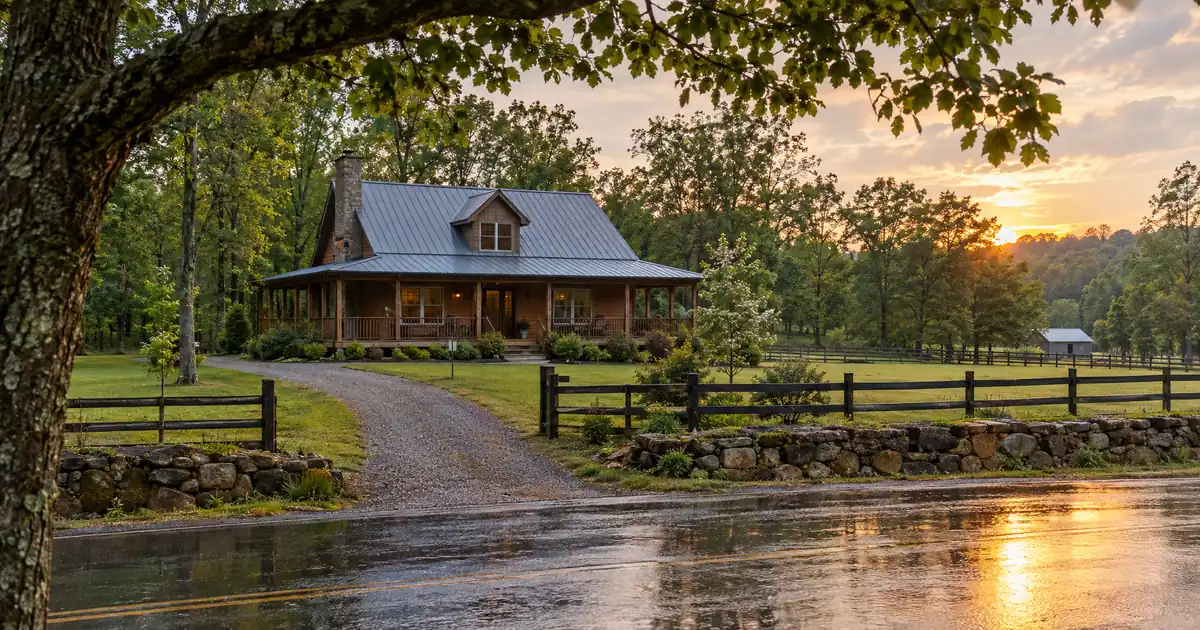
The Quick Read: The loan is sized on the house and its site, and the lowest of three limits sets the amount: your leverage tier applied to the lower of price or appraised value, the amount the rent can support, and the acreage cap. Across the wholesale network Lendmire works with, programs typically want five acres or fewer, and extra land adds little to the loan.
- Purchase leverage typically runs 75%-80% LTV on an investment property, subject to lender guidelines.
- Rural status can lower the maximum LTV; rural files at five acres or less are allowed to 75% on loans at or below $3,000,000.
- The lower of purchase price or appraisal governs. A higher appraisal never raises the loan.
- Rent must cover the full payment (principal, interest, taxes, insurance, and any HOA dues) at the program’s coverage floor.
- Acreage can decide eligibility before any math starts.
Picture a buyer who finds a rental house on twelve rolling acres. The listing price looks fair, and the rent looks strong. Then the lender asks about the parcel size, and the whole file changes. That is the story of acreage. This guide walks through how the amount is built, where the land hurts, and what to do about it. It sits next to Lendmire’s complete DSCR loans guide, which covers the basics.
DSCR Calculator
Run the numbers in your market
Rate source: Freddie Mac 30-yr average via FRED® — Federal Reserve Bank of St. Louis · effective Oct 29, 2026
Prefilled with starting assumptions — enter your own rent or nightly figures, taxes, insurance, and HOA for a more accurate picture.
Program parameters update from Lendmire’s centralized guideline source. Taxes and insurance are editable estimates.
As of Oct 29, 2026 · General Freddie Mac market benchmark, not a Lendmire loan offer. Rent, nightly rate, occupancy, taxes, and insurance are editable estimates. Short-term rental figures are estimates only and vary significantly by season, property type, management approach, and local short-term-rental rules — confirm local regulations before relying on them. Qualifying income for short-term rentals varies by program — some use appraisal market rent, others use documented STR history or projections — and is confirmed in underwriting. Not a Loan Estimate, approval, or commitment to lend. Program availability and eligibility are subject to lender guidelines, credit approval, property review, and underwriting.
Key Terms Defined
DSCR (debt service coverage ratio): The monthly rent divided by the full monthly payment. A ratio of 1.00 means rent equals the payment.
PITIA: Principal, interest, taxes, insurance, and any association dues. It is the full monthly obligation the rent has to cover.
LTV (loan-to-value): The loan amount as a percentage of the property’s value.
Value basis: The lower of the purchase price or the appraised value. Lenders apply LTV to this number.
Excess land: Acreage beyond what the home needs, which adds value but little rent.
Rural flag: A lender’s label for a property in a sparsely built-up area. It can lower the maximum LTV.
What Sets the Loan Amount on an Acreage Rental?
Three tests set the amount, and they run separately. Leverage looks at equity. Coverage looks at rent. Eligibility looks at the parcel itself. The final loan is the smallest number the three allow.
Test one is leverage. On a purchase, most files land at 75%-80% LTV, which means 20%-25% down. Select high-leverage programs reach 85% LTV with a score around 700 or higher. Rate-and-term refinances can run higher than cash-out, which tops out around 75% LTV across most of the network.
Test two is rent coverage. Monthly rent is divided by PITIA. 1.00 is where select programs start, and stronger ratios open better pricing and leverage. A separate select-lender path takes coverage below 1.00, with leverage and terms adjusted.
Test three is eligibility. Acreage is a gate. A parcel can fail the gate no matter how strong the rent looks.
Here is the practical order. First the parcel is screened. Then the appraisal sets value and rent. Then LTV and coverage produce two candidate loan amounts. The lower one wins.
How Does the Acreage Limit Work?
Most programs we place files with cap eligible parcels at about five acres, and the cap usually applies to the total parcel in the mortgage. It is not just the house lot. That screens out working farms, ranches, and rural-recreational land.
Larger parcels exist in a narrower lane. On loans up to $3,000,000, acreage up to twenty acres is possible through select lenders. Above $3,000,000, rural property is not offered, and non-rural parcels top out at ten acres. Rural property on five acres or less is allowed to 75% LTV on loans at or below $3,000,000. Final terms depend on lender guidelines, property type, leverage, and the borrower’s complete credit picture.
Those are network ranges, not promises. Each lender has its own overlays, and each file is underwritten individually. Treat the five-acre line as the comfortable zone and anything beyond it as a case-by-case review.
Why do caps exist? They are lender policy, not law. No federal rule sets an acreage limit for DSCR loans, because these are business-purpose investor loans. Lenders set limits because big parcels are harder to value, harder to resell, and often lean toward agricultural use.
Parcels at the very top of the loan range get their own treatment in Lendmire’s piece How Much a DSCR Lender Lends on a $10M Acreage Rental. This article stays with the typical rental house on modest land.
What Does “Rural” Change?
Rural status lowers the ceiling more often than it blocks the loan. There is no single definition of rural. Lenders look at how built-up the surrounding area is and how much acreage sits on the parcel.
A rural designation can trim the maximum LTV. That means more cash down for the same price. It can also bring thinner rent evidence, because rural areas have fewer rental comps.
So ask early: would any quoted terms change if the property comes back flagged rural? Do this before you go under contract, not after.
How Does the Appraisal Treat the Land?
The appraisal does two jobs. It sets the value that drives LTV, and it gives a market-rent opinion that drives coverage. For a one-unit rental, the rent opinion usually comes from the 1007 rent schedule. For a two- to four-unit property, the appraiser uses Form 1025, which Fannie Mae’s Selling Guide describes as the report for traditional appraisals of two- to four-unit properties. Those pages are useful here for form names only. They do not set DSCR rules.
On land value, appraisers adjust for lot-size differences against comparable sales. An appraisal-trade article at Working RE explains that residential appraisers typically adjust for lot size with a per-unit dollar figure, often without separating excess land from surplus land. Practitioners on Appraisers Forum note that there is no maximum amount of acreage on the standard Form 1004. That means the appraisal form does not enforce a limit. The program cap does.
Two practical points follow.
1. Value is capped at the lower of price or appraisal. If you pay extra for land, the appraisal may not follow. The gap becomes cash out of your pocket.
2. Land that outweighs the house is a red flag. When land value exceeds what the improvements contribute, the assignment starts to look like a land report. Raw land is not offered through these programs.
How Excess Land Shrinks the Loan
Extra acreage rarely adds loan dollars, and it often subtracts them. Some lenders exclude excess acreage from the value they lend against. Others accept the full parcel but lower the LTV. Here is the logic, using modeled assumptions rather than market data.
Say a buyer purchases a rental house on a parcel just over the program line. Assume the house and its site are worth a lot less than the full price, because part of the price went to surplus land. Here is the sequence a lender follows:
1. The appraisal values the whole parcel and, where required, the house and its site.
2. The lender applies the leverage tier (say 75% on a rural file) to the value it will count.
3. The lender compares that to what the rent supports at the coverage floor.
4. The smaller number is the loan.
Compare two files at the same purchase price.
| Factor | Parcel at or under the cap | Parcel over the cap |
|---|---|---|
| Value counted | Whole parcel | May exclude excess land |
| Typical LTV | 75%-80% purchase | Lower, or case by case |
| Rent from land | Little | Little |
| Cash needed | Down payment only | Down plus the uncounted gap |
The pattern is what matters. Every dollar of price the lender will not count comes from your pocket, not from the loan. That is why a buyer should price the house and site, not the whole parcel’s appeal.
Does Rent Still Have to Cover the Payment?
Yes. Rent must clear the program’s coverage floor, and land does not help. A strong rent on a house with five acres still has to cover PITIA. Rent from hunting leases, pasture, or crops usually does not count toward the ratio.
Here is how the math works. Monthly rent divided by monthly PITIA gives the ratio. Usually the lower of the signed lease and the appraiser’s market rent is what counts. On a vacant property, the appraiser’s rent alone is used.
Rural comps create the swing factor. With few nearby rentals, the appraiser’s opinion can come in lower than your pro forma. Your own projection does not set the number. When that happens, the supportable loan drops. One appraiser describes using the Form 1025 gross monthly rent method for properties lacking recent rental data, such as rural or excessive-acreage ones. Treat that as color, not a rule.
One more warning. Clearing 1.00 is not the same as positive cash flow. Repairs, vacancy, management, utilities, and capital costs sit outside the calculation. A rural rental often carries well, septic, and road upkeep that the ratio never sees.
DSCR vs. conventional financing
There are two common ways to finance an investment property, and they qualify you differently — here’s how investors weigh them.
Why investors choose it
- Qualifies on the property’s rental income — no personal tax returns, W-2s, or pay stubs needed to document income.
- No personal debt-to-income ceiling to clear, so existing mortgages and obligations don’t cap your borrowing the same way.
- Can be closed in an LLC, keeping the property inside a business entity.
- Built for scaling — not held to the limit on number of financed properties that conventional financing applies.
- Underwriting centers on the deal: generally qualifies when the rent covers the payment, a 1.00x coverage ratio being a common baseline (confirmed in underwriting).
- Designed specifically for investment property, including long-term and, where the program allows, short-term rentals.
Where it’s strong
- Often the lowest ongoing financing cost for a buyer who fully qualifies on personal income — a fit for a first property or a cost-first purchase.
Trade-offs for investors
- Requires full personal income documentation and must fit within a debt-to-income limit — salary, existing debts, and other mortgages all count.
- Typically held in your personal name rather than a business entity.
- Caps how many financed properties you can carry, which can become a ceiling as a portfolio grows.
- Evaluates you as a borrower as much as the property, which usually means more paperwork.
How investors usually choose: a first or single property often optimizes for the lowest financing cost; portfolio builders often optimize for leverage, vesting in an LLC, and scaling past conventional caps. The right answer depends on your goals, the property, and current guidelines — both paths run through select lenders in Lendmire’s wholesale network, with eligibility and terms confirmed in underwriting.
Purchase, Cash-Out, and Refinance on Acreage
Acreage limits apply to every transaction type, but leverage differs.
| Transaction | Typical ceiling | Notes |
|---|---|---|
| Purchase (investment) | 75%-80% LTV | Select programs reach 85% |
| Rate-and-term refinance | Up to 85% LTV | Subject to lender guidelines |
| Cash-out refinance | About 75% LTV | About 6 months seasoning common |
| Rural, 5 acres or less | 75% LTV | Loans at or below $3,000,000 |
Credit also plays a role. A 620 floor exists in parts of the network, most programs want around 660, and 700 or higher unlocks the strongest leverage. Reserves commonly run around 6 months of PITIA, stepping up to about 9 months above $1,500,000. Standard programs run up to $3,000,000. A bigger down payment can lower the payment and lift the ratio. It never erases acreage caps, credit floors, or property rules. The strongest files have both enough equity and enough rent coverage.
On a cash-out, the same acreage screen applies. If part of the parcel is excluded or the file is flagged rural, expect lower proceeds. For the mechanics of pulling equity, see Lendmire’s cash-out refinance on investment property overview.
Second Dwellings, Barns, and Farm Income
A second dwelling on acreage is reviewed case by case. There is no blanket rule, so do not assume it adds rent to the ratio. A barn, workshop, or hunting cabin typically adds nothing to coverage and can raise zoning questions.
Some property types are simply not offered. Manufactured homes (single- and double-wide), log homes, and barndominiums fall outside the network’s DSCR programs. If your “house” is a converted barn, stop there. Agricultural and rural-recreational parcels are also screened out, and raw land is not offered.
Short-term rentals on acreage, such as cabins or farm stays, are a separate lane. The parcel must sit within the acreage limit, the structure must be eligible, and the use must be legal. Short-term rental purchases run to 75% LTV, with about 12 months of hosting history and a 640+ score expected. Short-term rental rules can vary by city, county, HOA, and property type, so investors should confirm local rules before relying on projected rental income. These specifics are subject to lender guidelines and a full review of property, leverage, and credit.
If Your Parcel Is Over the Line
You have four realistic paths. None is automatic.
| Path | What it means | Tradeoff |
|---|---|---|
| Lower leverage | More cash down on the same file | Ties up more capital |
| Different program | A select lender with wider acreage | Terms adjust |
| Split the parcel | Separate house site from extra land | Time, cost, risk |
| Leave DSCR | Farm or portfolio credit | Different underwriting |
Moderately over the cap often has a workable answer. Far over the cap, or farm-dominant, usually points away from DSCR. Splitting a parcel can work, but it needs local approval and a survey. Weigh whether the split costs more than the equity it unlocks.
Think about it as an honest tradeoff. A twelve-acre house may fit one select lender at reduced leverage. The same house at forty acres likely does not fit any DSCR program. Lendmire arranges these files through select lenders, and every file is underwritten individually.
Checklist Before You Pay for an Appraisal
1. Confirm total acreage on the deed and tax record.
2. Check zoning and whether any agricultural classification applies.
3. Ask whether the area would be flagged rural.
4. Pull rental comps within a reasonable distance.
5. Confirm the structure is a conventional house, not a manufactured, log, or barndominium build.
6. Verify road access, well, and septic status.
7. Compare price to the likely value of the house and site.
8. Check that rent covers PITIA at your planned leverage.
9. Confirm reserves, credit tier, and loan size fit the program.
10. Keep use non-owner-occupied. DSCR loans are designed for investment properties and are reviewed differently from a standard owner-occupied mortgage.
Tax treatment varies; consult a qualified professional.
Frequently Asked Questions
Does the acreage limit apply to the whole parcel or just the house lot?
Usually the whole parcel in the mortgage. Programs typically cap eligible parcels near five acres, with a narrower lane for larger tracts. Some lenders exclude excess land from value instead, which shrinks the loan.
Can a strong rent override a big parcel?
No. Coverage and acreage are separate tests. Strong rent helps the ratio, but it does not make an oversized or agricultural parcel eligible.
Does a high appraisal increase the loan?
No. The lower of purchase price or appraised value is the base. A higher appraisal gives you equity, not a bigger loan.
Does a barn or second house add to the rent used?
Not by default. Extra structures are reviewed case by case, and outbuildings rarely add to coverage. Barndominiums are not offered at all.
Can I finance a short-term rental on acreage?
Possibly, if the parcel is within the limit and the structure is eligible. Purchases run to 75% LTV with hosting history and a 640+ score expected, subject to lender guidelines.
If you are buying or refinancing a rental property and want to see how the numbers work, Lendmire can help you compare DSCR loan options based on the property income, credit profile, leverage, and investor goals.
Before you fall for the land, check the parcel size and rural status, because for acreage rentals those two facts often decide the loan before the rent ever gets a vote.
About Lendmire
Lendmire — NMLS# 2371349 — is a mortgage brokerage specializing in DSCR investor loans, helping arrange financing across 41 markets, including Washington, D.C., through wholesale and investor-lending channels. The model centers on property-level rental income reviewed by the lender rather than W-2 documentation, subject to lender guidelines, suiting entity-owned and multi-property investors. Lendmire holds Scotsman Guide Top Mortgage Workplace recognition for 2025 and 2026.
Get Started
Ready to find the right loan for you?
See your offer in seconds. No credit pull, no obligation.
Informational only. Not a Loan Estimate, approval, or commitment to lend. Program availability and eligibility are subject to lender guidelines, credit approval, property review, and underwriting.
References
1. Fannie Mae Selling Guide B4-1.2-01
2. Working RE – excess/surplus land
3. Appraisers Forum – 1004 acreage
This article is part of Lendmire’s DSCR loan program — full qualification details, guidelines, and scenarios live on the program page.
Related reading: How Much Rent Counts on a Conventional Refinance vs. a DSCR Loan · Best DSCR Cash-Out Refinance Program on a Rental Property Capped at 75% Loan-to-Value · DSCR Loan vs Conventional Loan for an Austin Rental Buyer
Brandon Miller
Founder & CEO, Mortgage Loan Originator, Lendmire LLC
- Mortgage Loan Originator · NMLS# 1129696 · Verify on NMLS Consumer Access
- North Carolina Real Estate Broker · License# 343312 · Verify on NCREC
- North Carolina Insurance Producer · License# 19053198 · Property, Casualty, Life, Health · Verify on NAIC SBS
- Lendmire LLC · Firm NMLS# 2371349 · Verify firm licensure
Important disclosures. Lendmire (NMLS# 2371349) is a licensed mortgage brokerage. Lendmire is not a direct lender, depository institution, or financial advisor. All loan inquiries are subject to lender underwriting; this article does not constitute a commitment to lend. Rates, terms, and program guidelines are subject to change without notice and vary by borrower profile, property type, and state. Information in this article is general in nature and is not financial, legal, or tax advice. Equal Housing Opportunity. NMLS Consumer Access: nmlsconsumeraccess.org.