
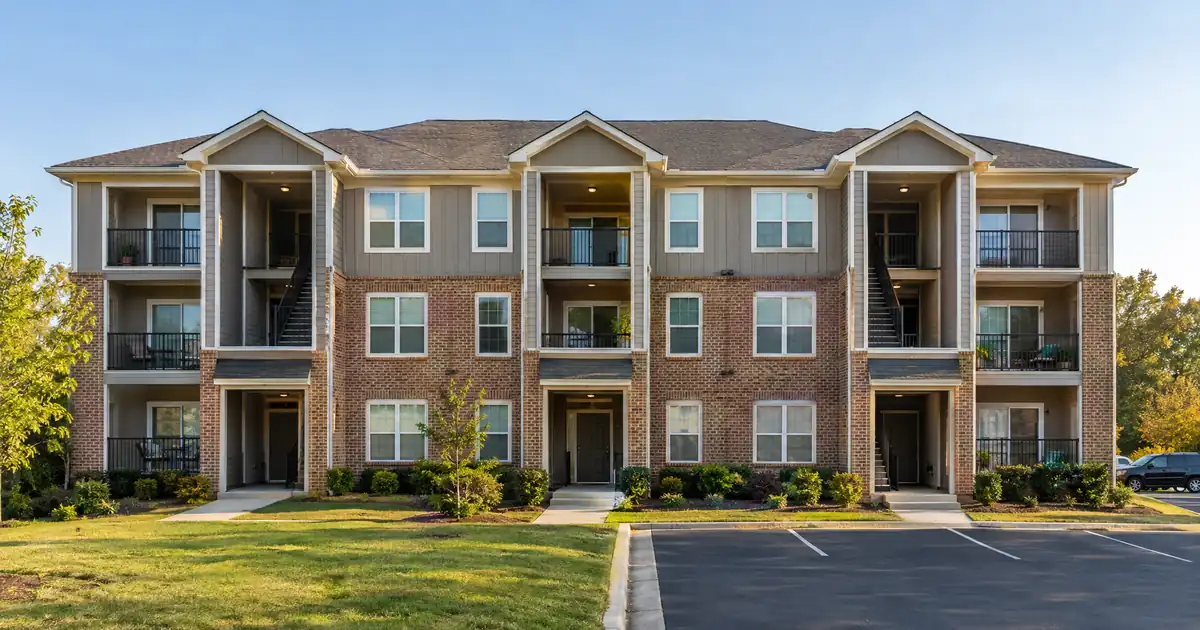
DSCR Portfolio Loan Blends Rent Across A Multi-Unit Short-Term Rental — The Quick Read: A DSCR portfolio loan adds up rent from every unit in a short-term rental property, then adds up rent from every other pledged property, and divides that combined total by the combined monthly debt service. One blended ratio decides the whole loan. A strong duplex can offset a soft single-family, but each property still gets checked on its own before the pool math happens.
That’s the short version. Now here’s how it actually gets built, where lenders draw hard lines, and where investors misread the math.
Short-Term Rental Calculator
Run the STR numbers in your market
Rate source: Freddie Mac 30-yr average via FRED® — Federal Reserve Bank of St. Louis · effective Sep 17, 2026
Prefilled with local estimates — enter your nightly rate, occupancy, taxes, and insurance for a more accurate picture.
Short-term rental income is documented with a 12-month history or a market data report. Program parameters update from Lendmire’s centralized guideline source.
As of Sep 17, 2026 · General Freddie Mac market benchmark, not a Lendmire loan offer. Nightly rate, occupancy, taxes, and insurance are editable estimates. Qualifying income for short-term rentals varies by program — some use appraisal market rent, others use documented STR history or projections — and is confirmed in underwriting. Not a Loan Estimate, approval, or commitment to lend. Program availability and eligibility are subject to lender guidelines, credit approval, property review, and underwriting.
What Does “Blending” Actually Mean Here?
Blending means the lender doesn’t score each property alone. It sums total rent across the whole pool, sums total housing payment across the whole pool, and divides once. That single number — not five separate numbers — decides whether the loan works.
Picture a four-unit short-term rental sitting inside a broader portfolio loan. Alongside it are two long-term single-family rentals. Instead of running three separate coverage checks, the lender does something different. They total every dollar of rent, combining STR and long-term income. Then they total every dollar of housing payment across all three properties. This gives one ratio and one yes-or-no answer. That’s the entire idea behind a blended, or “global,” debt-service coverage ratio (DSCR). This number shows whether a property’s rental income covers its housing payment.
The mechanic matters because it changes what “qualifying” even means. A single soft performer doesn’t automatically kill the file the way it would if underwritten alone.
How Does Rent Get Summed Inside a Multi-Unit STR Before It Ever Joins a Portfolio?
Rent gets built unit by unit first, then summed at the property level, before that property total ever joins a larger pool. A fourplex running as a short-term rental isn’t valued as one lump number from the start — each door gets its own income figure, and those figures get added together.
This two-layer structure trips people up. There’s blending within a multi-unit property (combining four doors into one property-level income figure), and there’s blending across a portfolio (combining multiple properties into one loan-level ratio). They’re related but distinct steps.
For the appraisal side, 2-4 unit properties commonly use the Fannie Mae Form 1025 small residential income property appraisal report structure. This isn’t because DSCR loans follow agency underwriting rules. It’s because this form is the industry-standard format for documenting rent unit by unit. Per that form, the appraiser must reconcile market rent for each individual unit before totaling the property. Barnes Walker’s legal glossary confirms this. The form documents current rents, market rents, and vacancy for each unit separately. It also gives more weight to the income approach than a typical single-family appraisal gets. The industry recognizes this form as the standard 2-4 unit income property report.
Here’s the catch on short-term rentals specifically: that long-term rent schedule wasn’t built for nightly income, and forcing seasonal, per-night numbers into a long-term rent form produces a misleading picture. Most non-QM programs handle it differently — with a dedicated short-term rental income analysis rather than the standard rent schedule.
How Do Lenders Source the STR Income Number Itself?
On a purchase with no operating history, projected income governs; on a refinance with a track record, actual receipts govern. These are two different documentation paths, and mixing them up is a common investor mistake.
For a purchase, most programs rely on a third-party market rent tool report. This report pulls a twelve-month forecast, checks occupancy assumptions, and compares the property against similar listings nearby. For a refinance, the property usually already has a rental history. In this case, lenders use actual trailing twelve-month income as the basis instead of a projection. This includes any zero-income months.
Across the wholesale network Lendmire works with, short-term rental qualifying income on files up to $2,000,000 runs off twelve months of documented operating history on a refinance, or the appraisal’s short-term-rent analysis on a purchase — calculated at 80% of gross income. That haircut exists because nightly income swings more than a signed annual lease, and lenders want a cushion built in before the ratio is even calculated.
Experience matters too. Most programs Lendmire places want to see the borrower has owned income property for at least twelve months somewhere in the last thirty-six — a first-time landlord jumping straight into a multi-unit STR file faces a different conversation than an investor with a track record.
The Math of Blending: Weak Property, Strong Property
Blending works because strong performers offset weak ones in the total — but every property still gets its own floor check first. A short-term rental clearing coverage well above 1.00 can carry a long-term rental sitting below breakeven, as long as the combined pool clears the lender’s overall bar.
Run it conceptually: Property A, a single-family long-term rental, runs coverage below 1.00 — rent alone doesn’t quite cover its payment. Property B, a duplex short-term rental in the same pool, runs coverage comfortably above 1.20. Add every dollar of rent together, add every dollar of payment together, and divide once. The blended ratio often lands in qualifying territory even though Property An alone would not.
That doesn’t mean weak properties get a free pass. Underwriters still look at each property individually first — condition, appraised value, occupancy history — before deciding whether the pool math should even be attempted. A property so weak it drags the whole blend below the lender’s floor gets flagged regardless of how strong everything else looks.
Coverage at or above 1.00 typically earns full leverage on most programs. Coverage between roughly 0.75 and 0.99 is a real path too, through select programs in Lendmire’s network, capped around $2,000,000 — but LTV and terms adjust when coverage runs below that 1.00 line, subject to underwriting. No-ratio options exist as well, generally requiring a longer clean housing history, though eligibility and terms are program-specific and never guaranteed by a single published floor.
Why Does a Single Vacant Door Matter Less on a Multi-Unit Property?
A vacancy on one unit inside a fourplex doesn’t zero out the file the way it would on a single-family rental. The remaining occupied units keep producing income, which is a structural cushion built into multi-unit properties before any portfolio-level blending even happens.
Compare the two situations. A vacant single-family rental produces no income until re-leased — its coverage effectively drops to zero for that stretch. A four-unit property losing one tenant still has three units generating rent, often nearly enough on their own to keep covering the payment, with reserves covering the gap. That’s a meaningful difference for investors weighing single-family scale-up against small multifamily.
We work with files across a wholesale network. A clear pattern shows up. Multi-unit deals with short-term rentals often look tight when they use long-term rent assumptions. But these same deals usually clear more easily once you document the trailing operating history. The stronger files typically run two scenarios side by side before submission: a projected scenario and an actual-history scenario.
Where Does This Break Down? The Edge Cases
Blending doesn’t rescue a property that legally can’t generate the income being claimed. If a specific unit or parcel isn’t permitted for nightly rental under local rules, that door’s income collapses to zero (or to long-term market rent) regardless of how well the rest of the pool performs.
This is the single biggest risk in multi-unit STR blending, and it’s parcel-specific, not city-wide. A city allowing short-term rentals generally doesn’t guarantee a specific address is zoned for it — HOA restrictions, overlay districts, and unit-level permits can all differ within the same block. Short-term rental rules can vary by city, county, HOA, and property type, so investors should confirm local rules for the exact address before relying on projected rental income. Municipal permission has to be documented for that specific property; it’s never assumed just because the surrounding market allows it.
Larger buildings hit a different wall entirely. Once a property crosses into five-plus units, it typically moves out of residential DSCR territory. Instead, it enters commercial multifamily underwriting. This is a separate category with its own appraisal standards and loan structure. The unit-count line matters more than most investors expect. Many investors mentally lump a fourplex and a small apartment building into the same financing bucket. But that’s not how lenders see it.
Here’s something worth knowing up front. Two lenders can review the identical short-term rental property and land on very different coverage numbers. Why? It comes down to how conservatively each lender discounts nightly income. This is exactly why you should shop your file across multiple programs. Don’t assume one quote reflects the whole market. This step matters more on STR-heavy portfolios than on plain long-term rental files.
What Should an Investor Actually Weigh Before Choosing a Blended Structure?
The upside is real: a blended structure lets a strong STR property carry a softer performer, often unlocking financing that wouldn’t clear property-by-property. The trade-off is equally real — cross-collateralization means every pledged property secures the same note, so trouble on one asset can put the rest of the pool at risk.
DSCR vs. conventional financing
Two common ways to finance an investment property in this market. They qualify you differently — here’s how investors weigh them.
Why investors choose it
- Qualifies on the property’s rental income — no personal tax returns, W-2s, or pay stubs needed to document income.
- No personal debt-to-income ceiling to clear, so existing mortgages and obligations don’t cap your borrowing the same way.
- Can be closed in an LLC, keeping the property inside a business entity.
- Built for scaling — not held to the limit on number of financed properties that conventional financing applies.
- Underwriting centers on the deal: generally qualifies when the rent covers the payment, a 1.00x coverage ratio being a common baseline (confirmed in underwriting).
- Designed specifically for investment property, including long-term and, where the program allows, short-term rentals.
Where it’s strong
- Often the lowest ongoing financing cost for a buyer who fully qualifies on personal income — a fit for a first property or a cost-first purchase.
Trade-offs for investors
- Requires full personal income documentation and must fit within a debt-to-income limit — salary, existing debts, and other mortgages all count.
- Typically held in your personal name rather than a business entity.
- Caps how many financed properties you can carry, which can become a ceiling as a portfolio grows.
- Evaluates you as a borrower as much as the property, which usually means more paperwork.
How investors usually choose: a first or single property often optimizes for the lowest financing cost; portfolio builders often optimize for leverage, vesting in an LLC, and scaling past conventional caps. The right answer depends on your goals, the property, and current guidelines — both paths run through select lenders in Lendmire’s wholesale network, with eligibility and terms confirmed in underwriting.
That trade-off shows up hardest at exit. Selling one property out of a blended pool typically triggers a release requirement rather than a clean, simple payoff — the remaining properties stay pledged and the loan gets restructured around what’s left. An investor who trades properties frequently may find separate, individual DSCR notes give more flexibility than one blended structure, even if the blended structure clears easier at closing.
For deeper detail on how STR income specifically interacts with entity-owned portfolios, Lendmire’s guide on short-term rental DSCR across an LLC portfolio walks through the entity-vesting side of this question. And for the difference between a property with a documented STR track record versus one that’s brand new to the platform, the operating vs. new-listing short-term rental comparison lays out how documentation requirements shift.
Key Terms Defined
DSCR (debt-service coverage ratio): a ratio comparing a property’s monthly rental income to its monthly housing payment — above 1.00 means rent covers the payment.
Blended (or global) DSCR: one combined ratio calculated by summing rent and summing payment across every property in a portfolio loan, rather than scoring each property separately.
PITIA: the full monthly housing obligation — principal, interest, taxes, insurance, and association dues where applicable — used as the denominator in a DSCR calculation.
Cross-collateralization: a structure where multiple properties all secure the same loan, meaning trouble on one property can affect the entire pool.
No-ratio loan: a program path where qualification doesn’t hinge on a published minimum coverage number, generally requiring a longer clean housing history and adjusted leverage.
DSCR loans are for business-purpose, non-owner-occupied investment properties. Lenders underwrite them as investor loans, not standard owner-occupied mortgages. This means they get reviewed differently. They’re also exempt from the disclosure timelines that apply to consumer mortgages. Want the full mechanics? Lendmire’s complete DSCR loans guide covers how coverage ratios, leverage, and documentation work together, starting from the basics.
Frequently Asked Questions
Can a single strong short-term rental carry a weaker long-term rental in the same portfolio loan? Yes, that’s the entire point of blending — total rent and total payment across the pool are summed and divided once, so a strong STR can offset a softer performer. Each property still gets individually reviewed first, and the lender may still flag a property so weak it drags the whole blend below the required threshold.
Does a short-term rental need a full year of history to qualify inside a portfolio loan?
On a refinance, yes — most programs in Lendmire’s network want twelve months of documented operating history at 80% of gross income. On a purchase with no track record yet, a market projection from the appraisal’s short-term-rent analysis typically substitutes, also calculated at 80% of gross.
What happens if one unit in a multi-unit STR isn’t legally permitted for nightly rental?
That unit’s projected income generally can’t be used, and the file falls back to whatever legal use the unit can support instead. Municipal and HOA permission has to be documented for the specific property — a city allowing short-term rentals broadly doesn’t guarantee a specific unit or address qualifies.
Is a blended portfolio DSCR loan always the better structure than separate individual loans? Not always — blending can unlock financing a weak property couldn’t get alone, but it also cross-collateralizes every pledged property against one note. Investors who plan to sell or trade properties frequently often find separate loans give cleaner exits, since a blended pool typically requires a release structure rather than a simple single-property payoff.
Do all lenders discount short-term rental income the same way?
No — discounting methodology, seasonality treatment, and documentation standards vary meaningfully between programs, so two lenders can produce noticeably different coverage numbers on the identical property. That’s a strong reason to compare multiple programs on a STR-heavy file rather than assume one quote reflects the whole market.
Are you trying to decide if a multi-unit short-term rental fits inside a blended portfolio structure? Or does it work better financed on its own? Lendmire can help you compare DSCR loan options. We look at the property’s documented income, credit profile, leverage, and your overall investor goals.
For current guidelines and terms, see Lendmire’s super jumbo DSCR loan programs page.
Self-employed borrowers can compare both super jumbo programs on Lendmire’s self-employed mortgages page.
About Lendmire
A DSCR-focused mortgage broker, Lendmire (NMLS# 2371349) places investor financing across 40 markets — 39 states plus Washington, D.C. — with DSCR eligibility generally reviewed by the lender on property cash flow instead of tax returns, subject to lender guidelines. Scotsman Guide named Lendmire a Top Mortgage Workplace in 2025 and 2026.
Investors focused on short-term rentals can review DSCR loans for Airbnb and short-term rentals.
Lendmire’s Top Mortgage Workplace recognition is documented by Scotsman Guide 2025 Top Mortgage Workplace and Scotsman Guide 2026 Top Mortgage Workplace.
Get Started
Ready to find the right loan for you?
In about 30 seconds you can review financing options available for your home or investment property. No commitment required.
Informational only. Not a Loan Estimate, approval, or commitment to lend. Program availability and eligibility are subject to lender guidelines, credit approval, property review, and underwriting.
References
1. Fannie Mae Form 1025 (official PDF)
2. Barnes Walker Legal Glossary — Form 1025
3. Appraisal Colorado — Form 1025 explainer
Brandon Miller
Founder & CEO, Mortgage Loan Originator, Lendmire LLC
- Mortgage Loan Originator · NMLS# 1129696 · Verify on NMLS Consumer Access
- North Carolina Real Estate Broker · License# 343312 · Verify on NCREC
- North Carolina Insurance Producer · License# 19053198 · Property, Casualty, Life, Health · Verify on NAIC SBS
- Lendmire LLC · Firm NMLS# 2371349 · Verify firm licensure
Disclosure information. Lendmire is a state-licensed mortgage brokerage under NMLS# 2371349. Lendmire is not a depository institution, direct lender, or financial advisor — all loans referenced are placed through wholesale lender partners and are subject to each lender's underwriting standards. This article is provided for general informational purposes and is not a commitment to lend, nor does it constitute financial, legal, or tax advice. Loan programs, terms, rates, and qualification standards change without notice and depend on borrower profile, property type, and the state in which the subject property is located. Equal Housing Opportunity provider. NMLS Consumer Access: nmlsconsumeraccess.org.


