
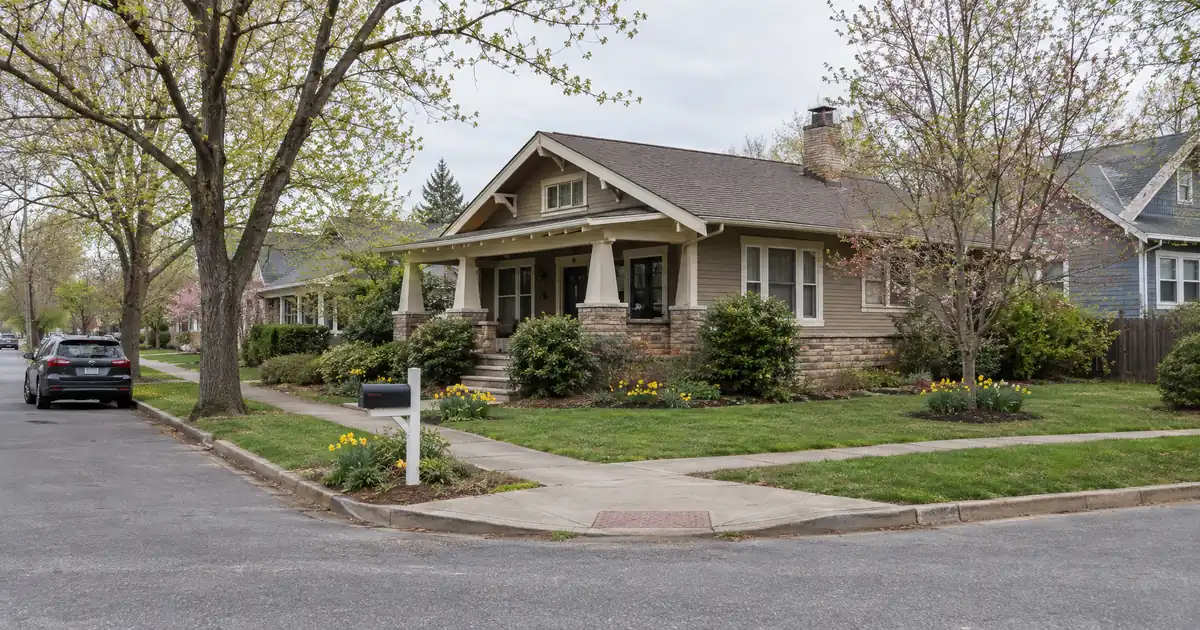
The Quick Read: Usually yes, as long as the pool as a whole still clears its coverage test and the vacant house is physically ready to rent. The appraiser’s market-rent opinion stands in for the missing lease, and the pooled ratio absorbs that house alongside the others. “Pool” here means a loan pool, not a swimming pool.
- The vacant house is credited at appraiser-supported market rent, not at a lease and not automatically at zero.
- Coverage on a portfolio loan is measured on the pool: total rent against total PITIA.
- Each house still gets its own condition, value and rent-readiness review.
- A house under rehab is a different problem from a house between tenants.
- Clearing the ratio does not mean the pool makes money.
Lendmire is a broker. It arranges these loans through select lenders in its wholesale network, and every file is underwritten individually, subject to lender guidelines. This article covers the mechanics, the edge cases, and the decision a pool owner actually faces.
What Is a DSCR Portfolio Pool?
A portfolio DSCR loan puts several rentals under one note. Every property secures the whole balance, which is cross-collateralization. A default on the note reaches every house in the pool. Corporate Finance Institute describes cross-collateralization and cross-default as the general concept.
Two words get mixed up. “Portfolio” can mean a bank keeps loans on its own books. “Blanket” means one note on several properties. This article is about the second: several rentals, one loan.
Across the wholesale network, the main structure is a 30-year portfolio loan with 2 to 20 properties under one note. Loan sizes typically run from $300,000 to $5,000,000, with larger balances on review. Leverage goes up to 80% of value on a purchase or rate-and-term refinance. The coverage floor of 1.00 is measured on the pool, so stronger houses can offset weaker ones. Property types include single-family, 2-4 unit, condo and townhome. Interest-only periods are available.
A second structure is a rental portfolio term loan for five or more rental properties or units. Loan sizes typically run from $500,000 to $50,000,000, with leverage up to 75% of value. Terms are fixed at 3, 5, 7 or 10 years with a balloon at maturity. Some of these loans are non-recourse, with carve-outs such as fraud and bankruptcy. Others are recourse and carry a personal guarantee. Reserves are held for taxes, insurance and capital expenditures.
The loan sizes and leverage limits above are ceilings and floors, not quotes. A single-property DSCR loan on one rental is a different product with different limits. For the full picture of how DSCR files work, Lendmire’s complete DSCR loans guide covers it.
How Is a Vacant House Counted?
A vacant house is counted at the appraiser’s market-rent opinion. It is not counted at a lease, because there is none, and it is not simply zeroed out. Every property in the pool still needs either a lease or appraiser-supported market rent.
The tool is the rent schedule. The appraiser comments on rent ranges, vacancy and trend, then lands on one reconciled monthly figure, as shown on Fannie Mae’s copy of Form 1007. DSCR programs borrow the form. They are not agency products, and the agencies do not set DSCR rules.
Here is how it runs on a file:
1. Each house is appraised. Single-family and condo get the 1007 rent schedule. A 2-4 unit property gets the 1025 report with unit-level rents. HUD Mortgagee Letter 2023-17 names the same pairing for proposed rent on FHA files. That is an FHA rule, useful here only as an analogy for how a missing tenant gets replaced by an appraisal.
2. Each house gets a rent credit. A vacant house is credited at market rent. A leased house is typically credited at the lower of the lease and market rent, though programs vary. An above-market lease should not be assumed to count in full.
3. The pool ratio is built. Total credited rent across the pool, divided by total PITIA across the pool. PITIA is principal, interest, taxes, insurance and association dues.
4. Property-level checks still run. Condition, value and rent-readiness are reviewed house by house. Some programs also test individual ratios in addition to the pooled one. Ask which test applies before the file goes in.
5. Evidence is assembled. For the vacant house that means the appraisal with the rent schedule, listing history, photos and rent comps. For leased houses, the leases. For all of them, the insurance, tax and HOA statements that build PITIA.
One side note. A vacancy factor is a haircut some programs apply to rent even on fully leased properties. A vacant house is a specific property with no tenant today. Different things, and they get confused on files.
How Much Does One Empty House Move the Pool?
The same house moves a small pool far more than a large one. This is arithmetic, so it shows in ratios only. Assume a pool where every house carries an equal share of the payment and rents cover the payment at about 1.25x.
| Pool size | Vacant house at zero rent | Vacant house at market rent |
|---|---|---|
| 3 houses | Pool drops to about 0.83x | Pool holds near 1.25x |
| 5 houses | Pool drops to about 1.00x | Pool holds near 1.25x |
| 10 houses | Pool drops to about 1.13x | Pool holds near 1.25x |
| 20 houses | Pool drops to about 1.19x | Pool holds near 1.25x |
These are modeled assumptions, not market data. They show the shape. Counted at zero, one empty house in a three-house pool takes a comfortable file below 1.00. In a twenty-house pool it barely registers.
The market-rent column is the point. When the appraiser supports market rent on the vacant house, the pool looks much like it would with a tenant. That is why vacancy at application is often survivable. It also shows what to watch: if the vacant house is rehab-grade and not rent-ready, the appraiser may not support a rent figure at all, and the zero-rent column becomes the real scenario.
A weak house matters mainly because it is a thin contributor. A house whose own rent covers only a small share of its payment can sit in the pool, but underwriting tests the pooled coverage, the leverage and the terms. Strong houses carry it only to a point.
Pooled Test or Per-Property Test?
Portfolio loans are measured on the pool, but some programs add property-level review. Know which one governs before you assemble the pool.
| Question | Pooled test | Per-property test |
|---|---|---|
| What is measured | Total rent against total PITIA | Each house’s rent against its own PITIA |
| Can strong houses offset weak ones | Yes | No |
| Effect of one vacant house | Diluted by the pool | Tested alone |
| Where it shows up | Portfolio loan structures | Separate loans, or some programs as an added check |
The pooled test is the reason investors choose a portfolio structure at all. Even so, “pooled” does not mean “the weak house doesn’t matter.” Condition and value reviews, release terms and cross-default all still apply to that house.
Vacant and Rent-Ready, or Vacant and Under Rehab?
Rehab scope matters more than vacancy. A house between tenants, clean and insurable, is routine. A house with open permits, missing systems or unfinished work is a different file.
| Condition | How it usually reads |
|---|---|
| Between tenants, rent-ready | Market rent from the appraiser; normal review |
| Light cosmetic work pending | May be supportable; appraisal may be subject to completion |
| Active rehab or unfinished work | Rent often unsupported; cure first or carve out |
| Uninsurable or legal-occupancy problem | Fix before it goes in the pool |
Some lenders also add a lease requirement before or after closing on a vacant house. That is program-dependent, so confirm it early. Investors in a heavy rehab often use bridge financing first, finish the work, then move into DSCR investor loans.
Short-term-rental houses carry one more trap. The 1007 measures monthly long-term market rent. It is not built for nightly-rate projections, and Fannie Mae’s appraiser guidance has a section on how the form treats short-term rentals. A house that cash flows on Airbnb income may look thin on a long-term rent schedule, and that gap can pull down the pooled ratio.
Keep It In, Cure It, Carve It Out, or Split the Pool
Four moves cover most vacancy problems. Which one fits depends on the house and the pool.
| Situation | Usual move |
|---|---|
| Rent-ready vacancy, pool clears with room | Keep it in |
| Vacancy ends soon with a tenant ready to sign | Lease it before the appraisal |
| Light work stands between the house and rent-ready | Finish the work, then include it |
| Rehab-grade house dragging the pool | Carve it out |
| Pool is small and one house keeps tripping it | Split into separate loans |
Keep it in. The pool clears the 1.00 floor on market rent and the house passes condition review. Nothing to fix.
Cure it. Signing a lease before the appraisal gives the file a document instead of an opinion. Finishing the work removes the rent-readiness question. Either costs time, so it only fits if the timing works on your end.
Carve it out. Pull the house and finance it separately, or later. The pool stays clean. The cost is that the carved-out house needs its own financing.
Split the pool. Separate loans mean each house must qualify alone, but a vacant house cannot drag down the others. The trade is giving up pooled coverage. Investors who got burned on a large blanket sometimes prefer two or three smaller loans.
Thinking it through: carving out is usually cleaner than keeping a rehab-grade house in a small pool. In a pool of ten or more with a rent-ready vacancy, keeping it in is usually fine. The middle cases are real judgment calls.
What Happens After Closing?
Underwriting-time credit and post-closing performance are two separate timelines. A vacant house credited at market rent at application is one thing. A house that goes vacant eighteen months in is another, and it tests cash management, not the original ratio.
Cross-default is the main exposure. If cash flow tightens, a blanket note can put every house at risk, not just the one that went empty. That is the cost of the structure, and it is why reserves and a cushion in the coverage number matter.
Releases deserve attention before closing. Partial releases, substitutions and the sale of one property out of the pool follow the loan documents and the lender’s release terms. The release price runs above the property’s allocated balance, and the remaining pool must still cover its debt service. A weak or vacant house left behind can complicate selling the strong ones, because the remaining pool may be re-tested. Read the release language before you sign, not when you want to sell.
On the rental portfolio term loan, prepayment is typically yield maintenance, and that interacts with releases too. Selling one house early is not free.
Passing the Ratio Is Not Making Money
DSCR compares rent to PITIA. That is all. Repairs, vacancy, management, utilities and capex sit outside the calculation, so a pool can clear 1.00 and still lose money in a vacant month.
For a vacant house, the carrying costs keep running with no rent against them. A pool that clears at 1.05 with a house in rehab has almost no room for a surprise. Reserves are the cushion, and they vary by lender, leverage, loan size and transaction type. Around 6 months of PITIA is common, stepping up to about 9 months above $1,500,000. Those are typical ranges, subject to lender guidelines.
A larger down payment lowers the payment and can lift the ratio. It does not erase leverage caps, credit floors, reserve rules or property eligibility. The strongest files clear both tests: enough equity and enough rental coverage.
Stress-Test the Pool Before You Bundle
Run four scenarios on the pool before it goes to a lender:
1. One vacancy at market rent. Does the pool stay at or above 1.00?
2. One vacancy at zero. What does the pool fall to if the appraiser will not support rent?
3. Two vacancies together. Turnover clusters. Two empty houses at once is realistic.
4. A rent dip plus a repair month. Coverage can hold while cash flow does not.
If scenario two breaks the pool, that house is a carve-out candidate or a cure candidate. If scenario three breaks it, the pool is too small or too thin for its own turnover.
Common Mistakes
- Assuming a vacant house is counted at zero, or assuming it is counted at full market rent with no appraisal support.
- Expecting an above-market lease to be credited in full.
- Leaving a rehab-grade house in a small pool and hoping the ratio absorbs it.
- Reading “pooled coverage” as “the weak house doesn’t matter.”
- Ignoring release terms until it is time to sell.
- Treating a 1.00 pool as positive cash flow.
- Bundling houses with different insurance and HOA situations without checking PITIA for each.
Documents to Assemble Before Applying
- Appraisal with rent schedule for each house: 1007 for single-family and condo, 1025 for 2-4 unit.
- Leases for occupied houses.
- For vacant houses: listing history, photos, rent comps and a note on rent-readiness.
- Insurance, tax and HOA statements for every house.
- Entity documents if the properties are held in an LLC. A special-purpose entity is required on some structures, per lender program requirements.
- A schedule of the properties with the numbers lined up.
Ineligible in the pool are owner-occupied property, co-ops, mixed-use and commercial property. Manufactured and mobile homes are not reviewable on these programs. Log homes and barndominiums are not offered through the network’s DSCR programs. A credit floor of 640 applies on the pool, with 680 or 720 on some structures.
Key Terms Defined
- Blanket loan: One note secured by several properties.
- Cross-collateralization: Each property secures the whole balance, not just its own share.
- Pooled DSCR: Total rent across the pool divided by total PITIA across the pool.
- PITIA: Principal, interest, taxes, insurance and association dues.
- Form 1007: The appraiser’s rent schedule for a single-family or condo investment property.
- Release price: What it costs to pull one property out of the pool, which runs above its allocated balance.
Frequently Asked Questions
Does one vacant house disqualify a portfolio DSCR loan?
Not by itself. A vacant house is credited at appraiser-supported market rent, so the pool can still clear its coverage floor. The risk rises in small pools and when the house is not rent-ready. Qualification stays subject to lender guidelines, credit approval and property review.
Is a vacant house’s income counted as zero?
Usually not. Market rent from the appraisal stands in for the missing lease. If the appraiser cannot support a rent figure, as with an unfinished rehab, the house may be counted at zero or removed from the pool. That is why condition matters more than the empty status.
Do I need a lease on the vacant house?
Many programs do not require one at application, since market rent substitutes. Some add a lease condition before or after closing, so confirm it with the lender early. For occupied houses, the lease is typically compared with market rent and the lower figure used.
Can I sell a vacant house out of the pool later?
Yes, under the loan’s release terms. The release price runs above the property’s allocated balance, and the remaining pool must still cover its debt service, so the lender may re-test. Read partial-release and substitution language before closing.
Does passing the pool test mean the portfolio cash flows?
No. The test compares rent to PITIA only. Repairs, vacancy, management, utilities and capex are outside it, so a pool at 1.05 can still run negative in a vacant month.
Next Step
If you are buying or refinancing a rental property and want to see how the numbers work, Lendmire can help you compare DSCR loan options based on the property income, credit profile, leverage, and investor goals. Reach the team at 828-256-2183 or request a quote. Lendmire’s piece How to Qualify Vacant LLC Doors for a DSCR Portfolio Cash-Out goes deeper on an adjacent question.
Tax treatment varies; consult a qualified professional.
About Lendmire
Lendmire is a non-QM mortgage brokerage (NMLS# 2371349) arranging DSCR investor loans in 41 markets, including Washington, D.C., through wholesale and investor-lending channels. DSCR loans are evaluated by the lender on rental income rather than personal income, subject to lender guidelines, which can make them a fit for LLC-owned portfolios, self-employed investors, and operators scaling beyond conventional loan caps. Recognized as a Scotsman Guide Top Mortgage Workplace in 2025 and 2026.
Get Started
Ready to find the right loan for you?
In about 30 seconds you can review financing options available for your investment property. No commitment required.
Informational only. Not a Loan Estimate, approval, or commitment to lend. Program availability and eligibility are subject to lender guidelines, credit approval, property review, and underwriting.
References
1. Corporate Finance Institute: Cross Collateralization
2. Fannie Mae Form 1007 (display copy)
3. HUD Mortgagee Letter 2023-17
This article is part of Lendmire’s DSCR loan program — full qualification details, guidelines, and scenarios live on the program page.
Related reading: Can an Investor With 10+ Doors in LLCs Get a DSCR Portfolio Loan? · How to Prepare Guarantor Credit for a Portfolio DSCR Loan · Whole-Portfolio Sale vs Selling House by House on a DSCR Portfolio Loan
Brandon Miller
Founder & CEO, Mortgage Loan Originator, Lendmire LLC
- Mortgage Loan Originator · NMLS# 1129696 · Verify on NMLS Consumer Access
- North Carolina Real Estate Broker · License# 343312 · Verify on NCREC
- North Carolina Insurance Producer · License# 19053198 · Property, Casualty, Life, Health · Verify on NAIC SBS
- Lendmire LLC · Firm NMLS# 2371349 · Verify firm licensure
Important disclosures. Lendmire (NMLS# 2371349) is a licensed mortgage brokerage. Lendmire is not a direct lender, depository institution, or financial advisor. All loan inquiries are subject to lender underwriting; this article does not constitute a commitment to lend. Rates, terms, and program guidelines are subject to change without notice and vary by borrower profile, property type, and state. Information in this article is general in nature and is not financial, legal, or tax advice. Equal Housing Opportunity. NMLS Consumer Access: nmlsconsumeraccess.org.