
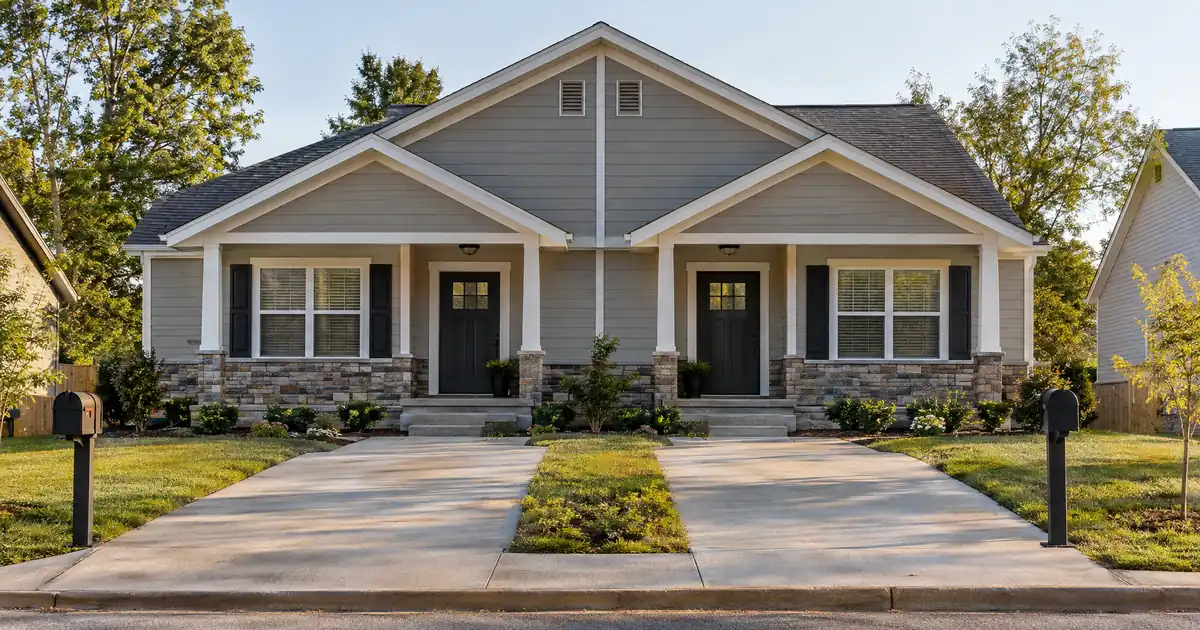
The Quick Read: For ten new duplexes, a construction loan generally pays for the build, and a DSCR loan generally replaces it once each building is finished, appraised, and rentable, so most investors use the two in sequence rather than choosing one. The two loans answer different questions. Construction lenders ask whether the project will get built. A DSCR lender asks whether the finished property’s rent covers its own payment.
- A DSCR loan is reviewed primarily on property-level rental income covering the payment, subject to lender guidelines. It generally needs a finished building to evaluate.
- A construction loan funds work in stages and is judged on the project, the budget, the builder, and you.
- Ten duplexes means twenty units. The hard part is sequencing the exits, not picking a product.
- Clearing a DSCR test does not make a building cash-flow positive. It only compares rent to the housing payment.
- The strongest plans test the take-out before the first shovel hits the ground.
The Honest Answer on Who Each Loan Is For
A construction loan is for the investor who owns the land (or is buying it) and needs money to build. It suits someone with a builder, a budget, a draw schedule, and the liquidity to carry the project. The loan is short-term by design, and it ends when you repay it or convert it.
DSCR Calculator
Run the numbers in your market
Rate source: Freddie Mac 30-yr average via FRED® — Federal Reserve Bank of St. Louis · effective Oct 15, 2026
Prefilled with starting assumptions — enter your own rent or nightly figures, taxes, insurance, and HOA for a more accurate picture.
Program parameters update from Lendmire’s centralized guideline source. Taxes and insurance are editable estimates.
As of Oct 15, 2026 · General Freddie Mac market benchmark, not a Lendmire loan offer. Rent, nightly rate, occupancy, taxes, and insurance are editable estimates. Short-term rental figures are estimates only and vary significantly by season, property type, management approach, and local short-term-rental rules — confirm local regulations before relying on them. Qualifying income for short-term rentals varies by program — some use appraisal market rent, others use documented STR history or projections — and is confirmed in underwriting. Not a Loan Estimate, approval, or commitment to lend. Program availability and eligibility are subject to lender guidelines, credit approval, property review, and underwriting.
A DSCR loan is for the investor who has a finished, rentable building and wants long-term financing against its income. It suits someone who wants the property to carry the file rather than a personal income stack. Lendmire is a broker that arranges these loans through a wholesale network of DSCR lenders. The complete DSCR loans guide covers the basics if the term is new to you.
So the real question for a ten-duplex program is not which loan wins. It is which loan covers which stage, and whether the second one will be there when the first one comes due.
Side-by-Side
The DSCR column reflects how programs in Lendmire’s wholesale network typically work. The construction column shows published industry norms, which vary by lender.
| Factor | Construction loan (industry norms) | DSCR loan (network guidelines) |
|---|---|---|
| Stage financed | Land and a partly built project | Finished, rentable property |
| Review basis | Project plus sponsor strength | Property rent versus the monthly payment |
| Documentation | Plans, budget, builder credentials, sponsor financials | Appraisal with market rent, credit, assets |
| Property types | Ground-up and major renovation | 1-4 unit rentals, including duplexes |
| Entity vesting | Often an entity with sponsor guarantees | Often an LLC, with guarantees common |
| Funding pattern | Staged draws after inspections | One funding at closing |
| Timeline shape | Runs on the build schedule | Tied to completion and appraisal |
| Reserves | Liquidity reviewed, varies widely | Commonly about 6 months of PITIA |
| Main risk | Delays, overruns, a thin exit | Coverage or value coming in short |
PITIA stands for principal, interest, taxes, insurance, and association dues. It is the full monthly housing obligation that rent is measured against.
Key Terms Defined
DSCR (debt service coverage ratio): monthly rent divided by the full monthly housing payment. A result of 1.00 means rent equals the payment.
Take-out loan: the permanent loan that pays off a short-term construction loan.
Draw: a release of construction funds after a milestone like framing or rough-ins, usually after an inspection.
Certificate of occupancy: the local sign-off that a building is complete enough to be lived in.
Lease-up: the stretch between completion and stable occupancy, when units are being rented for the first time.
Seasoning: a waiting period a lender wants between an event, like completion or purchase, and a refinance.
Cross-collateralization: pledging several properties against one loan, so each building backs the whole debt.
Can a DSCR Loan Fund the Build Itself?
Generally, no. A DSCR loan measures rent against a payment, and an unbuilt lot has no rent. There is no finished building to appraise, no lease, and no proof the project will be completed on budget.
Some brokers advertise combined build-and-hold products, and a few programs exist for ground-up work. They are unusual, they vary by program, and most single-close construction-to-permanent loans are written for owner-occupied single-unit homes. A ten-duplex investor build rarely fits that mold. Plan on two financing events: a construction loan, then a DSCR take-out.
When a Construction Loan Is the Better Fit
A construction loan is the right tool whenever the building does not exist yet. That is the plain answer, and it covers most of the build phase of a ten-duplex program. A few situations make it especially clear.
You are starting from land. Nothing else on this page can pay for foundations and framing. A construction lender reviews plans, the budget, the schedule, and the builder’s licenses. It usually orders an appraisal of the estimated completed value.
You want funding that follows the work. Draws release money at milestones, and interest is typically charged only on what has been drawn. That structure matches how a build actually spends money.
You have the liquidity and experience to carry a project. For a ten-duplex build, expect heavier review of your track record and cash than a single-home buyer would see. Construction lenders carry the completion risk, so they study the sponsor closely.
The tradeoff is that the loan runs on a clock. If the build slips or the exit looks thin, the maturity date does not move to match. Construction financing also generally asks you to bring more of your own equity than a stabilized rental purchase does.
When a DSCR Loan Is the Better Fit
A DSCR loan is the right tool once a building is finished and rentable. It is built for the take-out, and it is where most ground-up rental builders end up.
You want the property to carry the file. The loan is reviewed primarily on the rent covering the payment. Your personal income is not the main test, though credit and assets still matter.
You want long-term, amortizing financing. The spine of the network is the 30-year fixed. Select lenders add extended terms and interest-only periods, and ARM structures exist for investors who want them.
You are sizing a portfolio exit. Standard programs run up to $3,000,000 per loan. Above $2,500,000, the network generally holds to 30-year fixed structures. A pooled take-out across several buildings can add up quickly, so loan size is the lever to watch, not unit count. Duplexes stay in the residential 1-4 unit category.
Here is what typical files look like on an investment-property purchase. Most land at 75%-80% LTV, meaning loan-to-value, the loan as a share of the property’s value. Select high-leverage programs reach 85% LTV with roughly a 700+ credit score. On an investment-property cash-out refinance, most of the network tops out around 75% LTV, and about 6 months of seasoning is the common expectation. Credit floors start at 620 in parts of the network, most programs want around 660, and 700+ unlocks the strongest leverage tiers.
Coverage matters too. 1.00 is where many select programs start, and stronger ratios open better leverage and pricing. A separate select-lender path takes coverage below 1.00, with leverage and terms adjusted.
A larger down payment can lift the ratio. It does not erase leverage caps, credit floors, reserve rules, or property eligibility. The strongest files clear both tests: enough equity and enough rental coverage.
Business-purpose status also matters here. DSCR loans are designed for non-owner-occupied investment properties. Because they are business-purpose investor loans, they are reviewed differently from a standard owner-occupied mortgage, and the federal CFPB rule on exempt transactions turns on that loan purpose. Keep the file genuinely business-purpose.
How a Never-Leased Duplex Gets Its Rent Number
A brand-new building has no lease history, so the rent figure usually comes from the appraiser’s market-rent opinion. Duplexes are typically appraised on the form for two-to-four-unit properties, which includes rental comparables and a rent analysis. Fannie Mae’s appraisal form guidance names that form as Form 1025 and the single-family rent schedule as Form 1007. These are appraisal-form names only. DSCR loans are not agency products.
Depending on the program, a signed lease may also count. That matters when lease-up starts early. Lendmire’s piece Projected Income vs Booking History for a New Construction DSCR Loan shows how lenders treat income on a property with no track record.
Remember what the ratio measures. DSCR compares rent to PITIA only. Clearing 1.00 is not positive cash flow, because repairs, vacancy, management, utilities, and capital expenses sit outside the calculation. A thin ratio on a new build leaves little room for a slow lease-up.
DSCR vs. conventional financing
There are two common ways to finance an investment property, and they qualify you differently — here’s how investors weigh them.
Why investors choose it
- Qualifies on the property’s rental income — no personal tax returns, W-2s, or pay stubs needed to document income.
- No personal debt-to-income ceiling to clear, so existing mortgages and obligations don’t cap your borrowing the same way.
- Can be closed in an LLC, keeping the property inside a business entity.
- Built for scaling — not held to the limit on number of financed properties that conventional financing applies.
- Underwriting centers on the deal: generally qualifies when the rent covers the payment, a 1.00x coverage ratio being a common baseline (confirmed in underwriting).
- Designed specifically for investment property, including long-term and, where the program allows, short-term rentals.
Where it’s strong
- Often the lowest ongoing financing cost for a buyer who fully qualifies on personal income — a fit for a first property or a cost-first purchase.
Trade-offs for investors
- Requires full personal income documentation and must fit within a debt-to-income limit — salary, existing debts, and other mortgages all count.
- Typically held in your personal name rather than a business entity.
- Caps how many financed properties you can carry, which can become a ceiling as a portfolio grows.
- Evaluates you as a borrower as much as the property, which usually means more paperwork.
How investors usually choose: a first or single property often optimizes for the lowest financing cost; portfolio builders often optimize for leverage, vesting in an LLC, and scaling past conventional caps. The right answer depends on your goals, the property, and current guidelines — both paths run through select lenders in Lendmire’s wholesale network, with eligibility and terms confirmed in underwriting.
Ten Duplexes Is a Sequencing Problem
Ten buildings will not finish on the same day. Each one gets its own certificate of occupancy, its own appraisal, and its own rent opinion. That creates real choices, and each one carries a tradeoff.
Wait and close once. You finish all ten, lease them up, and take out the whole program together. This is simple on paper. The cost is carrying construction financing on finished buildings while you wait for the last one.
Take out in tranches. You refinance early finishers while later buildings remain on construction financing. This cuts carry on the early buildings. It also means several underwriting events, with each take-out dependent on the one before it.
Pool or go building by building. A pooled loan puts several duplexes under one note. Pooled structures generally come with release terms, and the newest building often sets the pace on seasoning. Per-building loans keep each property separate, so one weak building does not drag the others. Pooling can simplify paperwork, but it ties the buildings’ fates together.
Run the coverage math both ways before you commit. Say nine buildings clear about 1.25x and one lands near 0.90x. If the payments are similar, the pool blends to roughly 1.2x and the weak building hides inside the group. Taken alone, that tenth building might need a different path. A select-lender path below 1.00 exists, with leverage and terms adjusted, but you should plan around the standard path first.
Entity structure is part of the same decision. One LLC across ten buildings is simpler. Several LLCs separate the risk, which can help if one building runs into trouble. Loans to LLC-titled borrowers are available subject to lender program eligibility, and personal guarantees are common, so the entity does not remove your exposure.
What Can Go Wrong, and What to Do About It
Here is the practitioner pattern. On new-construction files, the take-out usually wobbles in one of three places: the rent opinion, the appraised value, or the seasoning clock. Brokers watch for these because the construction loan does not wait while you sort them out.
Coverage lands thin. Rent comes in below your assumption. Options include a larger down payment at take-out, which can lift the ratio, or a select-lender path below 1.00 with adjusted leverage and terms. Another option is to sell one building and pay down the balance.
Lease-up drags. Twenty units entering one market at once can slow absorption. Phasing the buildings gives each tranche room to lease before the next one lands. Be careful about aggressive coverage assumptions when early occupancy is low.
Construction runs long. Delays eat the maturity date. Ask your construction lender about extension terms before you sign, not after the budget slips. A short bridge loan is sometimes the stopgap.
Value comes in under the loan. The take-out is sized on appraised value and credit as well as coverage. A cash-out take-out tops out around 75% LTV on most files, while a rate-and-term payoff of the construction balance generally asks for less seasoning than cash-out. Seasoning is measured differently by program. Some count from title, some from the certificate of occupancy, and some from the first lease.
Two smaller items trip people up. DSCR loans often carry prepayment penalties, so ask before planning an early refinance. Insurance also changes hands, as builder’s risk coverage ends and permanent coverage has to be in place for the take-out.
Where Most Investors Get It Wrong
A common mistake is treating the DSCR loan as an afterthought. They line up the construction loan, break ground, and only then start asking what the permanent lender will want. Then a building completes with a rent opinion that does not clear the coverage they assumed.
Run the take-out first. Model the coverage on conservative market rent, check your credit against the tiers above, and confirm you will have reserves. Commonly that means around 6 months of PITIA, though reserves vary by lender, leverage, loan size, and transaction type, and loans above $1,500,000 typically step up to about 9 months. A quick pre-build checklist helps:
- Rent assumptions tested at conservative market levels.
- A target LTV and the equity to meet it.
- Credit and liquidity reviewed against the tiers above.
- An entity plan and a pooled-versus-individual decision.
- Insurance and title handoffs mapped from the build to the permanent loan.
The Verdict
Choose a construction loan first if the buildings do not exist yet. Choose a DSCR loan if they do and are ready to rent. For ten new duplexes you will almost certainly need both, and the plan that works is the one where the second loan is tested before the first is signed.
The construction loan carries the completion risk, so it is judged on the builder, the budget, and you. The DSCR loan carries the income risk, so it is judged on rent, value, credit, and reserves. Neither replaces the other, and neither is a shortcut. Programs change, and every file is underwritten individually, so qualification stays subject to lender guidelines and credit approval.
Frequently Asked Questions
Can a DSCR loan pay for the construction of the duplexes?
Generally not. A DSCR loan needs a finished property with rent to measure, and a vacant lot has none. A few brokers advertise combined products, but they are program-specific and unusual. Most investors build on a construction loan and refinance into DSCR financing after completion.
Do I need to finish all ten duplexes before I can get a DSCR loan?
No. Each building has its own completion and rent opinion, so you can take out finished buildings individually or in a group. Pooled structures often let the newest building set the seasoning pace, so the tradeoff is flexibility versus simplicity.
Does the construction lender care about my DSCR plan?
Yes, because the construction loan matures on a clock and the take-out is usually how it gets repaid. A credible exit plan makes the project easier to underwrite. Coverage tested on conservative market rent is a good starting point.
What happens if one duplex does not clear the coverage I need?
You have options. A larger down payment can lift the ratio, a select-lender path below 1.00 exists with leverage and terms adjusted, or you can sell the building. Within a pool, strong buildings can offset a weak one, though that depends on how the lender sizes the loan.
Can I use one LLC for all ten duplexes?
Often yes, subject to lender program eligibility. One entity is simpler, while several entities separate risk. Personal guarantees are common either way, so structure the entity for administration and liability rather than to avoid exposure.
Next Step
If you are buying or refinancing a rental property and want to see how the numbers work, Lendmire can help you compare DSCR loan options based on the property income, credit profile, leverage, and investor goals. Programs are arranged through select lenders in a wholesale network covering 41 markets, including Washington, D.C. Nothing here is a commitment to lend.
About Lendmire
Lendmire is a DSCR-focused mortgage brokerage, NMLS# 2371349, placing investor loans across 41 markets, including Washington, D.C. DSCR eligibility is generally reviewed by the lender around a property’s rental income rather than personal income documentation, which fits LLC-held rentals, self-employed investors, and portfolios scaling past conventional financed-property limits. Scotsman Guide named Lendmire a Top Mortgage Workplace in both 2025 and 2026.
Get Started
Ready to find the right loan for you?
In about 30 seconds you can review financing options available for your investment property. No commitment required.
Informational only. Not a Loan Estimate, approval, or commitment to lend. Program availability and eligibility are subject to lender guidelines, credit approval, property review, and underwriting.
References
1. CFPB – 12 CFR 1026.3 Exempt transactions
2. Fannie Mae’s appraisal form guidance
This article is part of Lendmire’s DSCR loan program — full qualification details, guidelines, and scenarios live on the program page.
Related reading: Can an LLC Get a No-Ratio DSCR Loan Instead of a Bridge Loan? · Can You Get Cash From a 2-4 Unit Rental With a DSCR Loan? · Can You Still Consolidate Rentals Into a DSCR Loan If Two Fail?
Brandon Miller
Founder & CEO, Mortgage Loan Originator, Lendmire LLC
- Mortgage Loan Originator · NMLS# 1129696 · Verify on NMLS Consumer Access
- North Carolina Real Estate Broker · License# 343312 · Verify on NCREC
- North Carolina Insurance Producer · License# 19053198 · Property, Casualty, Life, Health · Verify on NAIC SBS
- Lendmire LLC · Firm NMLS# 2371349 · Verify firm licensure
Required disclosures. Lendmire (NMLS# 2371349) operates as a licensed mortgage broker, not a direct lender or depository. The discussion in this article is general in nature and should not be relied upon as financial, legal, or tax advice — every investment scenario is unique and should be reviewed by a qualified professional. Any loan inquiry is subject to lender underwriting, and this article is not a commitment to lend or a guarantee of approval. Mortgage rates, loan terms, and program guidelines vary by borrower, property, and state, and may change without notice. Equal Housing Opportunity. Verify licensure at NMLS Consumer Access.