
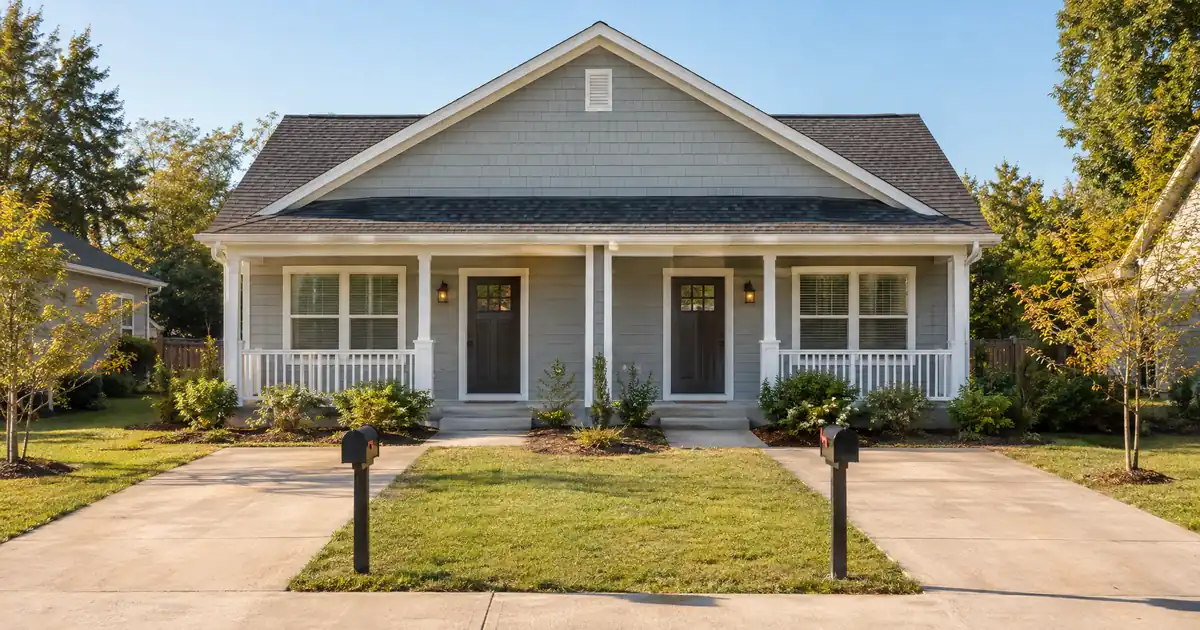
The Quick Read: Yes, a house, a duplex and a condo owned by one entity can share one DSCR loan, but only through a portfolio (blanket) structure, where one note is secured by every property and the pooled rent is tested against the pooled payment, subject to lender guidelines. A standard DSCR loan is written one property at a time. Owning several properties in one LLC does not merge those loans into one.
- Select portfolio programs in our wholesale network take roughly 2 to 20 properties under one note, and single-family, 2-4 unit, condo and townhome properties can mix.
- Leverage on these programs tops out at up to 80% on an investment-property purchase or rate-and-term refinance, and at 75% of pooled value on a cash-out.
- Coverage is measured on the pool, so stronger properties can offset weaker ones, but the same structure ties every property to the same loan.
- Properties held in different entities are generally not pooled until they are deeded into one entity.
- Selling one property later depends on the release terms in the note, so read them before you sign.
Key Terms Defined
Blanket (portfolio) loan: one loan secured by liens on several properties, with one payment instead of one per property.
Cross-collateralization: each property secures the whole loan, not just its own share.
Release clause: a term that lets you sell one property by paying down a set amount, while the loan stays on the rest.
Vesting: the name that holds legal title to a property, such as a single LLC.
PITIA: the monthly principal, interest, taxes, insurance and any association dues on a property.
DSCR: the debt service coverage ratio, which is monthly rent divided by PITIA.
What Does “One Entity” Actually Change?
Holding everything in one entity makes pooling possible, but it does not create a shared loan. Entity ownership answers who owns the properties. Loan structure answers how they are financed. Many investors confuse the two.
Say you own a single-family rental, a duplex and a condo in one LLC. You can finance them with three separate DSCR notes or with one portfolio note. Both are normal. The first gives you independence. The second gives you one payment and one closing, in exchange for tying the properties together.
Across our wholesale network, most programs that pool properties want one borrowing entity on the note. A special-purpose entity, typically an LLC, is required on some structures. An entity borrower is accepted subject to program terms, and recourse structures carry a personal guarantee from you.
| Ownership setup | How lenders usually view it |
|---|---|
| One LLC holds all properties | Cleanest path to one pooled note |
| Several LLCs, one owner | Usually not pooled as-is |
| Parent entity over subsidiaries | Lender-specific; often needs restructuring |
| Individual names plus an LLC | Title must be aligned before pooling |
If your properties sit in different entities, the usual fix is to deed them into one entity. The other fix is to keep separate loans. Moving title can affect existing financing and insurance, so sequence it with your lender and attorney. A few lenders in the network will look at common ownership across entities, but treat that as the exception.
How Is Each Property Type Treated?
A house, a duplex and a condo are each underwritten on their own merits, then combined into one test. The network’s portfolio programs accept single-family, 2-4 unit, condo and townhome properties. A duplex is one parcel and one asset with two rent streams. A condo is a separately deeded unit inside a larger project.
That difference drives the paperwork. Appraisers commonly use form 1007 to support rent on a one-unit rental and form 1025 for the income of a 2-4 unit building, as the Fannie Mae forms list shows. DSCR programs borrow those forms for rent support. They do not borrow the agency’s rules.
| Property | Rent support | Extra review | Pooling note |
|---|---|---|---|
| Single-family house | Lease or market rent | Standard appraisal | Simplest piece of the pool |
| Duplex (2-4 unit) | Rent per unit | Vacant units tested | One lien, two income streams |
| Condo | Lease or market rent | Project review | Project health can limit options |
| Townhome | Lease or market rent | Standard appraisal | Behaves like a house |
Every property in the pool still needs a lease or an appraiser-supported market rent. The condo is where files most often slow down. Lenders write their own condo rules, and a project with heavy investor concentration or pending litigation can trim leverage or narrow the lenders willing to look at it.
Some property types are not offered at all. Owner-occupied homes, mobile homes, co-ops, mixed-use property and commercial property are ineligible in the pool. Manufactured homes, log homes and barndominiums also fall outside these programs.
How Does Coverage Work Across a Mixed Pool?
The pool is tested as one number. Add up the monthly rent of every property, add up the monthly PITIA of every property, and divide. The floor on the main 30-year portfolio program is 1.00 on that pooled figure, so a strong house can carry a thinner condo.
Run the numbers on a modeled pool. These ratios are assumptions for illustration, not market data, and the three properties are assumed to carry similar monthly obligations:
- House: coverage near 1.25x.
- Duplex: coverage near 1.10x.
- Condo: coverage near 0.85x.
The pool lands near 1.07x. The condo sits below 1.00 alone, yet it can still be in the pool, because underwriting tests the pooled coverage, the leverage and the terms rather than each rental in isolation, subject to underwriting.
Now change the picture. Suppose the house is near 1.05x, the duplex near 0.95x and the condo near 0.70x. The pool lands near 0.90x, under the 1.00 pool floor. The practical fixes are a larger down payment, which lowers the payment and lifts coverage, removing the weakest property, or splitting the loan up.
A vacant duplex unit works the same way. Underwriting counts what the lease or the appraiser supports, so a unit sitting empty drags the pooled number down.
Two cautions apply. Clearing 1.00 is not the same as positive cash flow, because repairs, vacancy, management, utilities and capital costs sit outside the calculation. A bigger down payment also never erases leverage caps, credit floors or property eligibility. Strong files clear both tests: enough equity and enough rental coverage.
What Loan Terms Apply to a Portfolio Note?
Portfolio terms differ from single-property DSCR terms, so keep the two sets of figures apart. These are typical program ceilings and floors across select lenders in the network, not quotes.
The 30-year portfolio DSCR loan covers roughly 2 to 20 properties under one note, with loan sizes from $300,000 up to $5,000,000 and larger balances on review. Leverage runs up to 80% of value on an investment-property purchase or rate-and-term refinance. The term is 30 years, an interest-only period is available, and rates can be fixed or adjustable.
The rental portfolio term loan is built for five or more rentals under one loan, from $500,000 up to $50,000,000 with larger balances on review. Leverage runs up to 75% of value. Terms are fixed for 3, 5, 7 or 10 years with a balloon at maturity, and prepayment follows a yield maintenance schedule. Non-recourse versions exist, with recourse limited to carve-outs such as fraud and bankruptcy. Reserves are held for taxes, insurance and capital expenditures. Properties in several markets can sit under one loan.
Cash-out on a portfolio never exceeds 75% of pooled value. In the first six months of ownership, cash-out is capped by the seasoning rule. Leverage is limited to 90% of total cost in that window and 100% from six to twelve months.
The credit floor on portfolio files starts at 640, and some structures want 680 or 720. Compare that with a loan on one rental: purchases there typically land at 75%-80% LTV on an investment property, with a 620 credit floor in parts of the network and about 660 on most programs.
Pooled Loan or Separate Loans?
Pool when you plan to hold, and keep loans separate when you plan to trade. A blanket note rewards a stable, long-term portfolio.
| Factor | One pooled note | Separate DSCR loans |
|---|---|---|
| Qualification test | Pooled coverage | Each property alone |
| Closings and payments | One of each | One per property |
| Selling one property | Release terms apply | Sell independently |
| Risk spread | Every property is collateral | Each loan stands alone |
| Best fit | Long-hold, stabilized | Active buying and selling |
Work through four questions before choosing:
1. Do you plan to sell any of these properties soon? If so, keep it out of the pool.
2. Is one property clearly weak? Pooling can hide it, but it also ties it to your best asset.
3. Do you have a small number of properties or a larger portfolio? With a small number, separate loans are often the cleaner answer, since pooled programs start at two properties and the term loan at five.
4. Do you want one payment more than you want independence? That is the real tradeoff.
Lendmire’s piece How to Sell One of Two Rentals Under a Blanket DSCR Cash-Out Loan walks through the exit side in more detail.
What Can Go Wrong?
Pooling concentrates risk, and most mistakes come from underestimating that. These are the ones that show up most often in practice.
- Cross-default. A missed payment on the pool is a missed payment on all of it, and every property secures the note.
- Release pricing. The release price runs above the property’s allocated balance. Partial releases, substitutions and single-property sales follow the loan documents, and the remaining portfolio must still cover its debt service.
- Pooling a property you plan to sell. This is the single most avoidable error. Leave it out, or confirm the release terms first.
- Mismatched names. Title, insurance and the note should all show the same entity. A mismatch can stall a file late.
- Owner occupancy. Owner-occupied property is ineligible in the pool, so a unit you might live in does not belong in it.
- Assuming DSCR means blanket. It does not. Most DSCR loans are one note per property.
DSCR loans are designed for non-owner-occupied investment properties. Because they are business-purpose investor loans, they are reviewed differently from a standard owner-occupied mortgage. The CFPB’s Regulation Z commentary treats rental property that way, and it notes that expecting to occupy the property more than 14 days in the coming year changes the picture.
Across a wholesale network, one pattern repeats. Files that go sideways late are rarely about coverage. They are usually about entity housekeeping, a condo project question or a release term nobody read closely. Fixing those items before submission keeps a file cleaner.
What Do You Need to Gather?
Collect the documents per entity first, then per property. Requirements vary by lender and program, but this list covers most files.
For the entity:
- Formation documents and operating agreement
- A certificate of good standing
- Identification and a tax ID for the entity
- Details on who signs the guaranty on recourse structures
For each property:
- A current lease, or a plan for appraiser-supported market rent
- Proof of insurance naming the entity
- A title report and a payoff statement for any existing loan
- A condo questionnaire and project information for each condo unit
- An appraisal with rent support (form 1007 or 1025 style, depending on unit count)
How Do You Pool Properties You Already Own?
Pooling existing properties is a refinance, so existing liens get paid off. Start with title: every property should be vested in the one entity that will borrow. Then lay out each property’s rent and coverage so you know which ones help the pool and which ones drag it.
Next, decide whether the refinance is rate-and-term or cash-out. Rate-and-term runs up to 80% on the 30-year portfolio program. Cash-out stays at 75% of pooled value or below, and recently bought properties fall under the seasoning rule. Finally, read the release language and confirm it fits your exit plans. A broker can then compare how several lenders in the network treat your mix of properties.
For entity-level questions with a different twist, see Lendmire’s piece Can a Trust Hold Multiple Rentals Under One Super Jumbo DSCR Loan?. For the full picture of how these loans work, read the complete DSCR loans guide.
This article is educational and is not legal or tax advice. Tax treatment varies; consult a qualified professional, including an attorney or CPA, about your own situation.
Frequently Asked Questions
Can one entity’s house, duplex and condo go on one DSCR loan?
Yes, through a portfolio structure. The network’s portfolio programs accept single-family, 2-4 unit, condo and townhome properties under one note, subject to lender guidelines. A standard DSCR loan covers one property.
Can multiple LLCs share one note?
Generally not as separate entities. Pooling usually wants one borrowing entity, so the common fix is to deed the properties into a single entity. Otherwise you keep separate loans, depending on program guidelines.
Does a weak or vacant property sink the pool?
Not necessarily. Coverage is measured on pooled rent against pooled debt service, so stronger properties can offset a weaker one. If the pool falls below 1.00, a larger down payment, removing the weak property or separate loans are the usual options.
Can I sell one property later?
Often, yes, but it depends on the release terms. The release price runs above the property’s allocated balance, and the remaining portfolio must still cover its debt service. Read those terms before closing.
Is there a limit on how many DSCR loans I can hold?
Separate DSCR loans are generally underwritten file by file, and no single number applies across the network. On a pooled note, the 30-year program takes roughly 2 to 20 properties, and the term loan is built for five or more.
Next Steps
If you are buying or refinancing a rental property and want to see how the numbers work, Lendmire can help you compare DSCR loan options based on the property income, credit profile, leverage and investor goals. Lendmire is a mortgage broker that arranges financing through select lenders in its wholesale network across 41 markets, including Washington, D.C. Call 828-256-2183 to talk through whether pooling or separate loans fits your mix of properties.
About Lendmire
As a non-QM mortgage broker (NMLS# 2371349), Lendmire facilitates DSCR investor loans across 41 markets, including Washington, D.C. DSCR eligibility is generally reviewed around property-level rental income instead of personal income documentation, subject to lender guidelines, serving LLC-structured portfolios and self-employed borrowers who don’t fit conventional boxes. A two-time Scotsman Guide Top Mortgage Workplace (2025, 2026).
Get Started
Ready to find the right loan for you?
In about 30 seconds you can review financing options available for your investment property. No commitment required.
Informational only. Not a Loan Estimate, approval, or commitment to lend. Program availability and eligibility are subject to lender guidelines, credit approval, property review, and underwriting.
References
1. Fannie Mae: Selling Servicing Guide Forms
2. CFPB Regulation Z §1026.3 (official interpretation)
This article is part of Lendmire’s DSCR loan program — full qualification details, guidelines, and scenarios live on the program page.
Related reading: Can You Get a DSCR Loan for an Airbnb in Washington? · Can You Get a DSCR Loan for an Airbnb in New Jersey? · Can You Get a DSCR Loan for an Airbnb in Iowa?
Brandon Miller
Founder & CEO, Mortgage Loan Originator, Lendmire LLC
- Mortgage Loan Originator · NMLS# 1129696 · Verify on NMLS Consumer Access
- North Carolina Real Estate Broker · License# 343312 · Verify on NCREC
- North Carolina Insurance Producer · License# 19053198 · Property, Casualty, Life, Health · Verify on NAIC SBS
- Lendmire LLC · Firm NMLS# 2371349 · Verify firm licensure
Legal disclosures. Lendmire (NMLS# 2371349) is a state-licensed mortgage brokerage that arranges financing through wholesale lender relationships. Lendmire is not a direct lender, depository institution, or registered financial advisor. The discussion above is general informational content about real estate financing — it is not financial, legal, or tax advice, and readers should consult licensed professionals for guidance on their individual circumstances. Loan inquiries are subject to lender underwriting; this article does not represent a commitment to lend. Loan terms, rates, and qualification standards vary by borrower, property, and state, and are subject to change at any time. Equal Housing Opportunity. NMLS Consumer Access: nmlsconsumeraccess.org.