
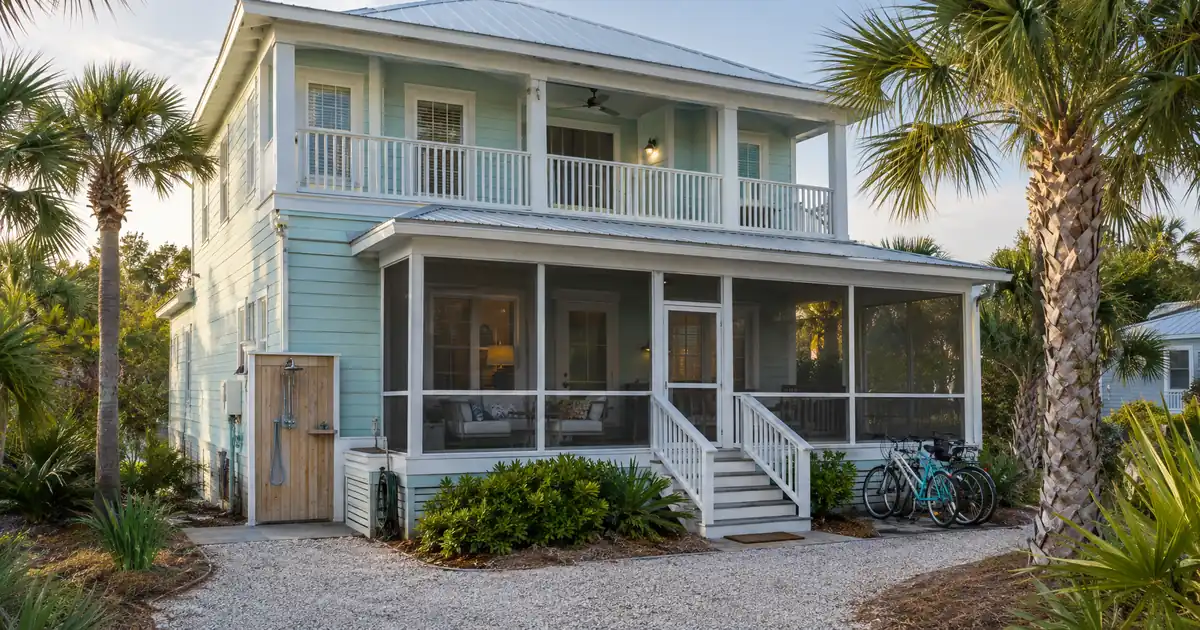
Finance A Beach House You Plan To Rent — The Quick Read: A beach house you plan to rent gets financed as a business-purpose investment, not a personal mortgage. The lender looks at what the property can earn — either from a long-term lease or a documented short-term rental history — and compares that income to the monthly obligation. That comparison is called DSCR, or debt-service coverage ratio. If the rent covers the payment, the file has a real shot regardless of your personal income.
Coastal property adds a layer conventional financing doesn’t have to deal with: flood zones, hurricane coverage, HOA rental restrictions, and income that swings by season. None of that kills a DSCR file. It just changes how the file gets built.
DSCR Calculator
Run the numbers in your market
Rate source: Freddie Mac 30-yr average via FRED® — Federal Reserve Bank of St. Louis · effective Sep 17, 2026
Prefilled with local estimates — enter your own rent or nightly figures, taxes, insurance, and HOA for a more accurate picture.
Program parameters update from Lendmire’s centralized guideline source. Taxes and insurance are editable estimates.
As of Sep 17, 2026 · General Freddie Mac market benchmark, not a Lendmire loan offer. Rent, nightly rate, occupancy, taxes, and insurance are editable estimates. Short-term rental figures are estimates only and vary significantly by season, property type, management approach, and local short-term-rental rules — confirm local regulations before relying on them. Qualifying income for short-term rentals varies by program — some use appraisal market rent, others use documented STR history or projections — and is confirmed in underwriting. Not a Loan Estimate, approval, or commitment to lend. Program availability and eligibility are subject to lender guidelines, credit approval, property review, and underwriting.
What Makes Beach-House Financing Different
A DSCR loan is reviewed around what the property earns, not what you earn personally — that’s the whole idea behind Lendmire’s complete DSCR loans guide. For an inland single-family rental, that’s usually a simple comparison: market rent versus the payment. For a beach house, three things complicate the math before you get anywhere near approval.
First, the rental income itself is often short-term. Second, the carrying costs — insurance especially — run meaningfully higher than an inland property of the same price. Third, the property type might not be a plain single-family house at all. It might be a condo, and beach condos come with rental restrictions and HOA quirks that inland rentals rarely see.
None of that is disqualifying. It’s just why a beach house file looks different from a standard rental file, and why getting the documentation right matters more here than almost anywhere else.
Key Terms Defined
DSCR (debt-service coverage ratio): the property’s monthly rental income divided by its full monthly payment — principal, interest, taxes, insurance, and HOA dues combined. A ratio of 1.00 means the rent covers the payment exactly.
PITIA: the full monthly housing obligation — principal, interest, taxes, insurance, and association dues. On a beach property, insurance and HOA dues typically make PITIA a bigger number than the mortgage payment alone.
Business-purpose loan: a loan made to an investment property held for income, not personal use. DSCR loans are business-purpose loans, which is why they sit outside the disclosure rules that govern a standard home mortgage — a distinction the Consumer Financial Protection Bureau draws around what counts as consumer credit.
Long-term rental (LTR) vs. short-term rental (STR): an LTR is a leased property with a tenant on a standard lease. An STR is a nightly or weekly rental — think Airbnb or VRBO. Beach properties are frequently STR by design, and the two income types get documented completely differently.
No-ratio loan: a program path where the lender doesn’t require a minimum DSCR at all. It exists, but it’s narrower and comes with tighter leverage than a standard file. Final terms depend on lender guidelines, property type, leverage, and the borrower’s complete credit picture.
Long-Term Lease or Short-Term Booking Calendar — Which Income Counts
The rental strategy you pick determines how the lender documents income, and that choice can change your coverage figure by a wide margin. Long-term rentals lean on an appraiser’s rent opinion. Short-term rentals lean on booking-platform data or operating history.
If you plan to lease the beach house year-round to one tenant, the lender typically orders an appraisal that includes a comparable-rent estimate for the property — a standard tool in rental underwriting. That market-rent figure becomes the top line in the DSCR calculation.
If you plan to run it as a vacation rental, the math runs differently. Through Lendmire’s wholesale network, short-term rental files typically qualify using twelve months of documented operating history on a refinance, or the appraisal’s short-term-rent analysis on a purchase — and either way, the underwritten number typically applies roughly 80% of gross projected income, not the full booking total. That haircut exists because gross platform revenue includes cleaning fees, platform commissions, and seasonal swings that don’t represent stable income.
This is also where a common misconception trips investors up. A stronger platform projection doesn’t automatically win. When there’s both a lease-equivalent market rent and a booking-platform projection on the table, underwriting tends to lean conservative and use the lower number — not whichever one makes the file look better.
STR files through this kind of program are generally reserved for investors who’ve already owned income property before — typically twelve months of ownership experience within the last three years — and they don’t run on the no-ratio path. A first-time landlord buying their first beach rental on a no-ratio basis is usually not the fit; a long-term lease structure, or a standard-ratio STR file with real operating history, tends to fit better.
Why PITIA Runs Higher at the Beach
Insurance is the single biggest reason a beach house’s coverage ratio looks worse than an inland property at the same price and rent. Wind and flood exposure push premiums up in a way that directly shrinks DSCR, because PITIA sits in the denominator of that ratio.
A recent GAO report found that homes in high wind-risk areas carry premiums roughly 58% higher than similar homes in medium-risk areas, and that in some southern coastal states, premiums have climbed 25% or more — well above the national average increase over the same stretch. That’s not a rounding error on a DSCR file. It’s the difference between a 1.15x file and a 0.95x file on paper alone.
Flood coverage is a separate policy from wind coverage, and coastal properties in mapped flood zones often need both. Coastal V-zones — the highest-risk flood classification, covering areas exposed to wave action — make up a small share of total flood policies nationally, under 2 percent, but a beach house sitting in one will carry a premium that reflects that risk. Federally backed loans in mapped high-risk zones require flood insurance as a condition of the loan, and an elevation certificate documenting the lowest floor of the structure is usually needed to price that policy accurately.
None of this is a reason to walk away from a beachfront file. It’s a reason to get real insurance quotes before you run your DSCR math, not after.
Condo, Condotel, or Single-Family — The Property Type Matters
Not every beach property qualifies the same way, and the condotel-versus-condo distinction is the one that trips up the most investors. A standard condo where you control your own unit’s occupancy is a very different underwriting file than a condotel where hotel-style management runs the booking calendar for you.
Through select programs in Lendmire’s wholesale network, non-warrantable condos — condos that don’t meet standard agency project requirements — typically qualify to 75% loan-to-value and up to $1,500,000, subject to underwriting. Condotels are narrower: typically up to 75% on a purchase, 65% on a refinance, capped at $1,500,000, and usually requiring $250,000 in cash-in-hand from the borrower. The reason for the gap is control. In a condotel with mandatory rental participation, the building — not you — decides who occupies the unit and when, which makes the income stream look more like a hotel revenue split than a rental you manage.
Buildings offering optional rental programs, where you retain full control over your own unit’s booking calendar, are generally evaluated more like a standard condo than a condotel. That distinction is worth confirming with the HOA before you write an offer, not after.
New construction is its own separate hurdle. A project where the developer still controls the HOA, or where units haven’t received a certificate of occupancy, typically isn’t eligible until control transfers to the owners’ association.
Building the DSCR Math on a Beach File
Say you’re looking at a beach property in the $1.5 million range, financed at 75% loan-to-value on a purchase through a program that reaches into the super-jumbo tier. At that size, credit typically needs to clear the 700 mark, and the file usually carries six months of PITIA in reserves on the subject property — twelve months if this is your first investment property.
The DSCR calculation itself is simple in structure even when the inputs are complicated: rental income, divided by the full monthly obligation including taxes, insurance, and HOA dues, produces the coverage ratio. If that ratio clears 1.00x, the file typically earns full leverage on the ladder for its size tier. Below that, some programs in the network will still look at the file — coverage between roughly 0.75x and 0.99x is a real path through select programs, generally up to $2,000,000, but leverage and terms adjust downward to compensate, subject to underwriting.
At the $1.5M-to-$2M tier specifically, cash-out is capped tighter than a standard rate-and-term refinance — typically 60% for beach and other short-term-rental collateral, or up to 70% on standard long-term rental collateral, both scoped to that same size band. Above $3,000,000, cash-out generally isn’t available on this ladder at all — those files run purchase or rate-and-term only, and get reviewed case by case before submission.
DSCR vs. conventional financing
Two common ways to finance an investment property in this market. They qualify you differently — here’s how investors weigh them.
Why investors choose it
- Qualifies on the property’s rental income — no personal tax returns, W-2s, or pay stubs needed to document income.
- No personal debt-to-income ceiling to clear, so existing mortgages and obligations don’t cap your borrowing the same way.
- Can be closed in an LLC, keeping the property inside a business entity.
- Built for scaling — not held to the limit on number of financed properties that conventional financing applies.
- Underwriting centers on the deal: generally qualifies when the rent covers the payment, a 1.00x coverage ratio being a common baseline (confirmed in underwriting).
- Designed specifically for investment property, including long-term and, where the program allows, short-term rentals.
Where it’s strong
- Often the lowest ongoing financing cost for a buyer who fully qualifies on personal income — a fit for a first property or a cost-first purchase.
Trade-offs for investors
- Requires full personal income documentation and must fit within a debt-to-income limit — salary, existing debts, and other mortgages all count.
- Typically held in your personal name rather than a business entity.
- Caps how many financed properties you can carry, which can become a ceiling as a portfolio grows.
- Evaluates you as a borrower as much as the property, which usually means more paperwork.
How investors usually choose: a first or single property often optimizes for the lowest financing cost; portfolio builders often optimize for leverage, vesting in an LLC, and scaling past conventional caps. The right answer depends on your goals, the property, and current guidelines — both paths run through select lenders in Lendmire’s wholesale network, with eligibility and terms confirmed in underwriting.
Here’s the honest picture from files like this: the strongest beach-house DSCR applications don’t come from investors chasing the highest possible gross rental projection. They come from investors who ran the insurance quote first, built the PITIA number conservatively, and then checked whether the income — lease or booking-platform — still clears 1.00x after that. A property that pencils at 1.3x on a napkin-math insurance guess can land at 0.9x once the real flood and wind premiums come back. Running the insurance numbers before making an offer saves a renegotiation later.
What Can Go Wrong
Local rental rules are the risk that sits outside the loan entirely. Short-term rental rules can vary by city, county, HOA, and property type, so confirming local rules before relying on projected rental income matters more at the beach than almost anywhere else — a beach town that allows nightly rentals today can restrict or ban them tomorrow, and that’s a zoning risk the lender didn’t create and can’t fix after closing.
HOA bylaws are a separate trap. Even in a city with no municipal restriction on short-term rentals, an HOA can prohibit them outright in its own governing documents. That’s worth confirming directly with the association, not assuming from the city’s public stance.
Appraisal methodology is shifting industry-wide, too. The standard rent-schedule forms used across non-QM lending are being phased out for agency loans and replaced with a different reporting structure, with narrative addenda expected to remain the main way STR income gets supported going forward. That’s a background shift worth knowing about, not something that should change how you approach a file today.
DSCR loans are designed for non-owner-occupied investment properties. Because they’re business-purpose investor loans, they’re reviewed differently from a standard owner-occupied mortgage — which is exactly why “I’ll rent it most of the year but stay there myself sometimes” is the gray area most DSCR programs aren’t built to underwrite cleanly. If personal use is part of the plan, that’s worth discussing candidly before shopping loan programs, because it can change which product actually fits.
Tax treatment can depend on how the funds are used and how the property is held; investors should keep clear records and speak with a qualified tax professional before relying on any deduction.
Who This Fits and Who It Doesn’t
This structure fits an investor buying a coastal property purely as a rental — someone comfortable vesting in an LLC, comfortable with insurance costs eating into the coverage ratio, and willing to document income the way the lender wants it documented rather than the way that looks best on paper. It also fits investors who already own rental property and are looking at the STR path with real operating history behind them.
It fits less well for a buyer who wants part-time personal use and part-time rental income from the same property — that’s the gray zone DSCR underwriting struggles with. And it’s not the easiest entry point for a brand-new investor targeting a condotel with mandatory rental-pool participation, where control over the unit — and therefore the income story — belongs to the building, not the owner. For comparisons between STR-focused DSCR structuring and other financing paths, Lendmire’s write-up on STR DSCR versus a bank statement loan walks through that fork in more detail, and the beach house versus ski cabin comparison is worth a look if you’re weighing coastal against mountain markets.
This isn’t legal or tax advice. Anyone structuring an entity, weighing occupancy plans, or relying on a specific tax outcome should talk to a qualified attorney or CPA about their own situation before closing.
Frequently Asked Questions
Can I get a DSCR loan on a beach house I also plan to use myself sometimes?
It’s a gray area most DSCR programs aren’t built to underwrite cleanly. DSCR loans are business-purpose products, which generally assumes the property is held for rental income rather than mixed personal and investment use. If personal use is a real part of the plan, that’s worth raising with a broker early, since it can steer you toward a different loan structure entirely.
Does flood insurance kill the DSCR math on a coastal property?
Not automatically, but it does shrink the ratio. Flood and wind coverage both sit inside PITIA, and coastal premiums run meaningfully higher than inland ones. The fix isn’t avoiding beach property — it’s getting a real insurance quote before finalizing your offer, so the DSCR number you’re working with reflects reality.
Can I use Airbnb income that doesn’t exist yet to qualify?
On a purchase with no operating history, the file typically leans on the appraisal’s short-term-rent analysis rather than a platform projection you generate yourself. On a refinance, twelve months of documented operating history is the more common path. Either way, the underwritten figure applies a discount to gross projected income, not the full booking total.
Is a condotel reviewable the same way as a beach condo?
Not usually on the same terms. A standard condo where you control occupancy generally has more room on the leverage ladder than a condotel with mandatory rental-pool participation, where the building controls who books your unit and when. Condotel files typically come with tighter loan-to-value caps and a cash-in-hand requirement.
What credit score do I need for a beach house DSCR loan?
It depends on loan size. Programs in Lendmire’s network typically start around a 660 floor on smaller balances, moving up to roughly 700 once the loan crosses into the higher size tiers common on coastal properties, subject to underwriting.
If you’re weighing a beach property against a mountain rental or comparing DSCR to other investor financing structures, Lendmire can help you compare options based on the property’s income, your credit profile, available leverage, and your goals as an investor.
For current guidelines and terms, see Lendmire’s super jumbo DSCR loan programs page.
Self-employed borrowers can compare both super jumbo programs on Lendmire’s self-employed mortgages page.
About Lendmire
As a non-QM mortgage broker (NMLS# 2371349), Lendmire facilitates DSCR investor loans across 40 markets, including Washington, D.C. DSCR eligibility is generally reviewed around property-level rental income instead of personal income documentation, subject to lender guidelines, serving LLC-structured portfolios and self-employed borrowers who don’t fit conventional boxes. A two-time Scotsman Guide Top Mortgage Workplace (2025, 2026).
Lendmire’s Top Mortgage Workplace recognition is documented by Scotsman Guide 2025 Top Mortgage Workplace and Scotsman Guide 2026 Top Mortgage Workplace.
Get Started
Ready to find the right loan for you?
In about 30 seconds you can review financing options available for your home or investment property. No commitment required.
Informational only. Not a Loan Estimate, approval, or commitment to lend. Program availability and eligibility are subject to lender guidelines, credit approval, property review, and underwriting.
References
1. Consumer Financial Protection Bureau – Regulation Z §1024.5
2. Government Accountability Office – Homeowners Insurance Report
Brandon Miller
Founder & CEO, Mortgage Loan Originator, Lendmire LLC
- Mortgage Loan Originator · NMLS# 1129696 · Verify on NMLS Consumer Access
- North Carolina Real Estate Broker · License# 343312 · Verify on NCREC
- North Carolina Insurance Producer · License# 19053198 · Property, Casualty, Life, Health · Verify on NAIC SBS
- Lendmire LLC · Firm NMLS# 2371349 · Verify firm licensure
Disclosures. The information presented in this article is general market commentary, not financial, legal, or tax advice. Lendmire is a mortgage brokerage (NMLS# 2371349) — not a direct lender or depository institution — and loan placement is subject to lender underwriting. Nothing in this content represents a commitment to lend. Loan terms, pricing, and program availability vary based on borrower qualifications, property characteristics, and state of subject property, and are subject to change at any time. Lendmire complies with Equal Housing Opportunity requirements. Consumer access: nmlsconsumeraccess.org.


