
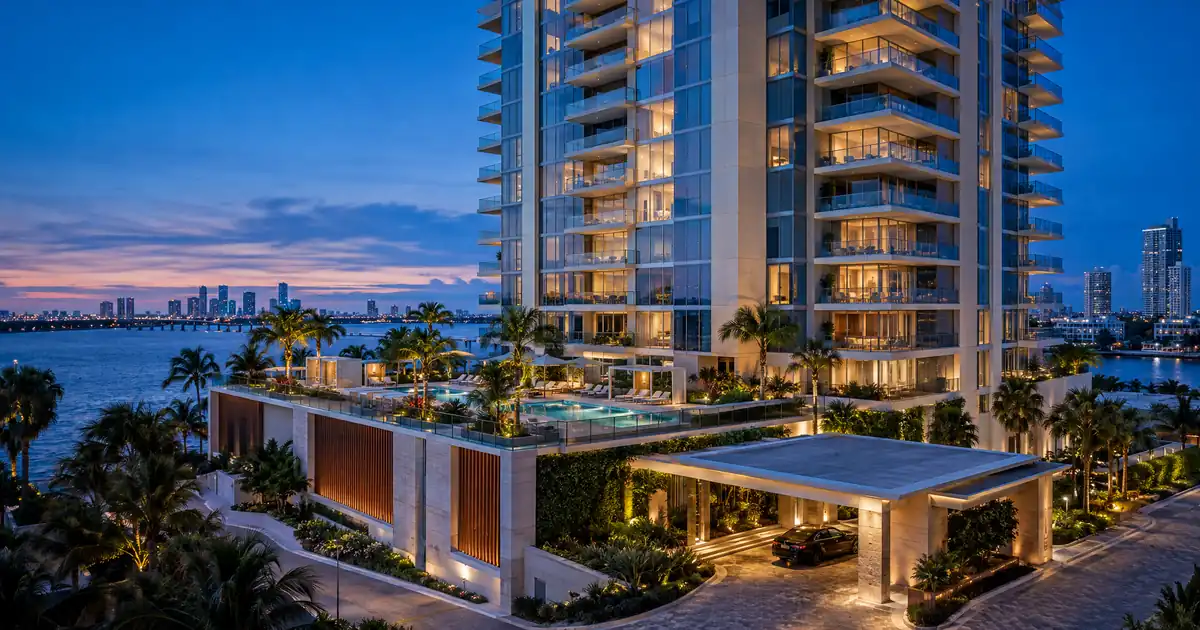
Finance A Luxury Condo As A Short-term Rental — The Quick Read: A luxury condo that runs as a nightly rental usually can’t get a conventional mortgage, because Fannie Mae and Freddie Mac won’t buy loans on buildings with heavy investor ownership, hotel-style amenities, or short-term rental activity. A DSCR loan sidesteps that problem entirely — it is reviewed on the property’s rental income instead of your traditional personal-income documentation, and it doesn’t check the same building-eligibility boxes. Across the size ladder, leverage runs up to 80% on smaller purchases and steps down as the loan gets larger, with short-term rental files capped near $2,000,000 and priced on documented rental income rather than a guess.
Here’s the part most people miss: the building itself is often the harder problem to solve, not the borrower. Get the property classification wrong and no amount of income or credit fixes it.
Short-Term Rental Calculator
Run the STR numbers in your market
Rate source: Freddie Mac 30-yr average via FRED® — Federal Reserve Bank of St. Louis · effective Sep 17, 2026
Prefilled with local estimates — enter your nightly rate, occupancy, taxes, and insurance for a more accurate picture.
Short-term rental income is documented with a 12-month history or a market data report. Program parameters update from Lendmire’s centralized guideline source.
As of Sep 17, 2026 · General Freddie Mac market benchmark, not a Lendmire loan offer. Nightly rate, occupancy, taxes, and insurance are editable estimates. Qualifying income for short-term rentals varies by program — some use appraisal market rent, others use documented STR history or projections — and is confirmed in underwriting. Not a Loan Estimate, approval, or commitment to lend. Program availability and eligibility are subject to lender guidelines, credit approval, property review, and underwriting.
Key Terms Defined
DSCR (debt service coverage ratio): the property’s monthly rental income divided by its full monthly housing payment — principal, interest, taxes, insurance, and HOA dues. A ratio of 1.00 means the rent covers the payment with nothing left over; above 1.00 means it covers with room to spare.
Non-warrantable condo: a condominium building that doesn’t meet Fannie Mae and Freddie Mac’s rules for buying loans on the secondary market — often because too many units are investor-owned, there’s pending litigation, or short-term rentals are common in the building.
Condotel: a condo unit inside a building operated like a hotel — front-desk services, a rental management pool, and amenities that make it look and function more like a resort than a residential building.
PITIA: principal, interest, taxes, insurance, and association dues — the full monthly obligation a lender measures rental income against.
Business-purpose loan: a loan made to an investor buying or refinancing a rental property, not a home they’ll live in. DSCR loans are structured this way, which is why they’re underwritten differently from a standard owner-occupied mortgage.
Why Conventional Financing Rejects the Building Before It Even Looks at You
The rejection almost never starts with the borrower — it starts with the condo project itself. Non-warrantability is a Fannie Mae and Freddie Mac classification tied to whether a project meets the rules that let loans get sold on the secondary market. A building with heavy investor concentration, a hotel-style front desk, or an active short-term rental scene often fails that test outright, regardless of the buyer’s credit or income.
DSCR lenders never sell into that secondary market. They hold and service loans through their own investor channels, so the GSE eligibility checklist simply doesn’t apply. That single structural fact is why a luxury condo in an investor-heavy building — the kind that gets an automatic no from a retail bank — can still get financed through a DSCR program.
Condotels get treated as their own category, tighter than either warrantable or non-warrantable condos. That’s because the operating model — pooled rentals, seasonal occupancy, hotel amenities — makes them a non-conforming property type from the start. This is exactly the gap DSCR programs were built to fill, though the terms are meaningfully tighter than a standard condo file.
Step 1: Classify the Property Before Anything Else
Before a lender talks income or leverage, it decides what kind of collateral it’s looking at: a standard warrantable condo, a non-warrantable condo, or a condotel. This single decision shapes every term that follows.
The classification isn’t always about paperwork. Buildings with heavy short-term rental activity often get treated as condotels regardless of their formal designation. That’s simply because the operating reality matches that model. Investors shopping a luxury tower with a rental desk and daily housekeeping should expect condotel terms, even if the HOA documents never use that word.
Across select lenders in Lendmire’s wholesale network, non-warrantable condos run up to roughly 75% loan-to-value and cap around $1,500,000, subject to underwriting. Condotels top out lower — around 75% on a purchase and 65% on a refinance, also near a $1,500,000 ceiling — and typically require a meaningful cash-in-hand cushion in reserves on top of the standard reserve requirement. These are program ranges, not guarantees, and they shift with credit profile and property condition.
Step 2: Document the Rental Income the Right Way
There are two paths, and which one applies depends entirely on whether the unit already has a rental track record.
Existing operating history (refinance). If you’ve owned the unit and rented it short-term for a stretch, the lender leans on actual performance — bank statements, platform payout records, a trailing twelve months of bookings. Across the programs Lendmire places files with, this path generally wants twelve months of documented operating history, and the borrower typically needs to be an experienced investor — meaning twelve months of owning income property somewhere in the last three years.
No history (purchase). Buying a unit with no rental track record of its own means the appraisal carries the weight. The appraiser builds a short-term-rental income analysis using comparable properties, market demand data, and seasonality — not a guess, and not a simple nightly-rate extrapolation.
This is where a common myth trips people up: an appraiser cannot just take the nightly rate, multiply by 30, and call it monthly rent. Appraisal-education guidance is explicit that this shortcut isn’t how a compliant analysis works — McKissock Learning notes that Form 1007, the standard long-term rent schedule, isn’t built for nightly-booking properties at all. That form exists to estimate monthly market rent on a conventional investment property — Fannie Mae’s own guidance confirms it’s used only when rental income qualifies a one-unit investment property under standard lease terms, not nightly stays. For a short-term rental, the appraiser substitutes a narrative income analysis tied to market comparables instead.
Step 3: Expect an Income Haircut
Whatever the top-line revenue number is, expect the qualifying figure to come in lower. Across the STR programs Lendmire arranges through its network, short-term rental income is qualified at 80% of the gross figure — either the appraisal’s rental analysis on a purchase, or the trailing operating history on a refinance. That haircut absorbs the natural swings in nightly-booking income: slow months, platform fee variance, seasonal dips.
If more than one income source exists for the same unit — say a long-term-rent appraisal figure alongside a short-term projection — the more conservative number is usually the one that governs the file. That matters directly for luxury units, where a strong short-term projection might otherwise dominate the math. A file that pencils beautifully on the optimistic number can look very different once the conservative figure is plugged in, so it’s worth modeling both before making an offer.
Step 4: Run the Actual DSCR Math
Once the qualifying income figure is set, the calculation is the same as any DSCR file: monthly qualifying rental income divided by the full monthly payment — principal, interest, taxes, insurance, and HOA dues combined. HOA is not optional in that denominator, and on a luxury condo it’s frequently the largest fixed cost after the loan payment itself.
Coverage at 1.00 or higher on the standard programs Lendmire places typically earns full leverage on the ladder above. Some select lenders in the network will also review files running between roughly 0.75 and 0.99 coverage, or even no-ratio scenarios with no rent-to-debt calculation at all — both real paths, but both come with reduced leverage and adjusted terms, subject to underwriting. Short-term rental files specifically are not eligible for the no-ratio path; they need a coverage ratio of 1.00 or better and generally cap near $2,000,000.
Where the Building Kills the Deal — Even When the Numbers Work
Some collateral problems have nothing to do with rental strategy. None of the fixes above can solve them. A condo can be non-warrantable because of deed restrictions, pending litigation, or a mandatory rental pooling requirement. That’s a fundamental collateral defect. It’s not a timing issue, and a stronger DSCR ratio won’t fix it.
Compare that to a presale restriction, which is purely timing-based: conventional guidelines require 90% of a new-construction project’s units to be sold before agency loans can close on the remaining units. Once the building crosses that threshold, the restriction disappears — and it barely matters to a DSCR lender in the first place, since DSCR programs don’t check that box at all.
HOA rules add a separate legal layer that neither the lender nor the borrower fully controls. HOA restrictions live in the CC&Rs, and they can legally ban short-term rentals regardless of what the city or county allows. AirROI’s glossary on HOA restrictions notes this exposure runs especially high in condo-dense markets, since condominiums are overwhelmingly HOA-governed. Boards can also pass new restrictions by resolution without a homeowner vote. That means a unit earning strong income one year can be banned from short-term rentals the next if enforcement activates. Short-term rental rules can vary by city, county, HOA, and property type. So it’s worth taking the time to confirm local rules and the building’s specific CC&R language before relying on projected rental income.
Insurance is a separate risk. It’s not just an afterthought at closing. A condo’s master policy typically covers the building shell and common areas. The owner’s own policy covers everything inside the unit. This is where the short-term rental question actually comes in. STR Guard Insurance’s guidance on condo STR coverage explains that operating as a nightly rental adds a commercial layer on top of standard unit-owner coverage. A plain HO-6 policy often doesn’t include this layer. Standard homeowners forms frequently exclude commercial hosting activity outright. Homeowners Insurance Authority’s coverage guide notes that most standard-form policies sharply limit or exclude protection once a unit is used for commercial hosting. This leaves gaps in property damage and liability coverage right where a nightly-rental investor needs protection most.
DSCR vs. conventional financing
Two common ways to finance an investment property in this market. They qualify you differently — here’s how investors weigh them.
Why investors choose it
- Qualifies on the property’s rental income — no personal tax returns, W-2s, or pay stubs needed to document income.
- No personal debt-to-income ceiling to clear, so existing mortgages and obligations don’t cap your borrowing the same way.
- Can be closed in an LLC, keeping the property inside a business entity.
- Built for scaling — not held to the limit on number of financed properties that conventional financing applies.
- Underwriting centers on the deal: generally qualifies when the rent covers the payment, a 1.00x coverage ratio being a common baseline (confirmed in underwriting).
- Designed specifically for investment property, including long-term and, where the program allows, short-term rentals.
Where it’s strong
- Often the lowest ongoing financing cost for a buyer who fully qualifies on personal income — a fit for a first property or a cost-first purchase.
Trade-offs for investors
- Requires full personal income documentation and must fit within a debt-to-income limit — salary, existing debts, and other mortgages all count.
- Typically held in your personal name rather than a business entity.
- Caps how many financed properties you can carry, which can become a ceiling as a portfolio grows.
- Evaluates you as a borrower as much as the property, which usually means more paperwork.
How investors usually choose: a first or single property often optimizes for the lowest financing cost; portfolio builders often optimize for leverage, vesting in an LLC, and scaling past conventional caps. The right answer depends on your goals, the property, and current guidelines — both paths run through select lenders in Lendmire’s wholesale network, with eligibility and terms confirmed in underwriting.
Who This Fits — and Who It Doesn’t
This structure fits an investor who wants to buy or refinance a condo in a building that a retail bank would reject outright. It also fits someone who’s comfortable qualifying based on the property’s income rather than traditional personal-income documentation. And it fits someone scaling a portfolio, since each acquisition is reviewed on its own rental income rather than stacked against a personal debt-to-income ceiling. Take a look at Lendmire’s complete DSCR loans guide to see how that scaling works across multiple properties.
It fits less well for a buyer counting on the most aggressive top-line rental projection to size the loan — the conservative haircut and lower-of convention mean the deal should be modeled on the discounted number, not the marketing pro forma. It also doesn’t fit anyone who hasn’t confirmed CC&R language or insurance eligibility yet. A file can underwrite perfectly on paper and still not be legally operable as modeled if the HOA prohibits short-term rentals or the insurance policy excludes commercial hosting.
DSCR loans are designed for non-owner-occupied investment properties. Because they’re business-purpose investor loans, lenders review them differently from a standard owner-occupied mortgage. That’s part of why building-level factors like HOA rules and non-warrantability carry so much weight in this process. For a side-by-side look at how this compares to a standard mortgage, check out Lendmire’s DSCR vs. conventional investment loan guide, which breaks down the underwriting differences in more detail.
Reserve requirements typically run around six months of the full monthly payment on the subject property for most files. That stretches to twelve months for a first-time real estate investor. This is worth planning around before you shop for a unit, since a luxury condo’s HOA dues push that reserve requirement higher than a comparable single-family rental. Credit floors on the size ladder generally sit in the mid-600s for smaller loans. They climb toward the low-700s as loan size grows past the $3,000,000 mark, and a clean seasoning history is required for the stronger tiers.
Tax treatment can depend on how the funds are used and how the property is held; investors should keep clear records and speak with a qualified tax professional before relying on any deduction.
This article is for general informational purposes and isn’t legal or tax advice. Anyone structuring a purchase, refinance, or entity vesting around one of these programs should talk to a qualified attorney or CPA about their specific situation before committing to a deal.
Frequently Asked Questions
Can a non-warrantable condo actually get financed as a short-term rental?
Yes, through select lenders in Lendmire’s wholesale network, subject to underwriting — non-warrantable condos typically run up to roughly 75% loan-to-value with a loan size capped near $1,500,000. The building’s non-warrantable status matters to conventional lenders selling to Fannie Mae and Freddie Mac, but it isn’t the same disqualifier for a DSCR program that holds its own loans.
What’s the difference between a non-warrantable condo and a condotel for financing purposes? A condotel is its own category with tighter terms than a non-warrantable condo, because it’s operated more like a hotel — pooled rental management, front-desk services, hotel-style amenities. Condotel financing through the network generally caps around 75% on a purchase and 65% on a refinance, near a $1,500,000 ceiling, typically with additional cash-in-hand reserves beyond the standard requirement.
Does the lender use the nightly Airbnb rate to calculate my qualifying income?
No — appraisers can’t simply multiply a nightly rate by 30 to produce a monthly rent figure. Instead, the appraisal builds a short-term-rental income analysis from comparable properties and market data, and the qualifying figure typically gets discounted to around 80% of that projected or documented gross income before it’s used in the DSCR calculation.
If my city allows short-term rentals, is my condo automatically eligible?
Not necessarily — HOA rules are a separate legal layer from city or county law, and an HOA can restrict or ban short-term rentals even where local law permits them. Short-term rental rules can vary by city, county, HOA, and property type, so confirming the building’s specific CC&R language is worth doing before relying on projected rental income.
How much can I borrow on a luxury condo short-term rental?
Short-term rental files through Lendmire’s network typically cap near $2,000,000 and require a coverage ratio of 1.00 or better, with income qualified at roughly 80% of documented or projected gross rental income. Larger luxury purchases above that threshold generally need to qualify on standard long-term rental income instead, following the broader size ladder that steps down in leverage as the loan amount grows.
Are you buying or refinancing a luxury condo? Lendmire can help you see how the numbers work. We compare DSCR loan options based on the property’s income, the building’s classification, your credit profile, and the leverage available to you. Reach out through Lendmire’s investment property refinance page or call 828-256-2183 to walk through your specific file.
For current guidelines and terms, see Lendmire’s super jumbo DSCR loan programs page.
Self-employed borrowers can compare both super jumbo programs on Lendmire’s self-employed mortgages page.
About Lendmire
Lendmire (NMLS# 2371349) is a mortgage brokerage focused on DSCR investor financing, helping arrange programs through wholesale and investor-lending channels in 40 markets, including Washington, D.C. DSCR loans are evaluated by the lender on property cash flow rather than personal income, subject to lender guidelines, supporting LLC closings and accommodating investors with four or more financed properties. Scotsman Guide Top Mortgage Workplace in both 2025 and 2026.
Investors focused on short-term rentals can review DSCR loans for Airbnb and short-term rentals.
Get Started
Ready to find the right loan for you?
In about 30 seconds you can review financing options available for your home or investment property. No commitment required.
Informational only. Not a Loan Estimate, approval, or commitment to lend. Program availability and eligibility are subject to lender guidelines, credit approval, property review, and underwriting.
References
1. McKissock Learning — Form 1007 and Its Impact on Short-Term Rental Appraisals
2. Fannie Mae Appraiser Update June 2024
3. AirROI — HOA Restrictions Glossary
4. STR Guard Insurance — Condo STR Insurance
5. Homeowners Insurance Authority — Short-Term Rental Coverage Guide
Brandon Miller
Founder & CEO, Mortgage Loan Originator, Lendmire LLC
- Mortgage Loan Originator · NMLS# 1129696 · Verify on NMLS Consumer Access
- North Carolina Real Estate Broker · License# 343312 · Verify on NCREC
- North Carolina Insurance Producer · License# 19053198 · Property, Casualty, Life, Health · Verify on NAIC SBS
- Lendmire LLC · Firm NMLS# 2371349 · Verify firm licensure
Disclosure information. Lendmire is a state-licensed mortgage brokerage under NMLS# 2371349. Lendmire is not a depository institution, direct lender, or financial advisor — all loans referenced are placed through wholesale lender partners and are subject to each lender's underwriting standards. This article is provided for general informational purposes and is not a commitment to lend, nor does it constitute financial, legal, or tax advice. Loan programs, terms, rates, and qualification standards change without notice and depend on borrower profile, property type, and the state in which the subject property is located. Equal Housing Opportunity provider. NMLS Consumer Access: nmlsconsumeraccess.org.


