
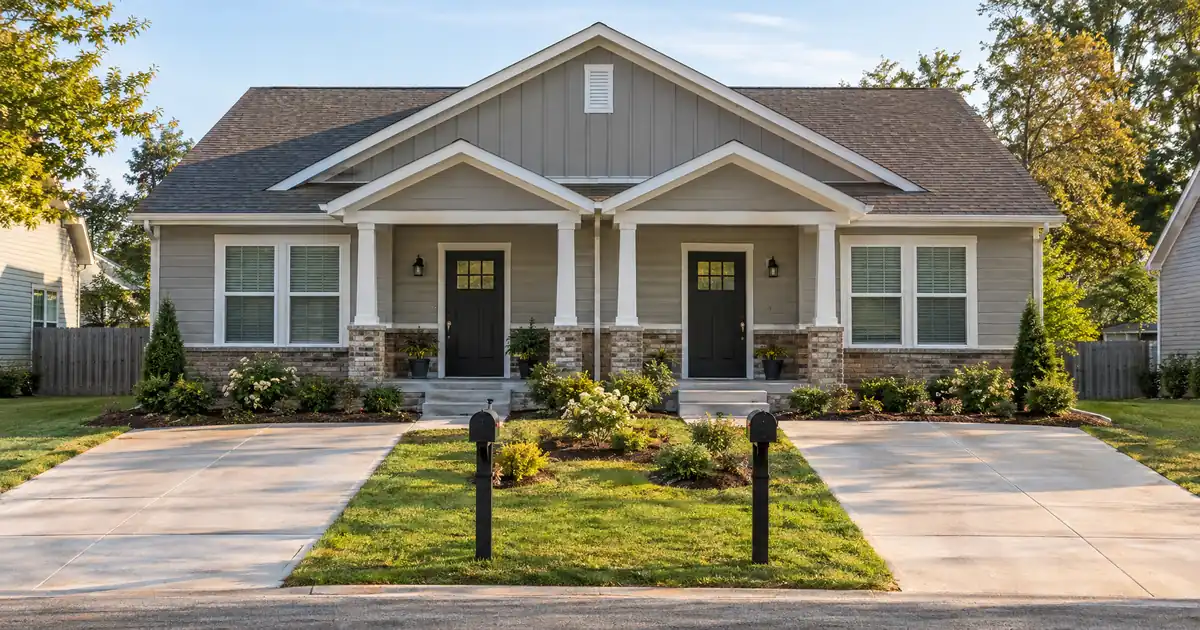
The Quick Read: Yes, but only on the rental portfolio term loan, because the five-unit building rules out the 30-year portfolio DSCR loan, which holds only one-to-four-unit rentals, condos, and townhomes. The pair adds up to seven units under one note, and the program qualifies the pool on combined rent against combined debt, subject to lender guidelines.
- The five-unit building is the deciding variable. The duplex fits almost anywhere.
- The 30-year portfolio DSCR loan takes the duplex but not the five-unit.
- The rental portfolio term loan takes both, with shorter fixed terms and a balloon at maturity.
- Coverage is measured on the whole pool, so a stronger building can offset a weaker one.
- Clearing 1.00 coverage is not the same as making money. DSCR counts rent against the payment only.
Why Five Units Is the Line
A duplex is residential collateral. A five-unit building is commercial-style multifamily collateral. That split drives which loan structure can hold each building.
Per LoopNet’s explainer on whether multifamily is commercial, properties with two to four units are treated as residential, and five or more are treated as commercial. The same page notes that zoning and local assessor practice can override the line. So the five-unit threshold is a market convention, not a DSCR rule. It still decides how a lender appraises, underwrites, and structures the loan.
Our wholesale network follows the convention. Most lenders in it are comfortable with a duplex in a pool. Far fewer will put a five-unit building under the same note as residential rentals. The ones that will usually do it through a specific program built for it.
How a Portfolio DSCR Loan Works
A portfolio DSCR loan, also called a blanket loan or cross-collateralized loan, is one note secured by several rentals. You get one loan, one payment, and one set of loan documents. These three names mean the same thing here.
Cross-collateralization means every property in the pool secures the whole debt. Default on the note and the lender can look to all of the collateral. That is the price of the convenience.
The DSCR itself is rental income divided by the monthly debt payment. On a pooled loan, you add up all the rent used for lender review, add up all the debt service once, and divide. Wikipedia’s entry on the debt service coverage ratio gives the formula: income over debt service, with above 1.0 meaning income covers the debt and below 1.0 signaling a shortfall. It is a total over a total, not an average of two separate ratios.
One more term matters here. A bank’s portfolio loan, meaning a loan the bank keeps on its own books, is a different sense of the word. It has nothing to do with this structure.
Which Structure Can Hold Both Buildings?
Two portfolio structures exist in the network, and they split on the five-unit building. Both are program ceilings and floors, not quotes, and each file is underwritten individually.
| Factor | 30-year portfolio DSCR loan | Rental portfolio term loan |
|---|---|---|
| Properties under one note | 2 to 20 | 5 or more properties or units |
| Loan size | $300,000 to $5,000,000 | $500,000 to $50,000,000 |
| Leverage | Up to 80% (purchase, rate-and-term) | Up to 75% |
| Five-plus-unit building | Not eligible | Eligible as small multifamily |
| Term | 30 years, interest-only period available | 3, 5, 7, or 10 years, balloon at maturity |
Both loan sizes may go higher on review.
The 30-year portfolio DSCR loan covers single-family homes, two-to-four-unit buildings, condos, and townhomes. A duplex plus a second duplex works. A duplex plus a five-unit building does not, because the five-unit sits outside that property list.
The rental portfolio term loan counts units as well as properties toward its five-or-more threshold. A five-unit building and a duplex total seven units, so the pair clears the count. The program lists small multifamily as eligible collateral. Think of it as the structure built for investors whose pool leans larger.
The trade-offs are real. Terms are fixed for three to ten years and end in a balloon, so you refinance or pay off at maturity. Prepayment uses yield maintenance, a payoff charge meant to make the lender whole for the interest it will not collect. Recourse and non-recourse versions both exist. A non-recourse loan looks to the real estate, with carve-outs for things like fraud and bankruptcy. A recourse loan carries a personal guarantee.
Reserves on the term loan are held for taxes, insurance, and capital expenditures. Some portfolio structures also require a special-purpose entity, typically an LLC, per lender program requirements.
How Each Building Gets Measured
Here is the part few lenders explain. The two buildings are not measured the same way, even inside one pool.
For the duplex, the lender compares rent used for lender review to the full monthly payment, meaning principal, interest, taxes, insurance, and any association dues. That payment total is called PITIA. Rent used for lender review is the lease or an appraiser-supported market rent.
For the five-unit building, the lender builds an operating picture: income, then expenses, then net operating income, or NOI. LoopNet’s explainer on multifamily property defines commercial DSCR on that same basis, NOI over debt service. You will need a rent roll and leases, and often an operating statement.
How a program folds those two inputs into a single pooled number is program-specific. The principle holds, though. One total of qualifying income goes over one total of debt service.
The appraisals differ too. The duplex is appraised on the small residential income report. Fannie Mae’s Form 1025 instructions describe that form as built for two- to four-unit properties, and Freddie Mac’s matching Form 72 carries the same scope. DSCR loans are not agency products. The forms matter only because they show where the appraisal method changes. A five-unit building moves to a commercial-style, income-based appraisal.
A Worked Pool
Say the duplex covers its own debt at roughly 0.95x and the five-unit covers its debt at roughly 1.30x. Those are modeled assumptions, not market data.
Whether the pool clears 1.00 depends on how much of the total debt sits on each building. If the five-unit carries most of it, the pool lands comfortably above 1.00. If the duplex carries most, it may not.
A rental below 1.00 can sit in the pool, and underwriting tests the pooled coverage, the leverage, and the terms. The stronger building helps the weaker one, but it can’t hide it.
This works in reverse too. A vacant or heavy-rehab five-unit drags the whole pool, and it can sink the file. Lenders in the network want a stabilized, leased building. A thin duplex is a smaller problem than a half-empty five-unit.
Here is a wrinkle on the leverage side. The term loan tops out at 75% of value, while the 30-year structure reaches 80% on a purchase. Adding the five-unit to the pool moves you into the lower-leverage structure. Plan your down payment for that cap, not for the higher figure.
Which Structure Fits Your Pair?
This one is a genuine judgment call. A single note is tidy, and the five-unit forces it onto the term loan, so the real question is whether you want a balloon.
Here is how the paths usually sort out:
1. Both buildings, one rental portfolio term loan. Best when you want one note and can handle a fixed term with a balloon and a yield-maintenance payoff.
2. Five-unit on the term loan, duplex on its own DSCR loan. Best when you want the duplex on a 30-year schedule, with its own lien and its own payoff. You pay for two closings and two payments.
3. Duplex joins other one-to-four-unit rentals in a 30-year portfolio DSCR loan; the five-unit stays separate. Best when you are really building a pool of small rentals and the five-unit is the outlier.
4. Wait on the five-unit. If it is vacant, mid-renovation, or mixed-use, it does not fit the pool yet.
If you are weighing larger pools, Lendmire’s piece How to Qualify for a Blanket DSCR Portfolio Loan at the Five-Million Mark covers the bigger end. For the full picture of how these loans work, see the complete DSCR loans guide.
What Can Go Wrong
Cross-default is the big one. Every property secures the whole debt, so a problem at one building can reach the other. A two-asset pool has no diversification to soften that.
Release terms come next. A partial release lets you sell one property out of the pool, but the release price runs above the property’s allocated balance. The remaining pool must still cover its own debt service. Read those terms before you sign, because they decide whether a future sale of the duplex is simple or expensive.
Eligibility traps also catch people:
- Owner-occupancy. Owner-occupied property is ineligible. Living in one of the five units takes that building out.
- Mixed-use. A five-unit with a storefront is mixed-use, and mixed-use is ineligible in the pool. So are co-ops and commercial property.
- Separate buildings do not add up. Two triplexes do not combine into five-plus-unit treatment. Aggregation generally only works for units on one parcel.
- Manufactured and mobile homes. These are not reviewable on any of these programs.
- Entity and title mismatch. If the duplex is titled in your name and the five-unit sits in an LLC, the file stalls until ownership lines up.
The cash-flow trap is separate. A pool that clears 1.00 can still lose money. DSCR leaves out repairs, vacancy, management, utilities, and capital expenditures. Treat it as a qualification test, not a profit forecast.
Key Terms Defined
PITIA: the monthly principal, interest, taxes, insurance, and association dues on a property.
NOI (net operating income): a building’s rental income minus its operating expenses, before debt payments.
Pooled DSCR: total qualifying income across all properties divided by total debt service on the whole loan.
Cross-collateralization: every property in the pool secures the entire loan, not just its own share.
Balloon: a lump-sum balance due at the end of a fixed term, usually paid off by refinancing.
Yield maintenance: a prepayment charge that compensates the lender for interest lost when you pay off early.
The File Checklist for a Hybrid Pool
Expect to document each building on its own terms:
- Five-unit: rent roll, leases, an operating statement, and evidence it is stabilized.
- Duplex: leases or an appraiser-supported market rent.
- Both: insurance, tax records, and consistent entity and title documents.
- You: a credit score that clears the portfolio floor. Across these programs it starts at 640, and some structures ask for 680 or 720.
Two different appraisal methods in one closing also means more moving parts to coordinate. Ordering both early keeps one report from holding up the other.
Frequently Asked Questions
Can a five-unit building go into the 30-year portfolio DSCR loan?
No. That structure holds single-family homes, two-to-four-unit buildings, condos, and townhomes. A five-unit building is eligible only inside the rental portfolio term loan, which accepts small multifamily.
Does a duplex count as one property or two?
One property with two units. It counts as a single property toward the 2-to-20 property range on the 30-year portfolio loan. On the term loan, units count toward the five-or-more threshold, so the duplex adds two.
Is the pooled ratio an average of the two buildings?
No. Underwriting adds up all qualifying income, adds up all debt service, and divides once. A large building carries more weight than a small one.
What if the five-unit has vacant units?
It weakens the file. Lenders in the network favor stabilized, leased buildings, and vacancy cuts the income that counts toward coverage. A mostly vacant or heavy-rehab building usually points to waiting or to a different financing path.
Can I sell just the duplex later?
Possibly, under the loan’s release terms. The release price runs above the duplex’s allocated balance, and the remaining pool must still cover its debt. Ask for the release language up front.
Next Step
If you are buying or refinancing a rental property and want to see how the numbers work, Lendmire can help you compare DSCR loan options based on the property income, credit profile, leverage, and investor goals. A mixed pair like this one is also worth comparing against a staged approach, with two separate loans.
Lendmire arranges DSCR financing through select lenders in its wholesale network. Eligibility depends on the lender, the property, and underwriting, and nothing here is a commitment to lend. For a related look at small-building pools, see Lendmire’s piece How to Qualify for a Blanket Super Jumbo DSCR Loan for a 2-4 Unit Portfolio.
The five-unit line was drawn for appraisers and underwriters long before DSCR existed, and a seven-unit pair still has to cross it.
About Lendmire
As a non-QM mortgage broker (NMLS# 2371349), Lendmire facilitates DSCR investor loans across 41 markets, including Washington, D.C. DSCR eligibility is generally reviewed around property-level rental income instead of personal income documentation, subject to lender guidelines, serving LLC-structured portfolios and self-employed borrowers who don’t fit conventional boxes. A two-time Scotsman Guide Top Mortgage Workplace (2025, 2026).
Get Started
Ready to find the right loan for you?
In about 30 seconds you can review financing options available for your investment property. No commitment required.
Informational only. Not a Loan Estimate, approval, or commitment to lend. Program availability and eligibility are subject to lender guidelines, credit approval, property review, and underwriting.
References
1. LoopNet — Is Multifamily Commercial?
2. Wikipedia — Debt service coverage ratio
3. LoopNet — What Is a Multifamily Home?
4. Fannie Mae — Form 1025 instructions
5. Freddie Mac — Form 72 / Fannie Mae Form 1025
This article is part of Lendmire’s DSCR loan program — full qualification details, guidelines, and scenarios live on the program page.
Related reading: Can an Investor With 10+ Doors in LLCs Get a DSCR Portfolio Loan? · How to Prepare Guarantor Credit for a Portfolio DSCR Loan · Can a Scattered Rental Portfolio Qualify for One DSCR Loan?
Brandon Miller
Founder & CEO, Mortgage Loan Originator, Lendmire LLC
- Mortgage Loan Originator · NMLS# 1129696 · Verify on NMLS Consumer Access
- North Carolina Real Estate Broker · License# 343312 · Verify on NCREC
- North Carolina Insurance Producer · License# 19053198 · Property, Casualty, Life, Health · Verify on NAIC SBS
- Lendmire LLC · Firm NMLS# 2371349 · Verify firm licensure
Compliance and disclosures. Lendmire (NMLS# 2371349) is a licensed mortgage broker and is not a direct lender, depository institution, financial advisor, or tax professional. Content in this article is general market analysis and educational information — not financial, legal, or tax advice for any specific situation. Lendmire does not guarantee loan approval; every transaction is subject to underwriting by the funding lender. Mortgage pricing and loan program guidelines are subject to change at any time without notice and vary by borrower characteristics, property type, and state regulations. Lendmire complies with Equal Housing Opportunity. Licensure verification: NMLS Consumer Access.