
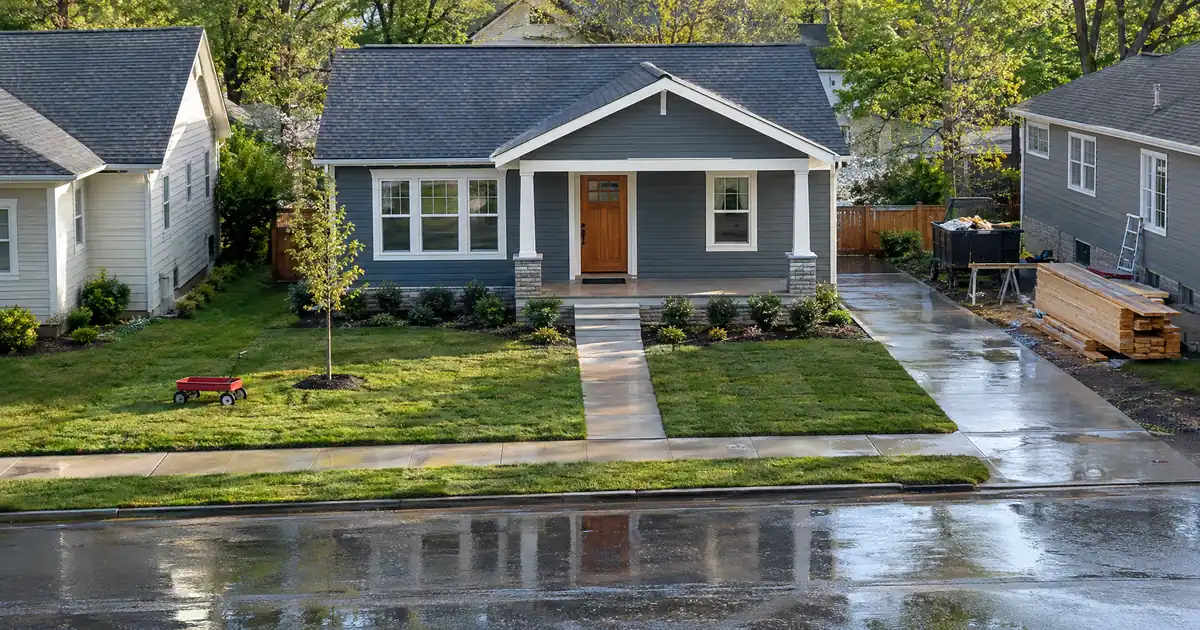
The Quick Read: You fund the cash portion of an out-of-state bridge purchase from assets you own, such as savings, sale proceeds, or equity in another investment property, and you document where every dollar came from, because a hard money lender lends against the property and still expects you to bring real equity. Where the property sits matters less than how clean your funds trail is.
- Bridge purchases without rehab typically go up to 80% of the purchase price, so expect to bring roughly 20% plus closing costs and reserves. Terms vary by lender, property, and experience.
- Fix-and-flip leverage is measured against project cost, runs 85% to 93% by experience tier, and stays capped at 75% of after-repair value.
- No true 100% purchase program exists. Rehab money can fund in draws, but that is a separate budget, not your down payment.
- A second loan stacked on top of the first, just to cover your down payment, is rarely available.
- Plan the exit before you close, because the bridge is short-term and interest-only.
The Quick Read covers the answer. The sections below cover the mechanics: where the cash can come from, how a lender treats it, and where the plan breaks.
What this loan actually costs to carry.
Hard money is sized against the project and priced by time. Enter the deal and see how much the program will lend, the cash required at closing, the carry while you hold it, and what is left at the exit.
Leverage tiers on the current program: 85% with fewer than 2, 90% with 2 or more, 93% with 5 or more completed projects — every tier capped at 75% of after-repair value. Loan amounts up to $5,000,000, larger by exception; terms of 6 to 18 months, interest-only, no prepayment penalty. The rehab portion funds in draws against completed work, not at closing.
Program parameters shown update from Lendmire’s centralized guideline source. Rate, points, and months are editable assumptions, not quoted terms.
Cost cap sets the loan · positive spread
Illustrative estimate only — not a quote, Loan Estimate, approval, or commitment to lend. Rate, points, and months are editable assumptions. Hard money is business-purpose financing for real estate investors, not a consumer mortgage. Leverage on the current program tops out at 93% of project cost for investors with a documented track record, capped at 75% of after-repair value, with rehab funding up to 100% of the documented budget released in draws; actual terms vary by lender, borrower experience, property, and exit. Lendmire is a mortgage broker, not a lender.
Key Terms Defined
Hard money bridge loan: A short-term, interest-only loan secured by the property. It “bridges” you to a sale or a long-term refinance. The lender reviews the property, your plan, and your exit.
Loan-to-cost: The loan as a share of what the whole project costs (purchase plus rehab). Fix-and-flip leverage is quoted this way.
After-repair value (ARV): What the property is expected to be worth when the work is done.
Cross-collateralization: Pledging a second property as extra security, so one loan is backed by two properties.
Sourcing of funds: The paper trail showing where your down payment came from. Bank statements, a sale settlement statement, or a signed note from a partner all count.
Takeout: The event that repays the bridge: a sale or a refinance into longer-term financing.
Why “Out of State” Matters Less Than You Think
Out-of-state buyers can use hard money. The loan is built on the property, not on where you live. Most of the process runs remotely: submitting the deal, signing electronically, and wiring funds to the title company. Remote notarization is common in many places.
Three things do change when you buy in another state.
First, the lender has to be able to lend where the property sits. Private-lending rules differ by state, and the lender’s footprint is not unlimited. Lendmire arranges hard money financing in 41 markets, including Washington, D.C., so confirm early that the property’s location is served.
Second, closing mechanics differ. Investor-education guidance notes that some states require an attorney while others use title companies. Your closing agent will tell you which applies.
Third, you can’t walk the property in an afternoon. That raises risk on the rehab side and the appraisal side, not on the down payment side. Hold that thought, because it changes how much cash you should bring. More on that below.
How Underwriting Treats Your Down Payment, Step by Step
A bridge lender looks at four things: the property, the plan, the exit, and you. Your down payment sits inside the “you” piece, and the lender reads it like this.
Step 1: The lender sets the leverage tier. On the programs Lendmire places files with, bridge purchases without rehab go up to 80% of the purchase price. Fix-and-flip files are sized on loan-to-cost: 93% of project cost at five or more completed projects, 90% at two or more, and 85% with fewer than two. Every tier is capped at 75% of after-repair value. Everything above the loan is yours to fund. All of this varies by lender, property, and experience.
Step 2: The lender checks the credit and experience profile. A 620 score is the typical minimum, with additional conditions below 660. First-time investors qualify at the lower leverage tiers. The top tier is reserved for experienced operators. If you are new, your down payment is larger. Plan on it.
Step 3: You show the cash. Expect to hand over recent asset statements. The lender wants proof you hold the down payment, closing costs, and a cushion for carrying the loan.
Step 4: The lender reads the sourcing. Underwriters question large, recent deposits and unexplained transfers. A transfer from your own brokerage account is easy to explain. A deposit of unknown origin is not. Skip any advice about making the source invisible. Lenders ask for documentation, and hiding a source of funds can sink an otherwise good file.
Step 5: The lender reviews borrowed money. Lenders split here. Some will accept funds drawn from equity you own, once documented. Others want the cash to be yours outright. Ask which camp a lender is in before you spend money on an appraisal.
Step 6: The lender tests the exit. A bridge has to be repaid. Many investors sell, or refinance into long-term rental financing once the property is stabilized. A down payment funded with borrowed money makes that later refinance harder to sort out, because the next lender will also read the sourcing.
Where the Down Payment Cash Can Come From
Every source below is real, and each fails differently. Pick the one whose failure you can survive.
| Source | How it works | Main risk | Fit |
|---|---|---|---|
| Cash savings | Statements show the funds | Drains reserves | Cleanest file |
| Sale proceeds | Settlement statement documents it | Timing gap between sale and purchase | Investors rotating assets |
| Cash-out on another property | Refinance pulls equity out | Seasoning, extra lien | Owners with built-up equity |
| Cross-collateral | Second property backs the bridge | Two properties exposed to one default | Strong equity, thin cash |
| Equity line on an owned home | Draw against equity | Line can be reduced; home is at risk | Owners who can carry it |
| Partner capital | Partner funds, documented by a note | Partner terms and disclosure | Deals with a clear role split |
Two rows deserve more than a table cell.
The equity line, in plain terms
An equity line (HELOC) is a revolving line of credit secured by your home. The CFPB explains that you can borrow against it repeatedly during a draw period. It also warns that a lender may stop further draws if the home’s value falls significantly or your finances change. And you could lose your home if you can’t repay.
That freezing risk is the catch for an investor mid-deal. These lines are also typically variable-rate, so the carrying cost can move while your bridge is running. A line is a tool, not free money. Treat the draw as a debt that has to be repaid when the bridge ends, and make sure the exit covers both loans.
Note the occupancy point, too. Hard money here is business-purpose, secured by non-owner-occupied property. An owner-occupied home is not collateral for the bridge itself. Using its equity through a separate bank line is a different transaction from putting it into the hard money loan.
Cross-collateral, the flexible one
If you own an investment property with real equity and little debt, some lenders can take it as added collateral. That can stretch leverage without you writing a check. It is also the most dangerous option on the table. Two properties now stand behind one loan, so a stalled exit puts both at risk. This option varies by lender. Ask whether a lender does it at all, and how it handles liens in two states.
Why a Hard Money Loan for the Down Payment Itself Is Rare
Many investors ask whether they can borrow the down payment on a second hard money loan. Usually no.
Hard money lenders want first-lien position on the property they finance. A second loan sitting behind the first, pushing combined leverage toward the full price, is the kind of structure a careful lender avoids. It also adds cost and risk for whoever sits second in line.
What does exist is a structure where a single bridge is secured against two properties, or where a loan on the property you already own funds the cash for the new purchase. Those are not second loans on the purchase. They are different collateral decisions, and they come with the leverage caps described above.
There is also no true 100% purchase program. When someone advertises close to full financing, look for what is actually financed. Usually it is a rehab budget funded in draws as work is completed, up to 100% of that budget. That is a figure about renovation costs, not a purchase loan-to-value. The down payment is still yours.
Collateral Across State Lines
This is where out-of-state deals get tricky, and where most explanations stop. Suppose your equity sits in one state and the purchase is in another.
Each property carries its own lien, its own title work, and its own appraisal. A lender securing both has to record in two jurisdictions. That means two title searches and two valuations. The lender’s licensing has to fit the state of the property it is lending against, too.
Practical consequences:
- Each property must qualify on its own. For hard money here that means non-owner-occupied residential property of one to four units, or ground-up construction up to ten units. Commercial, land, and owner-occupied property are not on the sheet.
- The extra collateral costs time and money. A second appraisal and second title search are real expenses. They come out of your cash, which is the thing you were short of.
- Leverage is blended. The lender looks at combined exposure across both properties, not just the new one.
- Existing mortgages on the equity property matter. A lender will look hard at what already sits ahead of it.
If the cross-state version feels like too much, the simpler alternative is to cash out the equity separately. Pull the money out of the existing property first, let it sit documented in your account, then use it as the down payment. That separates the two files cleanly. On the DSCR side, cash-out refinances generally top out around 75% LTV on standard rentals across most of the network, and roughly six months of seasoning is the common expectation. Treat that clock as part of your timeline.
What the Full Cash Need Looks Like
The down payment is not the whole check. Hard money borrowers cover several pieces beyond it.
| Cost | Financed by the loan? | Out of your pocket? |
|---|---|---|
| Down payment (gap to the loan) | No | Yes |
| Closing costs and fees | Generally no | Yes |
| Rehab budget | Draws, up to 100% of budget | Float between draws |
| Interest carry (interest-only) | No | Yes |
| Reserves and cushion | No | Yes |
| Remote oversight and travel | No | Yes |
The rehab float is the one first-timers miss. Draws fund against completed work. So you often pay a contractor first and get reimbursed after the work is verified. If you are managing a project from another state, keep extra cash on hand for exactly that.
Lendmire’s article Can Out-of-State Investors Get a Large Hard Money Bridge Loan? speaks to loan size, which is a separate question. Loan amounts on these programs run up to $5,000,000, with larger by exception.
A Worked Example, in Percentages
Run the numbers on a modeled bridge purchase with no rehab. These are assumptions, not market data.
Say you buy a single-family rental out of state. The bridge goes up to 80% of the purchase price. That leaves roughly 20% of the price for you to cover, before closing costs, interest carry, and reserves.
Now say you fund that 20% by pulling equity out of a rental you own free and clear. Your sourcing file has three items: the cash-out settlement statement, the account statement showing the deposit, and the wire out to the title company. Every dollar has a trail.
Compare that to a flip. A fix-and-flip buyer with two or more completed projects can reach 90% of project cost. A first-timer sits at the 85% tier. The gap between the tiers is your cash difference, and it shows why experience lowers your out-of-pocket money. Both are capped at 75% of after-repair value, so a project with an optimistic ARV does not get extra leverage.
Lenders for the long-term rental loan will test whether rent covers the full monthly obligation. Clearing a 1.00 coverage ratio, which is where many select programs start, does not mean the property produces positive cash flow. Repairs, vacancy, management, and utilities sit outside that calculation. A separate select-lender path takes coverage below 1.00 with leverage and terms adjusted. Cash left over after the bridge is what protects you when reality diverges from the plan.
Exit Planning: The Part That Decides Everything
The bridge term runs 6 to 18 months, interest-only, with no prepayment penalty. There are no multi-year options on this program. If you need a longer runway, you refinance into long-term rental financing.
Many investors do exactly that, and Lendmire brokers the refinance out of hard money into a DSCR loan once the property is stabilized. For the broader mechanics, see the complete DSCR loans guide. Two points matter for the down payment:
1. The refinance is a new approval. The long-term lender qualifies the property on rental income covering the payment, subject to lender guidelines, plus credit and reserves. Reserves commonly run about six months, though they vary by lender, leverage, and loan size.
2. Seasoning counts from your purchase. If you need roughly six months before the refinance works, size the bridge term so that clock runs out well before maturity.
One trap: delayed financing, an agency-style exception that lets cash buyers pull their money back out soon after purchase, is built for buyers who paid cash. A purchase funded by a bridge loan generally doesn’t qualify, because the settlement statement shows financing. Treat your later refinance as a standard cash-out with a seasoning clock, and don’t plan around anything faster.
And what if the exit slips? Build a fallback before you close. Options include extending with the lender if the program allows it, selling, or refinancing at lower leverage. Ask every lender how extensions work before signing.
Where the Plan Breaks
Be honest about the failure points.
- The lender won’t accept borrowed funds. You find out after paying for an appraisal. Ask first.
- The equity line gets reduced mid-deal. Your cash vanishes between contract and closing. Draw early and park the funds in your own documented account.
- Cross-collateral turns one problem into two. A stalled exit now threatens a property you never planned to put at risk.
- Your documentation is thin. Unexplained deposits slow files or end them.
- You underestimate the rehab float. Out-of-state projects tend to cost more to oversee, not less.
- The property isn’t eligible. Manufactured homes, log homes, and barndominiums are not offered on the DSCR side. Hard money covers non-owner-occupied one-to-four unit residential property.
The stronger play for most first-time out-of-state buyers is often the boring one. Use cash you own, keep the file simple, and carry extra reserves. Cross-collateral can work, though for a first remote deal it asks a lot.
How to Sequence It
Order matters more than speed. Lay it out like this:
1. Confirm the property’s location is served and the lender is permitted to lend there.
2. Choose your source and, if it’s a cash-out or sale, complete it first so the money is seasoned and documented.
3. Get the leverage tier and your credit position in writing.
4. Put the property under contract.
5. Submit your asset statements and sourcing file.
6. Close remotely, using the title company’s verified wire instructions. Call to confirm them by phone, since wire fraud targets remote buyers.
7. Start the exit clock the day you close.
Doing step 2 before step 4 is the habit that separates smooth files from stressful ones.
Frequently Asked Questions
Can I use borrowed money as my down payment?
Sometimes. Some lenders accept funds drawn from equity you own once it is documented, and others want the cash to be yours outright. Every lender reads large recent deposits closely. Ask early, and keep a complete paper trail.
Do I need a local bank account or address to buy out of state?
No. Remote submission, electronic signing, and wires to a title company are standard. What you need is a lender that serves the property’s location and a closing agent who knows that state’s closing practices.
Does a bigger down payment help my later DSCR refinance?
It helps in one way. A lower balance means a lower monthly payment, which can lift coverage. It does not erase leverage caps, credit floors, reserve rules, or property eligibility. The strongest files have enough equity and enough rental coverage.
What credit score do I need?
A 620 score is the typical minimum on these programs, with additional conditions below 660. First-time investors qualify at the lower leverage tiers, and the top tier is reserved for experienced investors. Everything varies by lender, property, and experience, and nothing is a commitment to lend.
Can the bridge cover 100% of my purchase?
No. There is no true 100% purchase program. Rehab money can fund up to 100% of the renovation budget in draws against completed work. The purchase itself needs your cash.
If you are buying, rehabbing, or refinancing an investment property and want to see how the numbers work, Lendmire can help you compare hard money options based on the project, the exit plan, leverage, and your goals.
About Lendmire
As a DSCR and non-QM mortgage broker, Lendmire — NMLS# 2371349 — connects investors with wholesale lending channels across 41 markets, including Washington, D.C. The property’s rental income, not the borrower’s traditional personal-income documentation, is central to lender review, which works for self-employed operators and portfolios beyond four financed properties. Scotsman Guide named Lendmire a Top Mortgage Workplace in both 2025 and 2026.
Get Started
Ready to find the right loan for you?
In about 30 seconds you can review financing options available for your investment property. No commitment required.
Informational only. Not a Loan Estimate, approval, or commitment to lend. Program availability and eligibility are subject to lender guidelines, credit approval, property review, and underwriting.
References
1. Tellus – Financing out-of-state properties
2. CFPB – What is a home equity line of credit (HELOC)?
This article is part of Lendmire’s hard money loan program — full qualification details, guidelines, and scenarios live on the program page.
Related reading: How Much Down Payment a Hard Money Lender Requires on a Flip · Hard Money Bridge Down Payment Requirements for Out-of-State Investors · Hard Money Down Payment vs HELOC Draw for an Investor Purchase
Brandon Miller
Founder & CEO, Mortgage Loan Originator, Lendmire LLC
- Mortgage Loan Originator · NMLS# 1129696 · Verify on NMLS Consumer Access
- North Carolina Real Estate Broker · License# 343312 · Verify on NCREC
- North Carolina Insurance Producer · License# 19053198 · Property, Casualty, Life, Health · Verify on NAIC SBS
- Lendmire LLC · Firm NMLS# 2371349 · Verify firm licensure
Required disclosures. Lendmire (NMLS# 2371349) operates as a licensed mortgage broker, not a direct lender or depository. The discussion in this article is general in nature and should not be relied upon as financial, legal, or tax advice — every investment scenario is unique and should be reviewed by a qualified professional. Any loan inquiry is subject to lender underwriting, and this article is not a commitment to lend or a guarantee of approval. Mortgage rates, loan terms, and program guidelines vary by borrower, property, and state, and may change without notice. Equal Housing Opportunity. Verify licensure at NMLS Consumer Access.