
The Quick Read: Your down payment is the gap between total project cost and what the lender advances. You size it by testing the deal against two limits, project cost and after-repair value, and then budgeting separate cash for closing costs, interest carry, reserves, and the first rehab draw. The stricter limit decides your cash in.
- Across the network, fix-and-flip leverage typically runs 85% of project cost with fewer than 2 completed projects, 90% at 2+, and 93% at 5+. Every tier is capped at 75% of after-repair value, and it all varies by lender, property, and experience.
- A bridge purchase with no rehab typically goes up to 80% of purchase price.
- Up to 100% of the rehab budget funds in draws against completed work, so you front early costs yourself.
- Purchase funding always stops short of the full price. The 100% figure applies to the rehab budget only.
- The down payment is one line item. Closing costs, carry, and reserves sit on top of it.
What the Down Payment Actually Is
The down payment on a hard money flip is not a flat percentage of price. It is whatever remains after the lender advances its share of the project. Hard money is short-term, interest-only financing secured by the property, so lenders look hard at the deal itself. They look at what you pay, what you spend on the rehab, and what the finished building should be worth.
What this loan actually costs to carry.
Hard money is sized against the project and priced by time. Enter the deal and see how much the program will lend, the cash required at closing, the carry while you hold it, and what is left at the exit.
Leverage tiers on the current program: 85% with fewer than 2, 90% with 2 or more, 93% with 5 or more completed projects — every tier capped at 75% of after-repair value. Loan amounts up to $5,000,000, larger by exception; terms of 6 to 18 months, interest-only, no prepayment penalty. The rehab portion funds in draws against completed work, not at closing.
Program parameters shown update from Lendmire’s centralized guideline source. Rate, points, and months are editable assumptions, not quoted terms.
Cost cap sets the loan · positive spread
Illustrative estimate only — not a quote, Loan Estimate, approval, or commitment to lend. Rate, points, and months are editable assumptions. Hard money is business-purpose financing for real estate investors, not a consumer mortgage. Leverage on the current program tops out at 93% of project cost for investors with a documented track record, capped at 75% of after-repair value, with rehab funding up to 100% of the documented budget released in draws; actual terms vary by lender, borrower experience, property, and exit. Lendmire is a mortgage broker, not a lender.
Two things follow from that. First, a strong deal can need less cash than a weak one at the same experience level. Second, the down payment is not your total cash to close. Closing costs, prepaid items, and fees are separate buckets, and we cover them below.
One disambiguation matters. Low-down-payment programs for owner-occupied 2-4 unit purchases are a different product. They are built for buyers who will live in one unit. A flip is business-purpose, non-owner-occupied lending, and none of those owner-occupant rules carry over.
Key Terms Defined
Down payment: The portion of project cost you fund yourself after the lender’s advance.
Loan-to-cost (LTC): The loan as a share of purchase price plus rehab budget.
After-repair value (ARV): The appraised or estimated value of the property once the work is finished.
Loan-to-ARV: The total loan as a share of ARV. It acts as a ceiling on the deal.
Draw: A release of rehab funds after a stage of work is completed and verified.
Seasoning: The time your cash has sat in your accounts before a lender accepts it as yours.
Proof of funds: A statement showing you hold the cash to close.
Cross-collateral: Pledging a second property as extra security for the loan.
DSCR: Debt service coverage ratio. It compares a rental’s income to its monthly payment of principal, interest, taxes, insurance, and any association dues, known together as PITIA.
How Underwriting Sizes Your Cash, Step by Step
Underwriting runs your deal through several tests and applies the most conservative result. Baseline Software’s fix-and-flip guide describes the same pattern: lenders run loan-to-value, loan-to-cost, and loan-to-ARV, and the tightest one controls. A lender may advertise a high cost percentage, but the ARV cap can override it.
Here is the sequence on most files we place:
1. Add up project cost. That is the purchase price plus the rehab budget.
2. Apply the cost test. Your experience tier sets the percentage of project cost the lender will advance.
3. Apply the value test. The total loan cannot exceed 75% of ARV, whatever your tier says.
4. Take the lower number. The gap between that and project cost is your cash.
5. Check how the lender splits the money. The purchase advance funds at closing, while the rehab budget typically releases in draws against finished work.
Run it with modeled index figures, not dollars. Say the purchase is 100 units of cost and the rehab is 30. These inputs are assumptions for illustration, not market data.
| Item (index units) | Thin spread | Wide spread |
|---|---|---|
| Purchase plus rehab | 100 + 30 = 130 | 100 + 30 = 130 |
| After-repair value | 140 | 180 |
| Cost test at 90% of project cost | 117 | 117 |
| Value cap at 75% of ARV | 105 | 135 |
| Limit that binds | ARV cap | Cost test |
| Your cash | 25 (about 19% of cost) | 13 (10% of cost) |
The tier said 90%, yet the thin-spread buyer put in nearly 19% of project cost. The ARV cap did the damage. A simplified example like this treats the advance as one pool, and real lenders split purchase and rehab, so ask how yours does it.
What Experience and Credit Change
Experience moves the cost test more than anything else. Typical network tiers, subject to lender guidelines, look like this:
| Completed projects | Cost test | Minimum cash share of project cost |
|---|---|---|
| Fewer than 2 | 85% of project cost | 15% |
| 2 or more | 90% of project cost | 10% |
| 5 or more | 93% of project cost | 7% |
The cash share in the last column is the floor before the 75% ARV cap applies. The top tier is reserved for experienced investors, and every figure varies by lender, property, and experience.
Credit works differently. A 620 score is the typical minimum, with additional conditions below 660. First-time investors do qualify, but at the lower leverage tiers. Underwriting stays asset-based, meaning the lender weighs the property, the plan, and the exit. It does not ignore credit.
Loan size is rarely the constraint on a 2-4 unit flip. Loan amounts run up to $5,000,000, larger by exception, and smaller balances vary by lender. Terms run 6 to 18 months, interest-only, with no prepayment penalty. Many lenders have a bridge-loan page on this; the same cash math applies, and Lendmire’s article Does a 2-4 Unit Flip Need a Bigger Down Payment With Hard Money? covers that question directly.
Why 2-4 Units Behave Differently
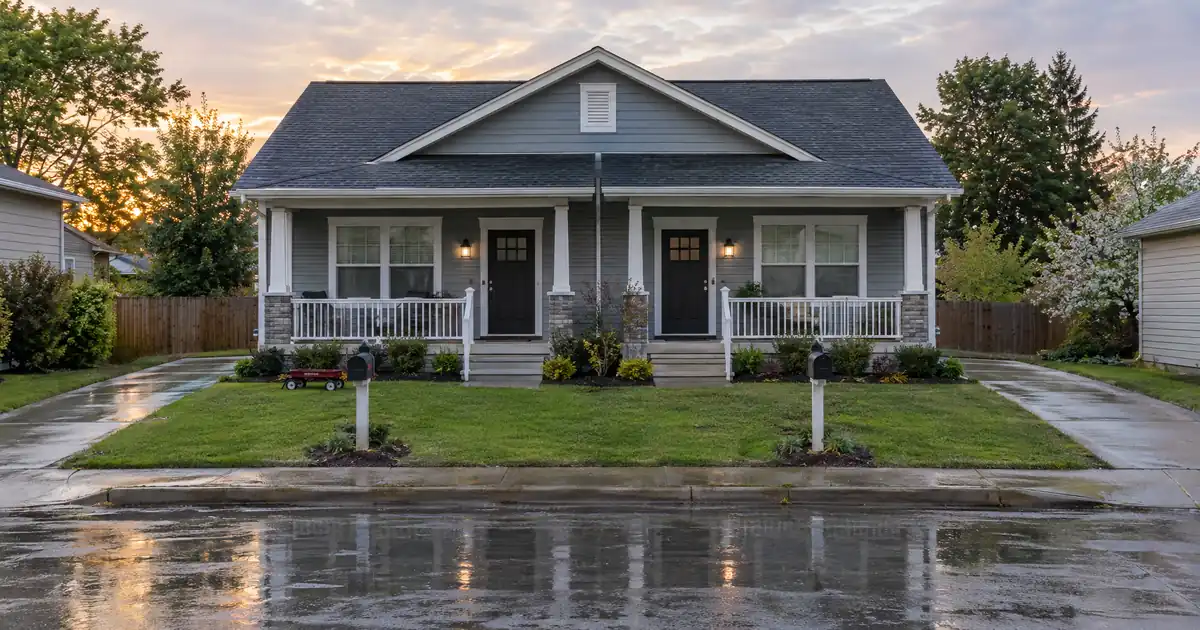
A property with two to four units counts as residential, and hard money lenders treat it much like a single-family flip. The collateral qualifies as non-owner-occupied residential property, 1-4 units. The differences show up in valuation and in the rehab.
Valuation comes first. On conventional 2-4 unit purchases, appraisers use the Small Residential Income Property Appraisal Report, known as Form 1025. The Fannie Mae Selling Guide names that form for two- to four-unit properties, including those inside condo or planned-unit projects. A hard money lender may use its own valuation product instead. Either way, the form shows what matters: rent and unit mix feed the value. Small multifamily comps are thinner than single-family comps, so a conservative ARV is more likely.
The rehab is the second difference. Each unit may have its own kitchen, bath, and systems, so the budget grows with unit count. Tenant-occupied units add a wrinkle, because vacating them delays work and starts the interest clock before the rehab can proceed. A bigger scope can also push your cost number toward the ARV cap, which raises your cash in.
The Full Cash Picture: Beyond the Down Payment
Budget these buckets together, because the down payment is only the first to leave your account:
- Down payment at closing.
- Closing costs and fees, which stay cash due even on a deal with a wide spread.
- Interest carry, since the loan is interest-only and payments continue through the whole project.
- The draw float, because rehab dollars release after work is done, so you front the early stages.
- Reserves, meaning cash left over for overruns and a slow exit. Lender requirements vary, so ask for yours early.
- Exit costs, including any extension fee if the project outlasts the term.
The timeline matters as much as the total. Cash leaves at closing, then again during the early rehab before the first draw reimburses you, and again through carry until you sell or refinance. A buyer who sized only the down payment can run dry in the middle of the project. That is the most expensive place to run dry.
Where the Down Payment Can Come From
Lenders care that the money is yours, documented, and not borrowed against the project. Policies differ by lender, and the table shows typical patterns.
| Source | Typical treatment | Main risk |
|---|---|---|
| Savings | Statements show the balance | Leaves no reserve |
| Borrowed funds | Lender may count the new payment | Debt stacks on the flip |
| Gift | Letter and paper trail | Seasoning varies by lender |
| Partner equity | Entity and title set up first | Profit split, lender consent |
| Cross-collateral | Second property pledged | Both properties at risk |
Seasoning has no universal rule. Some lenders accept proof of funds with no waiting period, while others want the cash in your accounts for one or two statement cycles. Ask before you move money around, because a transfer that looks harmless can create a documentation problem.
Borrowing the down payment deserves extra caution. Hard money lenders generally want first position on the property, so you cannot easily stack a second loan on the flip itself. Lenders may restrict borrowed down payments as well. Even when it is allowed, you carry two payments during a project that earns nothing until it sells.
Partners can fund the cash portion, but the structure has to be set before you make an offer. Decide who holds title, how profit splits, and how the lender will treat a partner’s capital.
Partner structures and entity-titled borrowers are handled, subject to program terms, so confirm eligibility before you sign anything.
Where the General Rule Breaks
A wide spread cuts your cash. When total cost sits well under the ARV cap, the cost test binds, and a top-tier investor may put in as little as 7% of project cost. That is still not zero. Closing costs and the draw float remain.
A big rehab can raise it. Some lenders limit the loan to a share of full cost when the rehab budget is larger than the purchase price or as-is value. That rule forces more cash on high-execution-risk projects. It is one lender’s structure, but it illustrates the principle.
Offers written as cash cause trouble. Write the contract as financed, not cash. A pre-approval or proof-of-funds letter is not a loan commitment, so only the lender’s formal approval obligates it.
Borrowed money can disqualify. Some long-term lenders disallow a borrowed down payment. Check the exit lender’s rules before you borrow the entry cash.
Cross-collateral is the common workaround. Pledging another property can replace cash, but it puts that property at risk if the flip stalls.
If You Are Short on Cash
When the math leaves you short, work through these options in order:
1. Renegotiate the price. A lower purchase price widens the spread and shrinks your cash.
2. Trim the scope. A smaller rehab lowers cost and the draw float.
3. Phase the work. Defer cosmetic items to protect reserves.
4. Bring in a partner. Set the structure in writing first.
5. Walk away. A deal that only works at maximum leverage and zero reserves has no cushion.
Treat the last option as a real choice. Thin reserves on a short-term loan are how flips turn into forced sales.
The Exit Counts Too
Many investors refinance out of hard money into long-term DSCR investor loans once the property is stabilized and rented, and Lendmire arranges that path. DSCR compares rent to the full monthly obligation, and in our network, 1.00 is where select programs start. A separate select-lender path takes coverage below 1.00, with leverage and terms adjusted. Cash-out refinances top out around 75% LTV on standard rentals, with about 6 months of seasoning as the common expectation. These specifics are subject to lender guidelines and a full review of property, leverage, and credit.
Clearing 1.00 does not mean the property produces positive cash flow. Repairs, vacancy, management, and utilities sit outside the calculation. The complete DSCR loans guide covers how coverage is calculated.
Time the refinance against your note term, because a flip that cannot refinance or sell inside the term can trigger extension costs. Tax treatment varies, so consult a qualified tax professional about how the funds and the property are handled.
Pre-Offer Checklist
Confirm these before you write an offer:
- Which leverage tier your completed-project count qualifies for.
- Whether the ARV cap or the cost test is likely to bind.
- How the lender splits the purchase advance and rehab holdback.
- Whether the lender accepts your source of funds, and what seasoning it wants.
- How much cash you need for closing costs, carry, reserves, and the first draw.
- What your exit is, and whether the exit lender’s timing fits the note term.
Frequently Asked Questions
Can I buy and flip a 2-4 unit with no money down?
Not on the purchase. The purchase advance stays below the full price: the top tier is 93% of project cost, and a bridge purchase with no rehab typically goes up to 80% of purchase price. That top tier is reserved for experienced investors. Up to 100% of the rehab budget can fund in draws, but you still pay closing costs and float early costs. Subject to lender guidelines, every file is underwritten individually.
Is the down payment the same as the cash I need to close?
No. The down payment is the gap between project cost and the advance. Cash to close adds fees and closing costs, and a full plan adds interest carry, reserves, and the draw float. Budget all of them before you make an offer.
Does a fourplex need more cash than a duplex?
Not by rule. The leverage percentages are the same, since they depend on experience and the ARV cap. A fourplex usually has a bigger rehab and higher cost, so the dollar cash can be larger. The real driver is how much room sits between cost and value.
Can an equity partner cover the down payment?
Yes, often. Set the entity, title, and profit split before the offer, and tell the lender early. Lender consent and eligibility vary by program and by lender, and the exit lender may have its own view of partner capital.
What if the rehab runs over budget?
Overruns usually land on you, because draws release against the approved budget. That is why reserves matter. Ask the lender how it handles budget changes before you close.
Next Step
If you are buying, rehabbing, or refinancing an investment property on a short timeline and want to see how the numbers work, Lendmire can help you compare hard money options based on the project, the exit plan, leverage, and your goals. The brokerage arranges financing through select lenders in its wholesale network across 41 markets, including Washington, D.C., and nothing here is a commitment to lend. Call 828-256-2183 to talk through a specific 2-4 unit deal.
About Lendmire
Lendmire (NMLS# 2371349), a non-QM mortgage broker serving investors in 41 markets including Washington, D.C., helps structure DSCR scenarios commonly evaluated around a property’s rental income rather than personal income paperwork, subject to lender guidelines. A Scotsman Guide Top Mortgage Workplace in 2025 and 2026, Lendmire places loans through wholesale investor lenders and is not a direct lender.
Get Started
Ready to find the right loan for you?
In about 30 seconds you can review financing options available for your investment property. No commitment required.
Informational only. Not a Loan Estimate, approval, or commitment to lend. Program availability and eligibility are subject to lender guidelines, credit approval, property review, and underwriting.
References
1. Baseline Software: Fix & Flip Loans Complete Guide
This article is part of Lendmire’s hard money loan program — full qualification details, guidelines, and scenarios live on the program page.
Related reading: Hard Money Bridge Down Payment Requirements for Out-of-State Investors · How a Hard Money Lender Counts Seasoning on a Flip · How to Budget Down Payment and Rehab Cash on a Hard Money Flip
Brandon Miller
Founder & CEO, Mortgage Loan Originator, Lendmire LLC
- Mortgage Loan Originator · NMLS# 1129696 · Verify on NMLS Consumer Access
- North Carolina Real Estate Broker · License# 343312 · Verify on NCREC
- North Carolina Insurance Producer · License# 19053198 · Property, Casualty, Life, Health · Verify on NAIC SBS
- Lendmire LLC · Firm NMLS# 2371349 · Verify firm licensure
Legal disclosures. Lendmire (NMLS# 2371349) is a state-licensed mortgage brokerage that arranges financing through wholesale lender relationships. Lendmire is not a direct lender, depository institution, or registered financial advisor. The discussion above is general informational content about real estate financing — it is not financial, legal, or tax advice, and readers should consult licensed professionals for guidance on their individual circumstances. Loan inquiries are subject to lender underwriting; this article does not represent a commitment to lend. Loan terms, rates, and qualification standards vary by borrower, property, and state, and are subject to change at any time. Equal Housing Opportunity. NMLS Consumer Access: nmlsconsumeraccess.org.