
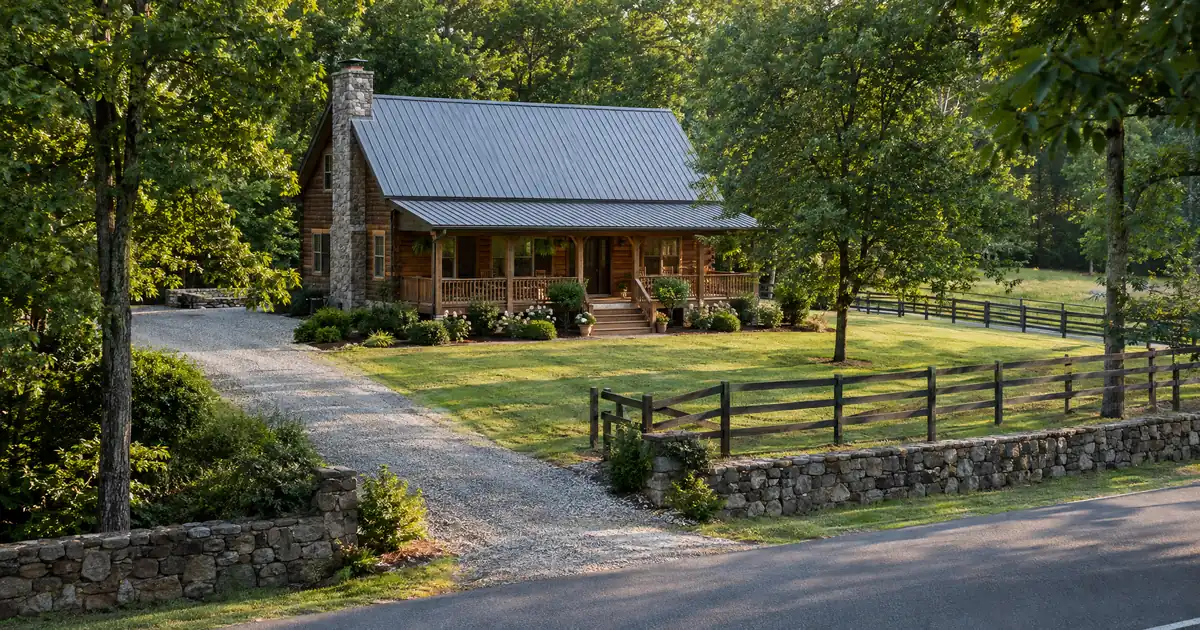
The Quick Read: Usually, yes, when the parcel is small enough and the house reads as a residential rental. Across the wholesale network, acreage is the first screen, ahead of rent. Standard programs typically run to about five acres or fewer, and land above a program’s cap is generally left out of the value used to size the loan.
- Acreage limits are lender policy, not law, so they differ by program.
- Working farms, ranches, and orchards are not offered, and the same goes for manufactured homes, log homes, and barndominiums.
- Land the lender will not count still has to be paid for, so cash at purchase rises.
- Strong rent does not override the acreage or property screen.
- Eligibility is subject to lender guidelines and individual file review. This is not a commitment to lend.
Lendmire is a DSCR-focused mortgage broker that arranges these loans through select lenders in its wholesale network across 41 markets, including Washington, D.C. The file mechanics on acreage are different from a suburban lot, and most problems show up before the rent is ever reviewed.
DSCR Calculator
Run the numbers in your market
Rate source: Freddie Mac 30-yr average via FRED® — Federal Reserve Bank of St. Louis · effective Oct 15, 2026
Prefilled with starting assumptions — enter your own rent or nightly figures, taxes, insurance, and HOA for a more accurate picture.
Program parameters update from Lendmire’s centralized guideline source. Taxes and insurance are editable estimates.
As of Oct 15, 2026 · General Freddie Mac market benchmark, not a Lendmire loan offer. Rent, nightly rate, occupancy, taxes, and insurance are editable estimates. Short-term rental figures are estimates only and vary significantly by season, property type, management approach, and local short-term-rental rules — confirm local regulations before relying on them. Qualifying income for short-term rentals varies by program — some use appraisal market rent, others use documented STR history or projections — and is confirmed in underwriting. Not a Loan Estimate, approval, or commitment to lend. Program availability and eligibility are subject to lender guidelines, credit approval, property review, and underwriting.
Why Is Acreage the First Gate?
Acreage is the first gate because it decides whether the property looks like a residential rental or a land-and-agriculture asset. Lenders set the limit by policy. Most standard programs we place files with sit around five acres or fewer. Some stretch further on smaller loan sizes, and the exact tiering depends on the program.
Why set a cap at all? Three reasons come up on nearly every file:
- Appraisal complexity. Large parcels have fewer comparable sales.
- Use classification. The more land, the more the property can look like a farm.
- Exit liquidity. A smaller pool of buyers can purchase a house with a lot of land.
Rural does not mean automatic decline. What matters is how built-up the surrounding area is, how many acres sit under the house, and whether rental demand can be shown. An appraiser generally wants to see an area with a meaningful share of land already developed. Open farmland in every direction is a problem for the comps, not just for the lender.
The stricter the overlay, the more the file leans on the basics. The same network that allows a stretch on acreage often wants higher credit and lower leverage when it does.
What Is the Appraiser Actually Doing on a Rural Rental?
The appraiser has two jobs: set the value, which drives leverage, and estimate market rent, which drives coverage. On a one-unit rental, the rent opinion usually comes from a rent schedule. Fannie Mae’s Selling Guide identifies Form 1007 as the Single-Family Comparable Rent Schedule. We use that form name as an industry document, not as a DSCR rule. A two-to-four unit property typically uses the small income report instead.
Rural comps are the weak spot. McKissock, an appraiser-education publisher, notes that rural areas have fewer sales, so appraisers may widen the search to neighboring towns and then explain the differences in distance, property characteristics, and market conditions. Its guidance on thin-comp assignments adds that appraisers may use older, farther, or less similar sales and value the land separately.
For the investor, that means the number can come in lighter or wider than a suburban appraisal. Appraisal reconsideration is a normal step when the comps are stretched, but a packet needs real in-area sales and honest condition adjustments to move anything.
What Happens to Land Above the Cap?
Land above a program’s cap is typically excluded from the value used for leverage, and you still pay the full price. That is the mechanism that surprises buyers most.
McKissock’s explanation of excess versus surplus land draws the line: excess land can be divided and sold, so it has separate value, while surplus land cannot and adds limited value. Lenders often go further and have the appraiser value only the home’s residential site.
Picture a buyer paying a single price for a house on a large parcel. If the appraiser credits only the homesite, the loan sizes against that lower value. The leverage percentage applies to the lower figure. The gap between price and counted value comes out of the buyer’s cash. A property that looks like a standard 20%-25% down purchase on paper can need meaningfully more cash in practice. Each figure is subject to lender guidelines and a complete review of property type, leverage, and credit.
The options on an over-cap parcel run roughly in this order:
1. Confirm the tier. A different program in the network may allow more acreage, usually with adjusted leverage or loan-size limits.
2. Carve out the excess. Some lenders exclude the extra land from collateral. Ask whether a survey or lot split is required.
3. Restructure the purchase. Negotiate price, or buy only the portion that qualifies.
4. Go outside DSCR. A working farm or large agricultural parcel belongs with agricultural or land lenders, not a residential investor program.
Which Property Types Fall Outside These Programs?
Working farms, ranches, and orchards are not offered. Manufactured homes (single- and double-wide), log homes, and barndominiums are also not offered through the network’s DSCR programs. McKissock notes that rural parcels can include log homes, earth berm homes, or converted barns, and those are the ones to flag early.
| Situation | Typical read | What to do |
|---|---|---|
| Ordinary house on extra land | Often workable under the cap | Confirm acreage tier |
| Hobby outbuildings, small shed or barn | Usually incidental | Disclose to the appraiser |
| Large barn, silo, livestock facility | May signal a farm | Expect a use review |
| Agricultural income on the property | Can push file out of residential programs | Consider ag lending |
| Barndominium, log home, manufactured home | Not offered | Pursue another financing path |
How Does the Coverage Math Work on Acreage?
DSCR divides qualifying rental income by the full monthly PITIA: principal, interest, taxes, insurance, and association dues. On a rental house with extra land, the rent side comes from the appraiser’s market rent and the lease. Lenders generally credit the lower of the two.
Land hurts the ratio in a quiet way. Land value can run well ahead of what the structure rents for, so the price is high compared with the rent the house can earn. Higher price means a larger loan at a given leverage, and a larger payment. Coverage falls even though the house itself is fine.
Where does 1.00 fit? Many select programs start at 1.00 coverage, meaning rent covers the payment. A separate select-lender path takes coverage below 1.00, with leverage and terms adjusted. Stronger ratios open better pricing and leverage. Clearing 1.00 is not the same as positive cash flow, because repairs, vacancy, management, utilities, and capex sit outside the calculation, and a rural house with a well, septic, and long driveway carries plenty of those.
Run the numbers on a house that rents at a level you can defend with local comps. If the file only clears coverage by leaning on a high rent assumption, the appraiser’s rent schedule will usually settle the question.
Purchase, Refinance, and Cash-Out on Acreage
Most purchase files land at 75%-80% LTV on investment property. Select high-leverage programs reach 85% LTV with roughly a 700+ score. Rate-and-term refinances can go higher than cash-out, and cash-out tops out around 75% LTV, with about six months of seasoning commonly expected. Cash-out on acreage works when the home and its site appraise as a residential rental and the balance fits the loan-size range, up to $3,000,000 on standard programs.
Credit tiers matter more here than on a suburban file. A 620 floor exists in parts of the network, most programs want around 660, and 700+ unlocks the strongest leverage. Reserves commonly run around six months of PITIA, with about nine months above $1,500,000. Those reserves have to be documented the same way on rural files as anywhere else. Program terms vary by lender, and every file is underwritten individually. For the wider picture, see the complete DSCR loans guide.
A bigger down payment lowers the payment and can lift coverage. It does not erase the acreage cap, credit floors, reserve rules, or property eligibility. The strongest files clear both tests: enough equity and enough rental coverage.
DSCR vs. conventional financing
There are two common ways to finance an investment property, and they qualify you differently — here’s how investors weigh them.
Why investors choose it
- Qualifies on the property’s rental income — no personal tax returns, W-2s, or pay stubs needed to document income.
- No personal debt-to-income ceiling to clear, so existing mortgages and obligations don’t cap your borrowing the same way.
- Can be closed in an LLC, keeping the property inside a business entity.
- Built for scaling — not held to the limit on number of financed properties that conventional financing applies.
- Underwriting centers on the deal: generally qualifies when the rent covers the payment, a 1.00x coverage ratio being a common baseline (confirmed in underwriting).
- Designed specifically for investment property, including long-term and, where the program allows, short-term rentals.
Where it’s strong
- Often the lowest ongoing financing cost for a buyer who fully qualifies on personal income — a fit for a first property or a cost-first purchase.
Trade-offs for investors
- Requires full personal income documentation and must fit within a debt-to-income limit — salary, existing debts, and other mortgages all count.
- Typically held in your personal name rather than a business entity.
- Caps how many financed properties you can carry, which can become a ceiling as a portfolio grows.
- Evaluates you as a borrower as much as the property, which usually means more paperwork.
How investors usually choose: a first or single property often optimizes for the lowest financing cost; portfolio builders often optimize for leverage, vesting in an LLC, and scaling past conventional caps. The right answer depends on your goals, the property, and current guidelines — both paths run through select lenders in Lendmire’s wholesale network, with eligibility and terms confirmed in underwriting.
What About Short-Term Rentals on Acreage?
Short-term rental on acreage is a narrower lane. Purchase leverage tops out at 75% LTV on a short-term rental, and cash-out tops out around 70%. Expect a 640+ credit score and about 12 months of hosting history, with a 1.00 coverage floor on purchases and on refinances. Leverage, reserves, and pricing vary by lender and program; the final terms follow the full file review.
The documentation problem is the rent schedule. Form 1007 documents monthly rent, not nightly stays, so nightly rate times 30 is not how the lender reads income. Large acreage can also hurt a cabin-style file because land value can outrun what the structure earns. For a related look at how short-term rental income is read on a non-resort house, see Lendmire’s piece Can a Suburban House Qualify as a Short-Term Rental on DSCR?.
Rural by Lender Versus Rural by Government
A property can be rural on a government tool and still be fine for a DSCR lender, or the reverse. The CFPB’s Rural and Underserved Areas tool exists to help creditors determine rural status for certain consumer-lending exemptions. It is not an investor eligibility test. Lenders define rural by their own measures: how developed the area is, comp availability, and acreage.
Mistakes That Derail Acreage Files
- Making an offer before checking the acreage tier. Ask first.
- Assuming strong rent overrides acreage. Coverage does not override the acreage or property screen.
- Treating all acres as counted value. Excess land is typically carved out or valued separately.
- Using nightly rates as monthly rent. The appraiser’s schedule is monthly.
- Ignoring structures. A barndominium or log home can end the file.
- Skipping the pre-offer checklist. Confirm legal rental use, access, well and septic, insurance availability, and the survey and parcel records before the appraisal contingency runs out.
DSCR loans are designed for non-owner-occupied investment properties. Because they are business-purpose investor loans, they are reviewed differently from a standard owner-occupied mortgage.
Tax treatment varies; consult a qualified professional.
Frequently Asked Questions
How many acres can a DSCR rental sit on?
Typically about five acres or fewer on standard programs across the network. Some programs allow more on smaller loan sizes, and the cap tightens as the loan grows. Confirm the tier before making an offer.
Will the lender count all the land in the value?
Usually not above the program’s cap. The appraiser may value only the home’s residential site, and the loan sizes on that lower figure. You still pay the full price, so cash at purchase rises.
Can I do a cash-out refinance on a house with acreage?
Often yes, if the home and site appraise as a residential rental and the balance fits the program. Cash-out tops out around 75% LTV on a standard rental, with about six months of seasoning commonly expected.
Does a barn or outbuilding disqualify the property?
Small outbuildings are usually incidental. Large barns, silos, or livestock facilities can signal a farm and trigger a use review. Barndominiums are not offered.
Is rural property automatically declined?
No. Eligibility turns on how built-up the area is, the acreage, and whether rental demand can be shown with comps and a market rent opinion.
If you are buying or refinancing a rental property and want to see how the numbers work, Lendmire can help you compare DSCR loan options based on the property income, credit profile, leverage, and investor goals. Reach the team at 828-256-2183 or request a quote.
About Lendmire
Lendmire is a non-QM mortgage brokerage (NMLS# 2371349) arranging DSCR investor loans in 41 markets, including Washington, D.C. DSCR eligibility is generally reviewed around property-level rental income rather than personal income, subject to lender and program guidelines, a fit for self-employed investors and LLC-owned portfolios. Lendmire was recognized as a Scotsman Guide Top Mortgage Workplace in 2025 and 2026.
Get Started
Ready to find the right loan for you?
In about 30 seconds you can review financing options available for your investment property. No commitment required.
Informational only. Not a Loan Estimate, approval, or commitment to lend. Program availability and eligibility are subject to lender guidelines, credit approval, property review, and underwriting.
References
1. Fannie Mae Selling Guide B4-1.2-01
2. McKissock – Appraising Rural Properties
3. McKissock – Credible Appraisal When Comps Are Limited
4. McKissock – Surplus Land vs. Excess Land
5. CFPB – Rural and Underserved Areas Tool
This article is part of Lendmire’s DSCR loan program — full qualification details, guidelines, and scenarios live on the program page.
Related reading: Can a New Rental Community Get a DSCR Loan Before Every Home Is Leased? · Hard Money vs Portfolio DSCR Loan for a Rental Package With Repairs · How to Choose a DSCR Loan or Bank Commercial Loan on a Rental
Brandon Miller
Founder & CEO, Mortgage Loan Originator, Lendmire LLC
- Mortgage Loan Originator · NMLS# 1129696 · Verify on NMLS Consumer Access
- North Carolina Real Estate Broker · License# 343312 · Verify on NCREC
- North Carolina Insurance Producer · License# 19053198 · Property, Casualty, Life, Health · Verify on NAIC SBS
- Lendmire LLC · Firm NMLS# 2371349 · Verify firm licensure
Important disclosures. Lendmire (NMLS# 2371349) is a licensed mortgage brokerage. Lendmire is not a direct lender, depository institution, or financial advisor. All loan inquiries are subject to lender underwriting; this article does not constitute a commitment to lend. Rates, terms, and program guidelines are subject to change without notice and vary by borrower profile, property type, and state. Information in this article is general in nature and is not financial, legal, or tax advice. Equal Housing Opportunity. NMLS Consumer Access: nmlsconsumeraccess.org.