
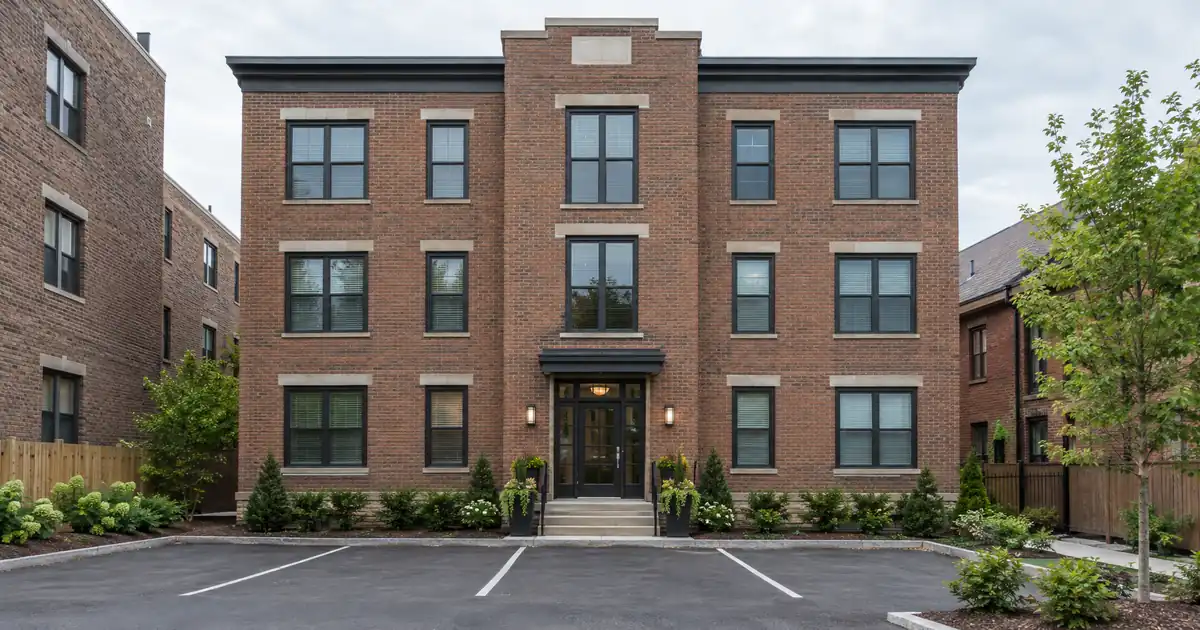
The Quick Read: Usually in the wider market, because a six-unit building is ordinary hard money collateral, but not through Lendmire’s own hard money sheet, which covers rehab on one-to-four-unit non-owner-occupied residential property, so a six-unit rehab needs a lender that writes commercial-scale bridge loans, with the exit chosen before the purchase closes.
- Six units moves the file out of residential treatment. Financing guides draw the line between two-to-four units and five or more.
- Hard money reviews the property’s rental income, the rehab budget, the after-repair value (ARV) and the exit. Credit matters, but it is not the main test.
- Rehab money comes in draws against finished work, so the investor funds each phase first.
- The exit is where six-unit deals break. A long-term DSCR refinance depends on program eligibility, seasoning, appraisal and rent already in place.
Why Six Units Changes the File
Six units is commercial territory for financing purposes. BiggerPockets describes two to four units as residential and five or more as commercial. That one line changes the appraisal, the underwriting inputs and the pool of lenders.
What this loan actually costs to carry.
Hard money is sized against the project and priced by time. Enter the deal and see how much the program will lend, the cash required at closing, the carry while you hold it, and what is left at the exit.
Leverage tiers on the current program: 85% with fewer than 2, 90% with 2 or more, 93% with 5 or more completed projects — every tier capped at 75% of after-repair value. Loan amounts up to $5,000,000, larger by exception; terms of 6 to 18 months, interest-only, no prepayment penalty. The rehab portion funds in draws against completed work, not at closing.
Program parameters shown update from Lendmire’s centralized guideline source. Rate, points, and months are editable assumptions, not quoted terms.
Cost cap sets the loan · positive spread
Illustrative estimate only — not a quote, Loan Estimate, approval, or commitment to lend. Rate, points, and months are editable assumptions. Hard money is business-purpose financing for real estate investors, not a consumer mortgage. Leverage on the current program tops out at 93% of project cost for investors with a documented track record, capped at 75% of after-repair value, with rehab funding up to 100% of the documented budget released in draws; actual terms vary by lender, borrower experience, property, and exit. Lendmire is a mortgage broker, not a lender.
On a one-to-four-unit rehab, a lender looks at the borrower, the budget and the ARV. On a six-unit building, the lender also wants the income side: a rent roll, lease terms, occupancy and operating history. If the building is half empty, the lender usually underwrites to a projected stabilized value, then asks how you will get there.
Here is where the brokerage’s program lines up with that. Across Lendmire’s hard money sheet, collateral is non-owner-occupied residential property of one to four units. Ground-up construction extends to ten units. Existing commercial-scale buildings are not on the sheet. So a six-unit rehab purchase is not a file Lendmire’s hard money program is built to place. An investor holding that deal should know this before spending on a scope of work.
That does not make the deal dead. Lenders write bridge loans on five-plus-unit buildings. Those loans follow commercial rules, and the terms differ lender by lender.
How a Hard Money Rehab Loan Is Built
Hard money sizes the loan on cost and on value, and the lower of the two sets the cap. Think of it as two pieces: money to buy the property, and a holdback for the renovation.
On Lendmire’s one-to-four-unit program, leverage is measured as a share of project cost, not as a plain purchase LTV. Typical tiers, which vary by lender, property and experience:
- 93% of project cost at five or more completed projects.
- 90% of project cost at two or more completed projects.
- 85% of project cost with fewer than two.
- Every tier is capped at 75% of after-repair value.
- Bridge purchases with no rehab reach up to 80% of purchase price.
- Up to 100% of the rehab budget funds in draws against completed work. That is a rehab-budget figure, not a purchase LTV.
There is no true 100% purchase program. The top tier is for experienced investors. First-time investors work in the lower tiers.
Terms run 6 to 18 months, interest-only, with no prepayment penalty. Loan amounts go up to $5,000,000, larger by exception. Credit starts at a 620 minimum, with added conditions below 660. Underwriting stays asset-based: the property, the plan and the exit. Nothing here is a commitment to lend, and each file is reviewed on its own.
Those are the figures for a one-to-four-unit file. A lender on a six-unit building will publish different caps and different documents. Do not carry these numbers over.
Key Terms Defined
After-repair value (ARV): The appraised value of the property once the planned renovation is complete.
Loan-to-cost: The loan as a share of what the project costs in total, purchase plus rehab.
Holdback: The part of the loan reserved for renovation and released only as work is completed.
Draw: One release of holdback funds after the lender confirms a phase of work is finished.
Stabilized: Units are leased, rent is being collected, and the building reads as a normal income property.
Exit: How the short-term loan gets paid off, by a sale or by refinancing into long-term debt.
How the Appraisal Differs at Six Units
A six-unit building generally gets a commercial or income-approach appraisal, not the small-residential form. The standard form for two-to-four-unit properties is Fannie Mae Form 1025, described as covering traditional appraisals of two- to four-unit properties. An appraiser’s explanation of that form says it is not for apartment properties with more than four units. DSCR loans do not run on agency rules. The form is only a useful marker for where the residential scale ends.
For the investor, this means two things. The valuation takes a different shape, built on income and comparable sales of similar buildings. And the ARV in your pro forma means little until an appraiser supports it. A low appraisal can leave bridge debt unpaid or force a smaller refinance.
How Draws Work Across Six Units
Draws release rehab money in stages, after finished work is verified, so the investor fronts each phase. A typical sequence runs like this.
1. The lender reviews the scope of work and rehab budget before closing.
2. The investor completes a phase, such as demolition, roofing or the first group of units.
3. An inspection or documentation confirms the work.
4. The lender releases that portion of the holdback.
5. The cycle repeats until the budget is spent.
The catch on multi-unit jobs is cash. You pay contractors first and get reimbursed after verification. Six units means more phases and a longer stretch of money out the door. Files that carry no working cash for that gap tend to stall mid-project.
Lendmire’s piece How to Fund Rehab Draws on Hard Money Before a DSCR Refinance walks through that cash gap in more detail.
Tenants in Place or Vacant?
This choice drives both the rehab schedule and the exit. A DSCR lender reads rent that is actually being collected. Vacant units are often not counted, or counted only at market rent. Projected rent gets no credit.
A building that is mostly empty during renovation is simple to work on and impossible to refinance until units are leased. A building with tenants in place keeps income flowing, but work is slower and has to be sequenced unit by unit. Neither is wrong. The right one depends on what the lender at the exit will count.
A common plan is to renovate in waves: finish two units, lease them, move to the next two. Each leased unit adds documented rent to the file that eventually goes to the long-term lender.
What a Lender Asks For
A six-unit hard money file typically needs:
- The purchase contract.
- A scope of work and a line-item rehab budget.
- The current rent roll with each unit’s lease terms, rent and occupancy.
- Trailing operating statements, if the building has been operating.
- A plan with projected rents and a stabilization path.
- Evidence of experience, liquidity and a named exit.
Missing or vague rent rolls are the most common gap. An unlabeled unit, a month-to-month tenant with no lease, or rent that does not match deposits will each draw questions. Clean entity documents, a clear scope and proof of cash for the draw gap keep the file from stalling on items that could have been fixed beforehand.
Hard Money vs. the Other Options
Compare the options by unit count first, because that decides which ones are even available.
| Option | Six-unit fit | Main catch |
|---|---|---|
| Lendmire hard money sheet | Rehab covers 1-4 units; construction to 10 | Existing 6-unit rehab is not offered |
| Commercial-scale bridge lender | Built for 5+ units | Terms and caps set by that lender |
| Conventional loan | Generally 1-4 units only | Not for a six-unit building |
| Long-term DSCR refinance | Depends on program eligibility | Needs stabilized rent and seasoning |
| Private partner capital | Flexible | Terms are negotiated |
The conventional row follows the standard financing line: conventional loans generally cover one to four units and anything larger is commercial.
Picking the Exit Before the Bridge
The exit date drives risk more than the entry date. The bridge is short and interest-only. A sale or a refinance has to be in place before the term runs out.
Many investors refinance out of hard money into long-term DSCR investor loans once the property is stabilized, and Lendmire brokers that path where the property fits a program. Here are the mechanics that matter.
On a long-term DSCR file with two to four units, coverage compares rent to the full monthly obligation: principal, interest, taxes, insurance and any HOA dues. On five-plus-unit commercial files, coverage is typically built from net operating income against debt service. Mixing the two formulas is a common error. Clearing the ratio also is not the same as positive cash flow. Repairs, vacancy, management, utilities and capital work sit outside the calculation.
For standard programs in Lendmire’s wholesale network, 1.00 is where select programs start, and stronger ratios open better pricing and leverage. A separate select-lender path takes coverage below 1.00, with leverage and terms adjusted. Cash-out refinances tend to top out near 75% LTV, with about six months of seasoning as the common expectation. Credit usually wants around 660, with 700 and above unlocking the strongest leverage. Reserves vary by lender, leverage, loan size and transaction type. Whether a six-unit building fits any of these depends on the program’s unit range, so confirm that before the bridge is signed. Lendmire’s complete DSCR loans guide covers how the ratio is built.
An unfinished rehab will not read as stabilized. An extension of the bridge is often the better move than forcing a refinance too early.
When Hard Money Is the Wrong Tool
- The building needs heavy work and most units will stay offline. The deal is not ready for permanent financing until units are leased.
- The budget has no room for overruns. Lendmire’s article How to Fund a Full-Gut Rehab Overrun on a Hard Money Loan covers what happens when costs exceed the plan.
- The only exit is “I will refinance.” That is not a plan without seasoning, an appraisal and program eligibility.
- The investor lacks working cash for the draw gap.
If a deal is a better fit for a slower, cheaper structure, take that route. Hard money exists to bridge a property that lenders will not touch yet.
A Short Note on Business-Purpose Treatment
DSCR and hard money loans are designed for non-owner-occupied investment properties. Because they are business-purpose investor loans, they are reviewed differently from a standard owner-occupied mortgage. If you plan to live in one unit, the rule still treats a building this size as business purpose: Regulation Z classifies credit to acquire an owner-occupied rental as business purpose when the property has more than two units. Lendmire’s program works only with non-owner-occupied collateral, so an owner-occupant needs a different path.
Frequently Asked Questions
Can I use hard money on a six-unit building?
In the broader market, yes, from lenders that write bridge loans on five-plus-unit properties. Lendmire’s hard money sheet covers one-to-four-unit rehab and ground-up construction to ten units, so an existing six-unit rehab purchase is not offered there. Always check each lender’s unit cap.
Is a six-unit building treated as commercial?
Yes, for financing purposes. Financing guides put two to four units on the residential side and five or more on the commercial side. That changes the appraisal and underwriting, and it narrows the long-term loan options.
Can hard money cover the whole rehab budget?
On Lendmire’s program, up to 100% of the rehab budget funds in draws against completed work, though that is a budget figure, not a purchase LTV. The investor fronts each phase and is reimbursed after verification. Leverage varies by lender, property and experience.
Do I need experience?
Experience sets the leverage tier. On the one-to-four-unit program, 5+ completed projects earn the highest tier, 2+ the middle tier, and first-time investors qualify at lower leverage. Underwriting stays asset-based, and a 620 credit minimum applies with added conditions below 660.
What if the rehab runs over budget or the appraisal comes in low?
Overruns come out of the investor’s cash, because holdbacks are fixed. Build contingency into the budget and confirm exit eligibility before closing the bridge.
If you are buying, rehabbing or refinancing an investment property on a short timeline and want to see how the numbers work, Lendmire can help you compare hard money options based on the project, the exit plan, leverage, and your goals.
About Lendmire
Lendmire is a non-QM mortgage brokerage (NMLS# 2371349) arranging DSCR investor loans in 41 markets, including Washington, D.C., through wholesale and investor-lending channels. DSCR loans are evaluated by the lender on rental income rather than personal income, subject to lender guidelines — a fit for LLC-owned portfolios, self-employed investors, and operators scaling beyond conventional loan caps. Recognized as a Scotsman Guide Top Mortgage Workplace in 2025 and 2026.
Get Started
Ready to find the right loan for you?
In about 30 seconds you can review financing options available for your investment property. No commitment required.
Informational only. Not a Loan Estimate, approval, or commitment to lend. Program availability and eligibility are subject to lender guidelines, credit approval, property review, and underwriting.
References
1. BiggerPockets: multifamily real estate financing
3. Appraisal Colorado Form 1025 page
This article is part of Lendmire’s hard money loan program — full qualification details, guidelines, and scenarios live on the program page.
Related reading: Can a DSCR Refinance Close Before Hard Money Maturity on a Long Rehab? · How a Lender Reads a Seller-Carried Note on a Hard Money Loan · Hard Money Overrun Documentation for a BRRRR Rehab Into a DSCR Loan
Brandon Miller
Founder & CEO, Mortgage Loan Originator, Lendmire LLC
- Mortgage Loan Originator · NMLS# 1129696 · Verify on NMLS Consumer Access
- North Carolina Real Estate Broker · License# 343312 · Verify on NCREC
- North Carolina Insurance Producer · License# 19053198 · Property, Casualty, Life, Health · Verify on NAIC SBS
- Lendmire LLC · Firm NMLS# 2371349 · Verify firm licensure
Compliance and disclosures. Lendmire (NMLS# 2371349) is a licensed mortgage broker and is not a direct lender, depository institution, financial advisor, or tax professional. Content in this article is general market analysis and educational information — not financial, legal, or tax advice for any specific situation. Lendmire does not guarantee loan approval; every transaction is subject to underwriting by the funding lender. Mortgage pricing and loan program guidelines are subject to change at any time without notice and vary by borrower characteristics, property type, and state regulations. Lendmire complies with Equal Housing Opportunity. Licensure verification: NMLS Consumer Access.