
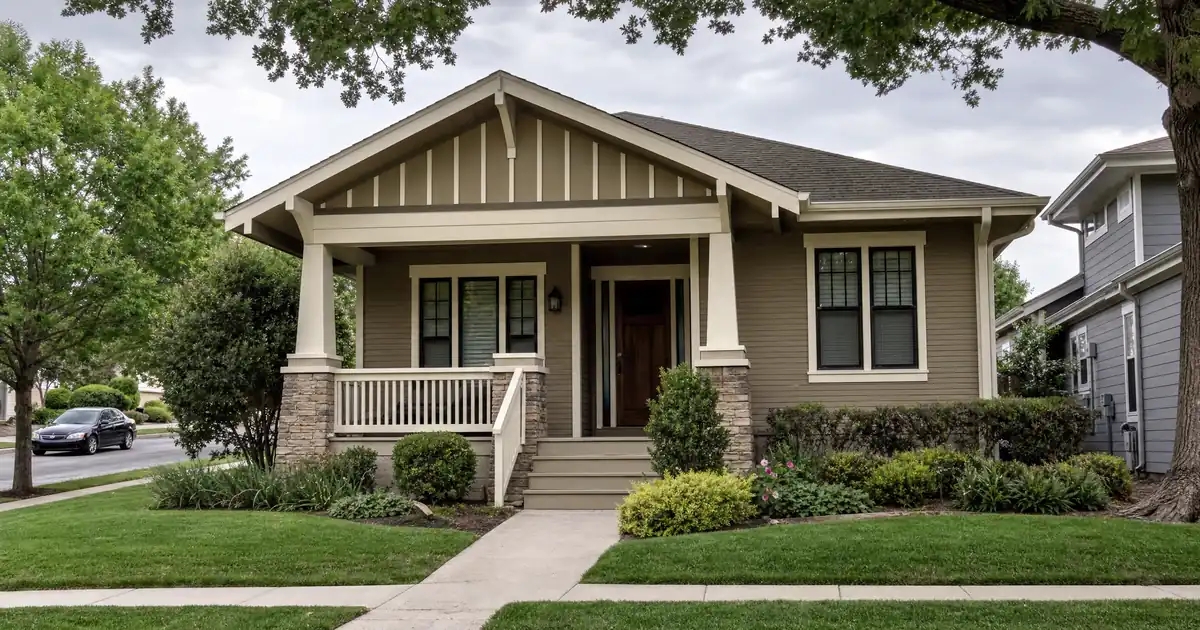
HELOC Denied Because You Own Too Many Financed Properties — The Quick Read: Yes, this happens constantly, and it’s almost never a federal rule. It’s a lender credit-policy overlay, and every lender draws the line somewhere different. Community banks and credit unions often cap non-owner-occupied home equity lines at three or four financed properties — tighter than the ten-property ceiling that governs conventional agency purchase loans. Once you know which wall you actually hit, the fix is usually a different product, not a smaller portfolio.
Key Terms Defined
Financed property — any property you own with an open mortgage balance, including your primary residence if it’s mortgaged; a multi-unit building still counts as one property.
How large a line the equity supports in your market.
An equity line is sized by combined loan-to-value, occupancy, and credit — not by rental coverage. Switch the occupancy or the credit band and the ceiling moves with it.
Investment-property lines require a 700 minimum credit score. Second-home tiers reach 640; primary-residence tiers reach 600.
A debt-to-income ratio above 45% requires 680+ credit. Profiles under 640 are limited to single-family homes. At least 75% of the approved line is drawn at closing. Ceilings, floors, and caps update from Lendmire’s centralized guideline source.
Line estimate
Illustrative estimate only — not a quote, Loan Estimate, approval, or commitment to lend. The rate is an editable assumption; equity-line pricing is variable through both the draw and repayment periods and never converts to fixed. Occupancy and credit drive the ceiling together: investment property runs to 70% combined LTV with a 700 credit floor and a $500,000 cap; a second home runs to 70% at a 640 floor with a $500,000 cap; a primary residence reaches up to 80% at a 600 floor, and its $750,000 maximum line applies only at 75% combined LTV or below with 720+ credit and a full appraisal. Lines above $500,000 require a full appraisal. Credit, debt-to-income, property type, and full underwriting review all affect the final line.
CLTV (combined loan-to-value) — the total of all liens on a property divided by its value, expressed as a percentage; a first mortgage plus a new HELOC both count toward this number.
DSCR (debt-service coverage ratio) — the ratio of a rental property’s monthly rent to its monthly mortgage payment, used to review a loan on the property’s income instead of the borrower’s.
REO schedule — the section of a loan application where a borrower lists every real estate property they own, along with financing status on each.
DTI (debt-to-income ratio) — total monthly debt payments divided by gross monthly income, the metric a retail lender uses to decide how much more debt you can safely carry.
Non-QM — short for “non-qualified mortgage,” a category of loans, including most DSCR products, underwritten outside the standard agency rulebook.
Seasoning — the minimum amount of time a lender requires you to own or hold a property before it will refinance it or count certain history toward approval.
Where the Ten-Property Number Actually Comes From
The ten-property ceiling you’ve probably heard about belongs to Fannie Mae’s conventional purchase and refinance rules — it has nothing to do with home equity lines directly. Under Fannie Mae’s own Selling Guide, the “total number of properties financed” counts every mortgaged property a borrower holds, treats a two-to-four-unit building as one property, and adds up jointly financed properties only once across all borrowers on the loan. Trade coverage of non-QM lending confirms the practical cutoff: Scotsman Guide reports that Fannie Mae and Freddie Mac won’t back new loans to investors who already own ten financed properties, while DSCR loans carry no such limitation.
That ceiling comes with escalating baggage well before it’s actually reached. Fannie Mae’s reserve requirements scale directly with property count: the guide requires 2% of aggregate unpaid balance in reserves for borrowers holding one to four financed properties, 4% for five to six, and 6% for seven to ten. So the real friction isn’t a wall at ten — it’s a liquidity requirement that gets steeper with every property you add, long before you get anywhere near the ceiling. Every figure here varies by lender and program — guidelines, property type, leverage, and credit profile all apply.
None of this is a HELOC rule. A HELOC application isn’t a Fannie Mae purchase transaction, so this specific ten-property line typically doesn’t apply to it at all. That’s precisely why an investor can get bounced by a bank’s home equity line application well below ten properties — the number that actually governs the decision belongs entirely to the individual lender writing the HELOC.
Why Your Bank’s HELOC Caps Lower Than That
A retail HELOC sits second in line behind your existing mortgage, and most banks and credit unions hold that lien on their own books rather than selling it — meaning they eat the loss directly if you default. That risk exposure is why home equity lines on rental property routinely run tighter than the agency purchase-loan world. Real examples from active investors bear this out: one credit union’s rental-property HELOC policy flatly stated the borrower could not own more than three properties, and a fourth-property owner could only get a line against a primary residence, not a rental (BiggerPockets). Large depository institutions confirm this variability exists broadly — some simply don’t write HELOCs on investment property at all, while others limit how many financed properties a given borrower can have before they’ll consider it.
Across select lenders in Lendmire’s own wholesale network, the tiers differ sharply by occupancy, and property count interacts with all of them:
- Investment property: minimum 700 credit score, 70% CLTV program ceiling, up to $500,000 per line.
- Second home: minimum 640 credit score, 70% CLTV program ceiling, up to $500,000 per line.
- Primary residence: minimum 600 credit score, 80% CLTV program ceiling, up to $750,000 per line. Final terms depend on lender guidelines, property type, leverage, and the borrower’s complete credit picture.
On top of those tiers, exposure limits apply at the borrower level: a borrower is generally capped at three lines totaling $750,000 combined across the network, and owning more than fifteen financed properties makes that borrower ineligible for the program outright, subject to lender guidelines. That fifteen-property line is a network-wide exposure cap, not a per-property CLTV rule — it exists specifically because a lender writing an equity line wants to know its total exposure to one investor, not just the math on one property.
The Vesting Problem Hiding Behind the Property-Count Problem
Plenty of investors get denied for a reason that has nothing to do with how many properties they own — it’s how the property is titled. Most equity-line programs, including this network’s, require title to sit in fee simple or leasehold, held either by an individual borrower or an inter vivos revocable living trust. LLCs, corporations, partnerships, and irrevocable, blind, or land trusts generally can’t hold title on this kind of product.
That means an investor who moved a rental into an LLC years ago — a common asset-protection move that has nothing to do with hitting any property-count ceiling — is disqualified from pulling equity through a HELOC on that specific property until the vesting changes back. This is a completely separate wall from portfolio size, and it’s one of the sharpest structural differences between a home equity line and a DSCR loan, which can generally accommodate LLC-titled property, subject to program guidelines. Investors comparing the two products directly can see the full mechanics laid out in Lendmire’s HELOC versus cash-out refinance comparison.
What Actually Changes As Your Debt and Reserves Stack Up
The retail underwriting math gets harder with every additional mortgaged property, independent of any single cap. A HELOC underwriter counts the full contingent monthly liability of every financed property you carry against your income — even properties with paying tenants — which is exactly why an investor with a strong overall portfolio can still see debt-to-income stretched thin on paper. Investors specifically fighting that math should look at how a high DTI causes a HELOC denial for the mechanics behind that calculation.
On this network’s own investment and second-home HELOC programs, the debt-to-income ceiling generally sits at 50%, tightening to 45% for credit profiles between 600 and 679 — pushing past 45% typically requires a minimum 680 score. The line is qualified using the interest-only payment calculated on the maximum available draw, not the current balance, which matters for anyone stacking multiple financed properties into one debt picture. Credit itself gets scrutinized closely, too: the program floor sits at 600, with a housing-payment history requirement (generally no more than one 30-day late in the past twelve months at 640 and above) applied across every financed property the borrower holds, not just the subject property. Investors whose credit profile is the sticking point should look at what a low credit score does to a HELOC application for the specific tiers involved.
The DSCR Workaround
DSCR loans sidestep the property-count problem entirely because the underwriting question changes: it’s not “how many mortgages does this borrower already carry,” it’s “does this specific property’s rent cover its own payment.” DSCR loans are designed for non-owner-occupied investment property; because they’re business-purpose investor loans, they’re reviewed differently than a standard owner-occupied mortgage. A file qualifies primarily on property-level rental income covering the payment, subject to lender guidelines — the borrower’s other financed properties simply aren’t part of the math the way they are on a retail HELOC application.
Across select lenders in Lendmire’s wholesale network, purchase leverage on DSCR loans typically lands at 75% to 80% LTV, with the higher end of that range generally reserved for borrowers around a 700 credit score. Cash-out refinancing tops out closer to 75% LTV network-wide, with roughly six months of ownership seasoning expected on most files. A 1.00 coverage ratio is where select programs start — a floor for specific products, never a universal standard — and stronger ratios generally open better leverage and pricing. Credit floors run as low as 620 in parts of the network, though most programs want closer to 660, and a 700-plus score tends to unlock the strongest leverage tiers. Loan sizes generally run from around up to $3,000,000 on standard programs (smaller balances available through select lenders), with files above $2,500,000 typically structured as 30-year fixed.
Coverage below 1.00 is available through select lenders in the network, with leverage and terms adjusted accordingly — it’s a real path, not a dead end, though it comes with tradeoffs. No-ratio qualification is available only through select lenders, generally for borrowers who already own a primary residence. Neither structure is universal, and both are reviewed file by file.
| Factor | Bank/Credit Union HELOC | DSCR Cash-Out Refinance |
|---|---|---|
| What gets qualified | Borrower’s aggregate DTI | Subject property’s rent vs. payment |
| Property-count sensitivity | High — each financed property adds liability | Low — evaluated file by file |
| LLC-titled property | Generally not eligible | Generally eligible, per program guidelines |
| Typical leverage ceiling | 70% CLTV (investment), network-dependent | Around 75% LTV cash-out, network-dependent |
Investors who want the fuller mechanics behind how this qualification math works can read Lendmire’s complete DSCR loans guide.
Where the Rule Still Bites: Property Types and Credit Tiers
Even inside a favorable program, a few structural walls still show up. This network’s HELOC does not extend to manufactured homes, co-ops, condotels, timeshares, barndominiums, log homes, commercial or mixed-use property, agriculturally zoned land, or raw land — those property types simply aren’t offered on this program. On the DSCR side, the same three property types are excluded from these programs entirely: manufactured homes (single- and double-wide), log homes, and barndominiums fall outside what select lenders in this network will finance, regardless of leverage or credit profile.
Credit tier also interacts with property type in a way investors miss. Borrowers with sub-640 credit are generally limited to single-family residences with a clean twelve-month housing-payment history — and because the second-home tier floors at 640 credit and the investment-property tier floors at 700, that restriction effectively reaches primary-residence transactions only. Valuation adds one more layer: lines from $25,000 up to $500,000 are typically valued using an automated model with no traditional appraisal required, while anything above $500,000 requires a full appraisal and a minimum 720 credit profile.
Across the wholesale network, the same pattern shows up on file after file: an investor with a dozen rental properties and strong credit gets a clean file review for a DSCR cash-out refinance sized to one property’s income, then gets flatly turned down for a modest HELOC on that same property at a local bank — not because anything changed about their credit, but because the bank’s own internal exposure policy simply stopped counting past four or five mortgages. Same investor, same equity, two completely different outcomes because the two products are answering two different questions.
What To Do Next If You Were Just Denied
Start by confirming the actual reason. A federal disclosure requirement under Regulation Z requires HELOC creditors to give applicants specific information about the product, and the CFPB’s consumer booklet exists precisely so borrowers understand these lines before and after applying — but nowhere in that federal framework is a portfolio-size cutoff specified. That eligibility line belongs entirely to the individual creditor, which means a denial at one bank tells you almost nothing about what a different lender, or a different product entirely, will decide.
Practical next moves, in order: get the specific denial reason in writing, check whether the REO schedule on your application was accurate (a misreported property count is a real and fixable error), ask whether the lender’s overlay is a hard exposure cap or a softer DTI issue tied to combined loan-to-value getting too high, and consider whether the specific property in question — and how it’s titled — is even eligible for a HELOC in the first place. If the answer keeps coming back “too many mortgages” no matter which lender you ask, a DSCR cash-out refinance sized to that one property’s rental income is generally the more direct path, since the rest of the portfolio never enters the underwriting.
Tax treatment can depend on how the funds are used and how the property is held; investors should keep clear records and speak with a qualified tax professional before relying on any deduction.
Investors weighing a HELOC against a DSCR cash-out refinance can reach Lendmire at 828-256-2183 or request a mortgage quote to see how a specific property’s rent, credit profile, and leverage goals line up against both products.
Frequently Asked Questions
Does a free-and-clear rental count toward the financed-property total?
Generally no — the agency definition specifically counts financed properties, so a rental you own outright typically doesn’t add to that number. Individual HELOC lenders may still ask for a full REO schedule listing every property you own, financed or not, since their own risk review looks at your total real estate holdings, not just the mortgaged count.
Does an LLC-titled rental count against me the same way a personally titled one does?
The bigger issue usually isn’t whether it counts — it’s whether it’s even eligible. Most equity-line programs, including this network’s, require title in an individual’s name or an inter vivos revocable living trust; LLC, corporate, or partnership vesting generally disqualifies that specific property from being pledged regardless of how many properties you own.
Does opening the new HELOC itself count as the property that pushes me over a limit?
Under Fannie Mae’s own framework, the count reflects properties already financed going into a transaction, not the subject property being newly financed — but retail HELOC lenders apply their own exposure logic, and some do factor the new line’s balance into post-closing DTI and CLTV calculations. It’s worth confirming directly with the specific lender before assuming either way.
If one bank denies me for too many financed properties, will another one approve me?
Quite possibly, since these caps are individual credit-policy overlays rather than a shared industry number — one credit union’s three-property ceiling has nothing to do with another lender’s fifteen-property exposure limit. That variability is exactly why shopping the specific product, rather than assuming the denial reflects a universal rule, often changes the outcome.
What if the property I want to pull equity from is already titled in an LLC?
A standard HELOC on this network generally won’t work without changing vesting back to an individual or revocable living trust first. A DSCR cash-out refinance can generally accommodate LLC-titled property instead, subject to lender program eligibility, which is usually the more direct route for investors who deeded property into an entity for liability protection.
About Lendmire
A DSCR-focused mortgage broker, Lendmire (NMLS# 2371349) places investor financing across 40 markets — 39 states plus Washington, D.C. — with DSCR eligibility generally reviewed by the lender on property cash flow instead of tax returns, subject to lender guidelines. Scotsman Guide named Lendmire a Top Mortgage Workplace in 2025 and 2026.
Investors who want the broader program framework can review how DSCR loans work.
Lendmire’s Top Mortgage Workplace recognition is documented by Scotsman Guide 2025 Top Mortgage Workplace and Scotsman Guide 2026 Top Mortgage Workplace.
Get Started
Ready to find the right loan for you?
In about 30 seconds you can review financing options available for your home or investment property. No commitment required.
Informational only. Not a Loan Estimate, approval, or commitment to lend. Program availability and eligibility are subject to lender guidelines, credit approval, property review, and underwriting.
References
1. Fannie Mae Selling Guide B2-2-03 — Multiple Financed Properties
2. Scotsman Guide — Invest in Your Future
3. Fannie Mae Selling Guide B3-4.1-01 — Minimum Reserve Requirements
4. BiggerPockets — HELOC on Rental Properties Discussion
Brandon Miller
Founder & CEO, Mortgage Loan Originator, Lendmire LLC
- Mortgage Loan Originator · NMLS# 1129696 · Verify on NMLS Consumer Access
- North Carolina Real Estate Broker · License# 343312 · Verify on NCREC
- North Carolina Insurance Producer · License# 19053198 · Property, Casualty, Life, Health · Verify on NAIC SBS
- Lendmire LLC · Firm NMLS# 2371349 · Verify firm licensure
Legal disclosures. Lendmire (NMLS# 2371349) is a state-licensed mortgage brokerage that arranges financing through wholesale lender relationships. Lendmire is not a direct lender, depository institution, or registered financial advisor. The discussion above is general informational content about real estate financing — it is not financial, legal, or tax advice, and readers should consult licensed professionals for guidance on their individual circumstances. Loan inquiries are subject to lender underwriting; this article does not represent a commitment to lend. Loan terms, rates, and qualification standards vary by borrower, property, and state, and are subject to change at any time. Equal Housing Opportunity. NMLS Consumer Access: nmlsconsumeraccess.org.


