
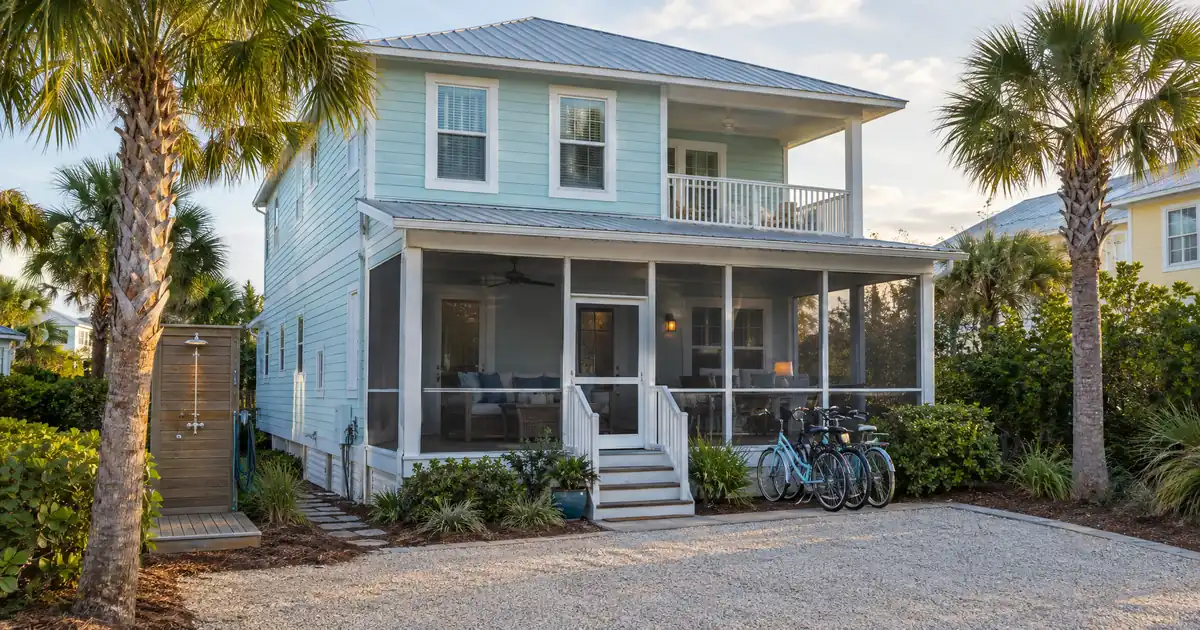
HOA Rental Cap Block A Business Owner’s — The Quick Read: Yes, an HOA rental cap or short-term rental ban can block the loan, but it does so through the appraisal and property-eligibility process, not through some special rule about business owners. A DSCR loan is a business-purpose loan for any non-owner-occupied rental, no matter who owns it. What actually decides the file is whether the specific unit is legally allowed to generate short-term rental income right now.
The business-owner framing is mostly a distraction. Whether the borrower runs a company, works a W-2 job, or invests as a side hustle changes nothing about how underwriting treats the property. What matters is the HOA’s governing documents, the cap’s current status, and whether that unit sits inside or outside the allowed count.
Short-Term Rental Calculator
Run the STR numbers in your market
Rate source: Freddie Mac 30-yr average via FRED® — Federal Reserve Bank of St. Louis · effective Sep 17, 2026
Prefilled with local estimates — enter your nightly rate, occupancy, taxes, and insurance for a more accurate picture.
Short-term rental income is documented with a 12-month history or a market data report. Program parameters update from Lendmire’s centralized guideline source.
As of Sep 17, 2026 · General Freddie Mac market benchmark, not a Lendmire loan offer. Nightly rate, occupancy, taxes, and insurance are editable estimates. Qualifying income for short-term rentals varies by program — some use appraisal market rent, others use documented STR history or projections — and is confirmed in underwriting. Not a Loan Estimate, approval, or commitment to lend. Program availability and eligibility are subject to lender guidelines, credit approval, property review, and underwriting.
Key Terms Defined
Rental cap: A rule in a HOA’s governing documents that limits the number or percentage of units that can be leased at any given time.
Grandfathering: A legal protection that lets an owner who purchased before a rental restriction was adopted keep their prior rental rights.
Business-purpose loan: Financing for a non-owner-occupied property, classified this way regardless of the borrower’s occupation, under Consumer Financial Protection Bureau rules for the federal truth-in-lending rulebook (the federal consumer-finance regulator the federal truth-in-lending rulebook §1026.3).
HOA questionnaire: A form the association completes for the lender disclosing occupancy mix, litigation history, reserves, and rental rules — this is where a cap or STR ban shows up in writing.
Coverage ratio (DSCR): The rental income divided by the full monthly housing payment. A ratio of 1.00 means the rent covers the payment exactly.
Why the Cap Matters More Than the Borrower’s Job Title
An HOA rental cap does not check whether the buyer owns a business. It checks whether the community has hit its allowed number of rented units. If the community is full, the property cannot legally be rented — and a lender is not going to underwrite income the borrower cannot lawfully collect.
Across the DSCR files reviewed through Lendmire’s wholesale network, the pattern stays consistent: lenders verify legal use before they calculate income, not after. Say a third-party check or the HOA questionnaire shows the unit can’t be rented short-term. In that case, the lender typically falls back to long-term market rent, if it uses any rental income at all. This is a property-eligibility gate, not a credit decision. No amount of business income or personal net worth changes it.
How a Rental Cap Actually Trips Up the File
The mechanics run in a set order, and knowing the order helps an investor catch the problem before it costs a signed contract.
1. Legal-use verification. Before short-term rental income counts toward the coverage ratio, the file has to confirm the municipality and the HOA both allow it. This is a binary check — permitted or not — done ahead of any DSCR math.
2. The HOA questionnaire. The association answers a standard form disclosing rental rules, litigation, and reserve health. A rental cap, a waitlist, or an outright STR ban surfaces here in writing.
3. The appraisal’s rent conclusion. Long-term rent typically gets documented on the standard rent-schedule forms the appraisal industry has used for decades. Short-term rental income does not fit that format — appraisers with STR experience generally will not force nightly-rate income into a form built for long-term leases, because doing so conflicts with how the form defines reportable income (Class Valuation).
4. What happens when the cap flags a problem. If the questionnaire or appraisal shows the unit is capped out or banned from STR use, most lenders in Lendmire’s network either revert to conservative long-term rent or decline to use rental income from that address at all — separate from the borrower’s credit profile or entity structure.
5. Business-purpose classification stays the same either way. The loan is still a business-purpose loan whether the buyer is self-employed, a contractor, or a full-time W-2 employee investing on the side.
Grandfathering Can Save a Deal — But Not Always
Grandfathering is the single biggest edge case investors overlook, and it can flip a “no” into a “yes” for existing owners. Some states protect owners who bought before a rental restriction passed, letting them keep prior rental rights even after the HOA tightens the rules. But that protection usually has carve-outs of its own: restrictions specifically targeting rentals under a set number of months, or capping how many times a year a unit can be rented, often apply to every owner regardless of when they bought (Gomez Law).
That distinction matters for short-term rentals specifically. A general rental cap might be grandfathered for a long-tenured owner. A short-term rental ban aimed at nightly or weekly stays frequently is not. An investor’s own attorney needs to read the specific declaration line by line — a lender cannot waive a state statute or a HOA’s private covenant, and neither can Lendmire.
Condo associations and single-family HOAs are also governed by different statutory frameworks in some states, and condo boards often have a freer hand to impose flat STR bans than a detached-home HOA does under the same state’s rules. State law itself varies too — some states cap how tight a rental restriction can get, while others let associations restrict much more aggressively. None of that is uniform, and it’s exactly why the HOA questionnaire and the declaration itself, not a general rule of thumb, decide the outcome.
Does a City STR Permit Override the HOA?
No. A city permit only covers the local government’s side of things. The HOA’s governing documents are a separate, private contract layer. Private covenants can be stricter than the local ordinance. A city may allow short-term stays with a permit while the HOA’s declaration still prohibits rentals below a set minimum stay. Lendmire’s network documents municipal permission per property in every DSCR file — it’s never assumed for an entire city or state. That’s because HOA and city rules operate independently, and both have to clear before rental income counts. That classification governs disclosure treatment under Regulation Z. It says nothing about whether the HOA will let the unit be rented.
What This Does to the Financing Pool
An HOA sitting near or at its rental cap creates friction well beyond the current buyer’s loan file. Lenders watch the ratio of renters to owner-occupants inside a community, and when that ratio gets out of balance, certain loan programs stop being available to anyone buying in — not just the investor trying to close this month. That constraint hits both the purchase and the eventual exit sale, since a future buyer faces the same cap.
Master-policy insurance costs can also climb in heavily rented communities. That cost flows straight into HOA dues, which sit inside the monthly obligation lenders use to calculate DSCR coverage. So a cap-adjacent community with rising dues can quietly erode a coverage ratio that looked fine on paper just six months earlier.
Waitlists compound the timing risk. Because many communities fill rental slots first-come, first-served, a buyer can be under contract on a property that’s already hit its cap before closing — leaving no legal path to rent it short-term at all. This dynamic is part of a larger pattern researchers have flagged in markets with heavy short-term rental concentration, where STR volume and HOA restrictions interact to shape regional rental supply (Florida Atlantic University Business Newsroom).
What DSCR Underwriting Looks Like Once the Property Clears
Once a lender confirms legal use, the loan mechanics run like any other DSCR file. Through Lendmire’s wholesale network, lenders generally document short-term rental income in one of two ways: twelve months of operating history on a refinance, or the appraisal’s short-term-rent analysis on a purchase. Either way, they count it at a discount to gross income rather than full gross receipts. This conservative haircut is standard across most programs in the network — it’s not a penalty specific to any one property.
Loan sizes on this program run from $150,000 up to $10,000,000, though short-term-rental and no-ratio files generally top out at $2,000,000. Leverage steps down as the loan size grows: purchases typically run up to 80% loan-to-value through roughly $1,000,000, stepping to 75% through the mid-tier bands, and settling lower on larger balances, subject to underwriting. Cash-out on standard rental collateral tops out around 75%, while cash-out on short-term-rental collateral is generally capped closer to 70%, both subject to lender guidelines. A coverage ratio of 1.00 or better typically earns full leverage; select programs in the network will consider ratios between roughly 0.75 and 0.99, but leverage and terms adjust downward when the ratio comes in below 1.00, subject to underwriting.
Credit score requirements are typically 660 on most files. That number moves up to 700 on loans above $3,000,000. Reserve requirements generally call for six months of the monthly housing payment on the subject property. Short-term-rental qualification is usually limited to investors who already have experience owning income property. First-time landlords typically don’t qualify. None of these figures are guarantees. Every file gets underwritten individually, based on the property, the borrower profile, and the specific program’s guidelines.
What Happens If the Cap Changes After You Close?
This is the risk most investors never think to ask about. If an HOA tightens its rental cap or moves from a percentage cap to an outright STR ban after a loan closes, the existing loan itself is not automatically called or restructured — but the investor’s ability to keep generating that income for future refinances or resale disclosures can change. An investor relying on rental income for a future cash-out refinance should keep documentation of the HOA’s rules at the time of purchase, since that history can matter if the association’s stance shifts later. This is a legal and title question first, not a lending question, and it belongs with the investor’s attorney reviewing the declaration and any recorded amendments.
Before Making an Offer: The Practical Checklist
Order matters here. Confirm these before signing a contract, not after the appraisal is scheduled.
DSCR vs. conventional financing
Two common ways to finance an investment property in this market. They qualify you differently — here’s how investors weigh them.
Why investors choose it
- Qualifies on the property’s rental income — no personal tax returns, W-2s, or pay stubs needed to document income.
- No personal debt-to-income ceiling to clear, so existing mortgages and obligations don’t cap your borrowing the same way.
- Can be closed in an LLC, keeping the property inside a business entity.
- Built for scaling — not held to the limit on number of financed properties that conventional financing applies.
- Underwriting centers on the deal: generally qualifies when the rent covers the payment, a 1.00x coverage ratio being a common baseline (confirmed in underwriting).
- Designed specifically for investment property, including long-term and, where the program allows, short-term rentals.
Where it’s strong
- Often the lowest ongoing financing cost for a buyer who fully qualifies on personal income — a fit for a first property or a cost-first purchase.
Trade-offs for investors
- Requires full personal income documentation and must fit within a debt-to-income limit — salary, existing debts, and other mortgages all count.
- Typically held in your personal name rather than a business entity.
- Caps how many financed properties you can carry, which can become a ceiling as a portfolio grows.
- Evaluates you as a borrower as much as the property, which usually means more paperwork.
How investors usually choose: a first or single property often optimizes for the lowest financing cost; portfolio builders often optimize for leverage, vesting in an LLC, and scaling past conventional caps. The right answer depends on your goals, the property, and current guidelines — both paths run through select lenders in Lendmire’s wholesale network, with eligibility and terms confirmed in underwriting.
1. Request the HOA’s current rental cap status in writing — how many units are rented against the cap, and whether a waitlist exists.
2. Pull the recorded declaration and any amendments — specifically language addressing short-term or transient rentals, not just general leasing.
3. Confirm municipal STR permission for the exact address — a city-wide allowance does not guarantee this specific unit or building qualifies.
4. Ask whether the HOA has adopted or is considering new restrictions — board meeting minutes often flag proposed amendments before they’re voted on.
5. Check whether existing owners hold grandfathered rights, and whether those rights extend to short-term use specifically or only to general leasing.
Want to know how underwriters qualify a specific STR property under DSCR guidelines? Lendmire’s guide to short-term rental DSCR loan criteria for business owners walks through the documentation an underwriter expects to see. Want a deeper look at what happens when an HOA has already gone to court over rental restrictions? See Lendmire’s coverage of HOA litigation blocking a luxury short-term rental.
For the end-to-end picture of how these loans work — qualification, structures, and the full process — see Lendmire’s complete DSCR loans guide.
Frequently Asked Questions
Does being a business owner exempt my loan from HOA rules?
No. Business-purpose classification under Regulation Z governs how the loan is disclosed and regulated, not whether the property can legally be rented. Every non-owner-occupied DSCR loan gets this classification regardless of the borrower’s occupation, and the HOA’s governing documents apply the same way to every owner.
Can I use short-term rental income if the HOA cap is already full?
Generally no, until the cap opens up or the property secures a documented exception. If the appraisal or HOA questionnaire shows the unit cannot legally operate as a short-term rental, most lenders will exclude that income or substitute conservative long-term market rent instead.
Does a grandfathering clause protect my short-term rental rights specifically?
Sometimes, but often only partially. Many state grandfathering statutes protect general leasing rights for existing owners but carve out short-term and high-frequency rentals as exceptions that apply to everyone, regardless of purchase date. The recorded declaration for that specific community is the only reliable answer.
How does an HOA cap show up in the appraisal?
It typically surfaces through the HOA questionnaire the association completes for the lender, not the appraisal form itself. Appraisers generally won’t insert short-term rental income into forms built for long-term lease comparables, so a flagged restriction usually pushes the file toward conservative rent treatment or exclusion of that income.
What loan size works for a short-term rental purchase under this program?
Short-term-rental files through Lendmire’s network generally run up to $2,000,000, with income counted at a discount to gross rent based on twelve months of operating history or the appraisal’s short-term rent analysis, subject to underwriting and program eligibility.
Sometimes a HOA’s rental rules aren’t clear on a property being considered for DSCR financing. In these cases, Lendmire can help investors compare loan options. Lendmire looks at the property’s documented rental history, the association’s governing documents, credit profile, and leverage goals. Investors can request a quote or call 828-256-2183 to walk through a specific property before making an offer.
Investors focused on short-term rentals can review DSCR loans for Airbnb and short-term rentals.
For current guidelines and terms, see Lendmire’s super jumbo DSCR loan programs page.
Self-employed borrowers can compare both super jumbo programs on Lendmire’s self-employed mortgages page.
About Lendmire
Lendmire is a non-QM mortgage brokerage (NMLS# 2371349) arranging DSCR investor loans in 40 markets, including Washington, D.C., through wholesale and investor-lending channels. DSCR loans are evaluated by the lender on rental income rather than personal income, subject to lender guidelines — a fit for LLC-owned portfolios, self-employed investors, and operators scaling beyond conventional loan caps. Recognized as a Scotsman Guide Top Mortgage Workplace in 2025 and 2026.
Lendmire’s Top Mortgage Workplace recognition is documented by Scotsman Guide 2025 Top Mortgage Workplace and Scotsman Guide 2026 Top Mortgage Workplace.
Get Started
Ready to find the right loan for you?
In about 30 seconds you can review financing options available for your home or investment property. No commitment required.
Informational only. Not a Loan Estimate, approval, or commitment to lend. Program availability and eligibility are subject to lender guidelines, credit approval, property review, and underwriting.
References
2. Class Valuation — Appraisal Form 1007 and Short-Term Rentals
3. Gomez Law — Can Florida HOAs Ban Airbnb
4. Florida Atlantic University Business Newsroom — STR/HOA Rules Drive Up FL Rents
Brandon Miller
Founder & CEO, Mortgage Loan Originator, Lendmire LLC
- Mortgage Loan Originator · NMLS# 1129696 · Verify on NMLS Consumer Access
- North Carolina Real Estate Broker · License# 343312 · Verify on NCREC
- North Carolina Insurance Producer · License# 19053198 · Property, Casualty, Life, Health · Verify on NAIC SBS
- Lendmire LLC · Firm NMLS# 2371349 · Verify firm licensure
Required disclosures. Lendmire (NMLS# 2371349) operates as a licensed mortgage broker, not a direct lender or depository. The discussion in this article is general in nature and should not be relied upon as financial, legal, or tax advice — every investment scenario is unique and should be reviewed by a qualified professional. Any loan inquiry is subject to lender underwriting, and this article is not a commitment to lend or a guarantee of approval. Mortgage rates, loan terms, and program guidelines vary by borrower, property, and state, and may change without notice. Equal Housing Opportunity. Verify licensure at NMLS Consumer Access.


