
The Quick Read: A DSCR lender sorts each property by class first, then tests rent against the full payment, so houses and buildings up to four units are read one way, while a building with five or more units moves to a commercial-style review with its own structure. The rest of the file, including credit, leverage and reserves, is set separately.
- Houses, condos, townhomes and 2-4 unit buildings take the residential path, where rent is compared with the full monthly obligation (principal, interest, taxes, insurance and association dues).
- A building with five or more units is not eligible on a single-property DSCR loan. In Lendmire’s network it fits only the rental portfolio term loan, which is underwritten more like commercial property.
- Most programs count the lower of the signed lease and the appraiser’s market rent, so an above-market lease does not lift the ratio.
- Coverage of 1.00 is where many select programs start. Clearing it does not mean the property produces positive cash flow.
- Under one pooled loan, stronger houses can offset a weaker building, but only up to the point where the pool still clears its coverage floor.
What Counts as a Small Apartment Building?
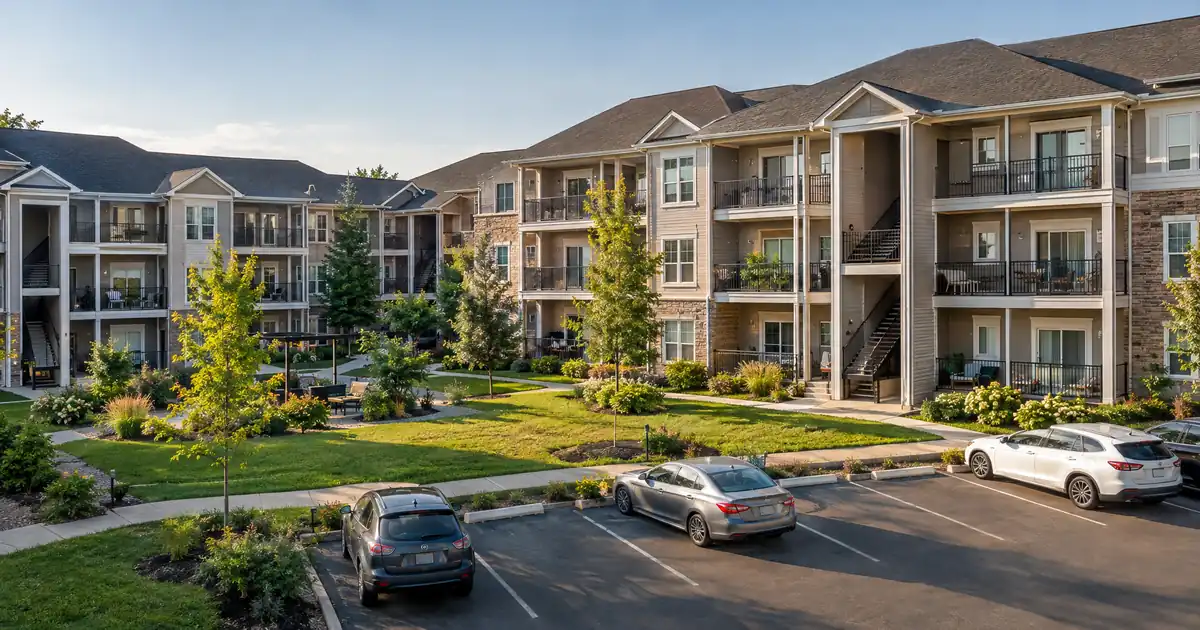
A small apartment building, to a DSCR lender, is a two-to-four-unit property. Five units or more is a different loan category. The line is a classification rule, not a physical one, and it changes the formula, the paperwork, the appraisal method and the lender pool.
Many investors use the phrase loosely. A fourplex and a six-unit building feel similar from the street. They sit on opposite sides of the line.
DSCR loans are designed for non-owner-occupied investment properties. Because they are business-purpose investor loans, they are reviewed differently from a standard owner-occupied mortgage. The property’s rent is the main qualifier. A file qualifies primarily on property-level rental income covering the payment, subject to lender guidelines.
Here is how the sorting works in practice:
- Single-family houses, condos and townhomes take the residential path.
- Two- to four-unit buildings also take the residential path. Their units are pooled against one payment.
- Five or more units move to commercial-style underwriting. In the network Lendmire works with, that means the rental portfolio term loan, covered below.
- Mixed-use buildings, such as apartments over a storefront, are not eligible in the pool programs.
Manufactured and mobile homes are not reviewable on these programs. Log homes and barndominiums are not offered through the network’s DSCR programs either.
How Underwriting Treats Houses and a Small Apartment Building in One File
Underwriting runs the same six steps on every property. The steps repeat for each asset, and what changes is the rent evidence and the structure around it.
1. Classify the property. The lender decides whether it is a house, condo, townhome, 2-4 unit building or larger.
2. Establish the rent. The appraiser gives an opinion of market rent. The file also carries any signed lease.
3. Choose the rent that counts. Most programs use the lower of the lease and the market opinion. A vacant or newly bought property usually leans on the appraisal figure alone, though programs differ on how a vacant unit inside a building is treated.
4. Build the obligation. The denominator is the full monthly obligation: principal, interest, taxes, insurance and association dues. On multi-unit buildings, taxes and insurance often weigh more heavily here.
5. Divide. Rent divided by that obligation gives the coverage ratio. A result of 1.00 means rent equals the payment.
6. Check the rest of the file. Credit, leverage, reserves, loan size and property type are tested on their own.
Across the wholesale network, 1.00 is where select programs start. It is a floor for those programs, never a universal rule. Stronger ratios open better pricing and more leverage. On a loan against one rental, coverage below 1.00 is available through select lenders in the network, with leverage and terms adjusted. That is a separate path, not a lower floor on the standard program.
A fourplex has an advantage over a single house on one point. If one unit sits empty, three still produce rent. A house with a vacancy has zero.
Where Rent Evidence Comes From
The rent used in the ratio is documented by the appraiser, not chosen by the borrower. Two appraisal forms carry that opinion. Fannie Mae’s appraiser resource page lists Form 1007, the single-family comparable rent schedule, and Form 1025, the small residential income property report. The Fannie Mae Selling Guide says Form 1025 is for two- to four-unit properties.
Those are only form names that DSCR lenders borrowed. A DSCR loan is not an agency product, and agency selling-guide rules do not govern it. The network’s programs set their own terms.
On a duplex or fourplex, each unit gets its own lower-of figure, and the results are added together. A lease above market does not help. A lease below market is the figure that counts. Month-to-month tenancies are usually treated at market rent, with the lease as support.
A typical file for houses plus a small building carries:
- current leases for every unit
- a unit-by-unit rent roll for any multi-unit building
- the appraisal with the rent schedule or income report
- insurance and tax figures
- entity documents if the properties sit in an LLC, depending on program guidelines
- proof of reserves
Price the deal on the likely appraisal number, not the best-case lease. That one habit prevents many failed files.
Why Five Units Changes the Whole Read
At five units the math switches from rent over payment to net operating income over debt service. Net operating income is property income after operating expenses. Debt service is the principal and interest on the loan.
Residential DSCR, by contrast, divides gross rent by the full payment and does not deduct operating costs. Two different ratios share one name. Mixing them gives wrong answers.
Because operating costs come out of income first, a building usually shows lower coverage on the same gross rent under the commercial-style method. A lender reviewing a larger building also looks at the rent roll and an operating statement, not just a rent opinion.
In the wholesale network, the home for five or more units is the rental portfolio term loan. It covers five or more rental properties or units under one note, and a single large building can qualify on its own unit count. Terms are fixed for 3, 5, 7 or 10 years with a balloon at maturity. That is a shorter, different structure than the 30-year fixed spine of a standard DSCR loan.
Moving from four units to five is a category change. It is not a small step. Investors who plan to grow into larger buildings should expect new documents, a different appraisal method and a different lender pool.
Key Terms Defined
DSCR (debt service coverage ratio): the property’s rent divided by its monthly obligation, which shows how far the rent covers the payment.
PITIA: principal, interest, taxes, insurance and association dues, the full monthly obligation used as the denominator.
Rent roll: a unit-by-unit list of tenants, lease terms and rents for a multi-unit building.
Market rent: the appraiser’s opinion of what a unit would rent for, which can replace or cap the lease figure.
Pooled coverage: total rent across several properties divided by their total debt service, used when one loan is secured by more than one rental.
Portfolio DSCR loan: one note secured by several rentals. The terms blanket loan and cross-collateralized loan mean the same thing here. A bank’s portfolio loan, which the bank keeps on its own books, is a different use of the word.
One Loan or Several?
Houses and a building can sit under separate loans or under one note. Each structure tests coverage differently, and the figures below are program ceilings and floors, never quotes. They are subject to lender guidelines.
| Factor | Single-property loan | 30-year portfolio DSCR loan | Rental portfolio term loan |
|---|---|---|---|
| Properties | One rental | 2 to 20 under one note | 5+ properties or units |
| Loan size | Up to $3,000,000 | $300,000 to $5,000,000 | $500,000 to $50,000,000 |
| Top leverage | 75%-80% LTV on purchase | Up to 80% on purchase | Up to 75% of value |
| Coverage test | That property alone | Pooled, 1.00 floor | Lender reviews the pool |
| 5+ unit building | Not eligible | Not eligible | Eligible |
Larger loan balances are reviewed individually on the portfolio structures. The 30-year portfolio loan has a 30-year term and an interest-only period is available. Eligible property types on that structure are single-family, 2-4 unit, condo and townhome.
The pooled test is the key difference. On a single-property loan, a weak building stands alone. On the 30-year portfolio loan, pooled rent is measured against pooled debt service, so stronger properties can offset weaker ones. A rental below 1.00 can sit in the pool, but underwriting tests the pooled coverage, the leverage and the terms.
Worked Example: Three Houses and a Fourplex
The following figures are modeled assumptions, not market data. Suppose an investor holds three houses and a fourplex. To keep the arithmetic plain, assume each of the four properties carries the same monthly obligation.
- House one covers its payment at about 1.30x.
- House two covers at about 1.20x.
- House three covers at about 1.15x.
- The fourplex covers at about 0.90x after the appraiser’s market rent replaces an above-market lease on one unit.
On four separate single-property loans, the fourplex is the problem file. At 0.90x it sits below the 1.00 start of many select programs. The investor would look at lower leverage, adjusted terms through select lenders or a stronger rent case.
Under one pooled loan, the picture changes. With equal obligations, pooled coverage is the average of the four ratios, about 1.14x. That clears a 1.00 pooled floor.
The cushion is thin, though. If the fourplex dropped to roughly 0.30x, perhaps from a lost tenant and a heavy tax reassessment, pooled coverage would fall to about 0.99x. One weak asset can eventually pull the whole pool below the floor.
Treat this as a stress test, not a plan. If the pool only clears because one asset is masking another, the investor should ask whether a single note ties the strong houses to a weak building, and what that does to later sales and refinances.
Where the General Rule Breaks
Five edge cases catch investors who rely on the general rule.
Vacant units. Programs differ. Some let the appraiser’s market rent stand in for a vacant unit. Others are less generous. Ask before assuming a vacant unit counts.
Five scattered houses are not a five-unit building. Adding up separate houses does not turn them into one commercial property. Each stays its own residential asset. Under the rental portfolio term loan they can share one note, but the structure treats them as a pool, not as one building.
Mixed-use. An apartment building with ground-floor retail is mixed-use. It is ineligible in the pool programs. So are owner-occupied property, co-ops and commercial property.
Short-term rentals. Income is documented differently, and program terms differ from long-term rental programs. Short-term rental rules can vary by city, county, HOA, and property type, so investors should confirm local rules before relying on projected rental income.
Clearing 1.00 is not profit. The ratio compares rent with PITIA only. Repairs, vacancy, management, utilities and capital costs sit outside the calculation. A duplex that passes can still run thin once those costs are priced in.
What If the Building Drags the Numbers Down?
Investors have five realistic levers. None is guaranteed.
- A larger down payment. It lowers the monthly payment and can lift the coverage ratio. It does not erase leverage caps, credit floors, reserve rules or property eligibility. The strongest files clear both tests: enough equity and enough rental coverage.
- Interest-only structures. Select lenders in the network offer interest-only periods, which lower the payment and raise the ratio on the same rent. The tradeoff is slower principal paydown.
- Better rent evidence. A fresh appraisal rent schedule or a corrected rent roll sometimes moves the number.
- A separate loan for the weak asset. Keeping the building off the pool protects the houses, at the cost of managing two loans.
- Lower leverage. Putting more equity into the weak asset may reopen options. A sub-1.00 path through select lenders is possible, with leverage and terms adjusted.
If every neighborhood on the shortlist produces weak coverage, the problem is the submarket, not the loan type.
How the Decision Looks in Practice
Most investors choose among three paths, and the right one depends on portfolio size, property mix and exit plans.
If the portfolio is all houses and buildings up to four units, with one or two weak files, a 30-year portfolio DSCR loan may help. It suits investors who value one note and pooled coverage. It is less useful for investors who expect to sell or refinance single properties often. Partial releases, substitutions and sales follow the loan documents, the release price runs above the property’s allocated balance, and the remaining pool must still cover its debt service.
If the portfolio includes a building with five or more units, or totals five or more properties or units, the rental portfolio term loan is the matching structure. Terms are shorter with a balloon at maturity, and prepayment uses yield maintenance, so selling mid-term carries a cost. Reserves are held for taxes, insurance and capital expenditures. Some structures are non-recourse, with the lender looking to the real estate and recourse limited to carve-outs such as fraud and bankruptcy. Others are recourse and carry a personal guarantee. Some also require a special-purpose entity, typically an LLC.
For loans against one house or a 2-4 unit building, reserves commonly run around 6 months of PITIA, vary by lender, leverage and transaction type, and step up to about 9 months above $1,500,000. On a standard rental cash-out, leverage tops out around 75% LTV, with about 6 months of seasoning the common expectation. On a pooled cash-out it never exceeds 75% of pooled value. Inside the first six months of ownership the loan is also capped at 90% of total cost, which is purchase price plus documented improvements. It is capped at 100% of total cost from six to twelve months, and the leverage ceiling still applies, so the loan is the lower of the two. After twelve months the appraised value alone is the basis. A rate-and-term refinance is not subject to the cost-basis cap.
Credit floors on the portfolio programs start at 640, and some structures want 680 or 720. Tax treatment can depend on how the funds are used and how the property is held; investors should keep clear records and speak with a qualified tax professional before relying on any deduction.
For more depth, the complete DSCR loans guide covers the full program picture.
Frequently Asked Questions
Can a DSCR loan cover a building with five or more units?
Not as a single-property DSCR loan. Those loans stop at four units. In Lendmire’s network, five or more units fit the rental portfolio term loan, which is underwritten more like commercial property. A single larger building can qualify on its own unit count, subject to lender guidelines.
Does the lender use my lease or the appraiser’s rent?
Most programs use the lower of the two. A lease above market does not raise the ratio, while a lease below market lowers it. On a multi-unit building the comparison is made unit by unit and then added up.
Can strong houses cover a weak building?
Only on a pooled structure. Under the 30-year portfolio DSCR loan, pooled rent is measured against pooled debt service, so stronger properties can offset weaker ones. On separate single-property loans, each file stands alone.
Is one loan better than separate loans?
It depends on exit plans and the weakest asset. One note can rescue a thin building, but it ties every property together when one is sold or refinanced. Separate loans keep assets independent at the cost of more files to manage. Investors who expect frequent sales often prefer separate loans.
Do reserves change when a building is added?
Yes, they can. Reserves vary by lender, leverage, loan size and transaction type, commonly around 6 months of PITIA on loans against one rental. The rental portfolio term loan holds reserves for taxes, insurance and capital expenditures. Larger balances typically step up.
Next Step
If you are buying or refinancing a rental property and want to see how the numbers work, Lendmire can help you compare DSCR loan options based on the property income, credit profile, leverage, and investor goals. Lendmire is a mortgage broker arranging DSCR investor loans through select lenders in its wholesale network, across 41 markets including Washington, D.C. Programs and eligibility are subject to lender guidelines and credit approval, and none of this is a commitment to lend. A mixed set of houses and a small building is best reviewed file by file, since the weakest asset usually decides which structure fits.
About Lendmire
Lendmire (NMLS# 2371349) is a DSCR-focused mortgage broker that helps arrange investor financing across 41 markets, including Washington, D.C., through wholesale and investor-lending channels. DSCR eligibility is generally reviewed by the lender around the property’s rental income rather than personal income documentation, subject to lender guidelines — which works for self-employed investors, LLC operators, and portfolios above four financed properties. Scotsman Guide named Lendmire a Top Mortgage Workplace in both 2025 and 2026.
Get Started
Ready to find the right loan for you?
In about 30 seconds you can review financing options available for your investment property. No commitment required.
Informational only. Not a Loan Estimate, approval, or commitment to lend. Program availability and eligibility are subject to lender guidelines, credit approval, property review, and underwriting.
References
1. Fannie Mae Appraisers & Property Underwriting
2. Fannie Mae Selling Guide B4-1.2-01
This article is part of Lendmire’s DSCR loan program — full qualification details, guidelines, and scenarios live on the program page.
Related reading: How a Portfolio Lender Weighs DSCR Houses All in One Town · Can a Rental Portfolio in One Small Market Get a DSCR Portfolio Loan? · How a DSCR Lender Tests Coverage With Weak Rentals in the Pool
Brandon Miller
Founder & CEO, Mortgage Loan Originator, Lendmire LLC
- Mortgage Loan Originator · NMLS# 1129696 · Verify on NMLS Consumer Access
- North Carolina Real Estate Broker · License# 343312 · Verify on NCREC
- North Carolina Insurance Producer · License# 19053198 · Property, Casualty, Life, Health · Verify on NAIC SBS
- Lendmire LLC · Firm NMLS# 2371349 · Verify firm licensure
Disclosures. The information presented in this article is general market commentary, not financial, legal, or tax advice. Lendmire is a mortgage brokerage (NMLS# 2371349) — not a direct lender or depository institution — and loan placement is subject to lender underwriting. Nothing in this content represents a commitment to lend. Loan terms, pricing, and program availability vary based on borrower qualifications, property characteristics, and state of subject property, and are subject to change at any time. Lendmire complies with Equal Housing Opportunity requirements. Consumer access: nmlsconsumeraccess.org.