
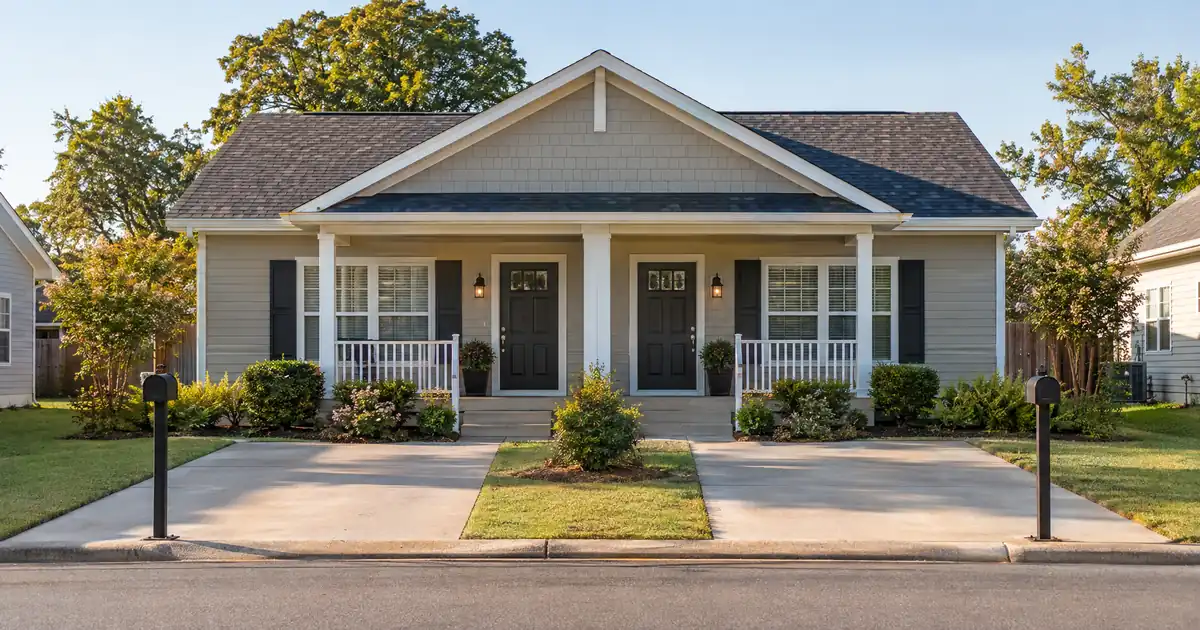
The Quick Read: Yes, usually. A portfolio DSCR loan can put single-family houses and 2-4 unit buildings such as duplexes under one note, because lenders sort eligibility by unit count and not by house versus duplex. Each property still has to qualify, and the pool is generally tested on combined rent against combined debt service, subject to lender guidelines.
- A portfolio (blanket) loan puts two or more rentals under one note. Select programs in the network take 2 to 20 properties.
- Single-family, 2-4 unit, condo, and townhome collateral can sit together in one pool.
- Coverage on the portfolio structure is measured on the pool, so a strong duplex can offset a thinner house.
- Each property still needs its own valuation and a lease or appraiser-supported market rent.
- The tradeoff is cross-collateralization: every property backs the whole balance.
Key Terms Defined
DSCR (debt service coverage ratio): the property’s rent divided by its monthly housing obligation. That obligation is principal, interest, taxes, insurance, and any HOA dues.
PITIA: the shorthand for those same costs: principal, interest, taxes, insurance, and association dues.
Blanket (portfolio) loan: one loan secured by two or more properties, with one payment for the whole thing.
Cross-collateralization: every property in the pool backs the entire loan, not just its own share.
Release clause: a loan term that lets you sell or refinance one property without paying off the whole note.
Allocated loan amount: the slice of the total balance assigned to each property. It drives the release price.
What Does “One Loan” Actually Mean?
One loan means one note over several properties. It does not mean one building. A duplex is a single property with two units, and it sits in the pool as one asset next to your houses.
That distinction matters because investors sometimes picture a “mixed” loan as a special exception. It usually isn’t. The dividing line lenders draw is unit count. One to four units is residential rental collateral. Five or more units is a different class, handled by a different product.
Across the wholesale network, the 30-year portfolio DSCR loan takes 2 to 20 properties under one note, with loan sizes from $300,000 to $5,000,000 (larger balances on review). Property types include single-family, 2-4 unit, condo, and townhome. Qualification runs primarily on property-level rental income covering the debt, subject to lender guidelines.
Which Property Types Can Share a Pool?
Most one-to-four-unit rentals can. Owner-occupied homes and commercial or mixed-use buildings cannot. Programs differ at the edges, so the table shows what is typical across the network.
| Property type | In a mixed pool? | Notes |
|---|---|---|
| Single-family house | Yes | Core collateral |
| Duplex, triplex, fourplex | Yes | One property, several units |
| Condo or townhome | Yes | Condos add project review |
| Small multifamily (5+ units) | Different product | Rental portfolio term loan |
| Owner-occupied home | No | Must be investment property |
| Mixed-use or commercial | No | Not offered |
| Mobile, co-op, manufactured, log, barndominium | No | Not offered |
Condos deserve a flag. A condo needs a project review on top of the unit appraisal. A 2-4 unit property inside a condo project also needs the project section attached, per AceValue Management’s explanation of Form 1025. Cleaner pools are simpler pools.
How Does the Ratio Work Across Houses and Duplexes?
On the portfolio structure, coverage is measured on the pool. Add up the rent used for lender review, add up the debt service, and divide. The floor on that structure is 1.00 on the pooled numbers. That is a program floor, not a universal standard, and stronger ratios open better terms.
Run the numbers on a modeled pool of three assets: two houses and one duplex. Say the houses each cover their own payment at about 0.95x, which is thin. The duplex has two rents against one building payment and covers at about 1.30x. Because the duplex brings two rents to one payment, its higher coverage can lift the blended result above 1.00. The pool lands near 1.05x in this illustration, which clears the pooled floor. These are modeled assumptions, not market data.
A few cautions apply:
- Weak houses cannot be stacked without limit. Underwriting still tests the pooled coverage, the leverage, and the terms.
- A house below 1.00 on its own can still sit in the pool as long as the pooled coverage clears the floor.
- Clearing 1.00 is not positive cash flow. DSCR compares rent to PITIA only. Repairs, vacancy, management, utilities, and capex sit outside it.
Leverage on the portfolio structure goes up to 80% of value on a purchase and on a rate-and-term refinance. A cash-out on the pool never exceeds 75% of pooled value, and it is limited by seasoning inside the first six months of ownership.
How Does Underwriting Treat Each Property?
Every property is underwritten on its own documents, even though the note is shared. A blanket loan does not remove per-property underwriting. It multiplies it.
The appraisal form depends on type. Fannie Mae’s Selling Guide lists Form 1004 for one-unit properties and Form 1025 for two- to four-unit properties. DSCR loans are not agency products, but the appraisal industry uses these same forms. A house typically pairs the appraisal with a separate Form 1007 rent schedule. The 1025 includes rental comparables, and Realvals notes it is often paired with the 1007 and 216 forms.
That is the practical difference. The house gives you one rent to support. The duplex gives you two units to document, either with leases or an appraiser-supported market rent.
A practitioner note: files that stall are rarely stalled by the ratio. They stall on one missing lease, one insurance binder in the wrong entity name, or one appraisal ordered on the wrong form. In a five-property pool, one weak document holds up the whole note. Build a per-property folder before the file goes out.
What Happens If You Want to Sell One Property?
Release terms are the part most investors skip, and they matter more in a mixed pool. Cross-collateralization means a problem at one property touches all of them. Default on the duplex and the houses are exposed too.
Partial releases, substitutions, and the sale of one property follow the loan documents and the lender’s release terms. Three things to expect:
- The release price typically runs above the property’s allocated balance.
- The remaining properties must still cover their debt service after the sale.
- Not every blanket has a release clause, so read the documents before you sign.
Allocation is where it gets personal. If the note assigns a large share of the balance to the house you most want to sell, the release price follows that number. Ask how balances are allocated before you commit.
Blanket Loan or Separate Loans?
A blanket trades flexibility for convenience. Which wins depends on whether you plan to sell, refinance, or hold.
| Factor | Blanket (portfolio) | Separate loans |
|---|---|---|
| Closings and payments | One closing, one payment | One per property |
| Qualification | Pooled coverage | Each property alone |
| Risk | Cross-collateralized | Contained per property |
| Selling one property | Depends on release terms | Clean, per loan |
| Weak property | Can be offset by strong ones | Must stand alone |
This is a genuine toss-up for many investors. A blanket makes sense when you are consolidating several existing loans, buying a bundle from one seller, or holding long term. Separate loans win when you expect to sell a property in the near term, or when one asset is weak enough to drag the pool.
If your properties sit in different states, Lendmire’s piece Can Properties in Different States Share One Blanket DSCR Loan? covers that wrinkle.
When a Mixed Pool Doesn’t Work
A mixed pool fails when something in it is ineligible, or when the pool is too small to matter. Owner-occupied property, mobile homes, co-ops, mixed-use, and commercial property are out. Manufactured homes, log homes, and barndominiums are not offered in the network’s DSCR programs.
Two other situations:
- Five or more units in one building. That moves toward the rental portfolio term loan, a separate structure. It covers five or more rental properties or units, with loan sizes from $500,000 to $50,000,000 and leverage up to 75% of value. Terms run 3, 5, 7, or 10 years with a balloon at maturity, and recourse and non-recourse options exist, with carve-outs on the non-recourse side. Prepayment uses yield maintenance.
- Lender variation. Some lenders keep houses and 2-4 units on separate programs. Appetite for mixed pools varies, which is the value of shopping several lenders. These specifics are subject to lender guidelines and a full review of property, leverage, and credit.
Edge Cases Worth Knowing
A house with an accessory unit is the usual gray area. Whether it counts as one unit or two depends on how it is appraised and permitted. Decide that early.
A duplex with one side vacant can still go in, but you need an appraiser-supported market rent for the empty unit. Adding a condo or townhome to a pool of houses is workable, and the condo review is the extra step.
On a refinance, you can pull several existing rentals into one note. For the broader picture of how these loans work, see Lendmire’s complete DSCR loans guide.
Getting Your File Ready
For each property, assemble:
- A lease, or an appraiser-supported market rent
- Proof of insurance
- Entity documents (a special-purpose entity, typically an LLC, is required on some structures, subject to lender program eligibility)
- A purchase contract or current mortgage statement
- Evidence of reserves, which vary by lender, leverage, and loan size
Credit matters too. The pool typically needs a score floor of 640, and some portfolio structures ask for 680 or 720. Recourse loans carry a personal guarantee. Business-purpose DSCR loans are built for non-owner-occupied investment property and are reviewed differently from an owner-occupied mortgage.
Frequently Asked Questions
Do all the properties have to be the same type?
No. Single-family, 2-4 unit, condo, and townhome properties can share one portfolio note. The limits are unit count and occupancy, not whether the building is a house or a duplex.
Can one weak property sink the loan?
Not necessarily. On the portfolio structure, coverage is tested on the pool, so stronger properties can offset weaker ones. Underwriting still tests pooled coverage, leverage, and terms, and every property needs its own lease or market rent.
How many properties do I need?
The 30-year portfolio program takes 2 to 20 properties under one note. At five or more rental properties or units, the rental portfolio term loan also becomes an option, subject to lender guidelines.
Does each property still need an appraisal?
Yes. Each is valued separately, using the form that matches its type. Single-family houses use a one-unit form. Duplexes use a 2-4 unit form with built-in rent analysis.
What is the biggest risk?
Cross-collateralization. Every property backs the whole balance, so trouble at one can affect all of them. Read the release terms before signing.
If you are buying or refinancing rental properties and want to see how the numbers work, Lendmire can help you compare DSCR loan options based on property income, credit profile, leverage, and investor goals. Reach the team at 828-256-2183 or request a quote.
Tax treatment varies; consult a qualified professional.
A pool is only as strong as its weakest document, so the investors who get a mixed portfolio under one note are usually the ones who built five clean property files before asking.
About Lendmire
Lendmire is a non-QM mortgage brokerage (NMLS# 2371349) arranging DSCR investor loans in 41 markets, including Washington, D.C., through wholesale and investor-lending channels. DSCR loans are evaluated by the lender on rental income rather than personal income, subject to lender guidelines — a fit for LLC-owned portfolios, self-employed investors, and operators scaling beyond conventional loan caps. Recognized as a Scotsman Guide Top Mortgage Workplace in 2025 and 2026.
Get Started
Ready to find the right loan for you?
In about 30 seconds you can review financing options available for your investment property. No commitment required.
Informational only. Not a Loan Estimate, approval, or commitment to lend. Program availability and eligibility are subject to lender guidelines, credit approval, property review, and underwriting.
References
1. AceValue Management – Form 1025
2. Fannie Mae Selling Guide B4-1.2-01
This article is part of Lendmire’s DSCR loan program — full qualification details, guidelines, and scenarios live on the program page.
Related reading: Can BRRRR Rehabs Go in a DSCR Portfolio Loan Before Leasing? · Can Houses, Condos and a Small Apartment Building Share One DSCR Loan? · Portfolio DSCR Loan vs Bank Portfolio Loan on What Each Verifies
Brandon Miller
Founder & CEO, Mortgage Loan Originator, Lendmire LLC
- Mortgage Loan Originator · NMLS# 1129696 · Verify on NMLS Consumer Access
- North Carolina Real Estate Broker · License# 343312 · Verify on NCREC
- North Carolina Insurance Producer · License# 19053198 · Property, Casualty, Life, Health · Verify on NAIC SBS
- Lendmire LLC · Firm NMLS# 2371349 · Verify firm licensure
Required disclosures. Lendmire (NMLS# 2371349) operates as a licensed mortgage broker, not a direct lender or depository. The discussion in this article is general in nature and should not be relied upon as financial, legal, or tax advice — every investment scenario is unique and should be reviewed by a qualified professional. Any loan inquiry is subject to lender underwriting, and this article is not a commitment to lend or a guarantee of approval. Mortgage rates, loan terms, and program guidelines vary by borrower, property, and state, and may change without notice. Equal Housing Opportunity. Verify licensure at NMLS Consumer Access.