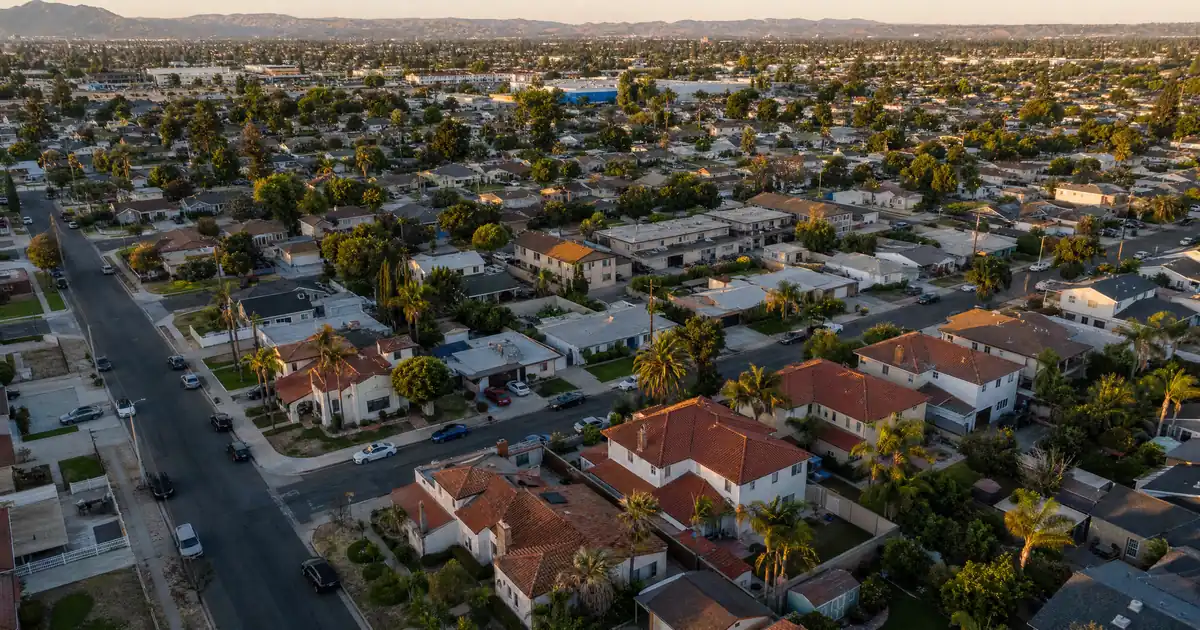
Anaheim’s median household income sits meaningfully above the broader Los Angeles-Long Beach-Anaheim metro figure, according to Census Reporter’s most recent American Community Survey estimate. That’s an odd number to lead with in a city best known for a theme park, but it’s the more useful one for an investor running DSCR math. Anaheim’s rental demand doesn’t rest on tourism alone. The city is densely populated relative to its footprint, with residents working across healthcare, manufacturing, defense electronics, and retail — sectors that keep renting whether or not the fireworks go off that night.
Lendmire works with investors buying or refinancing in Anaheim, California, helping place DSCR financing across 40 markets, including Washington, D.C.. The DSCR structure itself — qualifying a loan on a property’s rent rather than the borrower’s pay stubs — gets the full breakdown elsewhere. What matters here is where in Anaheim that structure actually clears, and where it doesn’t.
DSCR Calculator
Run the numbers in your market
Rate source: Freddie Mac 30-yr average via FRED® — Federal Reserve Bank of St. Louis · effective Jul 30, 2026
Prefilled with local estimates — enter your own rent or nightly figures, taxes, insurance, and HOA for a more accurate picture.
Program parameters update from Lendmire’s centralized guideline source. Taxes and insurance are editable estimates.
As of Jul 30, 2026 · General Freddie Mac market benchmark, not a Lendmire loan offer. Rent, nightly rate, occupancy, taxes, and insurance are editable estimates. Short-term rental figures are estimates only and vary significantly by season, property type, management approach, and local short-term-rental rules — confirm local regulations before relying on them. Qualifying income for short-term rentals varies by program — some use appraisal market rent, others use documented STR history or projections — and is confirmed in underwriting. Not a Loan Estimate, approval, or commitment to lend. Program availability and eligibility are subject to lender guidelines, credit approval, property review, and underwriting.
At a Glance: In Anaheim, California, DSCR lender review is underwritten primarily on a property’s rental income measured against its full monthly obligation, not the borrower’s traditional personal-income documentation — a distinction that matters here because small multifamily, per Redfin, tends to clear coverage more comfortably than single-family stock, which generally carries a higher price point relative to the rent it produces.
- West Anaheim’s average rents run well under the citywide average, a favorable rent-to-price gap for workforce rentals
- Small multifamily fourplexes nearby have listed at cap rates above what single-family typically produces here
- Anaheim Hills carries a meaningful price premium over the citywide median, but its rent premium is far more modest by comparison
- Multifamily listings tend to sit on market considerably longer than single-family — more room to negotiate entry price
- Disneyland’s large cast, alongside Kaiser Permanente, AHMC, L3Harris, and Kwikset, anchor demand that has nothing to do with hotel occupancy
Anaheim Market Snapshot
A quick read on the Anaheim investor landscape — figures come from the cited sources below. Confirm current property-level numbers before underwriting.
| Metric | Detail |
|---|---|
| Home prices | $948K median (Redfin) |
| Typical rents | $2,595 avg (Zumper) |
| Cap rates | 6.4% cap rate (Redfin Historic District) |
| Population | 344,579 population (Census Reporter Anaheim Profile) |
| Employment | 23,380 healthcare workers (Data USA) |
Two Economies Sharing One Rental Market
Disneyland is Anaheim’s largest single employer, with a sizable cast across its Anaheim operation, and that’s the number every competing DSCR pitch in this city leads with. It’s also only half the story. Data USA’s employment breakdown shows Health Care and Social Assistance, Manufacturing, and Retail Trade all standing out as major employment categories among Anaheim residents — a base that includes L3Harris’s defense electronics campus (a descendant of the old Hughes Aircraft operation) and Kwikset’s global headquarters, neither of which has anything to do with tourism.
AHMC’s Anaheim Regional Medical Center and two Kaiser Permanente facilities add clinical staffing demand on top of that. Kaiser’s Orange County-Anaheim Medical Center is a sizable acute-care facility per California’s HCAI facility database, serving a large regional health-plan membership. Add West Coast University’s Anaheim nursing and allied-health campus, which per Niche.com enrolls a meaningful mix of full-time and part-time students, and the tenant pool splits cleanly into two groups that rarely move together: hourly hospitality workers and salaried healthcare staff. For a DSCR portfolio, that’s a mild hedge against any single-industry slowdown.
Where the Multifamily Math Clears
Small multifamily is where DSCR coverage tends to work hardest in Anaheim, not single-family. West Anaheim and North Euclid post some of the lowest rents in the city, and the discount on price runs deeper than the discount on rent — which is the part that actually moves a coverage ratio.
West Anaheim’s average rents compare favorably to the citywide average, per Rent.com, and North Euclid runs a similarly modest rate for a broader unit mix. The Colony historic district, where single-family pricing sits well above its multifamily counterparts, still commands rents that are more affordable relative to price than premium submarkets — cheaper on price by a wider margin than it’s cheaper on rent, per Zumper’s average rent tracker.
That mismatch is exactly why 2-to-4-unit stock outperforms single-family on a coverage basis here. A fourplex in the Historic District recently listed at a cap rate above what a comparable Northwest Anaheim fourplex produced on current rents, with an even stronger projected yield once below-market leases roll to market rents, both per Redfin listing data. Citywide, multifamily carries a meaningfully lower price point relative to its unit count than single-family stock — and sits on market considerably longer, with fewer competing offers, against single-family’s faster-moving, multiple-offer pace. Slower-moving inventory with less competition tends to leave more room to negotiate below list, which is a more affordable way to improve a coverage ratio before a lender ever runs the numbers.
Why Doesn’t Anaheim Hills Cash Flow?
Because the price premium isn’t matched by a rent premium. Anaheim Hills’ median list price runs meaningfully above the city’s broader figure, per Go2Wendy’s comparison of the two submarkets. But median rent there, while somewhat higher than the citywide figure, doesn’t scale anywhere near proportionally — the rent gap is a fraction of the price gap.
Run a hypothetical: a single-family purchase in Anaheim Hills financed with a typical down payment, rented at the submarket’s going rate. Modeled against a property’s full monthly obligation — principal and interest, property tax, and insurance, treated as directional figures, not quoted terms against the purchase price — coverage tends to land well under the 1.00 mark in a hillside, view-oriented, family-driven submarket where buyers are competing on schools and lot size, not yield. That’s not a defect in the property. It’s the nature of the neighborhood.
For a DSCR file that lands below that threshold on long-term rent, the paths worth reviewing with a lender include reduced leverage, an interest-only structure, or — in select cases — a sub-1.00 program built for exactly this gap, all subject to credit profile, reserves, and program guidelines. None of that makes Anaheim Hills a bad buy. It makes it an equity and appreciation play, not a cash-flow one, and treating it as the latter is how an investor ends up disappointed at closing.
Redfin also shows Anaheim Hills prices softening somewhat year over year, with inventory noticeably thinner than the citywide pool — which means fewer recent comps for an appraiser to lean on. That thinness cuts both ways: less price competition on entry, but less certainty on any near-term equity story too.
The Platinum Triangle’s Long, Slow Build-Out
The Platinum Triangle is entitled for a large volume of residential units around Angel Stadium and Honda Center, with only a modest share completed since redevelopment began roughly two decades ago, per an Active Realty analysis of the pipeline. That slow pace matters for a DSCR investor because it means the flood-the-market risk that sinks a lot of transit-oriented districts hasn’t shown up here, at least not yet.
Condo pricing in the Triangle runs toward the higher end for one- and two-bedroom units, with rents that rank among the highest per-square-foot in the city per RentCafe’s neighborhood breakdown, driven by young professionals and stadium-and-arena-adjacent workers using the ARTIC transit station. That’s a tighter entry price than a fourplex, but a narrower unit count too, which changes the DSCR math from an income-stacking exercise to a single-unit coverage question.
Worth flagging: submarket-level softening can happen even while the citywide average holds flat. Zumper’s rent tracker shows one complex, the Summit of Anaheim Hills, with a notable year-over-year rent decline across a small sample of units — a reminder that a single building’s comps aren’t the city’s comps, and DSCR underwriting should lean on the specific asset, not the neighborhood average.
Running the Numbers on a Historic District Fourplex
Take a hypothetical fourplex priced near the current multifamily median in the Historic District, per Redfin. At a typical down payment and modeled rents in line with the Colony’s average, the four units bring in combined monthly income that, layered against principal and interest, property tax, and insurance — treated as directional figures, not quoted terms relative to the purchase price — lands in modestly positive coverage territory above the 1.00 mark that select DSCR programs use as a floor, though every file still runs through credit, reserves, and property-level underwriting before that number is confirmed.
DSCR files in markets like this one — dense small-multifamily inventory sitting next to a much higher-priced single-family tier — tend to arrive with two distinct rent stories on the same application: current in-place rents that are conservative, and a market-rent projection that assumes modest post-purchase lease-up. Lenders generally underwrite to the in-place figure, and the deals that move cleanest through review are the ones where the borrower isn’t counting on the market-rent bump to make coverage work in the first place.
Standard purchase programs on files like this typically run 75 to 80 percent LTV, with select strong files reaching up to 85 percent where guidelines allow, a minimum coverage ratio around 1.00 used as a program floor rather than a universal standard, and credit generally starting in the 620 to 700 range depending on leverage and loan size — reserves generally run about six months of the property’s full monthly obligation, moving closer to nine months for larger loan amounts. None of that is a guarantee of approval; it’s the shape of the guidelines most files are measured against, subject to lender overlays.
Where Most Anaheim DSCR Pitches Get It Wrong
A lot of the DSCR marketing aimed at this city leans entirely on Disneyland and short-term rentals — proximity to the park, tourism traffic, the promise of nightly income. That’s a real strategy for the right property type in the right zone, and conventional vs DSCR on investor loans covers how the two financing paths compare generally. But the pitch skips the workforce-rental case sitting underneath it: healthcare staff renting near Kaiser and AHMC, defense and manufacturing employees near L3Harris and Kwikset, and long-term tenants who never set foot in the park.
DSCR tends to make the most sense here for the self-employed investor or the LLC-titled portfolio where traditional personal-income documentation doesn’t cleanly reflect rental cash flow — subject to program eligibility for entity-held title. A W-2 employee buying one single-family rental with clean personal income might still find conventional financing pencils out fine, particularly on lower-leverage Colony or West Anaheim purchases where the loan amount stays modest. The flip point tends to show up around a third property, or sooner if the borrower’s returns don’t support rental add-backs cleanly — the full investor lending menu and DSCR loans in California both walk through program specifics in more detail. Investors weighing the two paths on a specific Anaheim address can compare DSCR options or call Lendmire at 828-256-2183.
The single biggest blind spot for a DSCR investor in Anaheim isn’t the theme park or the rent-control conversation everyone assumes it is — it’s comp reliability at the building level. The Summit of Anaheim Hills saw a sizable swing in rent within a single year while the citywide average sat flat. Anaheim Hills itself has a noticeably thinner pool of active listings to draw comps from than the broader city. An investor underwriting off a citywide or even submarket average, without pulling comps specific to the actual building, is underwriting a number the property may not deliver.
DSCR vs. conventional financing
Two common ways to finance an investment property in Anaheim, CA. They qualify you differently — here’s how investors weigh them.
Why investors choose it
- Qualifies on the property’s rental income — no personal tax returns, W-2s, or pay stubs needed to document income.
- No personal debt-to-income ceiling to clear, so existing mortgages and obligations don’t cap your borrowing the same way.
- Can be closed in an LLC, keeping the property inside a business entity.
- Built for scaling — not held to the limit on number of financed properties that conventional financing applies.
- Underwriting centers on the deal: generally qualifies when the rent covers the payment, a 1.00x coverage ratio being a common baseline (confirmed in underwriting).
- Designed specifically for investment property, including long-term and, where the program allows, short-term rentals.
Where it’s strong
- Often the lowest ongoing financing cost for a buyer who fully qualifies on personal income — a fit for a first property or a cost-first purchase.
Trade-offs for investors
- Requires full personal income documentation and must fit within a debt-to-income limit — salary, existing debts, and other mortgages all count.
- Typically held in your personal name rather than a business entity.
- Caps how many financed properties you can carry, which can become a ceiling as a portfolio grows.
- Evaluates you as a borrower as much as the property, which usually means more paperwork.
How investors usually choose: a first or single property often optimizes for the lowest financing cost; portfolio builders often optimize for leverage, vesting in an LLC, and scaling past conventional caps. The right answer depends on your goals, the property, and current guidelines — both paths run through select lenders in Lendmire’s wholesale network, with eligibility and terms confirmed in underwriting.
Frequently Asked Questions
How do you qualify for a DSCR loan in Anaheim?
Qualification centers on the property’s rental income relative to its full monthly obligation rather than the borrower’s personal income documentation. Lenders typically look for coverage at or above a program’s minimum ratio, reasonable leverage, sufficient reserves, and a qualifying credit profile, subject to individual lender guidelines and property type.
What credit score do you need for a DSCR loan in Anaheim, California?
Most DSCR programs begin evaluating files with credit profiles in the 620 to 700 range, though the exact minimum depends on leverage, loan size, and reserves on hand. Stronger credit generally supports higher leverage and more flexible coverage requirements, subject to program guidelines.
Does single-family or multifamily property qualify more easily for DSCR financing in Anaheim?
Small multifamily properties in submarkets like West Anaheim, North Euclid, and the Historic District tend to clear coverage more comfortably than single-family homes, largely because rents there are discounted less steeply than purchase prices relative to premium neighborhoods. Coverage still depends on the specific property’s in-place rents and full monthly obligation.
Can an investor get a DSCR loan for a property in Anaheim Hills?
Yes, though Anaheim Hills’ price premium generally isn’t matched by an equivalent rent premium, so coverage on long-term rent can land below a program’s benchmark. Reduced leverage, an interest-only structure, or a select sub-1.00 program may help bridge that gap, subject to credit profile, reserves, and lender guidelines.
What reserves are typically required for a DSCR loan in Anaheim?
Reserve requirements generally run around six months of the property’s full monthly obligation, moving closer to nine months for larger loan amounts. Exact reserve requirements vary by lender, program, and overall file strength.
About Lendmire
Lendmire is a non-QM mortgage broker, NMLS# 2371349, that helps investors structure DSCR financing across 40 markets, including Washington, D.C. Rather than funding or underwriting loans directly, Lendmire places DSCR scenarios through wholesale investor lenders, matching a property’s rental income profile to programs that generally evaluate coverage rather than traditional personal-income documentation, subject to lender guidelines. Recognized as a 2026 Top Workplace and a 2025 Scotsman Guide Top Mortgage Workplace by Scotsman Guide, Lendmire works with investors evaluating DSCR scenarios on specific Anaheim addresses, subject to credit profile, reserves, and program eligibility in every case.
Get Started
Ready to find the right loan for you?
In about 30 seconds you can review financing options available for your home or investment property. No commitment required.
Informational only. Not a Loan Estimate, approval, or commitment to lend. Program availability and eligibility are subject to lender guidelines, credit approval, property review, and underwriting.
References
1. Census Reporter — Anaheim, CA Profile
2. Redfin — Anaheim Multi-Family Homes for Sale
3. Redfin
4. Zumper
6. Census Reporter Anaheim Profile
7. Data USA
8. Disneyland Cast & Public Affairs
9. California HCAI — Kaiser Foundation Hospital Orange County-Anaheim
10. Rent.com
11. Go2Wendy — Anaheim Hills vs. Anaheim Neighborhoods
12. Active Realty
14. a 2025 Scotsman Guide Top Mortgage Workplace
Brandon Miller
Founder & CEO, Mortgage Loan Originator, Lendmire LLC
- Mortgage Loan Originator · NMLS# 1129696 · Verify on NMLS Consumer Access
- North Carolina Real Estate Broker · License# 343312 · Verify on NCREC
- North Carolina Insurance Producer · License# 19053198 · Property, Casualty, Life, Health · Verify on NAIC SBS
- Lendmire LLC · Firm NMLS# 2371349 · Verify firm licensure
Important disclosures. Lendmire (NMLS# 2371349) is a licensed mortgage brokerage. Lendmire is not a direct lender, depository institution, or financial advisor. All loan inquiries are subject to lender underwriting; this article does not constitute a commitment to lend. Rates, terms, and program guidelines are subject to change without notice and vary by borrower profile, property type, and state. Information in this article is general in nature and is not financial, legal, or tax advice. Equal Housing Opportunity. NMLS Consumer Access: nmlsconsumeraccess.org.