
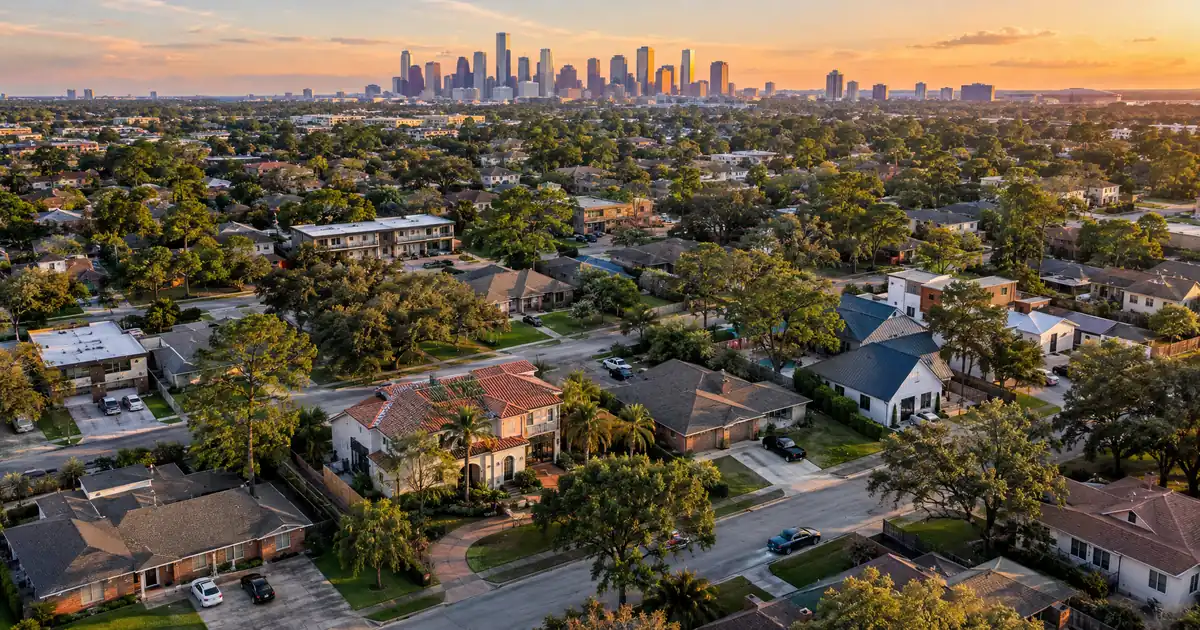
Run a Houston listing through the usual gross-yield shortcut and it looks fine. Then taxes and insurance land on the debt side of the ledger, and a deal that seemed to clear 1.00 slips below it. That gap between the headline rent-to-price ratio and the coverage number a lender calculates is where most first-time buyers of investment property loans in Houston, Texas get stuck. The fix is picking the submarket before picking the loan.
TL;DR: An investment property loan in Houston, Texas is a DSCR-style mortgage underwritten primarily on the property’s rental income measured against its full monthly obligation of principal, interest, taxes, and insurance, rather than on the borrower’s traditional personal-income documentation, and it fits best where price and rent sit close together.
DSCR Calculator
Run the numbers in Houston, TX
Rate source: Freddie Mac 30-yr average via FRED® — Federal Reserve Bank of St. Louis · effective Sep 24, 2026
Prefilled with starting assumptions — enter your own rent or nightly figures, taxes, insurance, and HOA for a more accurate picture.
Program parameters update from Lendmire’s centralized guideline source. Taxes and insurance are editable estimates.
As of Sep 24, 2026 · General Freddie Mac market benchmark, not a Lendmire loan offer. Rent, nightly rate, occupancy, taxes, and insurance are editable estimates. Short-term rental figures are estimates only and vary significantly by season, property type, management approach, and local short-term-rental rules — confirm local regulations before relying on them. Qualifying income for short-term rentals varies by program — some use appraisal market rent, others use documented STR history or projections — and is confirmed in underwriting. Not a Loan Estimate, approval, or commitment to lend. Program availability and eligibility are subject to lender guidelines, credit approval, property review, and underwriting.
- Northeast Houston Class C single-family homes ($120,000-$180,000 per Home Pros) model near 1.2 coverage at midpoint.
- Southwest Houston (Alief, Sharpstown) models around 1.0, so purchase price discipline decides the file.
- Third Ward fourplexes near the University of Houston stack four rent streams against one loan.
- Inner Loop neighborhoods are appreciation bets, and day-one coverage runs thin.
- Stabilized multifamily vacancy sits at 11.1% per Cushman & Wakefield and is easing. Track absorption before underwriting rent growth.
Houston Market Snapshot
A quick read on the Houston investor landscape — figures come from the cited sources below. Confirm current property-level numbers before underwriting.
| Metric | Detail |
|---|---|
| Home prices | $350K median sale price (Redfin Houston Housing Market) |
| Typical rents | $1,344 avg (RentCafe Houston Rent Report) |
| Recent appreciation | 60%+ 10-yr (Awning Market Analysis) |
| Cap rates | 3.55% cap rate (Restar Blog Houston Market) |
| Population | 7.9 million metro population (CultureMap Houston (Census data)) |
| Employment | 33,000+ employees (Memorial Hermann Health System) |
Northeast Houston: The Highest Coverage Per Dollar (With a Catch)
Northeast Houston (Aldine, Greenspoint, North Forest) offers the strongest coverage per dollar of purchase price in the metro. Class C single-family homes trade between $120,000 and $180,000 and rent for $1,100 to $1,400 a month, with cap rates running 6.5% to 8.5%, according to Home Pros’ Houston investor guide. Those are the highest gross yields in the metro. The same guide flags the tradeoff: heavier management, more deferred maintenance, and annual tenant turnover around 35% to 40%.
Lendmire Research modeled each submarket the same way: 75% LTV, a 30-year fully amortizing structure, and full obligations including taxes and insurance at Texas-average assumptions. Rent divided by that total is the coverage number. These are modeled results using the published price and rent bands, not observed closings. Exact terms depend on the lender’s guidelines, property type, leverage, and a full review of the borrower’s file.
At a $150,000 price and $1,250 rent, the file lands near 1.2. Push to the unfavorable corner ($180,000 price, $1,100 rent) and it drops to roughly 0.9. The favorable corner ($120,000 price, $1,400 rent) reaches about 1.7. So the spread inside one submarket is wider than the spread between submarkets. Buyers who pay list on a tired house and assume the neighborhood average rent will be right are the ones who end up below 1.00.
Turnover matters for the ratio too. A 35% to 40% annual churn rate means vacant months and make-ready costs that a lender’s coverage formula ignores but your bank account doesn’t. Skip the marginal deals here. Buy the ones that clear 1.15 or better on modeled numbers, so a vacancy or two doesn’t turn the property cash-negative.
One data point supports the rent side: Apartment Living Locators reports North/Northeast Houston annual rent growth of 5.4% in a Q1 analysis, ahead of most of the metro.
Southwest Houston: Alief, Sharpstown, and Westwood
Southwest Houston is the middle path. Coverage hovers right around 1.0 at midpoint, and price discipline decides which side of the line a file falls on. Acquisition costs run $175,000 to $250,000 with rents of $1,300 to $1,600 and cap rates of 5.5% to 7%, per the Awning market analysis and the Home Pros guide. Institutional buyers have been less active here, which leaves room for individual investors.
Model the midpoint (about $212,500 and $1,450 rent) and coverage comes out around 1.0 including taxes and insurance. The favorable corner ($175,000 and $1,600) reaches roughly 1.3. The unfavorable corner ($250,000 and $1,300) falls to about 0.8.
That spread tells the story. Southwest works for buyers who negotiate hard, or who target the lower half of the price band. It doesn’t work for someone paying the top of the range and hoping rent catches up.
| Submarket | Price band | Rent band | Modeled coverage |
|---|---|---|---|
| Northeast (Aldine, Greenspoint) | $120K-$180K | $1,100-$1,400 | 0.9-1.7 (mid ~1.2) |
| Southwest (Alief, Sharpstown) | $175K-$250K | $1,300-$1,600 | 0.8-1.3 (mid ~1.0) |
| Third Ward fourplex | $650K (assumed) | ~$1,400 per unit | About 1.2 |
Modeled at 75% LTV with taxes and insurance included. Bands come from the sources above. The fourplex price is an assumption. Every figure here varies by lender and program — guidelines, property type, leverage, and credit profile all apply.
Third Ward: Where a Fourplex Beats a Single-Family Purchase
In Third Ward, multi-unit product clears coverage that a single-family purchase at the same price couldn’t. The median home price in the neighborhood is $389,000, and demand is anchored by Texas Southern University and the University of Houston, which reports total enrollment of 46,676 students. A single house at that price needs a rent that the neighborhood’s single-family stock rarely delivers.
Small multifamily changes the math. Off Campus Universe puts shared-unit rents near campus at $700 to $1,200 per person and one-bedrooms at $1,200 to $1,700 a month. Consider an investor pricing a fully leased fourplex near campus at an assumed $650,000. Run the numbers on four units at a modeled $1,400 each, and rent-to-price lands near 0.86% a month. At 75% LTV with taxes and insurance included, that’s about 1.2 coverage. The income is spread across four leases, so one vacancy dents the file instead of gutting it. Final terms depend on lender guidelines, property type, leverage, and the borrower’s complete credit picture.
Here’s the catch. Student and campus-adjacent leases follow an academic calendar, and a fourplex leaning on per-bedroom rents needs consistent turnover management. It’s the best multi-unit case in the city, but not passive.
Spring Branch: The Workforce Middle Ground
Spring Branch gives inner-Loop proximity at a basis well below Heights or Oak Forest. It sits between the Energy Corridor and Downtown, with easy I-10 access. Bexley Realty Group describes budget-focused investors targeting the $330,000 price point and a price-to-rent ratio among the more favorable in the city.
The research doesn’t supply a clean Spring Branch rent figure, so coverage here stays qualitative. As a rule of thumb, a purchase at 75% LTV needs monthly rent near 0.7% of price to reach 1.00 with taxes and insurance included. Whether a given $330,000 house gets there depends on the specific rent comp.
This one’s a genuine toss-up against Southwest. Spring Branch has better job-center proximity and, in all likelihood, lower turnover than the far northeast. Southwest has a lower basis and easier math. An investor optimizing for the ratio picks Southwest, while one optimizing for tenant durability picks Spring Branch. Neither is wrong.
Inner Loop: An Appreciation Bet, Not a Coverage Play
Montrose, Heights, EaDo, and the Third Ward core price at $350,000 to $600,000-plus with cap rates of 3.5% to 5%. The research is blunt about it: these are appreciation plays, and rents don’t support positive cash flow without substantial down payments. Awning notes Heights renovated bungalows rent for $2,800 to $4,500 a month and Oak Forest values rose more than 60% over a decade. Both are real, and neither translates into strong day-one coverage.
An inner-Loop purchase can still make sense for an investor with equity to put down. Higher down payment can bring a marginal file back over the line, subject to lender guidelines. But as an entry point for a first rental, it’s the wrong place to start.
Why the Citywide Numbers Mislead
Houston’s headline figures conflict, and none of them predicts what a given property will cover. Redfin reports a median sale price of $350,000, down 2.8% year over year, or $173 per square foot. Zillow places its home value index far lower, at $263,563, down 2.5%. Different methodologies (sale prices versus a typical-value index) produce that gap. This article uses Redfin’s $350,000 as the citywide reference.
Restar adds another wrinkle. It puts Houston’s rent-to-price ratio at 6.45%, the highest among large Sunbelt metros, but a flat 45% expense ratio brings the net cap rate down to 3.55%. The annual gross yield translates to about 0.54% a month, which is under the roughly 0.7% needed for 1.00 at 75% LTV. The citywide average, run straight, models near 0.8. That’s why submarket selection is the whole game here. On the rent side, RentCafe puts average apartment rent at $1,344, with two-bedrooms at $1,506. These specifics are subject to lender guidelines and a full review of property, leverage, and credit.
The Demand Anchors Holding Rents Up
Houston’s rental demand rests on medical, aerospace, and port employment, and on population gains that remain among the largest in the country. The Kinder Institute at Rice University reports the metro added an estimated 126,720 people between mid-2024 and mid-2025, with Harris County adding 48,695 residents, the largest numeric gain of any U.S. county. Metro population is slightly above 7.9 million, per CultureMap Houston citing Census data. (Exact city-proper counts live on Census QuickFacts.)
The Texas Medical Center employs 106,000-plus people across 60-plus institutions, and Memorial Hermann alone lists 33,000-plus employees across 270 care sites. NASA Johnson Space Center supports 39,154 jobs statewide, with 2,997 federal employees on its own rolls.
Forward-looking demand deserves attention too. SPM Houston reports a 6-million-square-foot mixed-use medical complex called TMC3 in the works. That’s a catalyst for doctors, residents, travel nurses, and lab techs that isn’t fully priced into rents yet. Medical Center-adjacent workforce rentals are a buy-ahead-of-demand argument.
What Changes Over the Next 6-24 Months
Multifamily oversupply is easing, which should push renters back toward single-family and small-multifamily product. Per Cushman & Wakefield’s Q2 MarketBeat, net absorption hit 6,177 units, nearly triple the prior quarter, and year-to-date absorption of 8,377 units exceeded the 8,232 delivered. Stabilized vacancy dropped 30 basis points to 11.1%. Construction underway fell to 11,756 units, down 20.8% from Q1 and 36.4% from a year earlier.
Why it matters to a single-family buyer: renters who traded into newer Class A apartments during the concession-heavy stretch may face tighter competition as concessions dry up. That’s a tailwind for rent growth, but it’s a forecast, not a fact. Rod Khleif’s submarket analysis notes East End, South Central, and Northeast Houston are already positive on absorption versus supply.
Indicators worth tracking: quarterly absorption against deliveries, the stabilized vacancy trend, and submarket-level rent growth. What could break the pattern? A softening of the energy or medical hiring base, or a new wave of deliveries that reverses the pipeline decline. Underwrite at today’s rents, not next year’s.
How the Loan Side Works for a First Houston Purchase
A DSCR purchase in Houston is sized on the property’s rent, with typical leverage at 75% to 80% LTV. Lendmire, a DSCR-focused mortgage broker, arranges these loans through wholesale lender channels, and eligibility, pricing, and approval rest with the lending partner. For a primer on the mechanics, see Lendmire’s primer on DSCR loans. Terms vary by lender guidelines, property type, leverage, credit profile, and full file review.
A few parameters shape Houston deals, all subject to lender guidelines:
- Coverage floor: Most standard programs are built around a 1.00 benchmark, because rent covers the full obligation at that level. Some lenders review sub-1.00 files, but those usually require more cash down, lower leverage, or stronger compensating factors.
- Leverage: Typically 75% to 80% LTV, roughly 20% to 25% down. Up to 85% is possible only on the strongest files when guidelines allow.
- Credit: Tiers varies by scenario, with a 700 overlay on high-leverage requests.
- Reserves: Generally about six months of full obligations, rising to nine above $1,500,000.
- Loan size: Up to $3,000,000 on standard programs, with smaller balances routed through select lenders in the network. That matters in the northeast, where sub-$150,000 purchases are common.
If a Southwest file models at 0.9, the path isn’t dead. A lender may review a sub-1.00 program, a larger down payment, or different structuring. Eligibility review depends on credit approval and property review, and nothing is assured.
One pattern shows up on files from sprawling Sunbelt metros like this one. Investors frequently underwrite rent off an optimistic comp and skip the full obligation line. The cleaner files run coverage on taxes and insurance up front, document the lease or a market rent schedule, and confirm reserves before the offer goes in. Houston’s neighborhood-by-neighborhood spread makes that discipline more important here than in a uniform market.
LLC-titled purchases are common with these loans, subject to lender program eligibility. Investors can review DSCR loan options for Texas investors or see Lendmire’s DSCR programs for the broader footprint. To model a specific address, request a scenario quote or call 828-256-2183. Buyers should confirm current local rules, taxes, and insurance with qualified Houston professionals before committing.
Frequently Asked Questions
Which Houston submarket has the strongest coverage for a first investment property?
Northeast Houston models highest at about 1.2 at midpoint, with Class C homes at $120,000 to $180,000 and rents of $1,100 to $1,400. Southwest Houston (Alief, Sharpstown) is easier to manage but models nearer 1.0. Coverage in both depends heavily on the specific purchase price and a documented rent comp.
DSCR vs. conventional financing
Two common ways to finance an investment property in Houston, TX. They qualify you differently — here’s how investors weigh them.
Why investors choose it
- Qualifies on the property’s rental income — no personal tax returns, W-2s, or pay stubs needed to document income.
- No personal debt-to-income ceiling to clear, so existing mortgages and obligations don’t cap your borrowing the same way.
- Can be closed in an LLC, keeping the property inside a business entity.
- Built for scaling — not held to the limit on number of financed properties that conventional financing applies.
- Underwriting centers on the deal: generally qualifies when the rent covers the payment, a 1.00x coverage ratio being a common baseline (confirmed in underwriting).
- Designed specifically for investment property, including long-term and, where the program allows, short-term rentals.
Where it’s strong
- Often the lowest ongoing financing cost for a buyer who fully qualifies on personal income — a fit for a first property or a cost-first purchase.
Trade-offs for investors
- Requires full personal income documentation and must fit within a debt-to-income limit — salary, existing debts, and other mortgages all count.
- Typically held in your personal name rather than a business entity.
- Caps how many financed properties you can carry, which can become a ceiling as a portfolio grows.
- Evaluates you as a borrower as much as the property, which usually means more paperwork.
How investors usually choose: a first or single property often optimizes for the lowest financing cost; portfolio builders often optimize for leverage, vesting in an LLC, and scaling past conventional caps. The right answer depends on your goals, the property, and current guidelines — both paths run through select lenders in Lendmire’s wholesale network, with eligibility and terms confirmed in underwriting.
Can a Third Ward fourplex qualify on rent alone?
It can model well. A fourplex near UH and TSU at an assumed $650,000 with four units at $1,400 lands near 1.2 at 75% LTV with taxes and insurance included. Actual eligibility turns on lender guidelines, credit, reserves, and property review.
Do Inner Loop neighborhoods like Heights work for DSCR purchases?
Usually not on day-one coverage. Cap rates run 3.5% to 5%, and prices start around $350,000. Heights bungalows can rent for $2,800 to $4,500, but the basis is high. A larger down payment may help a file, subject to lender review.
Is Houston’s high vacancy a problem for a rental purchase?
It’s an apartment-sector issue, and it’s easing. Stabilized vacancy is 11.1%, per Cushman & Wakefield, with construction underway down 36.4% from a year earlier. Small-multifamily and single-family buyers may benefit as concessions fade, but rent growth isn’t guaranteed.
Which property types are ineligible for these programs?
Manufactured homes, log homes, and barndominiums fall outside the DSCR programs Lendmire places. Single-family rentals, duplexes, triplexes, and fourplexes are the typical fits in Houston.
The Number That Reframes the Market
Houston’s construction pipeline tells the forward story better than any price index. With 11,756 units under construction, 36.4% fewer than a year earlier, the supply wave that pressured rents is receding, and small-rental investors are the ones positioned to benefit.
For current guidelines and terms, see Lendmire’s DSCR loan programs page.
About Lendmire
Lendmire is a DSCR-focused mortgage brokerage, NMLS# 2371349, placing investor loans across 41 markets, including Washington, D.C. Lenders generally review DSCR eligibility around a property’s rental income rather than personal income documentation, which suits LLC-held rentals, self-employed investors, and portfolios growing past conventional financed-property limits. The firm is a 2026 Scotsman Guide Top Mortgage Workplace and was recognized by Scotsman Guide in 2025.
Get Started
Ready to find the right loan for you?
In about 30 seconds you can review financing options available for your investment property. No commitment required.
Informational only. Not a Loan Estimate, approval, or commitment to lend. Program availability and eligibility are subject to lender guidelines, credit approval, property review, and underwriting.
References
1. $120,000-$180,000 per Home Pros
2. Cushman & Wakefield, Houston Multifamily MarketBeat
3. Redfin, Houston Housing Market
4. RentCafe
6. Restar
9. apartmentlivinglocators.com — Are Houston Apartment Rents Going Up or Down in 2026
12. offcampus-universe.com — Houston Texas Apartments for Uh Students What Off Campus Life Looks Like
14. Zillow, Houston Home Values
15. Kinder Institute for Urban Research, Rice University
16. U.S. Census Bureau QuickFacts, Houston
18. NASA Johnson Space Center Economic Impact
19. spmhouston.com — Houston Medical Center Rental Property
20. East End, South Central, and Northeast Houston
21. a 2026 Scotsman Guide Top Mortgage Workplace
22. recognized by Scotsman Guide in 2025
This article is part of Lendmire’s DSCR loan program — full qualification details, guidelines, and scenarios live on the program page.
Related reading: Cash Out Refinance Investment Property Baytown Texas · Cash Out Refinance Houston TX Rental Property · DSCR Cash Out Refinance in Sugar Land, Texas: The 2026 DSCR Financing Guide to Telfair Rentals
Guides: DSCR Loans in Houston, TX · DSCR Loans in Texas
Brandon Miller
Founder & CEO, Mortgage Loan Originator, Lendmire LLC
- Mortgage Loan Originator · NMLS# 1129696 · Verify on NMLS Consumer Access
- North Carolina Real Estate Broker · License# 343312 · Verify on NCREC
- North Carolina Insurance Producer · License# 19053198 · Property, Casualty, Life, Health · Verify on NAIC SBS
- Lendmire LLC · Firm NMLS# 2371349 · Verify firm licensure
Legal disclosures. Lendmire (NMLS# 2371349) is a state-licensed mortgage brokerage that arranges financing through wholesale lender relationships. Lendmire is not a direct lender, depository institution, or registered financial advisor. The discussion above is general informational content about real estate financing — it is not financial, legal, or tax advice, and readers should consult licensed professionals for guidance on their individual circumstances. Loan inquiries are subject to lender underwriting; this article does not represent a commitment to lend. Loan terms, rates, and qualification standards vary by borrower, property, and state, and are subject to change at any time. Equal Housing Opportunity. NMLS Consumer Access: nmlsconsumeraccess.org.