
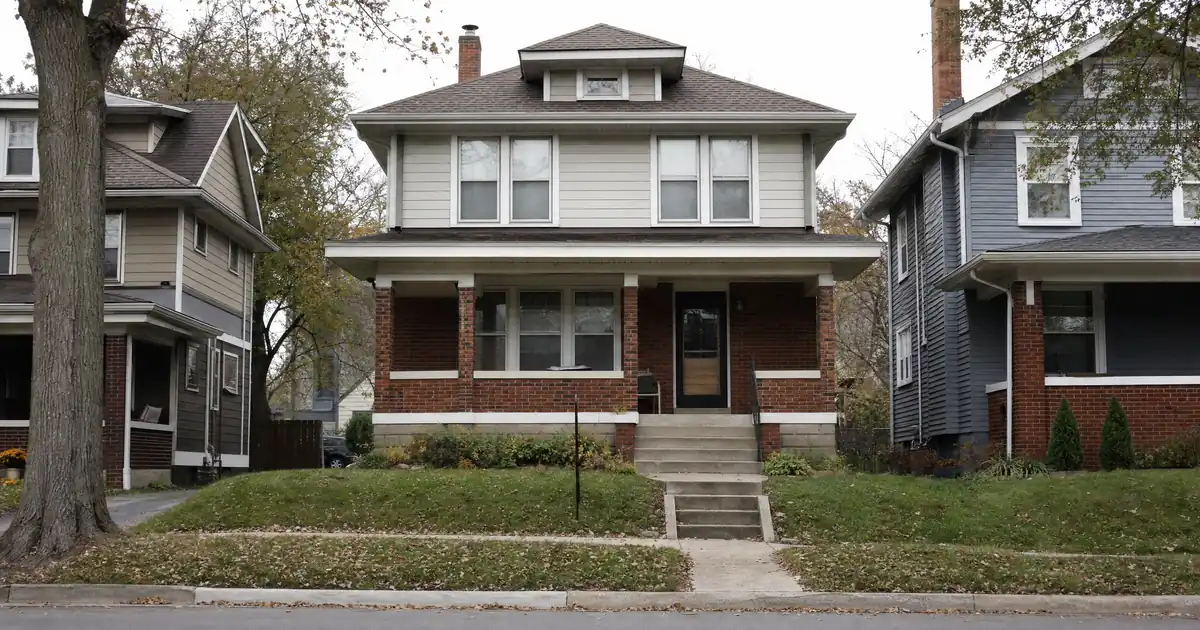
A duplex in the Volker neighborhood, two blocks from the UMKC campus, is exactly the kind of asset that investment property loans in Kansas City are built for — both 2-bedroom units renting for a combined $2,450 a month, a real comp pulled from active Kansas City multi-family listings. Model that same unit type priced at $240,000, financed at 75 percent loan-to-value, and the rent against a full monthly obligation — principal, interest, taxes and insurance — pencils to roughly 1.65x coverage. That is the kind of number that makes a DSCR file move through underwriting without much friction. It is also the kind of number that does not show up in every Kansas City submarket, which is the point of this piece.
This review focuses on Midwest workforce and small multifamily files where the property’s income, rather than the borrower’s traditional personal-income documentation, carries the underwriting — and on where, specifically within Kansas City, that math actually clears.
DSCR Calculator
Run the numbers in Kansas
Rate source: Freddie Mac 30-yr average via FRED® — Federal Reserve Bank of St. Louis · effective Jul 30, 2026
Prefilled with starting assumptions — enter your own rent or nightly figures, taxes, insurance, and HOA for a more accurate picture.
Program parameters update from Lendmire’s centralized guideline source. Taxes and insurance are editable estimates.
As of Jul 30, 2026 · General Freddie Mac market benchmark, not a Lendmire loan offer. Rent, nightly rate, occupancy, taxes, and insurance are editable estimates. Short-term rental figures are estimates only and vary significantly by season, property type, management approach, and local short-term-rental rules — confirm local regulations before relying on them. Qualifying income for short-term rentals varies by program — some use appraisal market rent, others use documented STR history or projections — and is confirmed in underwriting. Not a Loan Estimate, approval, or commitment to lend. Program availability and eligibility are subject to lender guidelines, credit approval, property review, and underwriting.
At a Glance: A DSCR investment property loan in Kansas City, Missouri is underwritten primarily on the subject property’s rental income measured against its full monthly obligation, rather than the borrower’s personal income documentation, with eligibility subject to lender guidelines and property review.
- Volker duplex rents run $2,450 per month near UMKC
- North Kansas City/Riverside entry prices span $180,000–$280,000
- Independence, Raytown and Grandview medians sit near $170,000–$220,000
- Crossroads/Midtown corridor vacancy runs above 13 percent — a submarket-specific flag
- Citywide multifamily occupancy is projected near 93.4 percent by year-end
Kansas City Market Snapshot
A quick read on the Kansas City investor landscape — figures come from the cited sources below. Confirm current property-level numbers before underwriting.
| Metric | Detail |
|---|---|
| Home prices | $305K median (Redfin Kansas City Housing) |
| Typical rents | $2,450/month combined 2-unit (Wardell Holmes real estate) |
| Cap rates | 5.0-5.5% (Northmarq) |
| Population | 2,254,288 population (Census Reporter) |
| Employment | ~7,000 employees (Kansas City National Security) |
| Vacancy | 13%+ crossroads corridor (Cushman & Wakefield KC) |
The Volker Duplex Math, Line by Line
Small multifamily near UMKC is one place where Kansas City’s rent-to-price ratio works well for a DSCR file, because per-door acquisition cost stays low while combined rent rolls stack. The Volker neighborhood sits directly on the newly extended KC Streetcar line.
The Main Street Extension — a 6-mile route now running from River Market through Midtown and the Country Club Plaza to UMKC — opened in late October and pulled ridership to roughly 10,000 daily riders, per KSHB reporting on the opening. Local investors had already purchased more than 150 properties along the corridor before the line even opened, with private investment tied to the extension estimated at $413 million, according to Wikipedia’s sourced summary of the project. That kind of pre-positioning by capital that studies transit corridors for a living is a reasonable signal that Volker, Midtown and Plaza-adjacent multifamily hold a durable long-term-rental thesis, not just a temporary lease-up bump.
On the paperwork side, this is the property type where the appraiser’s rent schedule matters more than almost anything else in the file. A duplex or fourplex needs a market-rent addendum (the 1007/216 form) that actually reflects both units’ rents, not just one — files stall when the appraisal comes back with a single blended figure and the lender’s reviewer can’t separate unit-by-unit income. Getting a current rent roll or signed leases in front of the appraiser before the inspection, not after, keeps that line item clean.
Consider a second modeled scenario, further out from campus: a package like the eight-unit Everton-style fourplex pairing in the Park Hill School District — two side-by-side fourplexes built in the 1980s, still generating rent from all eight one-bedroom units. No specific price or rent figure for that exact package is available here, but it illustrates the same mechanism: combined per-unit rents on a 2-4 unit building routinely clear a coverage ratio that a single comparable house in the same corridor cannot match, because the acquisition cost per bedroom stays lower.
Where the Bi-State Line Changes the Underwriting
Kansas City’s metro splits across two states, and that split creates a genuine submarket arbitrage most single-state metros don’t have. Missouri-side workforce housing in Independence and Raytown trades against Kansas-side premium suburbs like Overland Park and Leawood within the same labor pool and the same metropolitan statistical area — a comparison investors in Omaha or Wichita simply can’t run.
Leawood carries the highest median sale price on the Kansas side, around $761,000, with cap rates running lower — in the 4 to 6 percent range — because tenant demand there skews toward corporate relocators and long-tenure families rather than turnover-driven cash flow. That’s a stability play, not a yield play. Missouri-side Lee’s Summit runs a similar family-oriented profile at a lower entry point, with 3-bedroom rents in the $1,650–$2,100 range and cap rates closer to 5 to 7 percent — meaningfully better coverage math for a DSCR purchase than the Kansas-side premium suburbs, at a fraction of the acquisition cost.
The mechanical wrinkle: title and closing customs are not identical on both sides of the state line. A file moving through a Kansas-side closing agent follows different procedural conventions than one closing in Jackson County, Missouri, and the closing team needs to confirm which state’s process applies before scheduling — this is a settlement-reconciliation detail, not a loan-qualification one, but it’s worth flagging on any file that straddles both sides of a portfolio.
North Kansas City, Independence and the Workforce Corridor
Some of the strongest rent-to-value ratios in this metro sit in the entry-level workforce submarkets, not the premium ones. Independence, Raytown, Grandview and the North Kansas City/Riverside corridor carry median single-family prices between $170,000 and $220,000 against metro-wide rents commonly running $1,300 to $1,700 a month — a spread that clears coverage more comfortably than higher-priced suburban product.
Model a single-family purchase in that band: a $195,000 house renting for $1,500 a month, financed at 80 percent loan-to-value. Run the full monthly obligation — principal, interest, taxes and insurance — against that rent, and coverage lands around 1.15x to 1.20x. That’s not a wide margin, but it clears the 1.00x floor some select DSCR programs use as a minimum, and it does so at a price point where an investor can hold multiple doors without concentrating capital in one property.
The documentation friction here is different from the Volker duplex. On single-family workforce rentals, rent-comp availability is the recurring issue — appraisers working these transitional, price-mixed submarkets sometimes struggle to find three genuinely comparable rental comps within a tight radius, especially where recent renovation has pushed one property’s rent well above its block. A reconsideration-of-value request with recent, in-neighborhood lease comps recovers most of these files; treating it as a routine step rather than an emergency keeps the timeline sane.
The Northland Wildcard: Data Centers and Rent Lift
Three separate billion-dollar-plus data center commitments have landed in the Northland and Platte County corridor over a short span, and that concentration is worth tracking as a demand driver distinct from KC’s traditional downtown and Plaza rental centers. Google committed roughly $1 billion to a data center at the Hunt Midwest Business Center, with the state estimating around 1,300 supported jobs, and separately began construction on Project Mica — a $10 billion, 500-acre campus at I-435 and US-169 in Platte County slated for five hyperscale facilities. Meta opened its own $1 billion Northland data center as well, according to reporting cited by the Alpine Kansas City property-management blog.
Northmarq’s most recent submarket data backs this up directionally: Platte County posted a 2.4 percent asking-rent increase alongside a 40-basis-point vacancy decline, outpacing Downtown’s more modest 0.5 percent rent gain. That’s a meaningful gap for a metro this size, and it points toward Northland workforce rentals as a submarket to watch rather than one already fully priced.
Further west, the Panasonic battery plant in De Soto is running a multi-year hiring ramp rather than a single hiring event — currently employing around 1,800 people across four production lines, with a stated path toward 4,000 at full capacity and a second wing targeted for completion around 2027. Panasonic has also begun converting part of that plant’s output toward AI and data-center battery production, backed by a roughly $3 billion investment planned between fiscal years 2027 and 2029, per KCUR. That staged ramp supports a multi-year rental-absorption thesis for western Johnson County workforce housing near the plant, rather than a one-time catalyst that could stall.
Brookside, Waldo and the Appreciation Story (And Where It Breaks Down)
Kansas City’s ten-year appreciation record is genuinely strong — a cumulative 113.76 percent gain, or roughly 7.89 percent annualized, ranking in the top 30 percent of markets nationally, per NeighborhoodScout. Brookside and Waldo have been the primary driver of that trend, with home values commonly exceeding $350,000 on the strength of walkability and established housing stock, according to HomeRiver Group.
But the trailing twelve-month number tells a different story: appreciation has slowed to about 1.82 percent over the most recent year, down sharply from the historical pace. That gap matters for anyone underwriting a purchase-to-refinance strategy on a short timeline — the model works better as a 3-to-5-year hold than a 12-month flip-to-refi play, and Lendmire’s refinance pathway for investor properties is worth reviewing separately once seasoning requirements are met rather than assumed away up front.
The counter-example sits just a few miles away. Ivanhoe Northeast carries an average home value around $97,341, down 10.5 percent over the past year, per Zillow’s index. That’s a more affordable entry point in this review and, on paper, the highest coverage ratio a modeled scenario could produce — but a declining-value neighborhood also means thinner, less reliable appraisal comps and real valuation risk on any cash-out plan built around near-term equity growth. Cash flow and appreciation are pulling in opposite directions in these two neighborhoods, and a file built on the wrong assumption for the wrong submarket is where trouble starts.
Skip the Crossroads Lease-Up — For Now
Not every part of Kansas City’s rental market is tight. The Crossroads, Midtown and Crown Center corridor currently runs vacancy above 13 percent, according to Cushman & Wakefield’s Kansas City intelligence, even while citywide multifamily fundamentals stay comparatively firm — occupancy across the broader market improved 40 basis points by the end of last year and was projected to climb toward 93.4 percent, per MMG Real Estate Advisors.
This is a submarket-specific risk, not a citywide one, and it matters directly for DSCR underwriting on multi-unit product in that corridor. A lender’s reviewer pulling rent comps for a Crossroads building is going to see softer lease-up activity than one pulling comps for a Downtown-proper or Platte County property, where Northmarq’s data shows rents rising and vacancy tightening. Underwriting a rent-coverage assumption in the Crossroads corridor on the strength of citywide averages is a mismatch worth avoiding until that lease-up inflection actually shows up in the comps — not before.
The Paper Trail: What Actually Slows These Files Down
Kansas City’s biggest recurring friction points sit in three places: entity documentation, HOA questionnaires and appraisal-comp availability. LLC-titled purchases need current operating agreements and formation documents on file before submission, and eligibility for entity-titled loans depends on program guidelines — that’s a checklist item, not a negotiation. In Johnson County subdivisions like those around Overland Park and Leawood, many properties sit inside HOA-governed communities, and an incomplete HOA questionnaire is a common, avoidable delay; getting that document requested early, rather than after the appraisal comes back, keeps the file moving.
The cleaner files from a documentation standpoint tend to come in with a signed lease or a clear market-rent schedule already attached, current insurance quotes rather than expired ones, and a rent roll that separates unit-by-unit income on any 2-to-4-unit property. The common friction point on files from workforce corridors like Independence and Raytown, and on similar Midwest markets generally, is thin rent-comp coverage in transitional price bands — the reconsideration-of-value step recovers most of these, but it adds a round of back-and-forth that a well-documented submission avoids from the start.
Standard purchase leverage in this market typically runs 75 to 80 percent loan-to-value, with select strong files reaching up to 85 percent where program guidelines allow, and reserve requirements generally run around six months of the full monthly obligation, moving closer to nine months above the $1.5 million loan-amount mark. Credit-score tiers most commonly reviewed span a 620 floor up through a 700 threshold for the highest-leverage programs. All of these figures are guideline ranges reviewed case by case — review details remain subject to lender overlays and property-level review. Investors weighing options across the metro can compare DSCR options through Lendmire’s Missouri DSCR platform, or call 828-256-2183 to talk through a specific submarket.
DSCR financing itself qualifies primarily on the property’s rental income rather than the borrower’s traditional personal-income documentation. Anyone new to the structure may want to read the guide “What Is a DSCR Loan”, and the side-by-side comparison against a conventional investment loan lays out where each fits.
Frequently Asked Questions
How do you qualify for a DSCR loan in Kansas City, Missouri?
Qualification centers on the subject property’s rent measured against its full monthly obligation, rather than personal income documentation. Lenders reviewing Kansas City files typically want a signed lease or a market-rent schedule from the appraisal, a clean entity file if the property closes in an LLC, and reserves covering several months of payments — specifics vary by lender and program.
DSCR vs. conventional financing
Two common ways to finance an investment property in Kansas City, MO. They qualify you differently — here’s how investors weigh them.
Why investors choose it
- Qualifies on the property’s rental income — no personal tax returns, W-2s, or pay stubs needed to document income.
- No personal debt-to-income ceiling to clear, so existing mortgages and obligations don’t cap your borrowing the same way.
- Can be closed in an LLC, keeping the property inside a business entity.
- Built for scaling — not held to the limit on number of financed properties that conventional financing applies.
- Underwriting centers on the deal: generally qualifies when the rent covers the payment, a 1.00x coverage ratio being a common baseline (confirmed in underwriting).
- Designed specifically for investment property, including long-term and, where the program allows, short-term rentals.
Where it’s strong
- Often the lowest ongoing financing cost for a buyer who fully qualifies on personal income — a fit for a first property or a cost-first purchase.
Trade-offs for investors
- Requires full personal income documentation and must fit within a debt-to-income limit — salary, existing debts, and other mortgages all count.
- Typically held in your personal name rather than a business entity.
- Caps how many financed properties you can carry, which can become a ceiling as a portfolio grows.
- Evaluates you as a borrower as much as the property, which usually means more paperwork.
How investors usually choose: a first or single property often optimizes for the lowest financing cost; portfolio builders often optimize for leverage, vesting in an LLC, and scaling past conventional caps. The right answer depends on your goals, the property, and current guidelines — both paths run through select lenders in Lendmire’s wholesale network, with eligibility and terms confirmed in underwriting.
What are the requirements for an investment property loan in Kansas City, Missouri?
Most standard programs run 75 to 80 percent loan-to-value on a purchase, with a 1.00x DSCR used as a floor on select programs and credit tiers spanning a 620 floor to 700 for higher-leverage files. Reserve requirements generally run near six months of the monthly obligation, with property review and appraisal comps confirmed before closing.
Which Kansas City neighborhoods produce the strongest DSCR coverage on a purchase?
Workforce single-family corridors — Independence, Raytown, Grandview and North Kansas City/Riverside — post the strongest rent-to-price ratios given entry prices between $170,000 and $220,000 against metro rents commonly in the $1,300 to $1,700 range. Small multifamily near UMKC, like Volker, can clear even stronger coverage where combined unit rents stack against a single acquisition cost.
Does buying on the Kansas side change the DSCR math compared to Missouri?
Yes — Kansas-side suburbs like Leawood and Overland Park carry higher price points and lower cap rates, generally 4 to 6 percent, because tenant demand skews toward long-tenure, higher-income households. Missouri-side submarkets like Lee’s Summit or Independence typically produce stronger cash-on-cash coverage at a lower entry price, even within the same metro and labor pool.
What property types work best for DSCR cash-out in Kansas City?
Small multifamily — duplex, triplex and fourplex product in transitional near-downtown corridors — tends to stack rent rolls most efficiently for coverage purposes. DSCR financing is available for LLC-titled portfolios beyond conventional financed-property limits, subject to lender guidelines and property review.
Kansas City’s DSCR files also run through a metro with genuine economic depth behind the rent roll: the region’s Shared Services and Operational Centers sector alone employs 324,600 people, healthcare accounts for another 152,000, and manufacturing adds 118,033, per data reported by KCtoday from the Kansas City Area Development Council. A regional college in Kansas City enrolls 15,300 students and holds Carnegie R1 research status, the only such designation in the city, feeding rental demand along the Volker and Midtown corridor. The Kansas City National Security Campus brings more than 7,000 workers to a Department of Energy facility manufacturing 80 percent of the non-nuclear components in the national stockpile — a recession-resistant federal anchor with no real analog in Omaha, Wichita or Tulsa. On the healthcare side, Saint Luke’s Health System runs 10 hospitals across the region, with its flagship location staffing more than 600 physicians across 60-plus specialties. City population sits at 516,032 per the U.S. Census Bureau, while the broader metro runs 2,254,288 with a median household income of $83,785 — a touch above the national figure — according to Census Reporter’s ACS profile. Citywide, Redfin puts the median sale price at $305,000 over the most recent three-month window, up 8.9 percent year over year.
The single blind spot worth carrying into any Kansas City DSCR file is the gap between citywide averages and submarket reality. A 93.4 percent occupancy projection sounds like a market with no soft spots, but the Crossroads corridor is sitting above 13 percent vacancy at the same time, and a trailing twelve-month appreciation rate of 1.82 percent is a very different number from the ten-year average of 7.89 percent that gets quoted more often. Underwriting the wrong submarket’s average onto a specific property’s file is the mistake that turns a clean deal into a slow one — not the metro, the block.
About Lendmire
Lendmire — NMLS# 2371349 — is a DSCR and non-QM mortgage brokerage with investor loan programs in 41 markets, including Washington, D.C. DSCR eligibility is commonly reviewed by the lender on property-level rent rather than personal income documentation, subject to lender guidelines, and the brokerage helps arrange financing for LLC-owned portfolios beyond conventional financed-property limits. Recognized by Scotsman Guide as a 2026 Top Workplace and as a top-ranked workplace in 2025.
Get Started
Ready to find the right loan for you?
In about 30 seconds you can review financing options available for your investment property. No commitment required.
Informational only. Not a Loan Estimate, approval, or commitment to lend. Program availability and eligibility are subject to lender guidelines, credit approval, property review, and underwriting.
References
1. Redfin
3. Northmarq
5. Kansas City National Security Campus
7. KSHB
9. KCUR
12. Saint Luke’s Health System
15. Scotsman Guide — Top Workplaces 2025
This article is part of Lendmire’s DSCR loan program — full qualification details, guidelines, and scenarios live on the program page.
Related reading: DSCR Cash Out Refinance in Kansas City, Missouri: The 2026 DSCR Financing Guide to Brookside · DSCR Loans in Kansas City, Missouri: Investor Financing for Westport, Brookside, KCMO East Side & Real Estate Investors · Cash Out Refinance Investment Property Kansas City Missouri
Guides: DSCR Loans in Kansas City, MO · DSCR Loans in Missouri
Brandon Miller
Founder & CEO, Mortgage Loan Originator, Lendmire LLC
- Mortgage Loan Originator · NMLS# 1129696 · Verify on NMLS Consumer Access
- North Carolina Real Estate Broker · License# 343312 · Verify on NCREC
- North Carolina Insurance Producer · License# 19053198 · Property, Casualty, Life, Health · Verify on NAIC SBS
- Lendmire LLC · Firm NMLS# 2371349 · Verify firm licensure
Legal disclosures. Lendmire (NMLS# 2371349) is a state-licensed mortgage brokerage that arranges financing through wholesale lender relationships. Lendmire is not a direct lender, depository institution, or registered financial advisor. The discussion above is general informational content about real estate financing — it is not financial, legal, or tax advice, and readers should consult licensed professionals for guidance on their individual circumstances. Loan inquiries are subject to lender underwriting; this article does not represent a commitment to lend. Loan terms, rates, and qualification standards vary by borrower, property, and state, and are subject to change at any time. Equal Housing Opportunity. NMLS Consumer Access: nmlsconsumeraccess.org.