
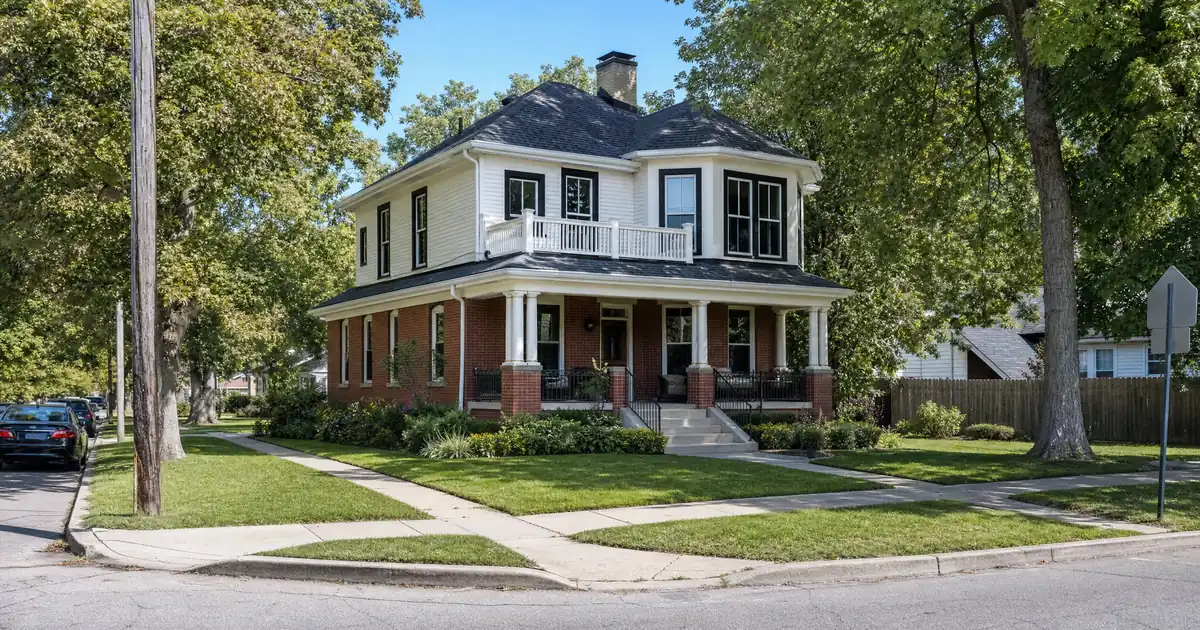
This article covers how investment property loans in Michigan City are structured for rental income qualification across inland grid neighborhoods. Where in Michigan City does a rent roll actually clear a lender’s coverage math on a straight purchase, rather than just reading well in a listing description? The short answer: the inland grid neighborhoods around Elston Grove, North End, Midtown, and Eastport — not the beachfront submarkets that dominate the city’s real estate marketing. Multi-unit product in that corridor prices at a real discount to acquisition cost per door, and the rent-to-value math on 2-4 unit conversions there clears standard DSCR thresholds more comfortably than the lakefront communities most out-of-state buyers search for first.
Key Takeaways: An investment property loan in Michigan City, Indiana is underwritten primarily on the subject property’s rental income measured against its full monthly housing obligation, with multi-unit product in the Elston Grove Historic District carrying enough combined rent to clear coverage more easily than a comparable single-family purchase.
DSCR Calculator
Run the numbers in Michigan
Rate source: Freddie Mac 30-yr average via FRED® — Federal Reserve Bank of St. Louis · effective Jul 30, 2026
Prefilled with starting assumptions — enter your own rent or nightly figures, taxes, insurance, and HOA for a more accurate picture.
Program parameters update from Lendmire’s centralized guideline source. Taxes and insurance are editable estimates.
As of Jul 30, 2026 · General Freddie Mac market benchmark, not a Lendmire loan offer. Rent, nightly rate, occupancy, taxes, and insurance are editable estimates. Short-term rental figures are estimates only and vary significantly by season, property type, management approach, and local short-term-rental rules — confirm local regulations before relying on them. Qualifying income for short-term rentals varies by program — some use appraisal market rent, others use documented STR history or projections — and is confirmed in underwriting. Not a Loan Estimate, approval, or commitment to lend. Program availability and eligibility are subject to lender guidelines, credit approval, property review, and underwriting.
- Multi-family listings carry a median asking price of $260,000, against a citywide typical home value of $139,192 (Zillow; Redfin).
- Michigan City home values rose 17.7 percent over the past year, per Zillow’s smoothed index.
- Median household income sits at $53,089, about three-quarters of the metro figure of $71,055 (Census Bureau QuickFacts).
- A new South Shore Line express station cut the Chicago commute to 67 minutes, a demand driver most breadth-level market research misses entirely.
- Roughly 42 percent of Michigan City households rent rather than own, a workable renter base for buy-and-hold underwriting.
Michigan City Market Snapshot
A quick read on the Michigan City investor landscape — figures come from the cited sources below. Confirm current property-level numbers before underwriting.
| Metric | Detail |
|---|---|
| Home prices | $157,959 median home value (City-Data.com Michigan City) |
| Typical rents | $989 median gross (City-Data.com Michigan City) |
| Population | 31,814 population (Census Reporter) |
| Employment | 501–1,000 employees (Blue Chip Casino LinkedIn) |
| Vacancy | 35.5% — Michiana Shores seasonal submarket (NeighborhoodScout) |
Elston Grove Is Where the Rent Roll Actually Clears Coverage
The Elston Grove Historic District sits a short walk from downtown and, since the Double Track rail project completed, from the new 11th Street South Shore station itself. Listings here show up in the multi-unit inventory that clears DSCR coverage most reliably in this market — and the reason is straightforward once the numbers are laid out.
A four-unit property recently listed in Elston Grove carried eight bedrooms and four bathrooms across two floors, with each of the four units renting at $980 per month and separate utility metering so tenants — not the owner — cover gas and electric (Homes.com). That’s $3,920 a month in gross rent across the building. Run that against a modeled purchase near the multi-family median listing price of $260,000, financed at 75 percent LTV — a standard purchase leverage point on most DSCR programs — and the combined rent clears the property’s full monthly obligation (principal, interest, taxes, and insurance) at well north of 2.0x. That’s a meaningfully higher cushion than the 1.00x floor found on select DSCR programs, since rent covering the payment at that level is the floor lenders look for on those programs, not the target.
A separate two-unit listing in the same neighborhood was marketed with a pro forma rental income potential of $27,900 a year and came with separate electric and gas metering plus an existing property manager in place (Redfin). This kind of turnkey, already-metered, already-managed income stream lowers the operational lift on a DSCR file — less lease-up risk, less guesswork on what the rent roll will actually look like going forward.
Contrast that against a single-family purchase at the citywide typical home value of $139,192 (Zillow). Using the citywide median gross rent of $989 a month as a stand-in for a single-family lease — a modeled assumption, not a submarket-specific figure — financed at 80 percent LTV, the coverage ratio comes in closer to 1.10x. That still clears typical program minimums, but with far less room to absorb a vacancy month or a maintenance surprise than the four-unit example above.
Working DSCR brokers see a recurring pattern in small Midwest cities with an older multi-unit housing stock like Michigan City’s: the single-family purchase often qualifies, but with a thinner margin, while the 2-4 unit conversion in the same neighborhood clears with real cushion because the aggregated rent roll scales faster than the incremental acquisition cost. Files built around the multi-unit product tend to move through lender review with fewer conditions tied to marginal coverage, simply because there’s more daylight in the number to begin with.
That’s not a universal rule — a strong single-family lease in a low-turnover pocket can still outperform a poorly-managed duplex. But as a starting filter for where to shop in this city, multi-unit product in the inland grid neighborhoods is the stronger lane.
The Shoreline Is a Different Trade
Skip the beach for straight long-term-rental DSCR purchases. Sheridan Beach, Duneland Beach, Long Beach, and Michiana Shores trade at a real premium to the inland neighborhoods, and the rent doesn’t scale proportionally against that premium the way it does in Elston Grove.
Michiana Shores and Duneland Beach carry a combined median real estate price of $658,122 — more expensive than 98.3 percent of Indiana neighborhoods — with average rental pricing around $3,888 a month (NeighborhoodScout). That rent figure looks strong in isolation, but measured against a purchase price nearly five times the citywide typical home value, the rent-to-value ratio is thin. NeighborhoodScout also reports 35.5 percent of residential real estate in this submarket sits vacant, a figure that reflects seasonal occupancy patterns rather than distress — second-home and vacation-adjacent product simply isn’t occupied year-round the way a workforce rental is.
Duneland Beach itself is characterized by two-story brick homes with three-bedroom, one-bath layouts, hardwood floors, and updated kitchens — genuinely attractive housing stock, just priced for second-home buyers rather than long-term tenants. These communities sit near Indiana Dunes National Park and draw demand from a different buyer entirely: the seasonal or vacation-rental investor, not the workforce buy-and-hold operator. That’s a legitimate strategy, but it’s a different loan conversation and a different rent assumption than the one this article is built around. An investor drawn to the shoreline for its natural setting should model the deal on seasonal occupancy patterns, not a straight 12-month lease assumption — the math simply doesn’t work the same way.
Blue Chip Casino, Franciscan Health, and the Corrections Anchor
Blue Chip Casino Hotel Spa, Boyd Gaming’s lakefront property headquartered in Michigan City, carries 501 to 1,000 employees according to its corporate profile. That’s a large, 24-hour-operations hospitality employer generating a steady stream of shift-work renters — housekeeping, food and beverage, gaming floor, and security staff — who tend to favor proximity and affordability over lakefront seasonal stock. That demand lands in the inland grid neighborhoods, not the beach communities.
Franciscan Health Michigan City anchors the healthcare side with 123 private inpatient beds in a $243 million facility built on an 86-acre site at U.S. 421 and Interstate 94. The hospital replaced the former downtown location and opened in January 2019, and its presence — alongside Northwest Health-La Porte serving the broader county — supports a steady base of healthcare-sector renters across shifts and pay grades.
Manufacturing rounds out the employment base: Hitachi Global Air Power (Sullair), a global industrial compressed air manufacturer headquartered in Michigan City, and Filter Specialists, Inc., founded in 1972 and still based locally, both contribute stable blue-collar payrolls that map onto the same workforce rental demand as the casino and hospital shifts.
The corrections sector adds a less conventional but genuinely large employment layer. Indiana State Prison has operated in Michigan City for well over a century, and the nearby Westville Correctional Facility is undergoing a $1.2 billion replacement project — reportedly the priciest state building project in Indiana history — expected to reach completion in early 2027, consolidating staff and inmates from both facilities. Separately, the 24-acre Indiana State Prison site itself, sitting a short walk from Lake Michigan and adjacent to the South Shore line, is being studied by regional planners for residential and commercial redevelopment. That’s an unusual setup: a maximum-security prison site on prime lakefront-adjacent land, actively discussed as a future mixed-use parcel. It’s not a near-term financing consideration for a purchase today, but it’s worth knowing as a long-horizon watch item for the west side.
The Rail Bet: Why Appreciation Might Outrun Rent Here
This is the finding that separates Michigan City from comparably sized Indiana cities, and it changes how a purchase decision should be timed.
The Double Track NWI project, a roughly $650 million rail infrastructure upgrade, cut the Michigan City-to-Chicago commute to an express 67 minutes on the South Shore Line — down from an hour and forty minutes before the project — and added a new 11th Street station (South Shore Line). Anchoring that station is a 220-unit mixed-use development with a 547-space shared parking garage, built to serve South Shore passengers, residents, and shoppers together (Rep. Frank Mrvan’s office). The project’s developer projected roughly 300 new residents with meaningful disposable income relocating to Michigan City to commute into high-paying Chicago jobs — a durable, income-verified renter pool landing directly in the same inland submarkets discussed above, not just the seasonal lakefront.
State-funded projections tied to the same rail project put expected private investment in Michigan City at roughly $600 million over 30 years. Ten months after the express schedule opened, industry trade press reported the region’s rail authority already calling that 30-year estimate conservative, citing $500 million in committed private-sector investment already in motion — including a $400 million lakefront project and a separate $100 million development on vacant land near Michigan Boulevard.
Here’s the tension worth sitting with: this is a textbook appreciation-led catalyst concentrated around the downtown and 11th Street corridor, and Zillow’s data already shows typical home values up 17.7 percent over the past year. An investor buying workforce housing near the new station today is underwriting a market where price appreciation may be running ahead of rent growth in the near term. That argues for treating a purchase now less as a pure day-one cash-flow bet and more as a position that could support a future cash-out move once rents catch up — a question the investment property refinance options page walks through in more detail, though that’s a separate decision for later, not day one.
Worth sizing carefully, too: Redfin currently lists only 8 multi-family properties for sale in Michigan City at any given time, with a median 129 days on market. A shallow, slow-moving comp pool means appraisals lean on a small number of recent sales — investors banking on the full 17.7 percent gain being instantly reflected in a future appraisal should build in a conservative cushion rather than assume it.
What Does a Purchase Actually Require Here?
Standard DSCR purchase programs in this market work off the same national guideline framework applied everywhere Lendmire operates, run through Indiana DSCR financing: purchase leverage typically runs 75 to 80 percent LTV, meaning 20 to 25 percent down on most files, with select strong-file scenarios reaching up to 85 percent LTV where program guidelines allow. Credit tiers on the sourced program framework run from a 620 floor up through 700 for the highest-leverage options, and reserve requirements typically land around six months of the property’s full monthly obligation, rising to roughly nine months on loan amounts above $1,500,000 — a threshold unlikely to come into play on most Michigan City purchases given the price levels discussed above.
On select programs, the minimum DSCR floor can go as low as 1.00 — meaning rent needs to cover the property’s full monthly payment including taxes and insurance, at minimum, for the file to qualify under that program’s terms. That’s a program-specific floor, not a universal standard, and it’s not a guarantee: exact eligibility depends on lender guidelines, credit profile, reserves, and property-level review, and some lenders may review lower-ratio or no-ratio scenarios with stronger compensating factors, different leverage, or additional cash down. Loan amounts on standard programs generally run up to $3,000,000, with smaller balances — which will describe most Michigan City purchases — routed through select lenders within the broader network.
For an investor comparing this against a conventional loan, the practical difference is documentation: DSCR lender review centers on the property’s income rather than personal W-2s and traditional personal-income documentation, which is how DSCR lender review works in general, and the guide “Where DSCR and Conventional Diverge” explains that choosing a DSCR loan against a conventional loan comes down to whether the borrower’s personal file or the property’s rent is the cleaner underwriting basis for their situation. Properties held under an LLC are common on these files, subject to lender program eligibility, and that structure tends to fit self-employed investors or anyone building a multi-property portfolio more naturally than a single W-2 borrower buying one rental.
On the operations side, expect the lender’s review to focus heavily on the lease documentation for multi-unit purchases — signed leases, rent rolls, utility metering setup — since a four-unit file with four tenants already in place and separately metered utilities, like the Elston Grove example above, moves through review with fewer open items than a vacant property requiring a rent survey or appraiser rent schedule. Investors buying a property with an existing property manager and active leases in hand, as in the two-unit Elston Grove listing referenced earlier, should have that documentation ready before the file goes to underwriting — it shortens the list of conditions considerably.
Frequently Asked Questions
How do you qualify for a DSCR loan in Michigan City, Indiana?
Qualification centers on the subject property’s rental income measured against its full monthly obligation, not the borrower’s personal income documentation. Most standard programs look for a DSCR of 1.00 or higher, with credit tiers and reserve requirements layered on top depending on the specific program and loan amount, subject to lender guidelines and underwriting review.
DSCR vs. conventional financing
Two common ways to finance an investment property in Michigan City, IN. They qualify you differently — here’s how investors weigh them.
Why investors choose it
- Qualifies on the property’s rental income — no personal tax returns, W-2s, or pay stubs needed to document income.
- No personal debt-to-income ceiling to clear, so existing mortgages and obligations don’t cap your borrowing the same way.
- Can be closed in an LLC, keeping the property inside a business entity.
- Built for scaling — not held to the limit on number of financed properties that conventional financing applies.
- Underwriting centers on the deal: generally qualifies when the rent covers the payment, a 1.00x coverage ratio being a common baseline (confirmed in underwriting).
- Designed specifically for investment property, including long-term and, where the program allows, short-term rentals.
Where it’s strong
- Often the lowest ongoing financing cost for a buyer who fully qualifies on personal income — a fit for a first property or a cost-first purchase.
Trade-offs for investors
- Requires full personal income documentation and must fit within a debt-to-income limit — salary, existing debts, and other mortgages all count.
- Typically held in your personal name rather than a business entity.
- Caps how many financed properties you can carry, which can become a ceiling as a portfolio grows.
- Evaluates you as a borrower as much as the property, which usually means more paperwork.
How investors usually choose: a first or single property often optimizes for the lowest financing cost; portfolio builders often optimize for leverage, vesting in an LLC, and scaling past conventional caps. The right answer depends on your goals, the property, and current guidelines — both paths run through select lenders in Lendmire’s wholesale network, with eligibility and terms confirmed in underwriting.
What are the requirements for an investment property loan in Michigan City?
Purchase leverage on most standard DSCR programs runs 75 to 80 percent LTV, with credit score tiers generally starting around 620 and reserve requirements typically around six months of the property’s monthly obligation. Multi-unit purchases in neighborhoods like Elston Grove often move through review more smoothly when lease documentation and utility-metering setup are already in place at the time of application.
Is a duplex or fourplex in Elston Grove a better DSCR buy than a single-family home?
Often, yes, based on the rent-to-price math in this specific market. Multi-family listings carry a median asking price around $260,000 against a citywide typical single-family value of $139,192, and the combined rent roll from two to four units tends to clear coverage with a wider margin than a comparable single-family purchase, though every file still depends on the specific rents, price, and program review.
Does the South Shore Double Track project actually help rental demand, or is that priced in already?
The rail upgrade cut the Chicago commute to an express 67 minutes and anchored a 220-unit development at the new 11th Street station, a genuine structural demand driver rather than a speculative one. Whether it’s fully priced into current listings is a fair question — home values are already up 17.7 percent over the past year, which suggests the market has started pricing the story in, though the $500 million in committed private investment reported ten months after the station opened suggests more of the story may still be ahead.
Are the lakefront neighborhoods like Duneland Beach or Sheridan Beach good DSCR buys?
Not for a straight long-term-rental purchase. These submarkets carry prices well above the citywide typical value with rent levels that don’t scale proportionally, making them a stronger fit for a seasonal or vacation-rental financing strategy than a standard 12-month-lease DSCR purchase.
Can Lendmire help arrange DSCR financing for investment properties in Michigan City?
Lendmire, NMLS# 2371349, arranges DSCR investor loans across 40 states plus Washington, D.C. — 41 markets total — through wholesale lending channels, including Indiana. Its programs qualify primarily on the subject property’s rental income rather than traditional personal-income documentation, which tends to suit multi-unit purchases and entity-held portfolios like the ones common in Michigan City’s inland grid neighborhoods.
About Lendmire
Lendmire helps arrange DSCR financing for Michigan City, Indiana investors as part of a broader non-QM footprint, with rental income–based financing across 41 markets available for both single-family and small multi-family purchases. Investors weighing a specific property here can request a scenario quote or reach the team directly at 828-256-2183 to walk through how a given rent roll measures against program guidelines. Review details are subject to lender overlays and property-level review in every case.
Lendmire, NMLS# 2371349, arranges these files through a wholesale investor-lending network rather than funding loans directly, helping arrange financing across its footprint. The model centers on the property’s rental income as reviewed by the lender rather than W-2 documentation, subject to lender guidelines, which tends to suit entity-owned purchases and investors scaling past a handful of financed properties. Lendmire holds a top-ranked workplace in 2025 recognition from Scotsman Guide and repeated that as a 2026 Scotsman Guide Top Workplace.
The investors who buy the multi-unit stock near the new station now, ahead of the next round of committed rail-driven investment, will come out ahead of the ones still shopping the beach.
Get Started
Ready to find the right loan for you?
In about 30 seconds you can review financing options available for your investment property. No commitment required.
Informational only. Not a Loan Estimate, approval, or commitment to lend. Program availability and eligibility are subject to lender guidelines, credit approval, property review, and underwriting.
References
1. Zillow
2. Redfin
4. City-Data.com Michigan City
8. Homes.com
9. Franciscan Health Michigan City
10. South Shore Line
12. Scotsman Guide — Top Workplaces 2025
13. a 2026 Scotsman Guide Top Workplace
This article is part of Lendmire’s DSCR loan program — full qualification details, guidelines, and scenarios live on the program page.
Related reading: Cash Out Refinance on Investment Property in Michigan City · Super Jumbo DSCR Loans In Michigan: Complete Guide · DSCR Investment Property Loans in Petoskey, MI: What It Takes to Qualify
Guides: DSCR Loans in Michigan City, IN · DSCR Loans in Indiana
Brandon Miller
Founder & CEO, Mortgage Loan Originator, Lendmire LLC
- Mortgage Loan Originator · NMLS# 1129696 · Verify on NMLS Consumer Access
- North Carolina Real Estate Broker · License# 343312 · Verify on NCREC
- North Carolina Insurance Producer · License# 19053198 · Property, Casualty, Life, Health · Verify on NAIC SBS
- Lendmire LLC · Firm NMLS# 2371349 · Verify firm licensure
Legal disclosures. Lendmire (NMLS# 2371349) is a state-licensed mortgage brokerage that arranges financing through wholesale lender relationships. Lendmire is not a direct lender, depository institution, or registered financial advisor. The discussion above is general informational content about real estate financing — it is not financial, legal, or tax advice, and readers should consult licensed professionals for guidance on their individual circumstances. Loan inquiries are subject to lender underwriting; this article does not represent a commitment to lend. Loan terms, rates, and qualification standards vary by borrower, property, and state, and are subject to change at any time. Equal Housing Opportunity. NMLS Consumer Access: nmlsconsumeraccess.org.