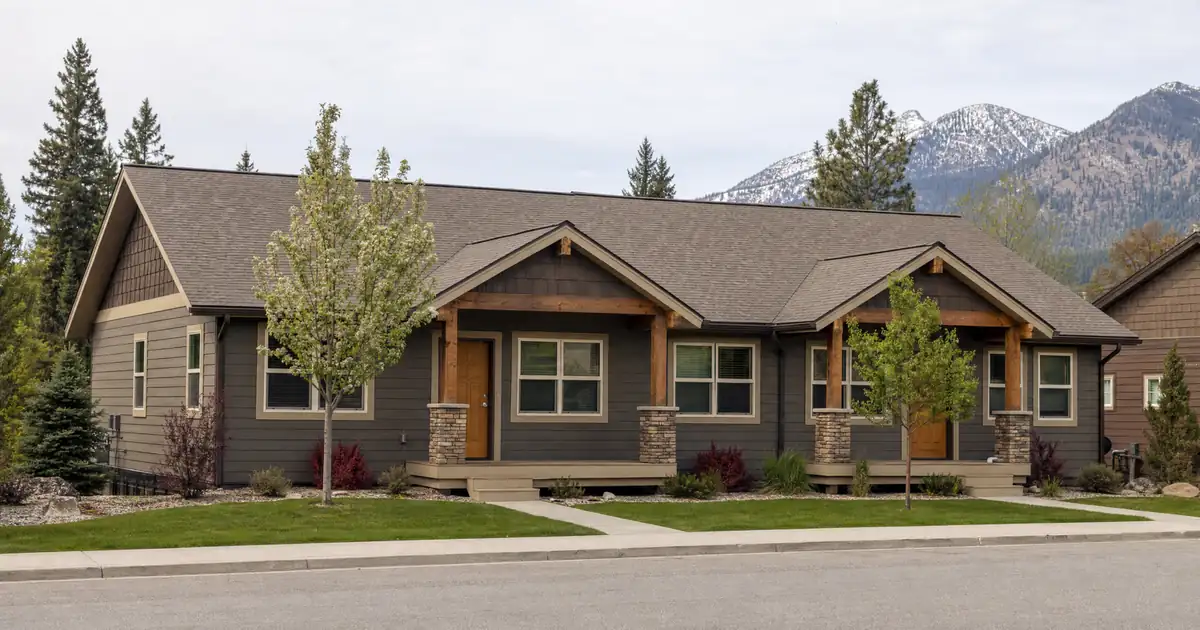
A rental near City Beach hits the DSCR math like this: a duplex priced around $449,000 — the low end of Whitefish’s current multi-family listing range — carries a one-bedroom unit renting near $1,536 and a two-bedroom near $1,838, based on current RentCafe averages for the market. Financed at 75% LTV with a modeled 25% down payment, and run through a full monthly obligation that includes principal, interest, and estimated escrow costs for property tax and insurance, the combined rent from both units pencils to roughly 1.25x coverage — comfortably above the 1.00x floor that Select-program DSCR guidelines are built around. That combination of price and rent is what tends to work in this town. A single ski-view chalet at $1.15 million, chasing the same rent roll from one unit, usually does not.
Lendmire (NMLS# 2371349), founded by CEO Brandon Miller, arranges DSCR financing for investors buying into small, supply-constrained rental markets like Whitefish, working through wholesale and investor-lending channels across 40 markets, including Washington, D.C. That footprint matters here because Whitefish rarely shows up in national DSCR content — most lenders treat Montana as a single statewide market and default to Bozeman or Missoula examples that don’t reflect how differently this particular town’s rent-to-price math behaves.
DSCR Calculator
Run the numbers in Whitefish, MT
Rate source: Freddie Mac 30-yr average via FRED® — Federal Reserve Bank of St. Louis · effective Jul 2, 2026
Prefilled with local estimates — enter your own rent or nightly figures, taxes, insurance, and HOA for a more accurate picture.
As of Jul 2, 2026 · General Freddie Mac market benchmark, not a Lendmire loan offer. Rent, nightly rate, occupancy, taxes, and insurance are editable estimates. Short-term rental figures are estimates only and vary significantly by season, property type, management approach, and local short-term-rental rules — confirm local regulations before relying on them. Qualifying income for short-term rentals varies by program — some use appraisal market rent, others use documented STR history or projections — and is confirmed in underwriting. Not a Loan Estimate, approval, or commitment to lend. Program availability and eligibility are subject to lender guidelines, credit approval, property review, and underwriting.
At a Glance: An investment property loan in Whitefish, Montana is underwritten primarily against the subject property’s rental income measured against its full monthly obligation, rather than the borrower’s personal income documentation — a structure that fits the town’s mix of small multifamily, condo, and single-family rental stock, where roughly 37%–40% of households rent rather than own, per RentCafe data.
- Downtown/Central Avenue is the most active rental submarket in town, per the Whitefish Chamber of Commerce.
- Current multi-family listings span well under the single-family median asking price in town.
- BNSF Railway and Logan Health together anchor a meaningful base of non-seasonal employment, cushioning ski-season swings.
- Roughly 252 new apartment units are absorbing into the Highway 93/40 corridor.
- No suburban expansion corridor exists — Whitefish is boxed in by mountains, ski terrain, and the lake.
Whitefish Market Snapshot
A quick read on the Whitefish investor landscape — figures come from the cited sources below. Confirm current property-level numbers before underwriting.
| Metric | Detail |
|---|---|
| Home prices | Median property value $684,300 (2024) (Data USA) |
| Typical rents | Avg rent $1,726 (RentCafe/Yardi Matrix) |
| Recent appreciation | 156.87% 10-yr (NeighborhoodScout) |
| Population | Population 9,600 (2025) (Whitefish Chamber of Commerce) |
| Employment | Employer headcounts (logan health 650 (Whitefish Chamber of Commerce) |
Why Whitefish Isn’t Just a Ski Town
Most Mountain West resort towns run on one engine: tourism. Whitefish runs on two. It’s still a division point on BNSF Railway’s mainline, a status it’s held since the Great Northern Railway relocated its operations here in 1904, and BNSF Railway still moves an estimated 34 trains a day through town carrying grain, intermodal, and mixed freight.
That matters for tenant demand because it’s non-seasonal, union-wage employment layered on top of the resort economy. Per the Whitefish Chamber of Commerce, the town’s top employers include Logan Health – Whitefish (650), BNSF Railway (420), Whitefish School District (250), Averill Hospitality (282), Glacier Restaurant Group (182), and Winter Sports, Inc. — the operator of Whitefish Mountain Resort — at 100 year-round with roughly 500 additional seasonal positions. Logan Health – Whitefish is a 25-bed critical access hospital with 160 physicians on staff, serving more than 30,000 people across Whitefish, Columbia Falls, and the Burlington Northern rail corridor toward Eureka — it’s the only hospital in the city, which makes it a durable, non-discretionary employment anchor.
Per Data USA, local employment grew from roughly 4,690 to 4,840 jobs between 2023 and 2024 — a 3.07% increase — with Health Care & Social Assistance (867 workers), Retail Trade (762), and Professional, Scientific & Technical Services (549) as the three largest employment sectors among residents. That last figure is worth sitting with: nearly 550 people in a town this size work in professional and technical fields, a signal that some of the downtown rental demand is remote-professional, not just seasonal hospitality staff.
Population is where sources genuinely diverge. The Whitefish Pilot’s coverage of the city’s Growth Policy presentation puts full-time residents at 9,163, with Flathead County — the fourth-largest county in Montana — at 113,679 and the fastest-growing county in the state since 2020. The Census Bureau’s ACS estimate via Census Reporter lands lower, at 8,749, which reflects a different survey methodology and vintage rather than an actual population decline. That same Census Reporter data puts median household income at $73,811 and median age at 44.4 — about 10% older than Montana’s statewide median of 40.4, which tracks with a resort-and-retirement demographic layered on top of the working population.
The Single-Family Trap (And the Multi-Unit Fix)
Single-family DSCR math is tight in Whitefish. Multi-unit math is not. Current multi-family listings run $449,000 to $2,249,000, while the median single-family home price sits at $1,150,000 — a gap wide enough that duplexes and fourplexes routinely stack rent rolls that beat a single-family home’s rent at a fraction of the entry price.
Housing stock backs this up structurally, not just anecdotally. Per NeighborhoodScout, single-family detached homes make up 59.62% of Whitefish’s housing units, but duplexes and small multifamily conversions account for another 10.53% — a meaningfully deep pool of existing 2-4 unit stock, concentrated in older in-town neighborhoods rather than the resort fringe. A four-unit condo building in the City Beach area, for example, sits on WR-4 high-density zoning that permits additional units to be built on the parcel — a rare combination in a town this land-constrained, and a stronger “buy the income stream, keep the upside” entry than assembling condos one at a time.
Working DSCR brokers see a recurring pattern in small resort towns with a legacy industrial anchor like this one: the file that clears easiest isn’t the ski-view single-family, it’s the unglamorous in-town duplex with tenants who work at the hospital or the rail yard rather than the front desk. Deals built around lakefront or ski-base product tend to lean on seasonal or short-term income assumptions that get scrutinized harder in underwriting, while a leased, non-seasonal duplex near downtown or City Beach usually underwrites on cleaner, more defensible numbers.
Where the Deals Actually Pencil
Downtown’s Central Avenue corridor is the most active rental market in town — walkable to restaurants, breweries, and boutiques, and it’s what makes it attractive to both investors and second-home owners, per the Chamber’s community profile. Tenant demand skews toward hospitality staff, young professionals, and the remote-work crowd drawn by walkability rather than ski proximity.
Ptarmigan Village, near the mountain base, functions as a lower-basis entry point into ski-area proximity without lakefront or ski-base pricing — condo and workforce-housing product here tends to fit long-term DSCR underwriting better than the resort’s luxury tier, since rents don’t depend on peak-season occupancy swings.
Grouse Mountain and Whitefish Hills round out the more residential end of the spectrum — larger lots, a family-and-long-term-tenant feel rather than a resort-transient one. Whitefish Hills specifically carries a Montana-specific structural angle worth watching: statewide legislative changes allowing by-right accessory dwelling units are expected to reshape density patterns in exactly these large-lot, established neighborhoods. An ADU added to an existing lot here could stack a second rent stream onto a single-family DSCR file — though any specific project should be checked against current City of Whitefish zoning and permitting before it gets underwritten.
Skip the Lakefront (For This Purpose)
Whitefish Lake frontage and Big Mountain ski-base product are the wrong DSCR entry point for most investors targeting rental coverage. These are the highest price tiers in town — custom timber-and-stone construction, ski-in/ski-out condos — and the rent they’d need to clear a 1.00x coverage floor on long-term lease terms rarely materializes without leaning on short-term or seasonal income. That’s not a knock on the properties. It’s a mismatch between the asset and the loan structure. Investors chasing appreciation and willing to underwrite thinner coverage, or blend in short-term rental income where local rules allow it, are playing a different game than the workforce-rental DSCR investor this article is written for.
What’s Feeding Long-Term Demand — And What Could Slow It
Whitefish’s own 2022 Housing Needs Assessment found the city needs 1,310 additional housing units by 2030, including 800 rental units and 580 below-market-rate units. That’s a city-documented, structural rental shortfall — not a marketing claim — and it’s the strongest argument for a durable long-term-rental demand thesis independent of any single employer’s hiring cycle.
The counterweight sits along the Highway 93/40 corridor, where two approved projects — the Alpine 93/40 development and the Edgewood Place project — will add roughly 252 units combined, with 21 deed-restricted as affordable under the city’s Legacy Program. That’s a meaningful lease-up concentrated in one corridor over a short window. DSCR investors eyeing product near 93/40 should underwrite rent growth conservatively until that supply gets absorbed, while downtown and City Beach product, facing less direct competition, is more likely to hold rent levels.
Appreciation data adds another layer of noise worth naming honestly. Redfin reports a $1.0 million median sale price as of November 2025, up 23.9% year-over-year, with homes now sitting 185 days on market versus 75 the year before — a near-tripling in time-to-sale. Zillow’s typical home value index, by contrast, shows $816,768, down 7.1% over the same period. That divergence isn’t a contradiction so much as a low-sample-size artifact — Redfin recorded only 23 sales that month — and it means appraisals in this market carry wider variance than in a deeper, higher-volume metro. A fresh local appraisal and a tight comp set matter more here than trusting either index in isolation.
First-Time Whitefish Investors: What the File Needs
The cleanest file from a documentation standpoint has complete leases, entity documents, title, and property details ready before it reaches lender review — that’s true anywhere, but it matters more in a thin-inventory market like this one where appraisal timelines and comp selection already carry extra friction. Standard DSCR purchase programs in Lendmire’s network typically run 75%–80% LTV, with select strong files reaching up to 85% on the highest-leverage tier; a 1.00 DSCR floor is the common qualifying baseline, though credit tier, reserves, and property type all shift what’s actually available on a given file. Reserve requirements generally run around six months of the full monthly obligation, rising to roughly nine months on loans above $1.5 million — a threshold that matters in a town where the multi-family upper range approaches $2.25 million.
For investors weighing DSCR against a conventional loan, the qualification mechanics differ enough to matter: DSCR underwriting leans on the property’s own rent-to-obligation math rather than the borrower’s personal debt-to-income profile, which tends to fit self-employed investors and LLC-titled acquisitions better than a W-2 borrower buying a single rental — see how DSCR and conventional financing actually compare for the broader tradeoff. Entity-titled purchases remain subject to lender program eligibility, and Whitefish’s small-inventory, multi-unit-friendly stock is exactly the kind of file where that structure tends to pencil.
One caution worth flagging before stress-testing any coverage ratio: rent estimates for Whitefish vary enormously by data provider. Apartments.com/CoStar puts average rent at $986 a month, RentCafe shows $1,726, and Zillow’s rental manager tool shows a median of $3,500 for all property types. That’s a roughly 3.5x spread for the same town. A lender’s automated rent survey may land far from what a specific unit actually commands — getting a local property manager’s quote for the exact unit type before underwriting is the difference between a clean file and a surprise at appraisal.
Investors ready to model a specific address can get a rental-income loan quote or reach Lendmire directly at 828-256-2183 to walk through how Lendmire’s Montana DSCR loan programs apply to a specific property type.
Common Questions From Whitefish Investors
Is Whitefish’s rental demand just seasonal ski traffic?
DSCR vs. conventional financing
Two common ways to finance an investment property in Whitefish, MT. They qualify you differently — here’s how investors weigh them.
Why investors choose it
- Qualifies on the property’s rental income — no personal tax returns, W-2s, or pay stubs needed to document income.
- No personal debt-to-income ceiling to clear, so existing mortgages and obligations don’t cap your borrowing the same way.
- Can be closed in an LLC, keeping the property inside a business entity.
- Built for scaling — not held to the limit on number of financed properties that conventional financing applies.
- Underwriting centers on the deal: generally qualifies when the rent covers the payment, a 1.00x coverage ratio being a common baseline (confirmed in underwriting).
- Designed specifically for investment property, including long-term and, where the program allows, short-term rentals.
Where it’s strong
- Often the lowest ongoing financing cost for a buyer who fully qualifies on personal income — a fit for a first property or a cost-first purchase.
Trade-offs for investors
- Requires full personal income documentation and must fit within a debt-to-income limit — salary, existing debts, and other mortgages all count.
- Typically held in your personal name rather than a business entity.
- Caps how many financed properties you can carry, which can become a ceiling as a portfolio grows.
- Evaluates you as a borrower as much as the property, which usually means more paperwork.
How investors usually choose: a first or single property often optimizes for the lowest financing cost; portfolio builders often optimize for leverage, vesting in an LLC, and scaling past conventional caps. The right answer depends on your goals, the property, and current guidelines — both paths run through select lenders in Lendmire’s wholesale network, with eligibility and terms confirmed in underwriting.
No — that’s the mistake generic Montana content makes. Roughly 37%–40% of Whitefish households rent rather than own, per RentCafe and Point2Homes data, and the town’s largest employers — Logan Health and BNSF Railway — run year-round, not seasonally. The seasonal swing is real at Winter Sports, Inc. (100 year-round staff versus roughly 500 in-season), but it layers on top of a non-seasonal tenant base rather than replacing it.
Why does the same duplex look profitable on one rent site and marginal on another?
Because Whitefish rent data comes from vendors using very different methodologies and sample sizes. CoStar, RentCafe, and Zillow’s rental tool show roughly a 3.5x spread on average rent for the same town. Treat any single aggregator figure as a starting point, not a final number, and confirm with a local property manager before finalizing a purchase offer.
Does the new Highway 93/40 apartment supply hurt existing small landlords?
It creates near-term absorption risk specifically in that corridor. Roughly 252 units are coming online there, and rent growth on nearby small multifamily should be underwritten conservatively until that supply leases up. Downtown and City Beach properties, which don’t compete directly with those units, are less exposed.
Can an ADU improve DSCR coverage on a Whitefish Hills property?
It’s a genuine possibility under Montana’s statewide by-right ADU allowance, since Whitefish Hills’ larger, older lots are well suited to adding a second unit. Any specific project still needs to clear current City of Whitefish zoning and permitting before a lender would credit the added rent in underwriting.
Why do multi-family listings pencil better than single-family homes here?
Current multi-family listings span $449,000 to $2,249,000 against a $1,150,000 single-family median — and a two-unit rent roll of $1,536 and $1,838, per RentCafe averages, often stacks to more combined monthly income than a single-family home rents for at a much higher price point. That gap is the core reason duplex and fourplex product tends to clear coverage thresholds that single-family purchases struggle to reach at current pricing.
Lendmire is a non-QM mortgage broker serving real estate investors through DSCR investor loan programs. Files are generally reviewed around the subject property’s rental income rather than a borrower’s W-2 history, which tends to fit LLC-held portfolios and self-employed buyers, and every scenario remains subject to lender review and program guidelines. The firm has been recognized by Scotsman Guide in 2025 and again as a top-ranked workplace in 2026.
One Thing Worth Watching Before You Buy
The biggest blind spot in Whitefish isn’t the price tag — it’s the thinness of the data underneath it. With roughly 23 home sales recorded in a single recent month and rent estimates swinging by a factor of 3.5x depending on the source, this is a market where two reasonable people can look at the same neighborhood and arrive at wildly different coverage ratios. That’s not a reason to avoid Whitefish — the rail-and-resort employment base and the city’s own documented rental shortfall both argue for real staying power. It’s a reason to get a local rent quote and a fresh appraisal before trusting any single number on the page.
Program availability, loan terms, and eligibility are subject to lender guidelines, credit approval, property review, and full underwriting. This article is educational and is not a loan offer or commitment to lend.
About Lendmire
Lendmire, NMLS# 2371349, is a non-QM mortgage broker serving real estate investors in 40 markets, including Washington, D.C., through DSCR investor loan programs. Qualification is generally reviewed around the subject property’s rental income, not the borrower’s W-2 history — a practical fit for LLC-titled portfolios and self-employed investors. All scenarios remain subject to lender review and program guidelines. Two consecutive Scotsman Guide Top Mortgage Workplace recognitions (2025, 2026).
Investment property review
See how the DSCR math works for Whitefish, Montana
Lendmire can review rent, leverage, property type, and DSCR fit before you get too far into the deal.
Informational only. Not a Loan Estimate, approval, or commitment to lend. Program availability and eligibility are subject to lender guidelines, credit approval, property review, and underwriting.
References
1. RentCafe/Yardi Matrix – Whitefish Rent Trends
2. Whitefish Chamber of Commerce
4. NeighborhoodScout – Whitefish, MT
5. BNSF Railway
8. Redfin – Whitefish Housing Market
9. Zillow Home Value Index – Whitefish, MT
11. as a top-ranked workplace in 2026
Brandon Miller
Founder & CEO, Mortgage Loan Originator, Lendmire LLC
- Mortgage Loan Originator · NMLS# 1129696 · Verify on NMLS Consumer Access
- North Carolina Real Estate Broker · License# 343312 · Verify on NCREC
- North Carolina Insurance Producer · License# 19053198 · Property, Casualty, Life, Health · Verify on NAIC SBS
- Lendmire LLC · Firm NMLS# 2371349 · Verify firm licensure
Required disclosures. Lendmire (NMLS# 2371349) operates as a licensed mortgage broker, not a direct lender or depository. The discussion in this article is general in nature and should not be relied upon as financial, legal, or tax advice — every investment scenario is unique and should be reviewed by a qualified professional. Any loan inquiry is subject to lender underwriting, and this article is not a commitment to lend or a guarantee of approval. Mortgage rates, loan terms, and program guidelines vary by borrower, property, and state, and may change without notice. Equal Housing Opportunity. Verify licensure at NMLS Consumer Access.