
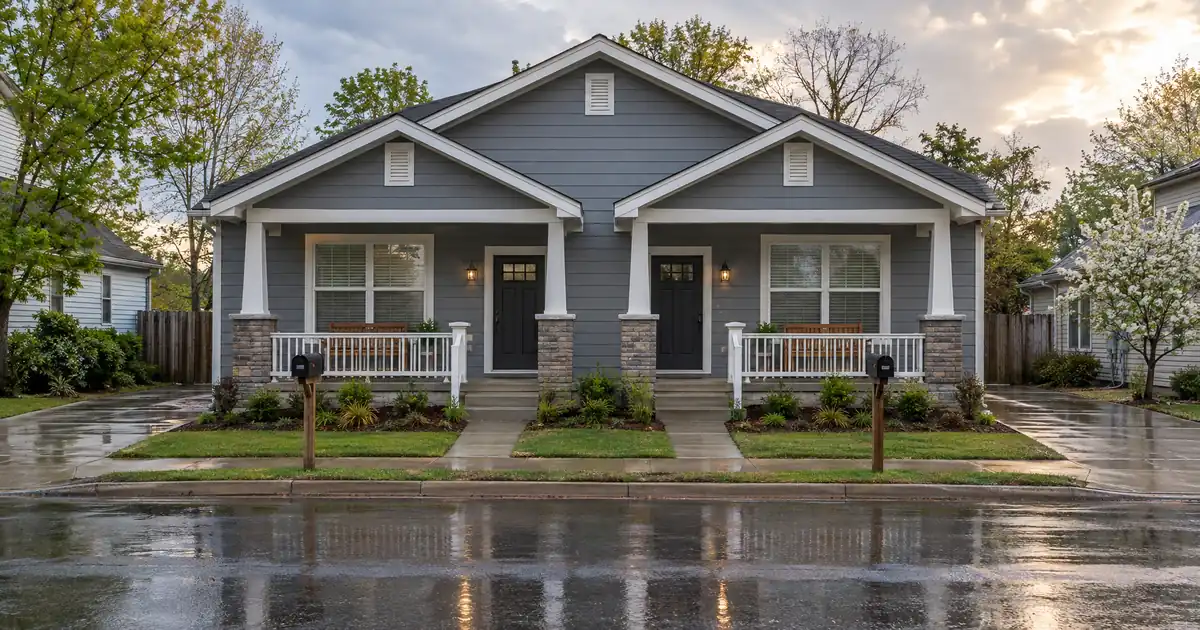
The Quick Read: On a 2-4 unit cash-out refinance, the appraiser’s closed-sales comps set the value, and the value sets the loan ceiling, so the comps matter more than your rehab budget or your target number. The same report also carries a per-unit rent opinion that feeds the coverage ratio. Both outputs come from one appraisal, which is why a thin or weak comp set can hurt twice.
- Most DSCR cash-out programs in the wholesale network top out around 75% LTV on a standard rental, subject to lender guidelines.
- The 2-4 unit report is Form 1025. It carries a sales comparison and a rent schedule.
- A value miss cuts cash-out faster than it cuts value, because the payoff stays fixed.
- Seasoning of about 6 months of ownership is the common expectation on cash-out.
- A reconsideration request runs through the lender and needs specific, documented problems.
Cash-out files on small multifamily fail in the same few places. The comps are thin. The unit count on the report is wrong. The rent opinion comes in under the lease. This piece walks through how those comps get picked, how adjustments work, and what an investor can actually do about a weak set. For the wider product picture, the brokerage’s complete DSCR loans guide covers how these loans are structured.
DSCR Cash-Out Calculator
Run the cash-out numbers in your market
Rate source: Freddie Mac 30-yr average via FRED® — Federal Reserve Bank of St. Louis · effective Oct 15, 2026
Prefilled with starting assumptions — enter your property’s value, balance, taxes, and insurance for a more accurate picture.
Program parameters update from Lendmire’s centralized guideline source. Taxes and insurance are editable estimates.
As of Oct 15, 2026 · General Freddie Mac market benchmark, not a Lendmire loan offer. Property value, balance, taxes, and insurance are editable estimates. Maximum loan-to-value varies by lender, program, property type, and seasoning. Not a Loan Estimate, approval, or commitment to lend. Program availability and eligibility are subject to lender guidelines, credit approval, property review, and underwriting.
Key Terms Defined
Comp: a closed sale of a similar property that the appraiser uses to support a value opinion.
Adjustment: a dollar change the appraiser applies to a comp’s sale price to account for a difference from the subject, such as size or condition.
Market area: the geographic zone where competing properties sell, which the appraiser may widen when closer sales don’t exist.
Gross rent multiplier (GRM): sale price divided by annual gross rent. It ignores expenses, so it works as a cross-check, not a full income method.
Rent schedule: the appraiser’s market rent opinion for each unit in the building.
Form 1025: the small residential income property appraisal report used for two- to four-unit properties.
Seasoning: the ownership period a lender expects before it will treat a refinance as cash-out against appraised value. On most files in the network that is about 6 months, measured from title recording.
Reconsideration of value (ROV): a formal request, made through the lender, asking the appraiser to revisit the value for stated reasons.
What Does the Appraiser Do on a 2-4 Unit Rental?
The appraiser inspects the building, reports two conclusions, and reconciles them into one value. For a two- to four-unit property, Fannie Mae’s Selling Guide names Form 1025 as the traditional report, based on interior and exterior inspection. DSCR loans are not agency products, and each lender in the network sets its own appraisal rules. The form name is simply the industry standard for this property type.
Form 1004 is the one-unit form. It stretches to a two-unit in narrow cases, such as a legal second unit that is minor in value. An investor-owned duplex or fourplex usually doesn’t fit that. Form 1007 is a single-family rent schedule. It is not the 2-4 unit tool.
Form 1025 does three jobs. It reports market rent for each unit. It carries the sales comparison. It can cross-check value with a GRM. Some assignments also attach an operating income statement.
For buildings of one to four units, appraiser-education material says the sales comparison approach carries most of the weight. Appraisals Unlimited makes that point and notes that at five units and up the property turns commercial and the income approach moves to the front. That boundary matters. A fourplex is valued like a house with extra kitchens, not like a 20-unit building on a cap rate.
How Are Comps Chosen for a 2-4 Unit?
The appraiser picks the closed sales that best compete with the subject, and the choice is the appraiser’s, not the borrower’s or the lender’s. Agency guidance says comps should share similar physical and legal characteristics with the subject, and the appraiser decides which sales are the best and most appropriate (Fannie Mae Selling Guide). That logic is a useful picture of how any appraiser works, even when the loan is non-QM.
| Factor | What it means on 2-4 units | What can go wrong |
|---|---|---|
| Unit count | Duplex comps for a duplex | Fourplex valued off triplexes |
| Unit mix | Bedroom and bath count per unit | Studio-heavy comp vs two-bed subject |
| Size | Gross living area, adjusted up or down | Large gap in square footage |
| Condition | Quality and condition ratings | Renovated subject, dated comps |
| Location | Same market area, similar blocks | Comps pulled from a weaker area |
| Recency | Recent closed sales | Stale sales in a moving market |
Closed sales are the base. Listings and pending deals can be context, but they don’t carry the value. Comps work best when they bracket the subject, with some above and some below it on key features.
One check investors skip: confirm the closed sales are actually 2-4 unit sales and not single-family homes. An appraisal that leans on single-family comps for a fourplex is a reconsideration candidate.
How Do Adjustments Work?
Adjustments make an unlike comp read like the subject. If a comp is smaller than the subject, its price is adjusted upward to compare fairly. Tax-assessor training material adds the weighting rule: comps needing the least adjustment get the most weight, and sales needing excessive adjustment may produce an unreliable value.
Typical adjustment categories on a small multifamily:
| Category | Direction | Why |
|---|---|---|
| Unit count or mix | Up or down | Different income capacity |
| Gross living area | Up if comp is smaller | Size drives price |
| Condition and quality | Up if comp is worse | Buyers pay for updates |
| Site and location | Either way | Competing blocks differ |
| Concessions | Down | Inflated price on a comp |
Read the adjustment grid for size, not just direction. Big adjustments on every comp tell you the comp set is a stretch. That is where an appraiser’s discretion, and the variance, grows.
Rent Comps and the Rent Schedule
Rent and value are separate outputs from the same report. Rental comps appear before the sales comps on Form 1025, per this appraisal forms guide, and the appraiser reconciles indicated market rents into a rent opinion for each unit.
Why this matters on a DSCR file: coverage compares rent used for lender review to the full monthly obligation (principal, interest, taxes, insurance, and any HOA dues). If the rent opinion lands low, coverage drops even when value holds. The network’s programs start at 1.00 coverage on select programs, and stronger ratios open better pricing and leverage. A separate select-lender path takes coverage below 1.00 with leverage and terms adjusted.
Appraisers also compare actual leases to market. Appraiser-education material notes that rents propped up by concessions, short-term leases, or related-party tenants get adjusted down. A building with long-tenured tenants well under market can also get flagged. Clean leases and a current rent roll help the appraiser support each unit.
Clearing 1.00 is not the same as positive cash flow. Repairs, vacancy, management, utilities, and capex sit outside the ratio.
A Worked Example
Picture a fourplex with a modeled value that depends on three closed comps. Say the subject has a gross living area larger than two of the comps and equal to the third. The appraiser adjusts the two smaller comps upward for size and one for condition. After adjustments, the three land close together, and the appraiser reconciles to a value near the middle.
Now apply the 75% cash-out ceiling for a standard rental. Loan size is appraised value times the LTV cap. The cash-out is what remains after the new loan pays off the old one and costs. Terms depend on the lender’s guidelines, the property type, the leverage, and a full review of the credit profile.
Here is the sensitivity, in percentages only. Say the appraisal comes in 5% under the owner’s expectation. At 75% LTV the maximum loan drops by 5% too. But the payoff balance did not move. So the cash-out shrinks by a larger share than the value did. The thinner the equity cushion, the sharper the effect. On a file with modest equity, a small value miss can wipe out most of the proceeds. The exact numbers vary by lender and program and follow a full review of property, leverage, and credit.
Run the GRM cross-check the same way. If the appraiser’s GRM from comparable buildings implies a value well off the sales-comp conclusion, expect the reconciliation to explain why. A gap usually points to either a rent opinion problem or a comp problem. These numbers are modeled assumptions, not market data.
Value Miss or Rent Miss?
Diagnose before you react. The fix differs.
| Symptom | Likely cause | First move |
|---|---|---|
| Value low, rents fine | Weak or distant sales comps | Document better comps |
| Rents low, value fine | Thin rent comps or lease issues | Supply leases and rent roll |
| Both low | Wrong unit count or condition | Check the report for factual errors |
| Value fine, coverage short | Rent opinion under the obligation | Review leverage and structure |
Check unit count, bed and bath count, square footage, and condition ratings first. Factual errors are the cleanest reason to ask for a second look.
How to Prepare Before the Appraisal
Preparation is documentation. The appraiser can only support what the file shows.
- A current rent roll and signed leases for every unit.
- Access to all units, with tenants notified.
- A list of capital improvements with dates and scope.
- Your own short list of recent closed 2-4 unit sales nearby, and rent comps for each unit type.
- Photos and notes on condition for anything the appraiser might misread.
For BRRRR-style files, the paper trail on the rehab matters. Your rehab spend or after-repair estimate is not the value. The closed-sales analysis is. Improvements may support a higher appraised value, depending on comps and underwriter review. Seasoning of about 6 months from title recording is the common expectation, so a freshly renovated building bought recently can run into that clock before the appraisal question even arises.
One operator note. On small multifamily files, the failure is rarely the math. It is a comp set built from the wrong property type, or a rent schedule the appraiser couldn’t support because the leases were missing. Both are preventable with a clean packet sent early.
How to Challenge Comps Properly
A reconsideration request is a lever, not a re-roll. Under the agency framework, a change to the value must rest on material, substantive issues. It can’t rest solely on the fact that the value doesn’t support the loan amount (Fannie Mae Selling Guide). Lenders create their own forms, and the request goes through the lender, not directly to the appraiser. Non-QM lenders are not bound by that framework, so each lender’s process controls on a DSCR file.
Steps that work:
1. Read the report line by line for factual errors in unit count, square footage, and condition.
2. Identify which comps are the wrong type or too far from the subject.
3. Assemble recent closed 2-4 unit sales that better match, with the reasons stated plainly.
4. Send the packet through the broker to the lender, not to the appraiser.
5. Keep it short. One clear, supported request beats a long list of complaints.
Evidence that helps: closed sales of the same unit count, documented condition differences, corrected facts. Evidence that fails: your target number, rehab receipts alone, and asking for a different appraiser.
Where the General Rule Breaks
Thin comp supply. Agency FAQ guidance allows less-similar sales when similar ones are scarce. Expect wider adjustments and more variance. Fewer fourplex sales means more appraiser discretion.
Condo or PUD units. A 2-4 unit in a condo or co-op project needs the project information attached, per the form instructions.
Mixed-use space. Commercial space complicates the report. Keep the rent schedule to residential units and expect lender review of the property type.
Five units and up. That’s a different valuation world. Fannie Mae’s multifamily requirements call for at least four closed sales in a sales comparison, and the income approach leads. Don’t expect small-building logic to carry over.
Ineligible property types. Manufactured homes, log homes, and barndominiums are not offered in the network’s DSCR programs, so no comp set will rescue them.
Higher rents do not equal higher value. On one-to-four unit buildings, sales comps lead. Raising rents helps coverage, but it won’t by itself lift the appraisal.
What the Decision Looks Like in Practice
The investor choice is mostly about timing, building, and leverage. This is a genuine toss-up for some owners: wait for better comps to close nearby, or refinance now at lower proceeds. If the comp pool is thin, a lower-leverage ask leaves more room for a conservative appraisal. If a file also needs reserves, those commonly run around 6 months of PITIA and about 9 months above $1,500,000, and Lendmire’s piece How Reserves Are Counted on a 2–4 Unit Rental Cash-Out Refinance covers that side.
The strongest files clear two tests: enough equity and enough rental coverage. A bigger equity stake never erases the leverage cap, credit floor, or property rules. Credit expectations vary: a 620 floor exists in parts of the network, most programs want around 660, and 700 or higher unlocks the strongest tiers. Standard loan sizes run up to $3,000,000. Tax treatment can depend on how funds are used; consult a qualified tax professional.
If you are buying or refinancing a rental property and want to see how the numbers work, Lendmire can help you compare DSCR loan options based on the property income, credit profile, leverage, and investor goals. Reach the team at 828-256-2183 or request a quote. Qualification is subject to lender guidelines and is not a commitment to lend.
Frequently Asked Questions
How many comps does the appraiser use on a 2-4 unit?
It varies by appraiser and lender. Comp count isn’t a fixed DSCR rule. What matters is that the closed sales are similar 2-4 unit properties, bracket the subject, and need modest adjustments. Agency multifamily rules for five units and up call for at least four closed sales, but that is a separate property class.
Do active listings count as comps?
Closed sales carry the value. Listings and pendings are context at most. If your report leans on listings, ask the lender whether the closed-sale support is thin.
Can I supply my own comps?
You can, but through the lender as part of a reconsideration request, not to the appraiser directly. The appraiser decides which comps are most appropriate, so your sales need to be closer in type and feature than the ones used.
Will higher rents raise my appraised value?
Not by themselves. On one-to-four unit buildings the sales comparison leads, and appraisers tend to be conservative on refinance files. Rents affect coverage more directly than value.
What if the appraisal comes in low on a cash-out?
Check the report for factual errors first, then document better closed 2-4 unit sales. Because the payoff is fixed, proceeds fall faster than value. Options include a documented reconsideration request, a lower-leverage structure, or waiting for stronger comps, all subject to lender guidelines.
For how equity extraction works on an investment property, see Lendmire’s guide to cash-out refinance on an investment property.
For current guidelines and terms, see Lendmire’s DSCR loan programs page.
About Lendmire
Lendmire (NMLS# 2371349), a non-QM mortgage broker serving investors in 41 markets including Washington, D.C., helps structure DSCR scenarios commonly evaluated around a property’s rental income rather than personal income paperwork, subject to lender guidelines. A Scotsman Guide Top Mortgage Workplace in 2025 and 2026, Lendmire places loans through wholesale investor lenders and is not a direct lender.
Get Started
Ready to find the right loan for you?
In about 30 seconds you can review financing options available for your investment property. No commitment required.
Informational only. Not a Loan Estimate, approval, or commitment to lend. Program availability and eligibility are subject to lender guidelines, credit approval, property review, and underwriting.
References
1. Fannie Mae Selling Guide B4-1.2-01
3. Fannie Mae Selling Guide B4-1.3-08
4. Pickens County Assessor appraisal-process PDF
This article is part of Lendmire’s investment property cash-out refinance program — full qualification details, guidelines, and scenarios live on the program page.
Related reading: How to Add a Fixed Second Behind a Rental Cash-Out Refinance · Can You Get a Cash-Out Refinance With an Eviction Filed on the Rental? · Can a Landlord Do a Rental Cash-Out Refinance Right After Moving Out?
Brandon Miller
Founder & CEO, Mortgage Loan Originator, Lendmire LLC
- Mortgage Loan Originator · NMLS# 1129696 · Verify on NMLS Consumer Access
- North Carolina Real Estate Broker · License# 343312 · Verify on NCREC
- North Carolina Insurance Producer · License# 19053198 · Property, Casualty, Life, Health · Verify on NAIC SBS
- Lendmire LLC · Firm NMLS# 2371349 · Verify firm licensure
Disclosure information. Lendmire is a state-licensed mortgage brokerage under NMLS# 2371349. Lendmire is not a depository institution, direct lender, or financial advisor — all loans referenced are placed through wholesale lender partners and are subject to each lender's underwriting standards. This article is provided for general informational purposes and is not a commitment to lend, nor does it constitute financial, legal, or tax advice. Loan programs, terms, rates, and qualification standards change without notice and depend on borrower profile, property type, and the state in which the subject property is located. Equal Housing Opportunity provider. NMLS Consumer Access: nmlsconsumeraccess.org.