
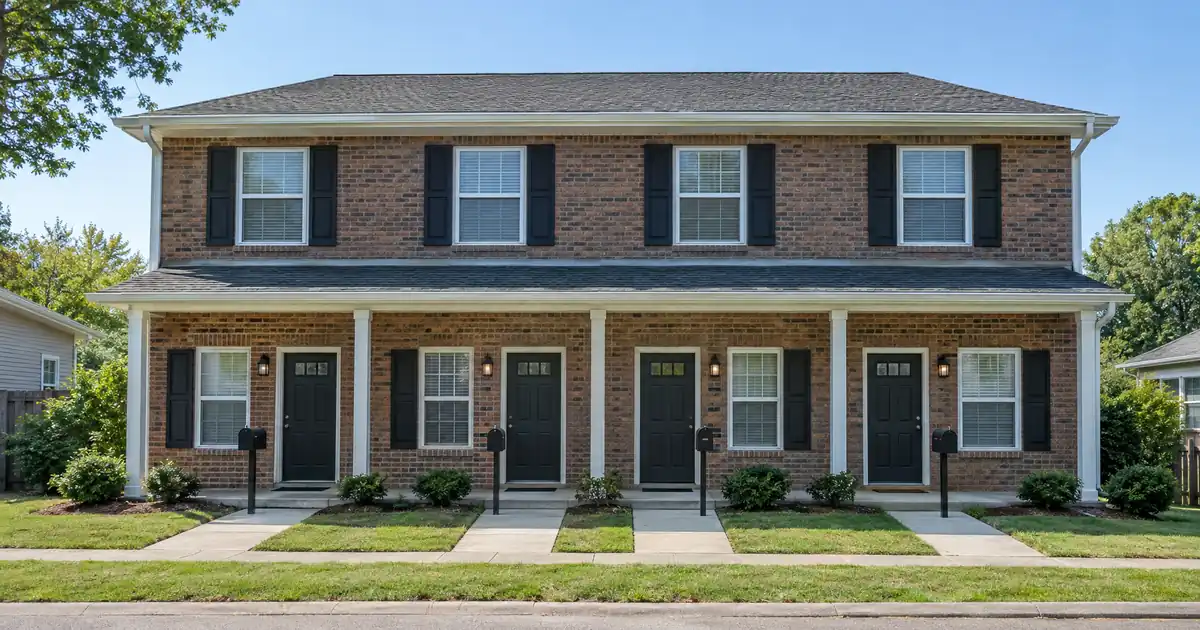
The Quick Read: Yes, it can work when three things line up: a lender writes lines on investment property, the fourplex is titled to you or your revocable trust, and your credit and debt-to-income ratio can absorb the line. The count of five financed properties rarely decides the answer by itself. Across Lendmire’s wholesale network, the fourplex’s own equity sets the size of the line, and the other rentals are tested at the borrower level.
- On an investment property, the ceiling is 70% combined loan-to-value, with a maximum line of $500,000.
- A 700 credit score is the floor for an investment line. Scores above 700 do not buy more leverage.
- LLC-titled rentals cannot hold the line. A vesting change or a DSCR cash-out refinance is the usual workaround.
- A borrower with more than 15 financed properties is not eligible, so five is well inside the limit. Bank-style property-count caps are usually the real obstacle.
Big banks and large retail lenders are where five-rental landlords most often hit a wall. Many of them do not write lines on rentals at all. Others stop at a low count of financed properties.
How large a line the equity supports.
An equity line is sized by combined loan-to-value, occupancy, and credit — not by rental coverage. Switch the occupancy or the credit band and the ceiling moves with it.
Investment-property lines require a 700 minimum credit score; second-home lines start at a 640 minimum and primary-residence lines at 600, and the combined-LTV ceiling steps down as the credit band drops on primary-residence and second-home lines and holds on investment-property lines; the line cap steps down on primary-residence lines and holds at every tier on investment-property and second-home lines.
A debt-to-income ratio above 45% requires 680+ credit. Profiles under 640 are limited to single-family homes. At least 75% of the approved line is drawn at closing. Ceilings, floors, and caps update from Lendmire’s centralized guideline source.
Line estimate
Illustrative estimate only — not a quote, Loan Estimate, approval, or commitment to lend. The rate is an editable assumption; equity-line pricing is variable through both the draw and repayment periods and never converts to fixed. Occupancy and credit drive the ceiling together: an investment property tops out at 70% combined LTV (minimum credit 700, line cap $500,000); a second home tops out at 90% combined LTV (minimum credit 640, line cap $500,000), with the ceiling stepping down as the credit band drops (the cap holds at every tier); a primary residence tops out at 90% combined LTV (minimum credit 600), and its $750,000 maximum line is available only at 75% combined LTV or below with a 700-or-better credit profile (720 on the longer-runway program) and a full appraisal. Lines above $500,000 require a full appraisal. Credit, debt-to-income, property type, and full underwriting review all affect the final line.
Key Terms Defined
HELOC: A home equity line of credit is a revolving credit line secured by the property. You draw what you need, up to a limit.
CLTV: Combined loan-to-value adds every lien on the property, including the new line, and divides by the property’s value.
Financed property: Any property that carries a mortgage in your name. Lenders usually count your primary residence too.
DTI: Debt-to-income is the share of your monthly income that goes to debt payments.
Fourplex: A building with four residential units. Five or more units is a commercial property.
DSCR: Debt service coverage ratio compares a property’s rent to its full monthly obligation. It is how rent-based loans qualify a property.
Does Owning Five Financed Rentals Block a Fourplex HELOC?
No. Five financed rentals do not block the line by themselves, but they change which tests matter. A lender looks at the fourplex as collateral and at you as a borrower. Those are two separate checks.
The property-level test asks how much equity sits in the fourplex. The other four mortgages do not touch that math. Each rental is its own collateral pool, so only the fourplex’s value and the liens on it count toward a fourplex line.
The borrower-level test is where the other four show up. The lender pulls your credit, adds every financed property’s payment to your debt load, and looks at your assets. That is where portfolio landlords get squeezed.
Availability matters before any of that. NerdWallet says a HELOC on an investment property is possible. It also says the lender pool is smaller, limits can be lower than on a primary home, and lenders see more default risk on a rental. That matches what brokers see. Many banks simply do not offer the product, and others cap how many financed properties a borrower can hold.
Lendmire arranges these lines through select wholesale partners. This article uses two program labels. The higher-leverage program is built for larger combined exposure. The longer-runway program carries different credit and tradeline standards. Where figures differ, each applies only within its own program.
Under both, a borrower owning more than 15 financed properties is not eligible. A landlord with five is nowhere near that.
What Counts as a Fourplex, and Where the Category Ends
A fourplex is the top of the eligible range. Properties with one to four units are residential, and the network’s HELOC programs accept single-family homes, 2-4 unit buildings, townhomes, PUDs, and condominiums, including non-warrantable condos. Five or more units is commercial, and commercial and mixed-use properties are not eligible. Neither are manufactured homes, co-ops, condotels, log homes, or agricultural zoning.
Occupancy is the other line to draw. If you live in one unit, the building is an owner-occupied multifamily, and that is a different loan with different terms. If you rent every unit, it is an investment property. Do not claim owner occupancy on a fully rented building. Lenders verify occupancy, and a misstatement turns a workable file into a serious problem.
On a fully rented fourplex, the investment-property rules below apply.
How the Line Size Gets Calculated
The line is the property value times the allowed CLTV, minus every lien already on the property. On an investment property in the network, that allowed CLTV is 70%, and the line tops out at $500,000.
Here is an illustration with modeled percentages, not market data. Say the fourplex is valued at 100 units of value. The existing first mortgage equals 45% of that value. At 70% CLTV, the new line can use up to 25% of value. If that figure would exceed $500,000, the $500,000 cap wins.
Credit above 700 does not change this. The investment table has two tiers, 720 and 700, and both top out at 70% CLTV. A 700 score is a hard floor with no tier beneath it. Higher scores buy a stronger file, not more leverage.
Other structure points:
- The line can sit in first or second lien position.
- Investment lines run a 5-year interest-only draw followed by a 25-year fully amortizing repayment. No other structure is offered on investment property.
- At least 75% of the line is drawn at closing.
- Pricing floats through both the draw and repayment periods and never converts to fixed.
- The minimum subsequent draw after closing is $1,000, as stated by the longer-runway program.
Market structures differ. NerdWallet describes a typical market HELOC as a 10-year draw followed by repayment of up to about 20 years. The network’s investment line is the 5-year draw and 25-year repayment above.
Valuation is also simpler than many landlords expect. Because an investment line caps at $500,000 and full appraisals begin only above $500,000, an investment HELOC usually uses automated valuation. A traditional appraisal is commonly not needed, though a borrower can request one. A fourplex has a thinner pool of comparable sales than a house does, so the automated value is worth sanity-checking before you apply.
The line is subject to lender guidelines and full file review. Lendmire’s piece How Much a Fourplex HELOC Releases With Five Financed Rentals walks through the release math in more detail.
How the Other Four Mortgages Show Up in Underwriting
They show up in your debt-to-income ratio, your credit history, and your exposure limits. They do not show up in the fourplex’s equity.
DTI. The maximum is 50%. The lender counts every financed property’s payment and qualifies the new line on an interest-only payment calculated on the maximum draw. That means the line weighs on your ratio at its full size, not just at what you drew. A landlord with five mortgages already has a full DTI before the line is added.
Credit. Investment lines require at least a 700 score. Housing history applies across all financed properties, so a late payment on any rental counts. The longer-runway program looks for two tradelines seasoned 12 months, or one seasoned 24.
Exposure. A borrower is limited to three lines. Combined exposure caps at $2,000,000 on the higher-leverage program and $750,000 on the longer-runway program. A landlord who already holds a HELOC on a primary residence is using one of the three.
Past credit events. A bankruptcy needs four years of seasoning from discharge or dismissal. Investment files follow a 7-year seasoning for foreclosure and 4 years for a deed-in-lieu, pre-foreclosure, or short sale.
Business bank statements are not the binding constraint here. The deposit analysis requires 680, but an investment line already floors at 700.
Title and Vesting: Individual, Trust, or LLC?
The line must be held by an individual borrower or an inter vivos revocable living trust. LLCs, corporations, partnerships, and irrevocable, blind, or land trusts cannot hold title. That is a key structural difference from a DSCR loan.
Many landlords hold rentals in an LLC for liability reasons. If the fourplex is already deeded to one, you have two options. You can change the vesting, or you can use a DSCR cash-out refinance, which can lend to an LLC subject to lender program eligibility.
Think before re-titling. Moving a mortgaged rental into an LLC is not on the exception list under the federal due-on-sale law for 1-4 unit residential property, according to FedLaws. So the transfer itself can trigger the first mortgage’s due-on-sale clause. Those are secondary legal summaries, not the statute text, and this is not legal advice. Ask your attorney and read your note before you move title just to qualify for a line.
The same summaries say a second lien that does not transfer occupancy is generally exempt. A new HELOC alone is typically not the problem. LegalClarity notes that these protections stop at five units.
Which Property to Borrow Against
Borrow against the property with the most equity and the cleanest title. That is often not the fourplex.
A fourplex is one title, one lien position, and one valuation. Its collateral file is simpler than four separate rentals. But the comparable-sales pool is thinner, and an automated valuation on a fourplex may land differently from what you expect.
Consider these tests:
- Equity position. Which property has the lowest existing CLTV? That one leaves the most room under the 70% cap.
- Title. Which one is already in your name or your revocable trust?
- Existing first mortgage. A HELOC leaves a low-cost first mortgage intact. A cash-out refinance replaces it.
- Line count. Three lines is the limit. Spend one where the equity is real.
A single-family rental held in your name with 40% equity can beat a fourplex held in an LLC. Eligibility is about title as much as value.
HELOC or DSCR Cash-Out Refinance?
A HELOC is judged on you. A DSCR cash-out is judged on the property. As the portfolio grows, personal DTI fills up with every rental’s payment, which is why scaling landlords often shift to property-based underwriting.
DSCR loans are designed for non-owner-occupied investment properties. Because they are business-purpose investor loans, they are reviewed differently from a standard owner-occupied mortgage. The loan is reviewed primarily on property-level rental income covering the payment, subject to lender guidelines.
| Factor | Fourplex HELOC | DSCR cash-out refinance |
|---|---|---|
| Underwritten on | You: credit and DTI | The property’s rent vs. its payment |
| Title | Individual or revocable trust | LLC possible, per program terms |
| Leverage | 70% CLTV on investment property | About 75% on standard rentals |
| Size | $25,000 to $500,000 on investment | Up to $3,000,000 on standard programs |
| First mortgage | Stays in place | Replaced by the new loan |
| Best when | Equity is solid and DTI has room | DTI is full or title is an LLC |
A DSCR cash-out typically wants about 6 months of seasoning and around a 700 score for stronger leverage tiers. 1.00 is where many select programs start for coverage. A separate select-lender path takes coverage below 1.00, with leverage and terms adjusted. DSCR compares rent to the monthly obligation only. Clearing 1.00 is not the same as positive cash flow, because repairs, vacancy, management, and utilities sit outside the calculation. The complete DSCR loans guide covers the full qualification picture.
Across the network, files that stall usually stall on title or DTI, not on equity. A landlord with strong equity and an LLC-held fourplex is more common than one with strong equity and an eligible borrower profile. Sorting out which test you fail first saves time.
DSCR cash-out refinance is available in 41 markets, including Washington, D.C. HELOC placements are narrower, covering only Lendmire’s 16 full-service states: AL, CA, CO, FL, GA, IN, MI, MT, NM, NC, OH, PA, TN, TX, VA, and WA.
Where the Answer Turns to No
Know the flip points before you spend time on an application:
- Title in an LLC, corporation, partnership, or land trust. The line cannot hold it.
- Five or more units, or mixed-use. Not eligible.
- Credit below 700. An investment line has no tier beneath that floor.
- DTI above 50%. The max-draw interest-only payment is what gets tested.
- More than 15 financed properties. Not eligible.
- Three lines already open. The borrower limit is three.
- Listed for sale recently. A property listed for sale, or listed within the past 60 days, is ineligible in NC, PA, TN, TX, and WA.
- Need above $500,000. An investment line cannot go there. Lines above $500,000 are primary-residence only.
Documents to Gather
Have these ready before the lender asks:
- Credit report, recent enough to be no more than 90 days old at closing.
- Income documentation, with leases or Schedule E for rental income.
- Mortgage statements for every financed property.
- Title information showing exact vesting.
- Proof of insurance on the fourplex.
Timing and Sequencing
Open the line before you buy the next rental, not after. A later lender will see the line and its balance. How a lender counts the undrawn portion varies, so a big line can crowd your DTI even if you never draw it. The same logic applies in reverse. Another mortgage added first fills your DTI, which can block the line.
A HELOC is also revolving credit secured by the property. The Consumer Financial Protection Bureau’s HELOC booklet warns that you could lose the property if you cannot repay. That booklet is written for homes, so read its warning as a general principle for a rental. The pricing on the line floats, so the payment can rise.
Tax treatment can depend on how the funds are used and how the property is held; investors should keep clear records and speak with a qualified tax professional before relying on any deduction.
Frequently Asked Questions
Do five financed rentals disqualify me?
Not on the network’s limits. A borrower owning more than 15 financed properties is not eligible, so five is well inside. The practical risk is DTI, because every financed property’s payment counts. Banks with their own property-count caps are a separate matter, and those caps vary by lender.
Can I use the fourplex if I live in one unit?
Yes, but that makes it an owner-occupied multifamily, which is a different loan from an investment line. If you rent every unit, it is an investment property, and the 70% CLTV ceiling applies.
What if my fourplex is in an LLC?
The HELOC cannot close in a LLC’s name. You would need a vesting change, which carries due-on-sale risk on the existing first mortgage, or a DSCR cash-out refinance. Talk to an attorney before re-titling.
Does a higher credit score raise my leverage on an investment line?
No. Both the 720 and 700 tiers reach 70% CLTV on an investment property, so credit above 700 improves the file but not the ceiling. The floor is 700, and there is no tier beneath it.
How much can I borrow against the fourplex?
Up to 70% CLTV on an investment property, minus existing liens, and never more than $500,000. Every figure is subject to lender guidelines and full file review.
Next Step
If you are considering a home equity line and want to see how the numbers work, Lendmire can help you compare HELOC options based on the property, the equity available, credit profile, combined leverage, and your goals. Lendmire is a broker and arranges financing through select lenders in its wholesale network. It is not a commitment to lend.
The edge between a HELOC and a DSCR cash-out usually comes down to one question: whether your personal debt-to-income ratio or the fourplex’s rent has more room left.
About Lendmire
Lendmire (NMLS# 2371349) is a mortgage brokerage serving homeowners and real estate investors in its 16 full-service states. Home equity lines of credit are arranged through wholesale lending channels; Lendmire brokers the line and the lender underwrites each application under its occupancy-based guidelines. Scotsman Guide named Lendmire a Top Mortgage Workplace in both 2025 and 2026.
Get Started
Ready to find the right loan for you?
In about 30 seconds you can review financing options available for your investment property. No commitment required.
Informational only. Not a Loan Estimate, approval, or commitment to lend. Program availability and eligibility are subject to lender guidelines, credit approval, property review, and underwriting.
References
1. NerdWallet – HELOC on an Investment Property
2. FedLaws – Garn-St Germain exceptions
3. LegalClarity – Garn-St Germain
This article is part of Lendmire’s investment property HELOC program — full qualification details, guidelines, and scenarios live on the program page.
Related reading: Investment Property HELOC Terms When Keeping a Low First Mortgage · Do Investors Scaling 2-10 Doors Fund Deals With a Cash-Out Refinance? · Is Moving a Conventional Rental Loan to DSCR Worth a Higher Payment?
Brandon Miller
Founder & CEO, Mortgage Loan Originator, Lendmire LLC
- Mortgage Loan Originator · NMLS# 1129696 · Verify on NMLS Consumer Access
- North Carolina Real Estate Broker · License# 343312 · Verify on NCREC
- North Carolina Insurance Producer · License# 19053198 · Property, Casualty, Life, Health · Verify on NAIC SBS
- Lendmire LLC · Firm NMLS# 2371349 · Verify firm licensure
Compliance and disclosures. Lendmire (NMLS# 2371349) is a licensed mortgage broker and is not a direct lender, depository institution, financial advisor, or tax professional. Content in this article is general market analysis and educational information — not financial, legal, or tax advice for any specific situation. Lendmire does not guarantee loan approval; every transaction is subject to underwriting by the funding lender. Mortgage pricing and loan program guidelines are subject to change at any time without notice and vary by borrower characteristics, property type, and state regulations. Lendmire complies with Equal Housing Opportunity. Licensure verification: NMLS Consumer Access.