
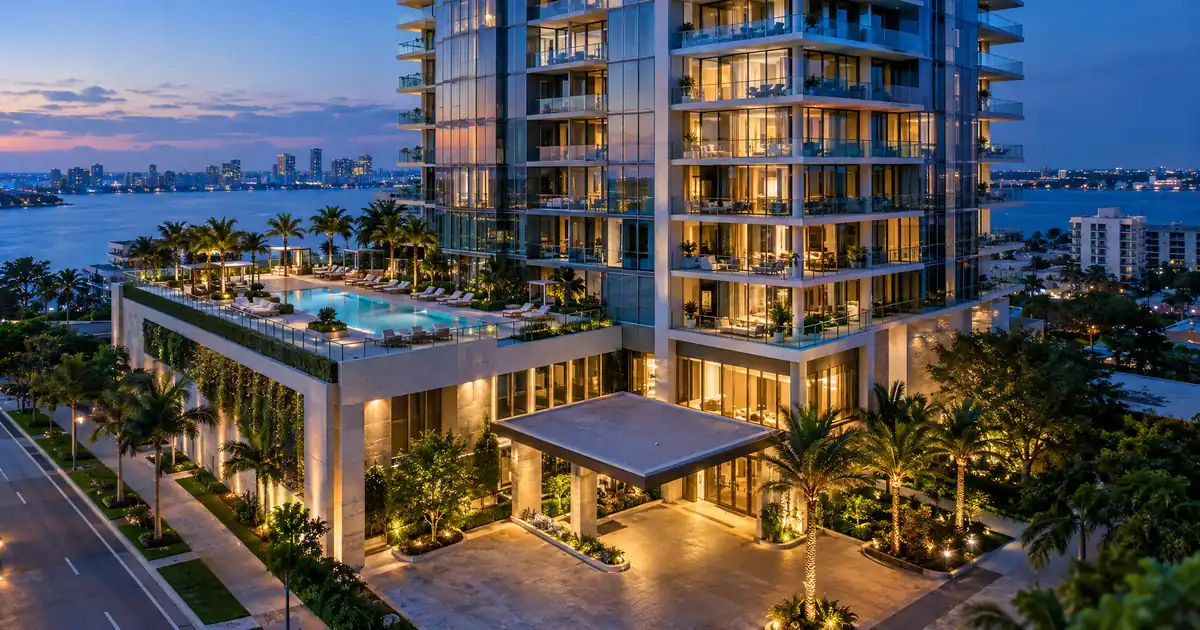
How Lenders Assess Condo Eligibility For A Luxury STR DSCR Loan — The Quick Read: DSCR lenders skip agency warrantability rules entirely and instead review the HOA’s operating model, rental-pooling structure, insurance adequacy, and litigation history before sizing the loan on the property’s rental income. Non-warrantable condos and condotels can both qualify, but at reduced leverage and lower loan caps than a standard warrantable condo. The deciding factor is usually why a building is non-warrantable, not the label itself.
A luxury short-term-rental condo in a resort tower or branded building often gets flat rejected by conventional lenders before the file even reaches underwriting. That’s not a credit problem. It’s a building problem. Agency guidelines from Fannie Mae and Freddie Mac disqualify entire condo projects for structural, legal, and operational reasons that have nothing to do with the borrower. DSCR loans work around this because they’re business-purpose products underwritten against the property’s cash flow, not the borrower’s income or the GSE checklist. That distinction is the whole reason luxury STR investors end up in non-QM territory in the first place.
Short-Term Rental Calculator
Run the STR numbers in your market
Rate source: Freddie Mac 30-yr average via FRED® — Federal Reserve Bank of St. Louis · effective Sep 17, 2026
Prefilled with local estimates — enter your nightly rate, occupancy, taxes, and insurance for a more accurate picture.
Short-term rental income is documented with a 12-month history or a market data report. Program parameters update from Lendmire’s centralized guideline source.
As of Sep 17, 2026 · General Freddie Mac market benchmark, not a Lendmire loan offer. Nightly rate, occupancy, taxes, and insurance are editable estimates. Qualifying income for short-term rentals varies by program — some use appraisal market rent, others use documented STR history or projections — and is confirmed in underwriting. Not a Loan Estimate, approval, or commitment to lend. Program availability and eligibility are subject to lender guidelines, credit approval, property review, and underwriting.
Key Terms Defined
Warrantable condo — a condo project that meets Fannie Mae and Freddie Mac’s eligibility standards for conventional financing, including limits on investor concentration, litigation, and rental restrictions.
Non-warrantable condo — a condo project that fails one or more agency standards (commercial space ratio, HOA delinquency, incomplete construction, pending litigation) but may still be reviewable through non-QM programs at reduced leverage.
Condotel — a condo unit operating with hotel-style services (rental desk, daily housekeeping, central key systems) or subject to mandatory rental pooling, treated as its own underwriting category separate from standard non-warrantable condos.
Mandatory rental pooling — an HOA or management arrangement requiring owners to place their units into a shared rental program, stripping the owner of direct control over occupancy and income.
Condo Questionnaire — the standardized intake form (Fannie Mae Form 1076 / Freddie Mac Form 476) lenders send to an HOA to collect financials, litigation status, and occupancy data; non-QM lenders commonly borrow the same form even though they aren’t bound by agency eligibility.
Why Agency Rules Don’t Govern This Deal
Fannie Mae and Freddie Mac exclude entire condo projects from conventional financing based on how the building operates. The borrower’s file doesn’t matter here. Fannie Mae’s Ineligible Projects standard disqualifies several types of projects. This includes projects where the HOA requires owners to join rental pooling. It also includes projects converted from hotels without a full gut rehab. Even projects with voluntary pooling agreements can get disqualified, if they carry blackout dates or occupancy limits. Freddie Mac has a parallel rule. Homebuyer.com’s guide to Freddie Mac ineligible projects explains it. This rule flags projects that operate like hotels. It also caps single-investor ownership concentration and commercial space ratios.
None of that governs a DSCR loan. DSCR underwriting sidesteps the warrantability question entirely because the loan is sized against the property’s rent, not the agency checklist. For a complete overview of how DSCR loans work, that shift from borrower-income underwriting to property-income underwriting is the mechanism that opens luxury STR condos to financing at all.
That said, “no agency rules” doesn’t mean “no rules.” DSCR underwriters run their own version of the same review — just with different consequences attached.
What Actually Gets Reviewed on the HOA File
Lenders send a condo questionnaire to the HOA early in underwriting, using it to pull financials, litigation status, and — for STR buildings specifically — the operating model. The document does double duty: confirming the building is financially sound and surfacing whether the property functions like a hotel.
The review typically covers:
- HOA financials — reserve funding, delinquency rate on common-expense assessments, and whether a qualifying reserve study exists
- Legal status — active litigation, with a real distinction between routine collections suits and construction-defect or structural-safety claims
- Insurance adequacy — whether the master policy meets coverage requirements, and whether unit-level HO-6 coverage is available
- Ownership concentration — how much of the building is owned by a single investor or entity
- Commercial space ratio — how much of the project is non-residential
- Construction status — whether the developer still controls the HOA and phases remain incomplete
Any one of these can flag a building as non-warrantable. None of them, on their own, automatically kills a DSCR file — the underwriter is weighing severity, not checking a box.
Non-Warrantable vs. Condotel: Same Problem, Different Category
These two labels get used interchangeably, and that’s a mistake that costs investors time. A non-warrantable condo and a condotel fail eligibility for different reasons, and they get treated differently in underwriting.
Non-warrantable status usually comes from financial or legal issues at the building level. This can include high delinquency, unresolved litigation, heavy investor concentration, or incomplete construction. None of these relate to how units get rented. So a non-warrantable building can still run a completely standard residential rental model.
A condotel, by contrast, is flagged because of hospitality-style operations — a front desk, daily housekeeping, central key systems, or room service — or because owners are locked into mandatory rental pooling that hands occupancy control to a management company. The physical layout matters too: units without a full kitchen (just a mini-fridge and microwave) read more like a hotel room than a residence.
Across our wholesale network, non-warrantable condos generally top out at 75% LTV and a $1,500,000 cap, while condotels are treated as their own category — up to 75% on a purchase, 65% on a refinance, capped at $1,500,000, and typically requiring $250,000 in cash-in-hand at closing. That gap in structure reflects the added risk of an owner having less control over the unit’s rental calendar.
The line that matters most: mandatory pooling is a harder stop than voluntary participation. When an owner keeps control of the booking calendar and the income, most lenders in the network treat it as a standard rental. When a management company controls occupancy and owners have no ability to opt out, that’s the structure that restricts financing options the most — regardless of how strong the trailing income looks.
Does the Reason for Non-Warrantable Status Matter?
Yes — the reason a building is non-warrantable matters more than the label itself. Take a building that’s non-warrantable because of investor concentration or a presale timing issue. That’s a very different risk than a building that’s non-warrantable because of mandatory rental pooling or unresolved structural litigation.
Think of it this way: investor-concentration or timing issues are usually temporary and building-specific — they don’t touch the unit’s rental strategy. Mandatory pooling, deed restrictions, and structural litigation are different. Those conditions travel with the property no matter what loan program is used, because they restrict what the owner can actually do with the unit. An investor evaluating a building non-warrantable for the “soft” reasons has real financing paths. An investor evaluating a building non-warrantable for the “hard” reasons is fighting the property itself, not the loan program.
How Income Gets Documented on a Luxury STR Unit
Short-term rental income on a DSCR file doesn’t come from a lease. On a refinance, lenders in the network typically look at twelve months of trailing operating history from the property itself. On a purchase — where there’s no history yet — underwriting leans on the appraisal’s short-term-rental analysis, applied at roughly 80% of gross rent to build in a cushion for vacancy and expense volatility.
That’s an important gap for investors to understand: the appraisal report and the DSCR income calculation aren’t always pulling from the same number. Appraisers completing Form 1007 rent schedules are barred from simply multiplying a nightly STR rate by 30 to estimate monthly rent — that shortcut ignores furniture, vacancy, and operating expenses baked into an STR business, and the form requires monthly-lease comparables instead. So a luxury condo’s appraised “market rent” often understates its actual nightly-rate performance. That’s not a defect in the process — it’s just two different measurements doing two different jobs, and investors shouldn’t assume the appraisal figure reflects achievable booking revenue.
On the network’s short-term-rental program specifically, coverage needs to clear 1.00 or better, loan amounts run to $2,000,000, and the program is reserved for investors who’ve already owned income property within the last three years — this isn’t a first-time-landlord product. Interest-only structuring is also available on eligible files, running up to 120 months on 30- and 40-year terms for coverage of 0.75 or better, qualified against interest, taxes, and insurance rather than full principal-and-interest.
I work files across a wholesale network of lenders, not just one shop. Because of this, I see the same pattern over and over. The strongest luxury STR condo files come in with clean trailing operating history. They also come with a favorable HOA questionnaire already in hand. Weak files look different. They show strong Airbnb numbers, but nobody looked closely at the HOA document. Usually, that HOA document decides whether the deal moves forward at all.
Insurance: Two Policies, Not One
The HOA’s master policy insures the building structure. It does not insure what’s inside a unit — flooring, cabinets, fixtures, furnishings, appliances. That gap is covered by an individual HO-6 “walls-in” policy, and most lenders require one when the master policy only covers the bare structure.
DSCR vs. conventional financing
Two common ways to finance an investment property in this market. They qualify you differently — here’s how investors weigh them.
Why investors choose it
- Qualifies on the property’s rental income — no personal tax returns, W-2s, or pay stubs needed to document income.
- No personal debt-to-income ceiling to clear, so existing mortgages and obligations don’t cap your borrowing the same way.
- Can be closed in an LLC, keeping the property inside a business entity.
- Built for scaling — not held to the limit on number of financed properties that conventional financing applies.
- Underwriting centers on the deal: generally qualifies when the rent covers the payment, a 1.00x coverage ratio being a common baseline (confirmed in underwriting).
- Designed specifically for investment property, including long-term and, where the program allows, short-term rentals.
Where it’s strong
- Often the lowest ongoing financing cost for a buyer who fully qualifies on personal income — a fit for a first property or a cost-first purchase.
Trade-offs for investors
- Requires full personal income documentation and must fit within a debt-to-income limit — salary, existing debts, and other mortgages all count.
- Typically held in your personal name rather than a business entity.
- Caps how many financed properties you can carry, which can become a ceiling as a portfolio grows.
- Evaluates you as a borrower as much as the property, which usually means more paperwork.
How investors usually choose: a first or single property often optimizes for the lowest financing cost; portfolio builders often optimize for leverage, vesting in an LLC, and scaling past conventional caps. The right answer depends on your goals, the property, and current guidelines — both paths run through select lenders in Lendmire’s wholesale network, with eligibility and terms confirmed in underwriting.
On a modest long-term rental, this distinction is a minor line item. On a luxury STR unit with high-end finishes and furniture, it’s not. Replacement cost on interior finishes and furnishings in a luxury short-term rental runs materially higher than a standard long-term rental unit, and underwriters confirm both policies are in place before closing.
What About Litigation Against the Building?
Not every lawsuit against an HOA kills financing. The key is telling routine legal matters apart from structural claims. If an HOA sues a delinquent owner, or faces a fully insured slip-and-fall case, lenders generally treat this as background noise. Construction-defect claims, structural-engineering findings, or safety-code violations fall into a different category entirely. These typically stay flagged until they’re resolved.
Non-QM underwriting generally mirrors that same substance-over-form read. The existence of a lawsuit isn’t the trigger — what the lawsuit is about is.
A Worked Look at the Leverage Ladder
Say an investor is eyeing a $1,200,000 non-warrantable oceanfront condo with voluntary STR participation and clean trailing rental history. Because the loan size falls in the $1,000,000-$1,500,000 tier, purchase and rate-term leverage in the network typically top out around 75% with a credit floor near 700 — down from the 80% available on loans under $1,000,000 with 660+ credit. If the same investor later wants to pull cash out, that ceiling drops further, generally to 70% on standard rental collateral in that tier (short-term-rental collateral runs a separate, lower cash-out ceiling around 60%).
Run the same scenario at $2,800,000 and the picture shifts again: leverage in that band typically holds near 75% for purchase or rate-term, credit expectations move to 720+, and — because the loan clears $2,000,000 — the file needs two appraisals rather than one. Push past $4,000,000 and every file gets reviewed case by case before submission, purchase or rate-term only, with no cash-out available at that size.
None of this locks in without underwriting review — coverage below 1.00 is a real path through select lenders in the network up to $2,000,000, but LTV and terms adjust downward when it’s used, and every figure here reflects the strongest available structure through the wholesale network rather than a guaranteed outcome. Understanding how DSCR loans compare to conventional financing helps frame why the property, not the borrower’s traditional personal-income documentation, is doing the qualifying work here.
Rental Rules Are Local — Confirm Before Relying on Projected Income
Whether short-term rental use is even legal for a given unit is a local question, decided by the city, county, and the HOA’s own documents — never assumed. Short-term rental rules can vary by city, county, HOA, and property type, so investors should confirm local rules before relying on projected rental income. This applies even inside buildings where the HOA itself permits STR use; municipal permission is a separate, property-specific check that has to be documented on its own.
DSCR loans are designed for non-owner-occupied investment properties. Because they’re business-purpose investor loans, they’re reviewed differently from a standard owner-occupied mortgage. Tax treatment can depend on how the funds are used and how the property is held; investors should keep clear records and speak with a qualified tax professional before relying on any deduction.
Frequently Asked Questions
Can a condotel with mandatory rental pooling still qualify for a DSCR loan?
It depends entirely on how the pooling is structured. Mandatory pooling that fully removes the owner’s control over occupancy and income is the type of condition most non-QM lenders restrict or decline, since the loan is sized against income the owner doesn’t directly control. Voluntary participation, where the owner sets the calendar and keeps the income, is a different risk profile and generally has more financing paths available.
Why does a non-warrantable condo cap out at lower leverage than a warrantable one?
Because the building carries added risk the lender is pricing for — whether that’s HOA financial instability, unresolved litigation, or incomplete construction. Through the network described above, non-warrantable condos generally top out near 75% LTV and a $1,500,000 loan cap, subject to underwriting and the specific reason for non-warrantable status.
If the HOA changes its rental rules after I buy, does that affect my existing loan?
DSCR loans are underwritten at origination based on the property and building conditions at that time. A later HOA rule change affecting rental use is a landlord and investment-strategy issue going forward, not something that reopens the original loan terms — though it could matter for a future refinance or resale.
Do lenders accept Airbnb income projections for a brand-new luxury unit with no rental history? On a purchase with no operating history, underwriting typically relies on the appraisal’s short-term-rental analysis rather than a self-reported projection, generally applied at a discount to gross rent. Documented twelve-month operating history becomes the standard once the property has been rented, most often reviewed at refinance.
Does a seasonal luxury market change how income is calculated?
Yes, in that trailing income is generally averaged over a full twelve months specifically to smooth out seasonal swings rather than annualizing a peak month. A unit that books heavily in winter and sits empty in summer is evaluated on its full-year average, not its best quarter.
Are you evaluating a luxury condo for short-term rental financing? Do you want to see how the building’s classification and the leverage ladder apply to your numbers? Lendmire can help. We compare DSCR loan options based on the property’s income, the HOA’s documentation, and your investor goals.
Investors focused on short-term rentals can review DSCR loans for Airbnb and short-term rentals.
For current guidelines and terms, see Lendmire’s super jumbo DSCR loan programs page.
Self-employed borrowers can compare both super jumbo programs on Lendmire’s self-employed mortgages page.
About Lendmire
Lendmire is a non-QM mortgage brokerage (NMLS# 2371349) arranging DSCR investor loans in 40 markets, including Washington, D.C. DSCR eligibility is generally reviewed around property-level rental income rather than personal income, subject to lender and program guidelines, a fit for self-employed investors and LLC-owned portfolios. Lendmire was recognized as a Scotsman Guide Top Mortgage Workplace in 2025 and 2026.
Lendmire’s Top Mortgage Workplace recognition is documented by Scotsman Guide 2025 Top Mortgage Workplace and Scotsman Guide 2026 Top Mortgage Workplace.
Get Started
Ready to find the right loan for you?
In about 30 seconds you can review financing options available for your home or investment property. No commitment required.
Informational only. Not a Loan Estimate, approval, or commitment to lend. Program availability and eligibility are subject to lender guidelines, credit approval, property review, and underwriting.
References
1. Fannie Mae Selling Guide — Ineligible Projects B4-2.1-03
2. Homebuyer.com — Freddie Mac Ineligible Projects Guide
3. McKissock Learning — Form 1007 and STR Appraisals
Brandon Miller
Founder & CEO, Mortgage Loan Originator, Lendmire LLC
- Mortgage Loan Originator · NMLS# 1129696 · Verify on NMLS Consumer Access
- North Carolina Real Estate Broker · License# 343312 · Verify on NCREC
- North Carolina Insurance Producer · License# 19053198 · Property, Casualty, Life, Health · Verify on NAIC SBS
- Lendmire LLC · Firm NMLS# 2371349 · Verify firm licensure
Disclosures. The information presented in this article is general market commentary, not financial, legal, or tax advice. Lendmire is a mortgage brokerage (NMLS# 2371349) — not a direct lender or depository institution — and loan placement is subject to lender underwriting. Nothing in this content represents a commitment to lend. Loan terms, pricing, and program availability vary based on borrower qualifications, property characteristics, and state of subject property, and are subject to change at any time. Lendmire complies with Equal Housing Opportunity requirements. Consumer access: nmlsconsumeraccess.org.


