
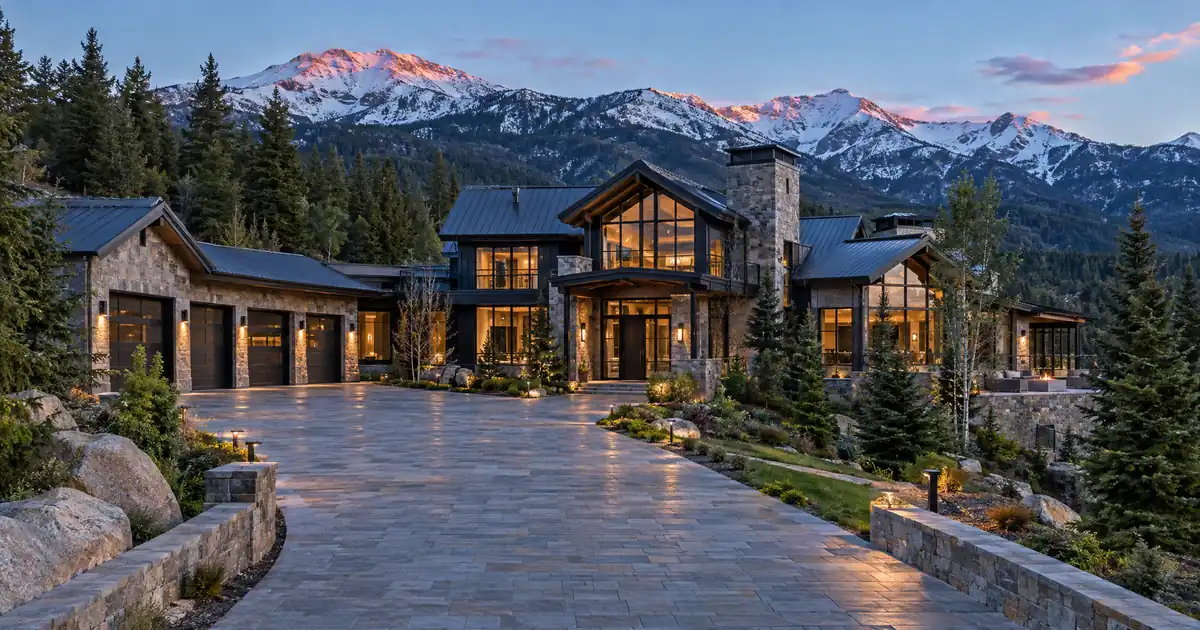
Luxury Rental DSCR Loans in Big Sky — The Quick Read: The lender doesn’t just take your projected nightly rate and multiply it out. It uses the appraiser’s rent conclusion — or, for short-term rentals, a documented income analysis discounted off gross bookings — and checks whether that number covers the full monthly housing payment. In a market where the average Big Sky home runs near $4.8 million against average annual short-term rental revenue in the low six figures, the coverage math is tighter than the headline nightly rate suggests. This piece walks through exactly what counts, what doesn’t, and where the leverage ladder steps down as loan size climbs.
Key Terms Defined
DSCR (debt-service coverage ratio): the number you get when you divide the property’s monthly rental income by its full monthly housing cost. A ratio at or above 1.00 means the rent covers the payment; below 1.00 means it doesn’t, on paper.
DSCR Calculator
Run the numbers in your market
Rate source: Freddie Mac 30-yr average via FRED® — Federal Reserve Bank of St. Louis · effective Sep 17, 2026
Prefilled with local estimates — enter your own rent or nightly figures, taxes, insurance, and HOA for a more accurate picture.
Program parameters update from Lendmire’s centralized guideline source. Taxes and insurance are editable estimates.
As of Sep 17, 2026 · General Freddie Mac market benchmark, not a Lendmire loan offer. Rent, nightly rate, occupancy, taxes, and insurance are editable estimates. Short-term rental figures are estimates only and vary significantly by season, property type, management approach, and local short-term-rental rules — confirm local regulations before relying on them. Qualifying income for short-term rentals varies by program — some use appraisal market rent, others use documented STR history or projections — and is confirmed in underwriting. Not a Loan Estimate, approval, or commitment to lend. Program availability and eligibility are subject to lender guidelines, credit approval, property review, and underwriting.
PITIA: principal, interest, taxes, insurance, and association dues — the full monthly obligation a lender adds up before comparing it to rent.
Business-purpose loan: a loan made to a property held for investment or rental income, not as a personal residence. DSCR loans are designed for non-owner-occupied investment properties. Because they are business-purpose investor loans, they get reviewed differently from a standard owner-occupied mortgage.
No-ratio loan: a program path where the lender doesn’t require a minimum coverage number at all, in exchange for reduced leverage and a stronger credit and reserve profile.
Short-term rental (STR) income analysis: a narrative appraisal exhibit built specifically for nightly-rental properties, used because the standard monthly rent form isn’t built for vacation-rental economics.
What the Rent Actually Has to Cover
Here’s the short version: rent has to cover PITIA — principal, interest, taxes, insurance, and any association dues. It also needs enough left over to clear whatever coverage ratio the specific program requires. Nothing else about the property’s appeal, brand recognition, or ski-in/ski-out location changes that math.
A few things worth knowing before diving into a Big Sky file:
- The lender’s number comes from an appraisal or a documented income analysis — never from the listing agent’s projection or the seller’s Airbnb screenshot.
- Long-term rent and short-term rent get verified through completely different mechanics, and mixing them up is the single most common reason a Big Sky file stalls.
- Coverage requirements and leverage move together — a thinner ratio usually means less leverage, not an automatic decline.
- Loan size changes everything above $3 million. Big Sky’s average home value sits well above that line, so most luxury purchases here land in the tiers where leverage steps down and cash-out disappears.
How a Long-Term Rental Gets Its Rent Number
For a conventional annual lease, the appraiser fills out a standard rent schedule — Form 1007 for a single-family rental — comparing the subject property against similar leased homes nearby. The lender then uses whichever number is lower: the appraiser’s market-rent opinion or the actual signed lease. An above-market lease sitting in your file doesn’t push the number up. That rule surprises a lot of first-time DSCR borrowers who assume their paper lease is the ceiling, when it’s really a floor at best.
This matters less in Big Sky, though, because almost nothing in this market gets bought as a straight annual lease. The overwhelming majority of Big Sky purchases in the luxury tier are underwritten as short-term rentals — which runs on a completely different track.
Why Nightly Rentals Don’t Just Multiply by 30
This is where most Big Sky files go sideways if the loan officer hasn’t done one before. Fannie Mae has stated directly that the standard rent schedule cannot be used to estimate short-term rental income, and that it would be incorrect for an appraiser to take a nightly comp rate, multiply it by 30, and call that the monthly rent — because that shortcut ignores furniture and fixture costs, cleaning and management expenses, and the vacancy built into a nightly booking calendar (Fannie Mae Appraiser Update, June 2024).
In practice, that means a Big Sky ski chalet with a $995 average daily rate doesn’t get credited at $995 times 30 nights. The appraiser produces a narrative short-term rental income analysis instead of forcing nightly data into the annual-lease form, and Fannie Mae’s own guidance confirms the appraisal supplies a data point — the lender still makes the final call on how much of that income actually counts toward the ratio (Fannie Mae Short-Term Rentals memo).
Lendmire places files through a wholesale network. In that network, an established short-term rental typically gets treated the same way. On a refinance, you need twelve months of documented operating history. On a purchase, the appraiser’s short-term rent analysis works instead. Lenders then credit roughly 80% of gross revenue. Why the haircut? Gross nightly revenue includes cleaning fees, platform commissions, and vacancy. That money never reaches the owner’s pocket. Fannie Mae flagged this same issue in its own guidance. Here, though, it’s applied through non-QM underwriting instead of agency underwriting.
A newly purchased Big Sky property with zero booking history has no trailing data to lean on. In that case the appraiser’s projected income becomes the entire basis for the coverage number, which is exactly why comp selection on a brand-new file matters more here than almost anywhere else.
The Leverage Ladder — and Why Big Sky Lands in the Middle of It
Big Sky’s average home value sits near $4.8 million, according to STR data platform Rabbu — well past the point where standard DSCR leverage applies. Most programs Lendmire arranges step leverage down as loan size rises, and Big Sky luxury purchases typically land in the middle-to-upper tiers of that ladder rather than the top.
On most files up to $1 million, purchase and rate-and-term leverage typically run around 80%, with cash-out around 75%, generally requiring credit in the 660 range. Between $1 million and $1.5 million, purchase and rate-and-term commonly move to about 75%, cash-out to roughly 70%, with credit closer to 700. From $1.5 million to $3 million — a range where a lot of Mountain Village and Spanish Peaks properties sit — purchase and rate-and-term typically hold near 75%, while cash-out generally steps down to around 60%, with credit expectations near 720.
Above $3 million, the math changes again. On most files between $3 million and $4 million, purchase and rate-and-term leverage typically runs closer to 65%, with cash-out no longer available and credit generally expected near 700. From $4 million up to $10 million, leverage typically settles around 60% on purchase and rate-and-term, still with no cash-out, and every file in that range goes through individual, case-by-case review before it’s even submitted — never a flat “up to” figure. Given where Big Sky’s average home price sits, plenty of estate-level purchases land squarely in that top bracket, which is worth planning for before you fall in love with a listing.
Above $2 million, lenders typically require two independent appraisals. This is a practical response to thin comp pools in resort markets — not a federal mandate. The only genuine federal two-appraisal requirement lives somewhere else entirely: the Consumer Financial Protection Bureau’s higher-priced mortgage loan flip rule. It forces a second appraisal only when a seller bought the property at a meaningfully lower price within the prior six months (CFPB). This rule targets fraud in flips, not luxury underwriting, and it rarely applies to a Big Sky purchase.
What Happens When Coverage Comes In Below 1.00
Coverage below 1.00 doesn’t automatically kill a Big Sky file. Select lenders in Lendmire’s wholesale network will still work with ratios in roughly the 0.75-to-0.99 range up to $2 million, though leverage and terms adjust downward to compensate, subject to underwriting. That path exists specifically for the scenario Big Sky produces so often: a stunning property with real seasonal earning power, priced high enough that even strong nightly rates don’t clear a full 1.00 against the payment.
A handful of lenders in the network also offer a no-ratio path, up to $2 million. This generally requires seven years of clean housing payment history and no late payments in the trailing two years. It’s always subject to underwriting, and it isn’t available on short-term rental collateral. It’s a narrower door. But for a well-qualified, well-capitalized buyer on a slower-earning shoulder-season property, it can mean the difference between qualifying and walking away.
Interest-only structuring is another lever worth knowing about. Most programs offer up to 120 months of interest-only payments on 30- and 40-year terms, generally up to 75% leverage, with coverage qualifying against the interest-only payment rather than a fully amortizing one. That alone can lift a marginal coverage number into comfortable territory on a high-value big Sky purchase.
Where Seasonality Complicates the Rent Number
Big Sky’s income doesn’t arrive evenly across the year, and that matters for how “documented history” gets interpreted. Year-over-year data shows revenue down 2.1% and occupancy down 4.1%, while average daily rate rose 13.9% — a pattern consistent with a market where winter carries most of the annual load (AirDNA). A property that looks strong on a full trailing-twelve-month average can still have summer months that would fail coverage entirely on their own.
DSCR vs. conventional financing
Two common ways to finance an investment property in this market. They qualify you differently — here’s how investors weigh them.
Why investors choose it
- Qualifies on the property’s rental income — no personal tax returns, W-2s, or pay stubs needed to document income.
- No personal debt-to-income ceiling to clear, so existing mortgages and obligations don’t cap your borrowing the same way.
- Can be closed in an LLC, keeping the property inside a business entity.
- Built for scaling — not held to the limit on number of financed properties that conventional financing applies.
- Underwriting centers on the deal: generally qualifies when the rent covers the payment, a 1.00x coverage ratio being a common baseline (confirmed in underwriting).
- Designed specifically for investment property, including long-term and, where the program allows, short-term rentals.
Where it’s strong
- Often the lowest ongoing financing cost for a buyer who fully qualifies on personal income — a fit for a first property or a cost-first purchase.
Trade-offs for investors
- Requires full personal income documentation and must fit within a debt-to-income limit — salary, existing debts, and other mortgages all count.
- Typically held in your personal name rather than a business entity.
- Caps how many financed properties you can carry, which can become a ceiling as a portfolio grows.
- Evaluates you as a borrower as much as the property, which usually means more paperwork.
How investors usually choose: a first or single property often optimizes for the lowest financing cost; portfolio builders often optimize for leverage, vesting in an LLC, and scaling past conventional caps. The right answer depends on your goals, the property, and current guidelines — both paths run through select lenders in Lendmire’s wholesale network, with eligibility and terms confirmed in underwriting.
That’s exactly why underwriting works off documented trailing history rather than a single peak-season snapshot — a winter-loaded income stream gets smoothed across twelve months, not credited at its best month. It’s worth stress-testing your own numbers the same way before assuming a headline nightly rate translates directly into rent used for lender review.
Lendmire’s experience across resort and seasonal markets shows a clear pattern. Files with a full trailing-twelve-month platform history clear underwriting faster than files that lean on a projection alone. That’s because both the appraiser and the lender have less guessing to do. New-construction or newly-purchased Big Sky properties without that history face different expectations. They should expect more weight placed on comps and a more conservative income conclusion. That’s the tradeoff for having no operating track record yet.
Non-Warrantable Condos and Entity Ownership
Big Sky’s condo and condotel product mixes often fall outside conventional lending. That’s part of why DSCR financing shows up so frequently in this market. Non-warrantable condos are typically reviewable up to about 75% leverage and $1.5 million. Condotels can work up to roughly 75% on a purchase or 65% on a refinance. These are generally capped at $1.5 million, with a required cash-in-hand contribution near $250,000. Most files also welcome LLC and entity vesting, subject to lender program eligibility. This matters for buyers structuring a Big Sky purchase for liability separation or estate planning, rather than personal name ownership.
Local Taxes Aren’t Part of the Ratio — But They Hit Your Cash Flow
Property taxes and insurance sit inside PITIA and directly affect the coverage ratio, but Big Sky layers on something most other rental markets don’t: a resort tax. Properties inside the Big Sky Resort Area District collect a 4% local resort tax on rental transactions, stacked on top of Montana’s 8% combined lodging tax — a 12% total lodging tax burden that never touches DSCR math directly, since it’s collected from guests and remitted, not paid by the owner as a housing cost. Still, it’s a real line item in the operating budget that affects what an investor actually nets, and it’s worth factoring into your own return projections even though it doesn’t move the coverage ratio itself.
A Worked Look at the Math (No Dollar Figures Attached)
Picture two identical Mountain Village chalets, same price, same location. The first gets underwritten on a full trailing-twelve-month STR platform history. After the 80%-of-gross haircut, it clears comfortably above 1.00x. The second is a brand-new purchase with no booking history. It relies entirely on the appraiser’s projected income analysis. Because that analysis is conservative about seasonality, it lands closer to a 0.9x coverage ratio.
The first file likely clears standard leverage in its size tier without issue. The second may need the sub-1.00 pathway — meaning reduced leverage and a stronger reserve position — or an interest-only structure to bring the qualifying payment down enough to clear closer to 1.00x. Same property type, same market, two very different underwriting paths, depending entirely on documentation.
The Practical Decision
If you’re weighing a Big Sky luxury purchase, the real question isn’t whether the market can produce strong nightly revenue — the data says it can. It’s whether that revenue survives the discount and documentation process intact enough to clear the coverage bar at the leverage tier your price point falls into. A $2.4 million property and a $5.5 million property in this same town can face genuinely different leverage ceilings, different credit floors, and different cash-out availability, purely because of where they land on the size ladder.
Luxury coastal rental markets like Tiburon and Siesta Key face similar size-ladder dynamics. This happens even though their seasonality and rent patterns look nothing alike. The mechanics behind documenting and discounting rent stay consistent across every luxury DSCR file. Want the fuller picture before running your own numbers? Lendmire’s complete DSCR loans guide walks through that framework property-type by property-type.
Tax treatment can depend on how the funds are used and how the property is held; investors should keep clear records and speak with a qualified tax professional before relying on any deduction.
Frequently Asked Questions
Can a brand-new Big Sky purchase with no rental history still qualify? Yes, but the income number comes entirely from the appraiser’s projected short-term rental analysis rather than trailing platform data. That tends to produce a more conservative rent figure than an established property with a full booking history, so it’s worth budgeting for tighter coverage on a first-year purchase.
Does a higher nightly rate automatically mean stronger DSCR? Not necessarily. Big Sky’s average home value runs high enough that gross revenue as a percentage of price can be thinner than in lower-priced resort markets, even with a strong average daily rate. The ratio depends on the payment size just as much as the income side.
What credit score do I need for a Big Sky luxury DSCR loan? It depends on loan size. Most programs start around a 660 floor on smaller balances and typically require closer to 700 or higher once the loan crosses roughly $3 million, subject to lender guidelines and program-specific overlays.
Can I use an LLC to hold a Big Sky rental property? Generally yes, subject to lender program eligibility — entity vesting is welcomed on most DSCR files without layered-entity complications, which is one reason investors favor this structure for liability separation.
Does the local resort tax affect my DSCR ratio? No. Resort and lodging taxes are collected from guests and remitted by the operator — they show up in your operating budget and net cash flow, but they don’t factor into the PITIA-versus-rent coverage calculation itself.
If you’re evaluating a Big Sky purchase or refinance and want to see how the numbers actually shake out at your price point, Lendmire can help you compare DSCR loan options based on the property’s income, your credit profile, available leverage, and your goals as an investor. Reach out at 828-256-2183 or request a quote to start running the specifics.
For current guidelines and terms, see Lendmire’s super jumbo DSCR loan programs page.
Self-employed borrowers can compare both super jumbo programs on Lendmire’s self-employed mortgages page.
About Lendmire
A non-QM mortgage broker (NMLS# 2371349), Lendmire arranges DSCR financing for real estate investors in 40 markets — 39 states plus Washington, D.C. Because deals are underwritten primarily on property cash flow rather than personal income documentation, the structure suits self-employed buyers and entity-owned portfolios. Lendmire places loans through wholesale investor lenders; it is not a direct lender. Scotsman Guide named Lendmire a Top Mortgage Workplace in both 2025 and 2026.
Get Started
Ready to find the right loan for you?
In about 30 seconds you can review financing options available for your home or investment property. No commitment required.
Informational only. Not a Loan Estimate, approval, or commitment to lend. Program availability and eligibility are subject to lender guidelines, credit approval, property review, and underwriting.
References
1. Fannie Mae Appraiser Update, June 2024
2. Fannie Mae Short-Term Rentals memo
3. Rabbu — Big Sky, MT Airbnb Market Data
4. AirDNA — Big Sky, Montana Vacation Rental Data
Brandon Miller
Founder & CEO, Mortgage Loan Originator, Lendmire LLC
- Mortgage Loan Originator · NMLS# 1129696 · Verify on NMLS Consumer Access
- North Carolina Real Estate Broker · License# 343312 · Verify on NCREC
- North Carolina Insurance Producer · License# 19053198 · Property, Casualty, Life, Health · Verify on NAIC SBS
- Lendmire LLC · Firm NMLS# 2371349 · Verify firm licensure
Important disclosures. Lendmire (NMLS# 2371349) is a licensed mortgage brokerage. Lendmire is not a direct lender, depository institution, or financial advisor. All loan inquiries are subject to lender underwriting; this article does not constitute a commitment to lend. Rates, terms, and program guidelines are subject to change without notice and vary by borrower profile, property type, and state. Information in this article is general in nature and is not financial, legal, or tax advice. Equal Housing Opportunity. NMLS Consumer Access: nmlsconsumeraccess.org.


