
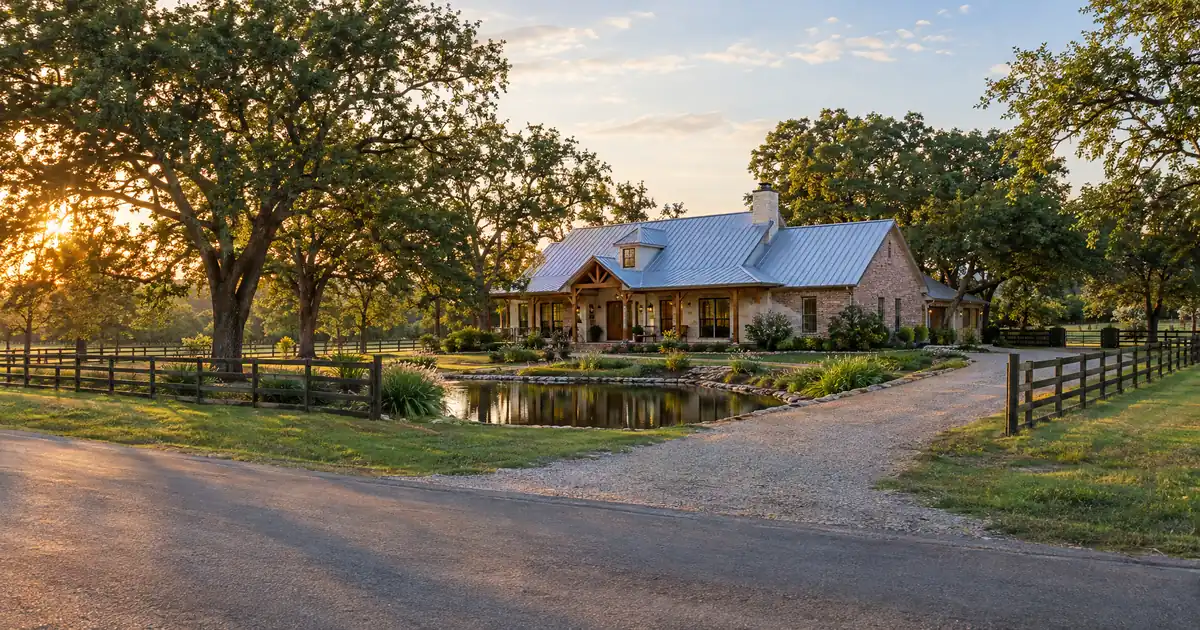
The Quick Read: A rental on Texas land can qualify for a DSCR HELOC when it is a non-owner-occupied rental on a lot of 10 acres or less, with rent that covers a stress payment on the whole line at 1.10x or better and enough equity under the combined-leverage ceiling, subject to underwriting. Rural-designated property is generally not eligible, even when the lot is within the acreage limit. The Texas homestead equity rules govern your own home. They do not govern a rental, and the acreage limits in Texas law are a separate question from the acreage limit in a lender’s program.
- The line is a standalone second lien behind the first mortgage you keep, or a standalone first lien on a paid-off rental. It is qualified on rent, and your personal income is not calculated.
- Through select programs, a second lien reaches 70% combined loan-to-value (CLTV) at a 720 score or better, on lines of $50,000 to $500,000.
- Lots to 10 acres can be eligible, but rural-designated, agricultural and hobby-farm properties are not.
- The Texas homestead rules only matter if you pull equity from the home you live on, and this line is never written on that home.
- Every figure here is a ceiling or floor, not an offer, and each file is underwritten on its own.
Three Ideas Hiding in One Title
The title bundles three separate questions, and mixing them up is how investors waste weeks.
The first is the product. “DSCR HELOC” is a practitioner’s label for a revolving line of credit on a rental, qualified on the property’s rent instead of the owner’s paycheck. DSCR stands for debt service coverage ratio, which is simply how many times the rent covers the payment.
The second is the Texas equity rules. These apply to a Texas homestead, meaning the home you live in. The Texas A&M Real Estate Research Center explains that these home-equity rules sit in the state constitution. They cover cash-out refinances, home equity loans and HELOCs. They require you to keep at least 20 percent equity, and they require a written notice before closing, with timing that varies by file and lender. The same page says these loans may not be taken on a rental or investment property.
The third is acreage, and acreage gets limited in two different places. Texas law caps how much land counts as a protected homestead. A lender’s program caps how much land it will lend against. The two numbers have nothing to do with each other.
If you keep those three apart, the rest of the process is mechanical.
Key Terms Defined
DSCR (debt service coverage ratio): Gross monthly rent divided by the qualifying monthly payment, so 1.10x means the rent is 110% of that payment.
HELOC: A revolving line of credit secured by property, where you draw what you need up to a limit.
CLTV (combined loan-to-value): The first mortgage balance plus the new line, divided by the property’s value.
Second lien: A loan that sits behind the first mortgage and gets paid second if the property is sold or foreclosed.
Homestead: The Texas home you live in as your primary residence, which gets special protections and special borrowing rules.
Stress payment: A qualifying payment calculated on the entire credit limit at a higher assumed rate, used only to test coverage. It is not what you actually pay.
What a DSCR HELOC Actually Is
A DSCR HELOC is one clear structure. It is a revolving line on a non-owner-occupied one-to-four-unit rental. It is written either as a standalone second lien behind the first mortgage you keep, or as a standalone first lien on a rental with no mortgage. It is never closed together with a purchase, never a third lien, and never a line on your own home or a second home.
Across the wholesale network Lendmire works with, a line like this is placed through select programs. Lendmire is the broker, and the lender reviews and approves. Availability of this product varies by state, so confirm with Lendmire whether it is offered in Texas.
Practitioners use the same label for two other things, which is where the confusion starts. One is an investment-property HELOC reviewed on your personal income and debt-to-income ratio. The other is a DSCR cash-out refinance, which replaces your first mortgage with a new, larger loan sized on rent. Those are separate programs with their own rules. The line described here keeps your existing first mortgage in place and does not open your personal income file.
If you want the wider picture of how rent-based lending works, Lendmire’s complete DSCR loans guide covers the full-loan version.
Which Texas Equity Rules Apply to Your Parcel?
The rules follow the collateral, not the product name. Ask one question first: is this property your homestead?
| Situation | Texas homestead equity rules | DSCR HELOC |
|---|---|---|
| Your own Texas home | Apply in full | Never offered on it |
| A second home or vacation home | Not eligible for these loans | Not eligible |
| A rental you do not live in | Do not apply | Possible, subject to underwriting |
If the land is your homestead, you are in homestead territory whatever the product is called. That means the 80% combined cap, the 12-day wait, a closing at a lender, attorney or title company office, and the other homestead conditions, all of which are built around your ability to repay as a consumer. None of that is a rent-coverage test.
If the land is a rental, the homestead framework does not attach to it. The leverage ceiling on a rental comes from the program, not from the constitution. For this line, that ceiling is 70% CLTV on a second lien through select programs, and that figure is a program ceiling rather than a legal one.
The practical result surprises people. A cap that looks like a Texas legal limit may not apply to your rental at all, and a limit you never heard of may sit in the program instead.
The Rural Homestead Twist
Say you live on 40 acres and rent a house on the back of the same land. The house you live in may be a protected rural homestead. The rental house is a rental. A line against the rental would need clean separation, meaning its own legal description, its own title and its own valuation, so it does not read as part of your homestead. Whether a split or carve-out is practical depends on survey, title and the lender, and it is worth asking a Texas real-estate attorney before you start.
The same goes for a former homestead you moved out of and rented. Whether it keeps homestead status after conversion can be a legal question, and a Texas attorney is the right person to answer it.
Acreage: Two Different Limits
Texas law and the lender each draw an acreage line, and they draw it for different reasons.
Under Texas Property Code §41.002, an urban homestead is limited to 10 acres. A rural homestead can reach 200 acres for a family and 100 acres for a single adult, and rural parcels may be non-contiguous. The statute also sets a test for urban status that looks at whether the land sits in a municipality, its extraterritorial jurisdiction or a platted subdivision, plus police and fire protection and utilities. These figures protect a home from creditors. They are not a lending cap and they do not make a property eligible or ineligible for a credit line.
The lender’s line is stricter and simpler. Lots up to 10 acres can be eligible for this program. Rural-designated property is outside it, and so are agricultural property, hobby farms, commercial or mixed-use property, and land contracts. Raw land is not a rental, so it has no place here either.
A few honest consequences follow:
- A 200-acre Texas ranch can be a perfectly valid rural homestead and still be far outside this program.
- A 6-acre parcel can fit the acreage number and still fail if the property is designated rural.
- A single-family rental on a few acres at the edge of town, with a lease in place, is the typical shape that fits.
- A farm lease, a hunting lease or timber income does not turn a house into an eligible property. It usually pushes the file toward the agricultural or hobby-farm exclusions.
Whether a property counts as rural-designated is a call the lender and the valuation make. Texas courts treat urban versus rural as a question of fact, so the label is not always obvious from the acreage alone. If your parcel is near the line, ask for a read before you pay for a survey.
How the Rent Test Works
Qualification is about the rent, not you. The program does not calculate your income, and it does not ask for tax returns, W-2s, pay stubs or a debt-to-income ratio. The rent, the lease, your credit report and the property valuation are all documented. The file qualifies primarily on property-level rental income covering the payment, subject to lender guidelines.
The test runs in four steps.
1. Find the rent. The program counts the lesser of the appraiser’s market rent (Form 1007) or the lease. A lease above market can count only with three months of receipts. A lease in place is required, and a two-to-four-unit property can have at most one vacant unit.
2. Build the stress payment. The qualifying payment is a fully amortizing payment on the entire credit limit at the starting rate plus 2 percentage points. It is built on the whole line, not just what you draw.
3. Divide. Gross monthly rent divided by that qualifying payment must be at least 1.10x.
4. Check the lender’s formula. On a second lien, how the first-mortgage payment joins the calculation is the lender’s own coverage method, and it governs.
A short illustration shows the logic without any dollar figures. Say a rental’s rent clears the stress payment on the full line at about 1.25x. That clears the 1.10x floor with room to spare. Now say the same property needs a bigger line and the stress payment grows, pulling coverage to 1.05x. The rent has not changed, but the property no longer passes at that line size. Often the fix is a smaller line. The illustration is only arithmetic. The lender’s own calculation decides every file.
Rural properties make the rent line harder, because comparable rural rentals are scarce. When the appraiser has few rental comps, the market-rent figure carries more weight and gets more scrutiny.
How Acreage Changes Your Line Size
The line is the smaller of two ceilings. One is the leverage ceiling. The other is the coverage test. Acreage can squeeze both.
On the leverage side, it works through value. Land with a house on it is harder to value than a house on a standard lot, because comparable sales are fewer and farther apart. A weaker value means less equity to borrow against. A valuation that treats extra acreage conservatively can shrink the line, even though the land is real.
For lines up to $400,000, the program uses an automated valuation with a confidence score of 85 or better plus a property inspection report, or a full interior appraisal. Larger lines take a full interior appraisal. Appraisal waivers are not accepted. On acreage, an automated valuation can fail its confidence threshold more often than it does in a subdivision, which pushes the file to a full appraisal.
A Worked Example in Percentages
Take a rental with no mortgage. At a 740 score or better, a first lien reaches 75% loan-to-value on lines to $500,000. At 700 to 739, it is 70%. If the line goes above $500,000 (up to $1,000,000), the ceiling is 65% at 720 or better.
Now take a rental with a first mortgage you keep. Say the first mortgage balance is 40% of the property’s value. The second-lien ceiling is 70% CLTV at 720 or better. That leaves room for a line of up to roughly 30% of value, subject to the lender’s valuation and underwriting. A lower value moves every one of those numbers down together.
Then run the rent test on the full line. If the line is large and the rent is modest, the stress payment is the binding limit. If the line is modest and the rent is strong, equity is. That is why two Texas rentals with the same value can get different line sizes.
Which Property Types Stay in the Program
Single-family homes, PUDs, townhomes, two-to-four-unit properties, warrantable condominiums and non-warrantable condominiums are eligible. Row homes, condotels, leaseholds, land trusts, age-restricted communities, modular and log homes, and properties with a solar lien are not. A property listed for sale in the prior two months is also out.
Short-term rental rules can vary by city, county, HOA, and property type, so investors should confirm local rules before relying on projected rental income. The program also requires a lease in place, which points the product at long-term tenants.
Credit, Seasoning and Who Can Borrow
Credit scores for this line start at 720 on a second lien and 700 on a first lien, using the lender’s own report. There can be no 30-day mortgage late in the last 12 months. The waiting period after a bankruptcy, foreclosure, short sale or deed-in-lieu is 48 months. Reserves and cash to close are not required, and a borrower can have at most 5 loans or $2,500,000 with the program.
Seasoning is six months. A rental bought or refinanced in the last six months is not eligible, and six months of ownership are required. If you closed on that rental last quarter, the line has to wait.
Borrowers must be US citizens, permanent residents or non-permanent residents with a Social Security number. Foreign nationals and ITIN borrowers are not eligible on this program.
LLC Titling
You can keep the rental in your LLC, subject to program terms. The members sign as guarantors, and a title holder who is not a borrower signs a non-borrowing owner acknowledgment and the security instrument. The borrowers on the line do not have to be the borrowers on the first mortgage. That is useful, because many investment HELOC programs reviewed on personal income want title in an individual’s name or a revocable trust.
How the Line Works After Closing
The mechanics matter, because this is not a lump-sum loan.
At least 80% of the line, and never less than $50,000, is drawn at closing. After that, each draw is at least $5,000. The draw period is five years, interest-only on the drawn balance. Then a 25-year fully amortizing repayment period follows, for a 30-year maturity. The rate is variable, and the rate and the pricing terms come with the lender’s HELOC disclosures.
The 80% draw rule changes how you size the line. Do not open a line much bigger than you plan to use, because most of it is drawn on day one, and the stress test runs on the entire limit.
Where the General Rule Breaks
Rules of thumb fail in a handful of Texas situations.
- Out-of-state owner. If you do not own a Texas homestead, a Texas rental is an ordinary non-homestead property for this purpose. The primary-residence rules do not bind it.
- Using your own Texas home. A line against your own home is a homestead loan with the 80% cap, the 12-day wait and the rest of the checklist. The DSCR HELOC is not a way around that, because the program never lends on your home.
- Mixed use on rural land. Neither the constitution nor the Property Code addresses overlapping business use of a rural homestead. That gray area is exactly why a rental on the same land needs clean separation.
- A parcel that is too big. Carving out a house lot, or choosing a different product, may be the answer.
- Label risk. Some depository institutions decline anything called a HELOC on non-home collateral, so the product name can matter to a lender even when the collateral is fine.
What Underwriters See on These Files
On acreage deals, the pattern across the network is consistent. The files that go smoothly have a lease in place, an appraiser who can find rental comps, a clear legal description and a first mortgage with no recent late payments. The files that stall usually have one of three problems: a rural designation nobody checked, a lease priced well above market with no receipts to back it, or a line sized so large that the stress payment drops coverage below 1.10x.
Programs below the standard coverage floor are available through select lenders in the network, but leverage and terms adjust. This particular line keeps its 1.10x floor.
The Decision, Step by Step
Run your parcel through these questions in order.
1. Is it my homestead? If yes, this is not the product. The homestead rules govern.
2. Is it a rental with a lease in place? If not, it is not a candidate.
3. Is the lot 10 acres or less, and not rural-designated, agricultural or a hobby farm? If not, consider another route.
4. Has it been six months since I bought or refinanced it? If not, wait.
5. Is there a first mortgage? If yes, the line is a second lien at up to 70% CLTV. If no, it is a first lien at up to 75% LTV.
6. Does the rent clear 1.10x on a stress payment over the full line? If not, shrink the line.
7. Is my score at 720 or better for a second lien, or 700 or better for a first? If not, the program is out of reach for now. Terms depend on the lender’s guidelines, the property type, the leverage, and a full review of the credit profile.
Tax treatment varies; consult a qualified professional.
If you are considering a home equity line on a rental property and want to see how the numbers work, Lendmire can help you compare DSCR HELOC options based on the property, the rent, the equity available, credit profile, combined leverage, and your goals. Reach the team at 828-256-2183.
Frequently Asked Questions
Do the Texas homestead equity rules apply to my rental?
No. The constitutional framework applies to a homestead, and the Texas A&M Real Estate Research Center notes those loans may not be taken on a rental or investment property. A rental is an ordinary non-homestead lien, and the leverage ceiling comes from the program rather than the constitution.
Does 200 acres of Texas land qualify?
No, not for this program. The 200-acre figure is the rural homestead limit under state law, which protects a home from creditors. A DSCR HELOC allows lots to 10 acres and excludes rural-designated, agricultural and hobby-farm property, so a ranch of that size falls outside it.
Can my LLC hold the rental and still get the line?
Yes, subject to program terms. Vesting in your LLC is allowed on investment property, the members sign as guarantors, and a title holder who is not a borrower signs the non-borrowing owner acknowledgment and the security instrument.
Can I borrow against the home I live on with this line?
No. This line is never written on your own home or a second home. A line on your Texas homestead is a different product with the 80% combined cap, the 12-day wait and the full homestead checklist.
What if I bought the rental recently?
You have to wait. A rental bought or refinanced inside the last six months is not eligible, and six months of ownership are required. After that, the file is reviewed on rent, credit and valuation, subject to underwriting.
Lendmire’s DSCR HELOC in Texas page presents the program for Texas landlords.
About Lendmire
Lendmire is a mortgage brokerage (NMLS# 2371349) arranging home equity lines of credit — primary-residence, second-home and investment-property lines — through a wholesale lending network in its 16 full-service states. Eligibility is determined by the lender on each file. Scotsman Guide named Lendmire a Top Mortgage Workplace in both 2025 and 2026.
Investors who want the broader program framework can review how DSCR loans work.
Get Started
Ready to find the right loan for you?
See your offer in seconds. No credit pull, no obligation.
Informational only. Not a Loan Estimate, approval, or commitment to lend. Program availability and eligibility are subject to lender guidelines, credit approval, property review, and underwriting.
References
1. Texas A&M Real Estate Research Center — What to Know About Home Equity Loans in Texas
2. Texas Property Code §41.002
This article is part of Lendmire’s DSCR HELOC program — full qualification details, guidelines, and scenarios live on the program page.
Related reading: DSCR HELOC vs Cash-Out Refinance for Pulling Equity From a Rental · DSCR HELOC for 1099 Contractors and How Much You Can Borrow · DSCR HELOC Lenders for Investors Who Qualify on Rental Income
Guides: DSCR HELOC in Texas
Brandon Miller
Founder & CEO, Mortgage Loan Originator, Lendmire LLC
- Mortgage Loan Originator · NMLS# 1129696 · Verify on NMLS Consumer Access
- North Carolina Real Estate Broker · License# 343312 · Verify on NCREC
- North Carolina Insurance Producer · License# 19053198 · Property, Casualty, Life, Health · Verify on NAIC SBS
- Lendmire LLC · Firm NMLS# 2371349 · Verify firm licensure
Legal disclosures. Lendmire (NMLS# 2371349) is a state-licensed mortgage brokerage that arranges financing through wholesale lender relationships. Lendmire is not a direct lender, depository institution, or registered financial advisor. The discussion above is general informational content about real estate financing — it is not financial, legal, or tax advice, and readers should consult licensed professionals for guidance on their individual circumstances. Loan inquiries are subject to lender underwriting; this article does not represent a commitment to lend. Loan terms, rates, and qualification standards vary by borrower, property, and state, and are subject to change at any time. Equal Housing Opportunity. NMLS Consumer Access: nmlsconsumeraccess.org.