
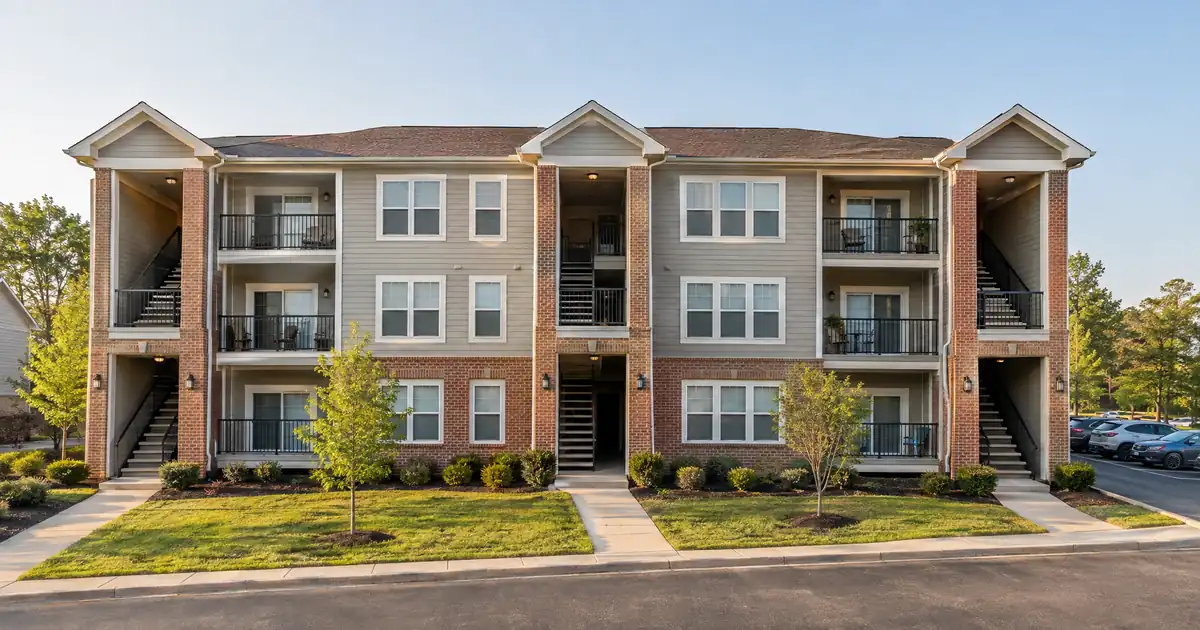
The Quick Read: Raising NOI can support a cash-out refinance, but only to the extent the appraisal recognizes the higher income and the loan clears both a leverage cap and a rent-coverage test. The appraised value sizes the loan. Your pro forma does not.
- Across most of Lendmire’s wholesale network, cash-out on an investment property tops out around 75% LTV, subject to lender guidelines.
- About 6 months of ownership, measured from title recording, is the common seasoning expectation.
- On a 2-4 unit building, rent drives coverage and the appraisal leans on comparable sales. On 5+ units, NOI drives value directly.
- Reserves commonly run around 6 months of PITIA, stepping up to about 9 months above $1,500,000.
- Clearing 1.00 on coverage is not the same as positive cash flow.
You raised rents, filled units, or trimmed expenses. Now you want the equity back out. The mechanics are simple to state and easy to get wrong in practice, because three different people will calculate your NOI: you, the appraiser, and the underwriter. Each may land on a different number.
DSCR Cash-Out Calculator
Run the cash-out numbers in your market
Rate source: Freddie Mac 30-yr average via FRED® — Federal Reserve Bank of St. Louis · effective Oct 8, 2026
Prefilled with starting assumptions — enter your property’s value, balance, taxes, and insurance for a more accurate picture.
Program parameters update from Lendmire’s centralized guideline source. Taxes and insurance are editable estimates.
As of Oct 8, 2026 · General Freddie Mac market benchmark, not a Lendmire loan offer. Property value, balance, taxes, and insurance are editable estimates. Maximum loan-to-value varies by lender, program, property type, and seasoning. Not a Loan Estimate, approval, or commitment to lend. Program availability and eligibility are subject to lender guidelines, credit approval, property review, and underwriting.
This guide walks through what happens to a raised NOI at the lender, step by step. It also covers the variations by unit count, the places where the general rule breaks, and how to decide how much to pull. For the broader program picture, Lendmire’s complete DSCR loans guide covers the fundamentals.
Market Snapshot
A quick read on underwriting norms for stabilized multifamily. The vacancy figure comes from the cited source and is a general market norm, not a program parameter. Confirm current property-level numbers before underwriting.
| Metric | Detail |
|---|---|
| Vacancy and credit-loss allowance | Typically 5–10% for stabilized multifamily (ProPrise) |
| Cap rate | Set by the appraiser from market sales; varies by market and property |
Key Terms Defined
- NOI (net operating income): effective gross income minus operating expenses, before debt service, depreciation, and capital expenditures.
- Cap rate: NOI divided by property value, an unleveraged yield that assumes an all-cash purchase, per Wall Street Prep.
- DSCR (debt service coverage ratio): a rent-to-debt measure. On 2-4 unit DSCR programs it compares qualifying monthly rent to the monthly payment (principal, interest, taxes, insurance, and HOA dues).
- In-place NOI: income based on current rents and actual expenses.
- Stabilized NOI: income based on market rents and a normalized vacancy allowance. This is the figure underwriters and appraisers prefer.
- Seasoning: the ownership period a lender expects before it will size a cash-out loan to appraised value rather than cost.
- LTV (loan-to-value): the new loan divided by the appraised value.
How Does a Higher NOI Become Cash?
Higher NOI becomes cash through a chain: income rises, appraised value rises, the loan is sized to that value, and the old loan is paid off. Cash to you is what remains after payoff, closing costs, and any required reserves. Break any link and the proceeds shrink.
The income approach is the logic investors use to see equity. Value equals NOI divided by a market cap rate. A Motley Fool primer on capitalization rate notes that residential markets mostly price homes off comparable sales, while commercial markets price off income. That distinction sets up the central split in this topic.
Picture a 12-unit building where rents have been pushed up and the owner’s NOI looks much stronger. The owner’s math says value rose by the NOI gain divided by the cap rate. That is a planning number. The lender’s appraiser is not obligated to agree with it. Any improvement may support a higher appraised value, depending on comps and underwriter review. It never adds a fixed amount.
Does Unit Count Change the Math?
Yes. Unit count decides which appraisal method and which coverage test apply. Buildings with 2-4 units are treated as residential. Buildings with 5 or more units are treated as commercial. The same rent increase can move the loan very differently depending on which side of that line the property sits.
2-4 units. Appraisers typically report on the Small Residential Income Property Appraisal Report (Form 1025). Its income approach uses a gross rent multiplier: total gross monthly estimated rent times the multiplier gives an indicated value, per the form’s own layout. It does not divide NOI by a cap rate. The appraiser then reconciles the sales comparison and income indications into one opinion of value.
The practical result: on a duplex through a fourplex, higher rents help mostly through the coverage test. Do not assume a big appraisal jump from NOI alone, because comparable sales usually carry the most weight. Rent pushed above market rent may earn little extra credit.
5+ units. Here NOI drives value directly. Pricing and available terms vary by lender, borrower profile, property type, and full underwriting review. Coverage is also tested differently: stabilized annual NOI divided by annual debt service, supported by a rent roll, trailing operating statement, and leases.
Lendmire arranges both kinds of files through select lenders in its wholesale network, but the documents and sizing logic differ. Know which lane your building sits in before you plan the proceeds.
Which NOI Will the Lender Actually Use?
The lender uses the lower, normalized number, not the one on your spreadsheet. An appraiser often builds its own stabilized income view, as MMCG Invest’s discussion of defensible NOI explains. Owner-reported figures get adjusted, and normalized NOI is typically lower.
ProPrise’s multifamily underwriting guide separates two ideas worth knowing:
- In-place NOI reflects current rents.
- Stabilized NOI reflects market rents and normalized vacancy.
It also confirms that NOI excludes debt service and depreciation. Capital expenditures sit outside it as well.
A rent increase signed last month shows up in the in-place figure, but a conservative reviewer may discount it until it has history behind it. That is why timing matters. A raise with several months of collected rent behind it reads very differently from a lease signed the week before the appraisal.
How Do Underwriters Adjust Your Numbers?
They adjust income down and expenses up. Common adjustments include a vacancy deduction even at full occupancy, an imputed management fee for self-managers, and replacement reserves.
| Line item | Owner’s view | Underwriter’s view |
|---|---|---|
| Vacancy | Today’s occupancy | Normalized for the submarket |
| Management | Often zero if self-managed | Imputed fee added |
| Reserves | Usually omitted | Often added per unit |
| Other income | Best recent month | Documented and recurring only |
| Rent level | Signed leases | Tested against market rent |
BSRE Consulting’s NOI overview makes the vacancy point plainly: a fully leased building still gets a vacancy deduction. A self-managed owner who shows no management line should expect one to be added. The NOI the loan sees will then be lower than the one on your statement.
Rent-driven gains and expense-driven gains also get different treatment. Rent growth is tested against market rent. An expense cut may be normalized back toward typical levels if it looks temporary, such as deferred maintenance. Gains from raising rents on documented, renewed leases tend to hold up better than gains from skipping repairs.
How Do You Prove the Increase?
Make the paper trail agree with itself. The rent roll, trailing operating statement, and executed leases should tell the same story. Unexplained gaps between them are a common reason files stall.
A practical package for a raised-NOI file:
1. Current rent roll with unit, tenant start date, lease end, and rent for every unit.
2. Executed leases that match the rent roll line for line.
3. Trailing operating statement showing the months before and after the increase.
4. Proof of collection, such as deposits that match the stated rents.
5. Concession disclosure. Free months and move-in credits overstate income if they are hidden, as Crequity’s underwriting factors guide cautions.
6. Expense documentation for taxes, insurance, utilities, repairs, and any management fee.
On 2-4 unit DSCR files, the package is usually lighter. The core is the lease, the rent schedule from the appraisal, and the property’s payment. For 5+ units, expect the full operating-statement review.
Step by Step: From Appraisal to Net Proceeds
Cash-out equals the new loan, minus the payoff of the existing loan, minus closing costs and any reserves the file requires. Value sets the loan size. Rent sets the coverage. They are two separate tests, and the file must pass both.
1. Appraisal sets value. The appraised value, not your pro forma, sizes the loan.
2. Leverage cap applies. On a cash-out refinance of an investment property, most of the network tops out around 75% LTV. Rate-and-term refinances, which return no cash at closing, can reach higher leverage. Exact terms depend on the lender’s guidelines, property type, leverage, and a full review of the borrower’s file.
3. Coverage is tested. On 2-4 units, rent against PITIA. Many select programs start at 1.00. A separate select-lender path takes coverage below 1.00, with leverage and terms adjusted. Stronger ratios open better pricing and leverage.
4. Credit and reserves are checked. A 620 floor exists in parts of the network, most programs want around 660, and 700 or higher unlocks the strongest leverage tiers. Reserves commonly run about 6 months of PITIA, and about 9 months above $1,500,000.
5. Net proceeds are what remains after payoff and costs.
Run the logic on a stabilized fourplex. Say the appraiser’s value comes in well below your pro forma. The loan shrinks by the LTV cap times the size of the miss, while the payoff does not move. Proceeds fall faster than the value does. That is why Lendmire’s page on a BRRRR cash-out refinance against a low appraisal frames the ARV as a planning number and the appraisal as the sizing number.
Lowering the loan request reduces the payment and can lift coverage. It never removes leverage caps, credit floors, or reserve rules. The strongest files clear both tests: enough equity and enough rental coverage.
Where the General Rule Breaks
Higher NOI is not a guaranteed ticket to more cash. These edge cases are where raised-NOI plans most often fall short.
Recent purchase. If you bought recently, the loan may be sized to the lower of cost or appraised value until seasoning passes. About 6 months of ownership, measured from title recording, is the common network expectation. A building bought and stabilized quickly may need to wait before the new income counts toward sizing.
Above-market rents. Pushing rents beyond what comparable units achieve may earn little extra credit, even with a signed tenant. Appraisers generally anchor to market rent.
Low appraisal. If the value comes in light, you can ask the appraiser to reconsider with additional comparable sales or rent data. Do not assume the number will move. Plan the loan on the lower value first.
Self-managed properties. The imputed management fee can shrink NOI enough to matter, especially on small buildings where the fee is a larger share of income.
Owner-occupied two-unit neighborhoods. On a 2-4 unit appraisal, the income approach may carry less weight where owner-occupants dominate the area. The appraiser still reports estimated market rent, but comparable sales will drive the value.
Short-term-rental collateral. Short-term rentals follow separate parameters. Purchases reach up to 75% LTV, refinances sit around 70%, and cash-out is 70%. Expect a 640 or higher score and about 12 months of hosting history. Leverage, reserves, and pricing vary by lender and program; the final terms follow the full file review.
Ineligible property types. Manufactured homes (single- and double-wide), log homes, and barndominiums are not offered through the network’s DSCR programs.
Coverage versus cash flow. DSCR compares rent to PITIA only. Clearing 1.00 does not mean positive cash flow, because repairs, vacancy, management, utilities, and capex sit outside the calculation. A file can qualify and still leave an owner with thin monthly margin.
How Much Should You Pull?
Pull less than the cap allows unless the next use of the money clearly earns more than the added carrying cost. This is the real decision. The loan cap tells you the maximum. It does not tell you the right amount.
| If your situation looks like this | The case for a smaller pull | The case for pulling to the cap |
|---|---|---|
| Coverage near 1.00 after the new loan | Cushion against vacancy and repairs | Rarely a good fit |
| Strong coverage and deep reserves | Little reason to hold back | Redeployment can make sense |
| Rents recently raised, not yet renewed | Protects against turnover shock | Only if leases are locked in |
| Next acquisition already identified | Keep a margin for surprises | Reasonable if the deal covers itself |
A smaller cash-out leaves more reserves and a lower payment against the same rent, which lifts coverage. Pulling to the leverage cap leaves little room if a unit goes vacant or a roof fails. Investors with thin coverage should treat the cap as a ceiling, not a target. If the investor’s next purchase would also be financed, a stronger coverage ratio on the refinanced asset may help the larger portfolio.
Consider the structure options too. The spine of the network is the 30-year fixed. Extended terms such as 40-year and interest-only periods are available through select lenders in the network, and adjustable structures exist for investors who want them. Above $2,500,000, the network generally holds to 30-year fixed structures. Loan sizes run up to $3,000,000 on standard programs, and smaller balances route through select lenders.
Plan for payoff of the existing loan, any prepayment charge, and closing costs. These reduce net proceeds and are often underestimated. For a comparison with a lower-cost-to-close approach, see Lendmire’s piece Who Offers A No Cost Cash Out Refinance?.
Refinance, Hold, or Sell?
It depends on what the equity would do next. Refinancing makes sense when the cash earns more than the new debt costs and the building still covers itself. Holding makes sense when the existing loan is favorable and no use for the cash is lined up. Selling makes sense when the gain from forced appreciation outweighs the building’s future income.
Capital recycled out of a stabilized asset can fund the next acquisition. Tax treatment can depend on how the funds are used and how the property is held; investors should keep clear records and speak with a qualified tax professional before relying on any deduction.
A quick self-check before applying:
- Do the rent roll, leases, and operating statement match?
- Have the higher rents been collected for several months?
- Is the rent at or below what comparable units achieve?
- Have I included a management fee, vacancy, and reserves in my own numbers?
- Would the building still cover its new payment if one unit sat empty?
If the answer to any of these is no, fix that first.
Frequently Asked Questions
Do I keep the full value I added?
Not automatically. The appraiser’s opinion of value sets the loan, and the loan is capped at a percentage of that value. You also pay off the existing loan and closing costs first, so net cash is always smaller than the value gain. Terms vary by lender guidelines, property type, leverage, credit profile, and full file review.
How soon after raising rents can I refinance?
It depends on the seasoning rule and on how much rent history you can document. About 6 months of ownership, measured from title recording, is the common network expectation for cash-out. Beyond that, a longer record of collected rent makes the higher income easier for a reviewer to credit.
Does NOI or DSCR matter more?
Both matter, for different jobs. On 5+ unit buildings, NOI drives the appraised value and an NOI-based coverage test applies. On 2-4 units, DSCR-style programs compare rent to the monthly payment, while the appraisal leans on comparable sales. Each file needs enough equity and enough coverage.
Can I pull cash out if my coverage is below 1.00?
Possibly, through select lenders in the network, with leverage and terms adjusted. Many select programs start at 1.00, and a separate select-lender path takes coverage below 1.00. Stronger credit and more reserves typically help those files. Qualification is subject to lender guidelines and property review.
Does the rent-to-payment ratio mean the property cash flows?
No. It compares rent to PITIA only. Repairs, vacancy, management, utilities, and capital expenses sit outside the calculation, so a file can clear the ratio and still run tight month to month.
If you are buying or refinancing a rental property and want to see how the numbers work, Lendmire can help you compare DSCR loan options based on the property income, credit profile, leverage, and investor goals. Call 828-256-2183 or request a quote through the site; every file is underwritten individually and is not a commitment to lend.
For the mechanics of pulling equity out of a rental property, see Lendmire’s guide to cash-out refinance on an investment property.
About Lendmire
As a non-QM mortgage broker (NMLS# 2371349), Lendmire facilitates DSCR investor loans across 41 markets, including Washington, D.C. DSCR eligibility is generally reviewed around property-level rental income instead of personal income documentation, subject to lender guidelines, serving LLC-structured portfolios and self-employed borrowers who don’t fit conventional boxes. A two-time Scotsman Guide Top Mortgage Workplace (2025, 2026).
Get Started
Ready to find the right loan for you?
In about 30 seconds you can review financing options available for your investment property. No commitment required.
Informational only. Not a Loan Estimate, approval, or commitment to lend. Program availability and eligibility are subject to lender guidelines, credit approval, property review, and underwriting.
References
1. ProPrise: Multifamily Underwriting Guide
3. The Motley Fool: Capitalization Rate
4. Form 1025 sample layout (e-appraise)
5. MMCG Invest: Building a Defensible NOI
6. BSRE Consulting: NOI in Real Estate
7. Crequity: Multifamily Underwriting Factors
This article is part of Lendmire’s investment property cash-out refinance program — full qualification details, guidelines, and scenarios live on the program page.
Related reading: Cash-Out Refinance Loans on Investment Property Using Rental Income · Rental Cash-Out Refinance for Investors Funding the Next Deal · Cash-Out Refinance Seasoning Rules for a Rental Bought With Cash
Brandon Miller
Founder & CEO, Mortgage Loan Originator, Lendmire LLC
- Mortgage Loan Originator · NMLS# 1129696 · Verify on NMLS Consumer Access
- North Carolina Real Estate Broker · License# 343312 · Verify on NCREC
- North Carolina Insurance Producer · License# 19053198 · Property, Casualty, Life, Health · Verify on NAIC SBS
- Lendmire LLC · Firm NMLS# 2371349 · Verify firm licensure
Compliance and disclosures. Lendmire (NMLS# 2371349) is a licensed mortgage broker and is not a direct lender, depository institution, financial advisor, or tax professional. Content in this article is general market analysis and educational information — not financial, legal, or tax advice for any specific situation. Lendmire does not guarantee loan approval; every transaction is subject to underwriting by the funding lender. Mortgage pricing and loan program guidelines are subject to change at any time without notice and vary by borrower characteristics, property type, and state regulations. Lendmire complies with Equal Housing Opportunity. Licensure verification: NMLS Consumer Access.