
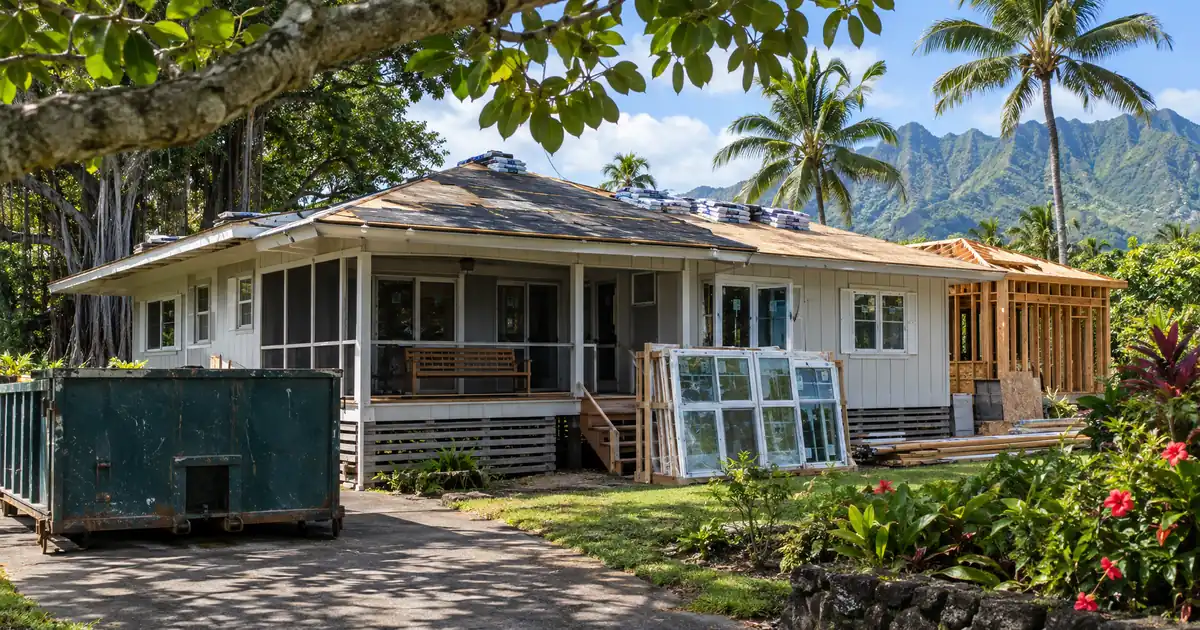
The Quick Read: You refinance out of a hard money loan by paying the short-term bridge note off with a long-term loan that qualifies primarily on the property’s rental income, subject to lender guidelines. For most Hawaii rental investors, that long-term loan is a DSCR loan, and the work is mostly timing, documentation, and sizing the new loan to value and rent.
- A payoff-only refinance and a cash-out refinance follow different rules, and the cash-out version carries a seasoning clock of about 6 months.
- The new loan is sized to the appraised value and the rent test, not to your old payoff balance.
- Leasehold tenure and Hawaii’s two recording systems can add steps, so build in extra runway before the maturity date.
- Rent coverage of 1.00 is where many select programs start.
Hard money is built to end. The note is interest-only, it matures in months, and the full balance comes due at once. A DSCR loan is built to stay: it amortizes over a long term and is underwritten to the property’s rent rather than your traditional personal-income documentation. This guide walks the handoff between the two, step by step, and flags where Hawaii changes the plan.
DSCR Cash-Out Calculator
Run the cash-out numbers in Hawaii
Rate source: Freddie Mac 30-yr average via FRED® — Federal Reserve Bank of St. Louis · effective Oct 15, 2026
Prefilled with starting assumptions — enter your property’s value, balance, taxes, and insurance for a more accurate picture.
Program parameters update from Lendmire’s centralized guideline source. Taxes and insurance are editable estimates.
As of Oct 15, 2026 · General Freddie Mac market benchmark, not a Lendmire loan offer. Property value, balance, taxes, and insurance are editable estimates. Maximum loan-to-value varies by lender, program, property type, and seasoning. Not a Loan Estimate, approval, or commitment to lend. Program availability and eligibility are subject to lender guidelines, credit approval, property review, and underwriting.
What Does Refinancing Out of Hard Money Actually Mean?
It is a payoff-and-replace. The new lender wires funds to the hard money lender, the bridge note is satisfied, and a long-term mortgage takes the first-lien position. Nothing converts or rolls over. Two separate loans exist, and one ends.
Most investors do this after a purchase-and-rehab. Hard money covered the acquisition and the repairs, and the property is now rented or rent-ready. At that point, the investor wants to stop paying for short-term money. The bridge note was never meant to hold a rental for years.
The hard money program Lendmire brokers runs 6 to 18 months, interest-only, with no prepayment penalty, and leverage is tied to project cost and after-repair value (all of which varies by lender, property, and experience). Because the term is short, the exit is not an afterthought. It is the other half of the deal, and many investors line up the long-term loan through Lendmire’s hard money exit refinance program before the bridge loan is even funded.
How Does the DSCR Underwriting Actually Treat This Loan?
A DSCR loan divides qualifying monthly rent by the monthly obligation: principal, interest, taxes, insurance, and any association dues. That is the whole ratio. The lender is asking whether the rent covers the payment on the property, which is why the file leans on the appraisal, the lease or market rent, and the property’s condition instead of personal income.
Three points matter for a hard money exit.
First, the loan is sized two ways, and the lower number wins. One limit comes from the appraised value and the leverage cap. The other comes from the rent test. If value is strong but rent is thin, the rent test limits the loan. If rent is strong but the appraisal comes in light, value limits it.
Second, coverage of 1.00 is a starting point, not a promise. Across the wholesale network, 1.00 is where select programs start. Stronger coverage opens better terms and more leverage. A separate path through select lenders takes coverage below 1.00, with leverage and terms adjusted to match.
Third, clearing 1.00 does not mean the property cash flows. The ratio covers rent against the payment only. Repairs, vacancy, management, utilities, and capital expenses sit outside the calculation, and an investor who confuses the two can overpay for a property that qualifies but loses money.
For the full mechanics behind the ratio, Lendmire’s complete DSCR loans guide covers what lenders review and how programs differ.
Key Terms Defined
Balloon payment: the full remaining balance of the hard money loan, due in one lump sum at maturity.
Seasoning: the period you must own the property, measured from the recording of title, before a lender will treat a refinance as cash-out against current value.
Rate-and-term refinance: a refinance that pays off the old loan and costs without returning cash to you at closing.
Cash-out refinance: a refinance where proceeds exceed the payoff and closing costs, so some equity returns to the borrower.
Per diem: the daily interest that keeps accruing on the old loan until the payoff funds arrive.
Payoff letter: the written statement from your current lender showing the exact amount needed to satisfy the loan on a stated date.
The Step-by-Step Sequence
1. Read the bridge note. Find the maturity date, any extension terms, any minimum-interest clause, and any exit fee. Hard money terms vary, so do not assume a clean payoff.
2. Request a written payoff letter. Ask for a figure with a valid-through date and the per diem. Extension, late, or default charges can be added to the payoff, and the new loan has to cover them.
3. Confirm the property is rent-ready. A DSCR lender wants a finished or near-finished rental, supportable rent, and an appraisal that supports the new loan amount. A half-finished rehab is a problem for the appraiser as much as the lender.
4. Document the rent. The rent figure comes from a signed lease, an appraiser’s market rent, or documented operating history, depending on the program.
5. Choose payoff-only or cash-out. This decision drives seasoning, leverage, and how much equity you can pull.
6. Assemble the file. Expect the payoff letter, lease or rent evidence, an insurance binder showing a non-owner-occupied rental, entity documents if an LLC holds title (subject to lender program eligibility), and asset statements for reserves.
7. Appraise, review title, and fund. The title or escrow company wires the payoff, and the old lender releases its lien.
Payoff-Only or Cash-Out? The Seasoning Question
This is where most hard money exits are won or lost. A payoff-only refinance replaces the bridge and returns no cash. On a rate-and-term refinance of an investment property, the network’s ceiling is 85% loan-to-value. A cash-out refinance on a standard rental tops out at 75% loan-to-value, and it generally expects about 6 months of ownership measured from title recording.
If your balance fits under the rate-and-term ceiling, a payoff-only exit often works even when the property has been owned a short time. Some programs treat that file differently from a cash-out. Confirm the exact seasoning treatment with the lender before you count on it.
The agency delayed-financing exception for cash purchases generally does not carry over here, because a hard money lien secured by the property usually takes the deal out of that exception. Treat a hard money payoff as its own category.
Here is a hypothetical, with percentages only. Say an investor’s bridge balance equals 70% of the new appraised value, and rent clears roughly 1.15x on the full monthly obligation. Pricing and available terms vary by lender, borrower profile, property type, and full underwriting review. A cash-out would also fit under 75%, but only if the property has met the seasoning expectation and the extra proceeds keep the loan at or below that cap.
Change one input. If the balance is 80% of value, rate-and-term can still work, but a cash-out is off the table because 75% is the ceiling. The investor either brings cash to closing or waits for value to improve.
Your Exit Options Compared
| Situation | Best-fit path | Main constraint |
|---|---|---|
| Rented, balance well under value | DSCR rate-and-term | Rent must cover the payment |
| Rented, owned 6+ months, real equity | DSCR cash-out (75% LTV cap) | Seasoning and reserves |
| Maturity arrives before seasoning ends | Extension, then refinance | Extension fees added to payoff |
| Rent below the payment | Sub-1.00 path via select lenders | Lower leverage, adjusted terms |
| Strong W-2 borrower, one rental | Conventional investor loan | Heavy documentation |
| Rehab unfinished | Finish first, or extend | Appraisal needs a completed property |
The flip point between DSCR and conventional is the borrower, not the property. A salaried investor with clean traditional personal-income documentation and one rental may find a conventional loan cheaper, though it is more documentation-heavy. A self-employed investor, an LLC owner, or anyone running several rentals usually finds the DSCR path cleaner. Lendmire’s DSCR vs conventional comparison is a good companion read.
Property Condition, Appraisal, and the Documents That Hold Files Up
Appraisal is the single biggest swing factor on a hard money exit. The appraiser values the finished property against comparable sales, and an improvement may support a higher appraised value, depending on comps and underwriter review. It never adds a fixed percentage.
The usual causes of a stalled file are predictable:
- The rehab is not finished, so the appraisal reflects an as-is condition.
- The property is vacant and the lender wants a stronger rent basis.
- Entity documents do not match the title.
- Reserves fall short. Many programs want about 6 months of PITIA, stepping up to about 9 months on loans above $1,500,000, though conservative files at modest leverage can see reserves waived.
- The credit score is below the lender’s floor. The network has a 620 floor in places, most programs want around 660, and 700 or higher unlocks the strongest leverage.
Loan size also matters. Standard DSCR programs run up to $3,000,000, and above $2,500,000 the network generally holds to 30-year fixed structures. Property type matters too. Manufactured homes, log homes, and barndominiums are not offered in these programs.
Hawaii-Specific Wrinkles
Hawaii does not change the underwriting math. It changes the paperwork and the property mix.
Leasehold tenure. Fee simple and leasehold are common in Hawaii, and a leasehold property can narrow the options. Lenders look at how much of the ground lease remains and whether the lease rent is fixed or resets. As the remaining term shortens, fewer programs apply. Check this early, because it can decide the exit before the appraisal is ordered.
Land Court and the Regular System. Hawaii runs two parallel recording systems, and a property under Land Court carries a certificate of title. Identify the system at the start, because it can add title steps. Your title company can confirm which applies.
Recording the release. After the payoff, the old lender must deliver a recordable release of its mortgage. Under Hawaii Revised Statutes § 506-8, if the mortgagee does not provide one within sixty days of a written request sent by certified or registered mail, a court-order route is available. Verify that the release actually posts in the state’s recording records instead of assuming the lien vanished when the wire landed.
Condotels and short-term rentals. A property run as a vacation rental may be reviewed under a different program than a long-term rental.
Island logistics. Appraiser availability, insurance, and a smaller local lender pool can all stretch a file. The practical answer is to start sooner, not to assume the process runs the same as on the mainland.
What If the Refinance Stalls?
Plan for the maturity date arriving before the file is ready. You have a short ladder of options.
1. Negotiate an extension. Expect extension fees and added interest, and expect them on the payoff letter.
2. Switch to a payoff-only refinance. If the cash-out clock is the obstacle, a rate-and-term exit may avoid it.
3. Bring cash to closing. If the balance sits above the leverage cap, a paydown can bridge the gap.
4. Try a different lender in the network. Guidelines differ on seasoning, reserves, and rent treatment, which is where a broker earns its place.
5. Sell. If rent and value do not support the new loan, a sale may be the cleaner exit.
If the loan is already in default, the stakes change. Hawaii allows both judicial and power-of-sale (nonjudicial) foreclosure, and Nolo’s summary of Hawaii foreclosure law covers how reinstatement works, including reinstatement up to three business days before a nonjudicial sale. Business-purpose DSCR loans are exempt from TRID consumer-disclosure timing, so those consumer rules should not be assumed to govern the timeline. Talk to a Hawaii real estate attorney before relying on any reinstatement window, because the details depend on the notice and the loan documents.
Business-Purpose Status
DSCR loans are designed for non-owner-occupied investment properties. Because they are business-purpose investor loans, they are reviewed differently from a standard owner-occupied mortgage. That status still has to be supported. CFPB examination procedures note that a checked business-purpose box with no documentation of how the proceeds will be used may be insufficient evidence, so investors with a personal-use history on the property should expect extra questions.
Tax treatment can depend on how the funds are used and how the property is held; investors should keep clear records and speak with a qualified tax professional before relying on any deduction.
Mistakes That Cost Investors the Most
- Sizing off the payoff. The new loan follows value and rent. A big payoff does not create loan capacity.
- Counting cash-out equity before seasoning is met. Know the clock before you plan the next purchase around the proceeds.
- Ignoring the maturity date. Start the refinance process well before maturity, since Hawaii title and appraisal steps can add time.
- Skipping the insurance binder. The policy must show a non-owner-occupied rental.
- Assuming a lien release is automatic. Verify the recording.
- Treating 1.00 as profit. Coverage is a payment test, not a cash-flow forecast.
Frequently Asked Questions
Can I refinance out of a hard money loan before the term ends?
Yes. The Lendmire-brokered hard money program carries no prepayment penalty, though terms vary by lender, property, and experience. Check your own note for minimum-interest clauses or exit fees before you set a payoff date.
Do I have to wait 6 months to refinance a hard money loan?
Not always. The roughly 6-month seasoning expectation applies to a cash-out refinance on a standard rental. A payoff-only refinance may be treated differently, so ask the lender how it handles seasoning on a rate-and-term file.
How much can I borrow when I refinance into a DSCR loan?
On an investment property, the network’s ceiling is 75% loan-to-value on a cash-out refinance and 85% on a rate-and-term refinance, subject to rent coverage, credit, and reserves. A short-term rental caps lower on cash-out, at 70%. The new loan size is the lower of the value limit and the rent limit.
Does a Hawaii leasehold property qualify?
It can, but options narrow as the remaining ground lease shortens, and lenders look closely at lease rent resets. Eligibility depends on the lender and program, so confirm lease terms before you order an appraisal.
What if my rent does not cover the payment?
Coverage below 1.00 is available through select lenders in the network, with leverage and terms adjusted. The stronger move is often to improve the rent, add a paydown, or extend the bridge while the unit is leased.
Next Steps
If you are buying or refinancing a rental property and want to see how the numbers work, Lendmire can help you compare DSCR loan options based on the property income, credit profile, leverage, and investor goals. As a DSCR-focused mortgage broker, Lendmire arranges these loans through select lenders in its wholesale network across 41 markets, including Washington, D.C.; reach the team at 828-256-2183. Programs change, every file is underwritten individually, and nothing here is a commitment to lend.
Hawaii’s small lender pool and slower title steps reward the investor who plans the exit before the bridge loan ever funds.
About Lendmire
Lendmire, NMLS# 2371349, is a non-QM mortgage broker serving real estate investors in 41 markets, including Washington, D.C., through DSCR investor loan programs. Qualification is generally reviewed around the subject property’s rental income, not the borrower’s W-2 history — a practical fit for LLC-titled portfolios and self-employed investors. All scenarios remain subject to lender review and program guidelines. Two consecutive Scotsman Guide Top Mortgage Workplace recognitions (2025, 2026).
Get Started
Ready to find the right loan for you?
In about 30 seconds you can review financing options available for your investment property. No commitment required.
Informational only. Not a Loan Estimate, approval, or commitment to lend. Program availability and eligibility are subject to lender guidelines, credit approval, property review, and underwriting.
References
1. Justia – Hawaii Revised Statutes § 506-8
2. Nolo – Summary of Hawaii’s Foreclosure Laws
3. CFPB – TILA Narrative Exam Procedures
This article is part of Lendmire’s hard money loan program — full qualification details, guidelines, and scenarios live on the program page.
Related reading: How to Refinance Out of a Hard Money Loan in Florida · How to Refinance Out of a Hard Money Loan in Wyoming · How to Refinance Out of a Hard Money Loan in Indiana
Guides: Hard Money Loans in Hawaii
Brandon Miller
Founder & CEO, Mortgage Loan Originator, Lendmire LLC
- Mortgage Loan Originator · NMLS# 1129696 · Verify on NMLS Consumer Access
- North Carolina Real Estate Broker · License# 343312 · Verify on NCREC
- North Carolina Insurance Producer · License# 19053198 · Property, Casualty, Life, Health · Verify on NAIC SBS
- Lendmire LLC · Firm NMLS# 2371349 · Verify firm licensure
Required disclosures. Lendmire (NMLS# 2371349) operates as a licensed mortgage broker, not a direct lender or depository. The discussion in this article is general in nature and should not be relied upon as financial, legal, or tax advice — every investment scenario is unique and should be reviewed by a qualified professional. Any loan inquiry is subject to lender underwriting, and this article is not a commitment to lend or a guarantee of approval. Mortgage rates, loan terms, and program guidelines vary by borrower, property, and state, and may change without notice. Equal Housing Opportunity. Verify licensure at NMLS Consumer Access.