
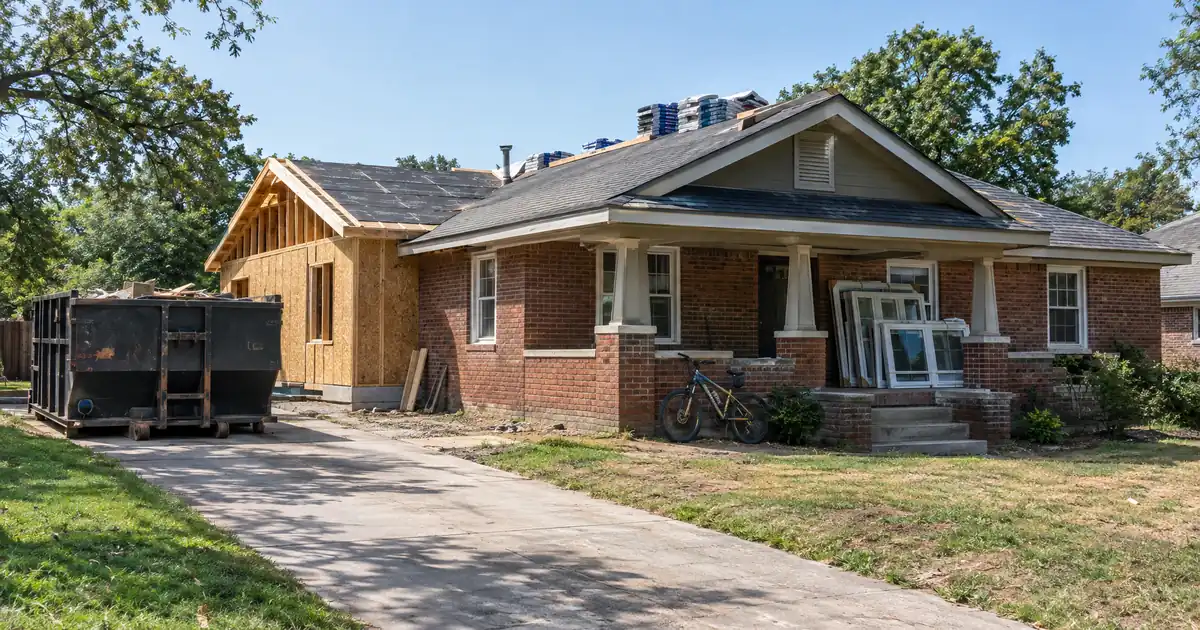
The Quick Read: A new long-term lender pays off the hard money bridge at closing. For rental investors that takeout is usually a DSCR loan, and it must pass two tests: the appraised value must support the loan amount, and the property’s rent must cover the full monthly obligation.
- The exit loan is sized on its own appraisal, not on your after-repair estimate.
- A payoff-only refinance and a cash-out refinance follow different rules, and cash back usually waits for seasoning of about 6 months from title recording.
- Rent coverage is measured against the full monthly payment, and the appraiser’s rent figure usually beats the lease.
- Start before the bridge matures, because the payoff balance grows while you wait.
- Qualification is subject to lender guidelines, credit approval, and property review.
What an Exit From Hard Money Really Looks Like
A hard money loan is a short bridge, and the exit is simply the next loan paying it off. Title orders a written payoff statement from the old lender. The new lender wires that amount at closing, and the old lien is released.
DSCR Cash-Out Calculator
Run the cash-out numbers in Oklahoma
Rate source: Freddie Mac 30-yr average via FRED® — Federal Reserve Bank of St. Louis · effective Oct 15, 2026
Prefilled with starting assumptions — enter your property’s value, balance, taxes, and insurance for a more accurate picture.
Program parameters update from Lendmire’s centralized guideline source. Taxes and insurance are editable estimates.
As of Oct 15, 2026 · General Freddie Mac market benchmark, not a Lendmire loan offer. Property value, balance, taxes, and insurance are editable estimates. Maximum loan-to-value varies by lender, program, property type, and seasoning. Not a Loan Estimate, approval, or commitment to lend. Program availability and eligibility are subject to lender guidelines, credit approval, property review, and underwriting.
The two loans measure risk differently. Hard money lends against the property, the plan, and your track record. On a fix-and-flip, the amount is driven by project cost and is capped at 75% of after-repair value. A DSCR exit lends against the appraised value of a finished, rentable property and the rent it produces. That is why a bridge that looked fine on paper can stall at the exit. The two lenders ask different questions.
Across the wholesale network Lendmire works with, a typical hard money term runs 6 to 18 months, interest-only, with no prepayment penalty. All of that varies by lender, property, and experience. The short runway is the point. The exit has to be planned before the bridge closes, not after the rehab ends.
Many investors who stabilize a property then move into long-term rental financing. Lendmire arranges that path through the hard money exit refinance program, and the rest of this article explains how those files work.
Key Terms Defined
Payoff statement: a written balance from the old lender showing principal, accrued interest, fees, and a per-day amount after the good-through date.
Rate-and-term refinance: a new loan that pays off the old one and closing costs, with no cash back to the borrower.
Cash-out refinance: a new loan that returns cash above the payoff and costs, which brings tighter leverage and seasoning rules.
Seasoning: the time a lender wants to pass before it will lend against value instead of cost, or before it will return cash.
DSCR: monthly rent divided by the full monthly property payment, which covers principal, interest, taxes, insurance, and any HOA dues.
Appraised rent: the market rent an appraiser reports on a rent schedule, Form 1007 for single-family homes and Form 1025 for two to four units.
Your Exit Options Side by Side
Most investors choose among four exits. Each has a different best case and a different failure point.
| Exit | Best for | What must be true | Main risk |
|---|---|---|---|
| DSCR loan | Leased or leasable rentals | Value and rent both pass | Low appraisal or low rent |
| Conventional loan | W-2 owner of few properties | Personal income documents clear | Entity and portfolio limits |
| Bridge extension | Rehab running late | Lender agrees to terms | Added fees and carry |
| Sale | Flips and failed rentals | Market supports price | Lost long-term hold |
Conventional works for some investors. If you hold one or two rentals in your own name and your traditional personal-income documentation shows clean income, a conventional exit can be the right call. DSCR becomes the practical lane when title sits in an LLC (subject to lender program eligibility), when your traditional personal-income documentation does not show the income, or when your financed property count is climbing. For the full picture of how these loans work, see the complete DSCR loans guide.
The Two Tests Every Exit Has to Pass
A DSCR exit passes or fails on two separate tests. Passing one does not pass the other.
The value test. The new lender sizes the loan off its own appraisal. Your after-repair estimate does not count. The break-even appraisal is the payoff plus exit costs, divided by the leverage cap.
Run the numbers with an index. Say the payoff plus exit costs equal 100 units. On a rate-and-term refinance of an investment property, the DSCR program allows up to 85% LTV. The appraisal needs to come in near 118 units for the loan to cover the payoff. On a cash-out refinance, the ceiling is 75% LTV. The appraisal needs to reach roughly 133 units just to break even, before any cash comes back. These specifics are subject to lender guidelines and a full review of property, leverage, and credit.
Now say the appraisal lands at 110 units. At 85% the loan covers about 93.5 units, so you bring roughly 6.5 units to closing. The payoff also grows while you wait, because it includes accrued interest, extension fees, and any exit fee. A late exit raises the bar.
The rent test. DSCR divides rent by the full payment. A ratio of 1.00 is where select programs start, and stronger ratios open better pricing and leverage. Sub-1.00 coverage is available through select lenders in the network, with leverage and terms adjusted.
On most files the appraiser’s rent figure is the number that counts, even when your signed lease is higher. A lease that beats the market schedule does not lift the ratio. If the schedule comes in low, you can challenge it with better rent comps. You can also raise rent to market at renewal, or ask the lender whether it uses the lower of lease or market rent.
Clearing 1.00 does not mean the property makes money. The ratio compares rent to the payment only. Repairs, vacancy, management, utilities, and capex all sit outside it. Budget for those separately.
Payoff-Only Versus Cash-Out (and the Two-Step Plan)
The label on your refinance changes the leverage you get and the time you wait.
If the new loan covers only the payoff and closing costs, it is generally rate-and-term. Cash above that makes it cash-out. In the DSCR program, cash-out tops out at 75% LTV, and about 6 months of ownership, measured from title recording, is the common seasoning expectation. Lenders in a network draw this line differently, so ask early which one applies to your file.
Some investors use a two-step plan. First, a payoff-only refinance stops the bridge interest as soon as value and rent support it. Later, once seasoning is met, a cash-out refinance pulls equity for the next deal. The tradeoff is two sets of closing costs and two appraisals. The plan pays off when carrying the bridge costs more than closing twice. It does not pay off when the property will hit the seasoning mark soon anyway.
Be careful about which clock applies. The recorded deed, the date of your last loan, and your lease history are separate clocks. A payoff-only step may or may not restart the cash-out clock, and that is lender policy, not law. Get the answer in writing from the takeout lender before you commit.
Equity is also not guaranteed cash. What you can pull depends on rent used for lender review, the full payment, reserves, and the 75% ceiling.
How the Exit Works, Step by Step
1. Pick the exit before you close the bridge. The bridge maturity has to outlast the gap between purchase and refinance, including any seasoning wait.
2. Confirm your file basics. The DSCR program has a 620 credit floor in parts of the network. Most programs want about 660, and 700 or higher unlocks the strongest leverage tiers. Loan sizes run up to $3,000,000 on standard programs.
3. Choose payoff-only or cash-out. Decide this before the appraisal, since it sets the leverage cap.
4. Order the payoff statement. Ask for a good-through date and the per-day figure after it.
5. Complete the appraisal and rent schedule. The value and the rent both come from this report.
6. Verify reserves. Reserves commonly run around 6 months of the full payment. Conservative rate-and-term files at modest leverage under $1,500,000 can see reserves waived, while loans above that size typically step up to about 9 months. This varies by lender, leverage, and loan size.
7. Close and release the lien. Title wires the payoff, and the old lender releases its mortgage.
Gather these documents ahead of time: the hard money note, the draw history and rehab invoices, the recorded deed and settlement statement, a signed lease with proof of rent, current insurance, entity documents if an LLC holds title, and proof of reserves.
Where the General Rule Breaks
The step list above describes a clean file. These are the named edge cases where it bends.
Delayed financing does not rescue a hard money purchase. Conventional delayed financing is a Fannie Mae concept for cash buyers, and Fannie Mae’s selling guide is where the idea originates. A purchase secured by a lien on the subject property generally falls outside it. A DSCR exit is not an agency product, so it follows its own network guidelines instead.
Rehab funded on credit cards or other debt. Paying that debt from loan proceeds generally turns the file into cash-out. Plan for the lower leverage cap and the seasoning wait.
Low appraisal. The usual options are to bring cash, take a smaller payoff-only loan, extend the bridge, wait and reappraise, or dispute the report with stronger comps.
Low rent. The usual options are to lease at market, challenge the schedule, or look at select lenders that allow coverage below 1.00 with adjusted leverage and terms.
Property type. Manufactured homes (single- and double-wide), log homes, and barndominiums are not offered in the network’s DSCR programs. If your rehab project is one of those, plan a different exit.
Entity vesting. If an LLC holds title, expect lenders to review the entity documents, subject to lender program eligibility. Many banks do not lend to entities at all, which is a main reason investors turn to DSCR.
Business purpose. DSCR loans are designed for non-owner-occupied investment properties. Because they are business-purpose investor loans, they are reviewed differently from a standard owner-occupied mortgage. The CFPB’s Regulation Z rule draws that line for credit extended primarily for a business purpose. Hard money and the DSCR exit usually sit on the same side of it.
Oklahoma lien release. Oklahoma law sets a deadline for a mortgage holder to release the lien after payoff, generally 30 days, and a written demand can start a shorter clock with penalties for a holder who stalls. In practice, the title company handles this. Ask it to confirm the release was filed with the county clerk after closing. Older form-site language citing a different deadline can be outdated, so rely on your title company rather than a form.
When the Bridge Is Maturing Before the Exit Is Ready
A late exit is the most expensive failure in this process. Three moves help.
First, ask the hard money lender about an extension before maturity, not after. Extensions usually carry fees, so price them against the cost of a payoff-only exit. Second, if value and rent already pass, close a payoff-only refinance and revisit cash-out later. Third, if a property is not rent-ready, finish the work and the lease-up first. A DSCR lender needs a rentable property to measure.
If your numbers fall short at every submarket you are looking at, that is a signal to rethink the deal, not the loan type. A sub-1.00 structure can be a defensible choice when the property has a clear appreciation story. It is not a rescue for a file that does not pencil.
Common Mistakes That Stall the Exit
- Sizing the bridge off after-repair value, then learning the exit lender’s appraisal came in lower.
- Assuming the seasoning clock started when the rehab ended, when it usually runs from title recording.
- Counting on the lease rent instead of the appraiser’s rent schedule.
- Treating a DSCR above 1.00 as proof the property makes money.
- Closing twice without pricing the second closing.
- Skipping the written seasoning answer from the takeout lender.
Tax treatment can depend on how the funds are used and how the property is held; investors should keep clear records and speak with a qualified tax professional before relying on any deduction.
For a shorter explainer on the basic question, see Lendmire’s piece Can I Refinance Out Of A Hard Money Loan?.
Frequently Asked Questions
How soon can I refinance a hard money loan on a rental?
A payoff-only refinance generally has no waiting period on the DSCR side, as long as the appraised value and the rent both support the loan. Cash back is different, and about 6 months from title recording is the common expectation for cash-out. Each lender sets its own seasoning policy, so confirm yours in writing.
Does paying off hard money count as cash-out?
Not by default. If the new loan covers only the payoff and closing costs, lenders generally treat it as rate-and-term. Any cash returned above that, including cash that reimburses rehab spending, moves it into cash-out with the 75% LTV ceiling.
What if my hard money loan matures before the refinance closes?
Ask for an extension before the maturity date and price the fee against a payoff-only exit. If the property passes the value and rent tests, a payoff-only refinance can stop the interest while a later cash-out waits for seasoning. If the property is not leased yet, finishing lease-up usually comes first.
Can an LLC refinance out of hard money into a DSCR loan?
Yes, in many cases, subject to lender program eligibility. Lenders review the operating agreement and the entity’s ownership, and the DSCR loan is reviewed primarily on property-level rental income covering the payment, subject to lender guidelines. Many conventional lenders will not lend to entities at all.
Will my lease or the appraiser’s rent figure count for the ratio?
The appraiser’s market rent schedule usually decides the number, even when your lease is higher. Some lenders use the lower of the two. If the schedule looks wrong, the usual fix is stronger rent comps or a lease reset at market.
What the Decision Looks Like in Practice
Choose your exit before the bridge closes. Then match the loan type to your situation. A leased, stabilized property with a clean appraisal is a straightforward DSCR candidate. A property still mid-rehab needs the bridge to outlast the work. A property that falls short on value or rent needs a plan B, and the sooner that plan starts, the cheaper it is.
If you are buying or refinancing a rental property and want to see how the numbers work, Lendmire can help you compare DSCR loan options based on the property income, credit profile, leverage, and investor goals. Lendmire is a broker that arranges financing through select lenders in its wholesale network across 41 markets, including Washington, D.C., and nothing here is a commitment to lend.
About Lendmire
Lendmire — NMLS# 2371349 — is a mortgage brokerage specializing in DSCR investor loans, helping arrange financing across 41 markets, including Washington, D.C., through wholesale and investor-lending channels. The model centers on property-level rental income reviewed by the lender rather than W-2 documentation, subject to lender guidelines, suiting entity-owned and multi-property investors. Lendmire holds Scotsman Guide Top Mortgage Workplace recognition for 2025 and 2026.
Get Started
Ready to find the right loan for you?
In about 30 seconds you can review financing options available for your investment property. No commitment required.
Informational only. Not a Loan Estimate, approval, or commitment to lend. Program availability and eligibility are subject to lender guidelines, credit approval, property review, and underwriting.
References
1. Fannie Mae Selling Guide B2-1.2-03
This article is part of Lendmire’s hard money loan program — full qualification details, guidelines, and scenarios live on the program page.
Related reading: Projected vs History Income for an Out-of-State First Airbnb DSCR Loan · How a Qualifying Rent Works on a DSCR Loan · How a 40-Year DSCR Loan Works as an Out-of-State Investor
Guides: Hard Money Loans in Oklahoma
Brandon Miller
Founder & CEO, Mortgage Loan Originator, Lendmire LLC
- Mortgage Loan Originator · NMLS# 1129696 · Verify on NMLS Consumer Access
- North Carolina Real Estate Broker · License# 343312 · Verify on NCREC
- North Carolina Insurance Producer · License# 19053198 · Property, Casualty, Life, Health · Verify on NAIC SBS
- Lendmire LLC · Firm NMLS# 2371349 · Verify firm licensure
Important disclosures. Lendmire (NMLS# 2371349) is a licensed mortgage brokerage. Lendmire is not a direct lender, depository institution, or financial advisor. All loan inquiries are subject to lender underwriting; this article does not constitute a commitment to lend. Rates, terms, and program guidelines are subject to change without notice and vary by borrower profile, property type, and state. Information in this article is general in nature and is not financial, legal, or tax advice. Equal Housing Opportunity. NMLS Consumer Access: nmlsconsumeraccess.org.