
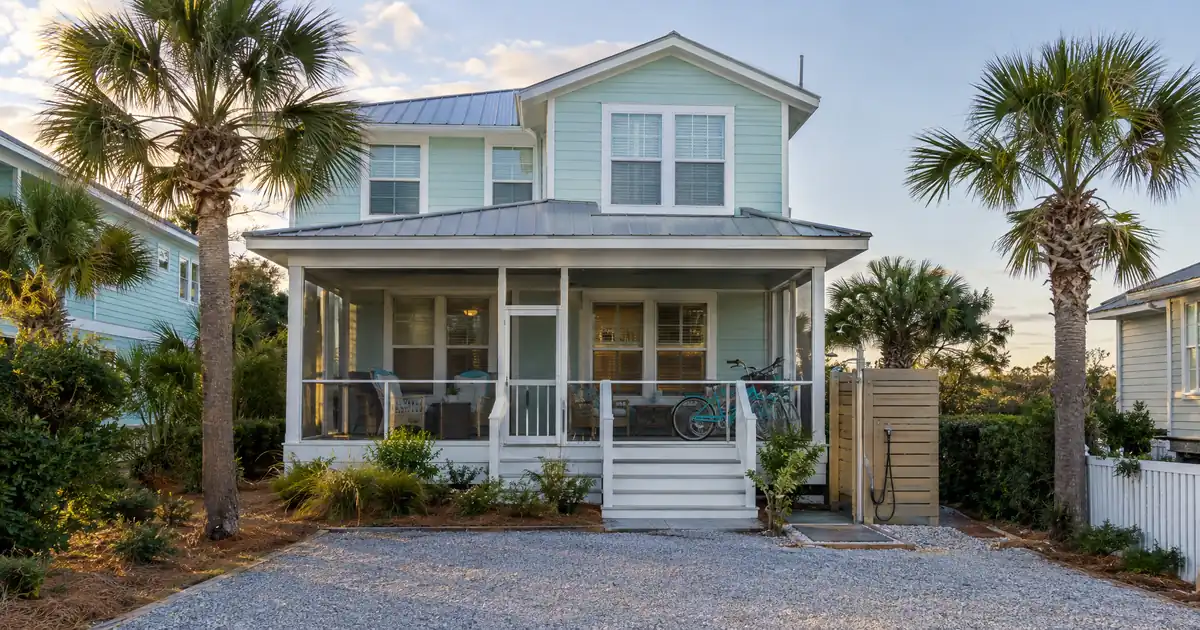
Rented Beach House Qualifies As A Business-purpose DSCR Loan — The Quick Read: A beach house qualifies as a business-purpose loan when the owner buys it to rent out rather than to live in. The federal exemption that makes this possible sits in CFPB Regulation Z §1026.3, which excludes credit extended primarily for a business or investment purpose from consumer-mortgage rules. A DSCR loan then qualifies the file using the property’s rental income instead of the owner’s pay stubs, subject to lender guidelines.
That’s the short version. The longer version matters more, because the line between “vacation home” and “rental property” is not about the house — it’s about intent and use. Get that wrong and the loan program you thought you qualified for isn’t the one you actually get.
DSCR Calculator
Run the numbers in your market
Rate source: Freddie Mac 30-yr average via FRED® — Federal Reserve Bank of St. Louis · effective Sep 17, 2026
Prefilled with local estimates — enter your own rent or nightly figures, taxes, insurance, and HOA for a more accurate picture.
Program parameters update from Lendmire’s centralized guideline source. Taxes and insurance are editable estimates.
As of Sep 17, 2026 · General Freddie Mac market benchmark, not a Lendmire loan offer. Rent, nightly rate, occupancy, taxes, and insurance are editable estimates. Short-term rental figures are estimates only and vary significantly by season, property type, management approach, and local short-term-rental rules — confirm local regulations before relying on them. Qualifying income for short-term rentals varies by program — some use appraisal market rent, others use documented STR history or projections — and is confirmed in underwriting. Not a Loan Estimate, approval, or commitment to lend. Program availability and eligibility are subject to lender guidelines, credit approval, property review, and underwriting.
What Makes a Beach House “Business Purpose” Instead of Personal?
Occupancy intent decides it, not the address or the listing photos. A house at the beach that the owner plans to live in is a consumer transaction. The same house, bought to be rented to someone else and never occupied by the owner, is a business-purpose transaction.
Regulation Z exempts business, commercial, or investment-purpose credit from the consumer-lending rulebook that governs owner-occupied mortgages. A lender has to make a real determination on each file — not just take the borrower’s word for it — about whether the loan is primarily for that exempt purpose. Buying a single-family house with the plan to rent it to someone else is the textbook example of business-purpose credit.
This is also the reason DSCR loans exist as a separate lane in the first place. DSCR loans are designed for non-owner-occupied investment properties. Because they are business-purpose investor loans, they are reviewed differently from a standard owner-occupied mortgage.
How Does a DSCR Loan Actually Qualify the Property?
DSCR underwriting looks at what the property earns, not what the borrower earns on a W-2 or tax return. Lenders review the loan primarily on property-level rental income covering the payment, subject to lender guidelines. They measure market rent, or documented lease income, against the proposed monthly obligation.
That coverage ratio — rent divided by the full monthly payment including taxes, insurance, and any HOA dues — is the whole story. A ratio of 1.00 means the rent covers the payment exactly. Above 1.00, there’s cushion. Below 1.00, the property costs more to carry than it brings in, and the file needs a different structural approach.
For a long-term rental, an appraiser typically documents market rent using a standard comparable-rent schedule pulled from similar leased properties nearby. For a beach house marketed nightly on Airbnb or VRBO instead of leased by the year, that standard rent form doesn’t fit — nightly income behaves nothing like a twelve-month lease, and treating it that way understates or misstates the real cash flow. This is where short-term rental files diverge from ordinary DSCR underwriting, and it’s worth its own section below.
Lendmire’s complete DSCR loans guide walks through the mechanics of that qualification process in more depth for investors who want the full picture before running numbers on a specific property.
Key Terms Defined
Business-purpose loan: Financing extended primarily to generate income or run a business, rather than to buy a home the borrower will live in — this is what exempts DSCR loans from consumer-mortgage disclosure rules.
DSCR (debt-service coverage ratio): The property’s rental income divided by its full monthly payment obligation; a way to measure whether the rent covers the debt without looking at the borrower’s personal income.
Occupancy intent: What the owner actually plans to do with the property — live in it, rent it out, or some mix of both — which determines whether a loan is business-purpose or consumer-purpose.
No-ratio loan: A DSCR structure where no minimum coverage ratio is published or required, generally paired with reduced leverage and stronger reserves; available through select lenders in Lendmire’s wholesale network, subject to underwriting.
Short-term rental (STR) income: Nightly or weekly rental revenue documented through platform history or a specialized appraisal analysis, rather than a standard monthly lease comparable.
Does It Matter If the Owner Stays There Sometimes?
Yes — meaningfully. Occupying the property yourself, even occasionally, pushes the intent question toward “this is partly mine to use,” which is the opposite of what a business-purpose loan requires. The exemption discussion is worth one plain paragraph and no more: credit to acquire a rental property that the owner doesn’t occupy is treated as business purpose, while a property the owner expects to use for a meaningful chunk of the year drifts back toward consumer classification. That’s a legal and lending distinction, separate from how the IRS taxes rental income on a property with mixed personal and rental use — the IRS applies its own personal-use threshold for reporting purposes, and that tax rule is not the same test a lender applies when classifying the loan itself. Two different agencies, two different questions, and conflating them is a common and avoidable mistake.
Let’s say an investor really plans to rent out the beach house and doesn’t want to treat it as a second home. In that case, the loan purpose statement, the entity used to hold title, and the lack of any personal-use plan on file should all point the same way. A lender’s own comments confirm why getting this right matters: files properly documented as business-purpose skip the personal ability-to-repay verification that a consumer loan would require, per CFPB compliance guidance. Still, the property gets a real appraisal, and the borrower still gets a real credit and reserve review.
What About Short-Term Rental Income Specifically?
Short-term rental income can qualify a DSCR file. But lenders underwrite it differently than a standard lease. Across Lendmire’s wholesale network, lenders generally document STR income on a beach house through twelve months of operating history for a refinance, or through the appraisal’s short-term-rent analysis for a purchase. That income is typically counted at a discount to gross receipts, not at full face value.
This discount exists because nightly income carries costs a standard lease doesn’t have — cleaning turnover, platform fees, off-season vacancy, and seasonal swings that a beach market feels more than most. Most programs Lendmire places files with want to see that the investor has owned income property before. STR qualification is generally reserved for borrowers with some track record, not a first-time landlord buying their first rental sight unseen.
Here’s something worth saying plainly: whether a specific beach town or county actually permits short-term rentals is a local question, never a loan-program question. Investors must document municipal permission to operate a short-term rental for the specific property. Short-term rental rules can vary by city, county, HOA, and property type, so investors should confirm local rules before relying on projected rental income. A lender reviewing the file cares whether the operation is legal where the house sits. That’s a property-level check, not something the loan program assumes.
What Leverage and Coverage Actually Look Like on These Files
The strongest leverage in Lendmire’s network runs 80% on purchase and rate-and-term for loan sizes up to $1,000,000, with cash-out capped at 75% on standard rental collateral in that same tier (and 70% on cash-out where the collateral is short-term-rental income, credit 660 or better). Move up in loan size and leverage steps down: 75% purchase and rate-and-term through $3,000,000, with cash-out sliding to 70% and then 60% as balances climb past $1,000,000 and $1,500,000 respectively, credit floors rising to 700 and 720 along the way. Final terms depend on lender guidelines, property type, leverage, and the borrower’s complete credit picture.
Above $3,000,000, purchase and rate-and-term leverage typically runs 65%, no cash-out, credit 700 or better — and above $4,000,000, every file is reviewed case by case before submission, purchase or rate-and-term only, still no cash-out. That review-first framing matters: nobody should read a flat “up to 60%” on a $5,000,000 beach compound and assume it’s automatic.
Coverage of 1.00 or better earns the full leverage on the ladder above. Coverage between 0.75 and 0.99 is a real path through select lenders in Lendmire’s network up to $2,000,000, with LTV and terms adjusting to compensate, subject to underwriting — a workable option for a beach house priced ahead of its trailing rent but with real appreciation upside. No-ratio qualification, where no minimum coverage figure is published, is available through a handful of lenders in the network up to $2,000,000 with a clean seven-year housing-payment history, subject to underwriting; it’s a real path, but not one built around a specific low ratio being guaranteed.
DSCR vs. conventional financing
Two common ways to finance an investment property in this market. They qualify you differently — here’s how investors weigh them.
Why investors choose it
- Qualifies on the property’s rental income — no personal tax returns, W-2s, or pay stubs needed to document income.
- No personal debt-to-income ceiling to clear, so existing mortgages and obligations don’t cap your borrowing the same way.
- Can be closed in an LLC, keeping the property inside a business entity.
- Built for scaling — not held to the limit on number of financed properties that conventional financing applies.
- Underwriting centers on the deal: generally qualifies when the rent covers the payment, a 1.00x coverage ratio being a common baseline (confirmed in underwriting).
- Designed specifically for investment property, including long-term and, where the program allows, short-term rentals.
Where it’s strong
- Often the lowest ongoing financing cost for a buyer who fully qualifies on personal income — a fit for a first property or a cost-first purchase.
Trade-offs for investors
- Requires full personal income documentation and must fit within a debt-to-income limit — salary, existing debts, and other mortgages all count.
- Typically held in your personal name rather than a business entity.
- Caps how many financed properties you can carry, which can become a ceiling as a portfolio grows.
- Evaluates you as a borrower as much as the property, which usually means more paperwork.
How investors usually choose: a first or single property often optimizes for the lowest financing cost; portfolio builders often optimize for leverage, vesting in an LLC, and scaling past conventional caps. The right answer depends on your goals, the property, and current guidelines — both paths run through select lenders in Lendmire’s wholesale network, with eligibility and terms confirmed in underwriting.
Reserves typically cover six months of the property’s monthly obligation — interest, taxes, and insurance if the loan is interest-only. That requirement steps up to twelve months for a first-time rental investor. Loans above $2,000,000 generally require two independent appraisals instead of one. Interest-only structuring is also available, with up to a 120-month interest-only runway on 30- and 40-year terms, up to 75% leverage, where coverage clears 0.75 or better.
Based on broker experience across these files, beach and coastal STR properties are consistently among the easier short-term rental cases to underwrite. That’s because established coastal vacation corridors tend to have deep rental data and years of platform history to draw from. Compare that to a downtown condo, where a city’s STR rules might change year to year. This data depth doesn’t remove the discount applied to gross STR income. But it does make the appraisal and income analysis more straightforward than in a market with thin comparable data.
Beach House, Second Home, or Standard Rental — Which Loan Fits?
| Scenario | Loan Type | Income Basis |
|---|---|---|
| Owner occupies part of the year, no consistent rental plan | Second-home / consumer mortgage | Owner’s personal income and DTI |
| Owner never occupies, rents long-term | DSCR (standard) | Market rent or signed lease |
| Owner never occupies, rents nightly | DSCR (STR-qualified) | Discounted trailing STR income or appraisal STR analysis |
| Owner unsure of income, strong reserves/credit | DSCR no-ratio (select programs) | No published minimum ratio; reduced leverage |
The middle two rows are where most beach-house investors land. The first row is a different product entirely, and worth naming honestly rather than forcing a DSCR structure onto a property the owner actually wants to use.
Where This Trips Investors Up
A few patterns show up repeatedly on beach house files:
- Treating occasional personal stays as harmless when they actually undercut the business-purpose classification the loan depends on.
- Assuming a standard rent comparable captures Airbnb income — it doesn’t, and STR files need STR-specific documentation instead.
- Confusing the tax code’s personal-use threshold with the lending classification question; they’re related concepts handled by different agencies for different reasons.
- Assuming a listing that “rents great” online translates directly into appraised, underwritable income without a documented operating history or appraisal support.
None of these are disqualifying on their own — they’re just places where the file needs to be built correctly from the start rather than corrected midstream.
Anyone weighing this path can request a quote or call Lendmire at 828-256-2183 to talk through how a specific beach property’s rent history, credit profile, and target leverage line up against the ladder above.
Frequently Asked Questions
Can I use a DSCR loan if I plan to stay at the beach house occasionally?
Occasional personal use pushes the file away from business-purpose classification, and enough of it can move the loan into consumer territory entirely. If real personal use is planned, that’s worth discussing upfront rather than assuming a DSCR structure will still apply.
Do I need an LLC to get a DSCR loan on a beach rental?
Not always — DSCR loans can typically close in an individual’s name or in an entity, subject to program eligibility and lender guidelines. Entity vesting is common among investors building a portfolio, largely for liability and organizational reasons rather than a hard loan requirement.
How is short-term rental income different from long-term lease income on these files?
STR income is generally documented through trailing operating history or an appraisal’s short-term-rent analysis and counted at a discount to gross receipts, while long-term rental income comes from a standard rent comparable or signed lease at closer to full value. The two paths use different documentation and produce different qualifying numbers for the same property.
What credit score do I need for a beach house DSCR loan?
Most programs across Lendmire’s network start around a 660 floor at smaller loan amounts, rising toward 700 and then 720 as loan size increases past $1,000,000 and $1,500,000. Exact requirements depend on loan size, leverage requested, and property type, subject to underwriting.
Can I refinance a beach house I already own into a DSCR loan?
Yes — a rate-and-term or cash-out refinance is possible on a business-purpose basis if the property is genuinely non-owner-occupied and rented. Cash-out leverage is more conservative than purchase leverage on these files, and terms adjust with loan size and coverage.
If buying or refinancing a beach rental and wanting to see how the numbers actually line up, Lendmire can help compare DSCR loan options based on the property’s income, the credit profile involved, target leverage, and overall investor goals.
For current guidelines and terms, see Lendmire’s super jumbo DSCR loan programs page.
Self-employed borrowers can compare both super jumbo programs on Lendmire’s self-employed mortgages page.
About Lendmire
Lendmire (NMLS# 2371349) is a DSCR-focused mortgage broker that helps arrange investor financing across 40 markets, including Washington, D.C., through wholesale and investor-lending channels. DSCR eligibility is generally reviewed by the lender around the property’s rental income rather than personal income documentation, subject to lender guidelines — which works for self-employed investors, LLC operators, and portfolios above four financed properties. Scotsman Guide named Lendmire a Top Mortgage Workplace in both 2025 and 2026.
Get Started
Ready to find the right loan for you?
In about 30 seconds you can review financing options available for your home or investment property. No commitment required.
Informational only. Not a Loan Estimate, approval, or commitment to lend. Program availability and eligibility are subject to lender guidelines, credit approval, property review, and underwriting.
References
1. CFPB Regulation Z §1026.3 (via Cornell LII)
3. CFPB ATR/QM Small Entity Compliance Guide
Brandon Miller
Founder & CEO, Mortgage Loan Originator, Lendmire LLC
- Mortgage Loan Originator · NMLS# 1129696 · Verify on NMLS Consumer Access
- North Carolina Real Estate Broker · License# 343312 · Verify on NCREC
- North Carolina Insurance Producer · License# 19053198 · Property, Casualty, Life, Health · Verify on NAIC SBS
- Lendmire LLC · Firm NMLS# 2371349 · Verify firm licensure
Important disclosures. Lendmire (NMLS# 2371349) is a licensed mortgage brokerage. Lendmire is not a direct lender, depository institution, or financial advisor. All loan inquiries are subject to lender underwriting; this article does not constitute a commitment to lend. Rates, terms, and program guidelines are subject to change without notice and vary by borrower profile, property type, and state. Information in this article is general in nature and is not financial, legal, or tax advice. Equal Housing Opportunity. NMLS Consumer Access: nmlsconsumeraccess.org.


