
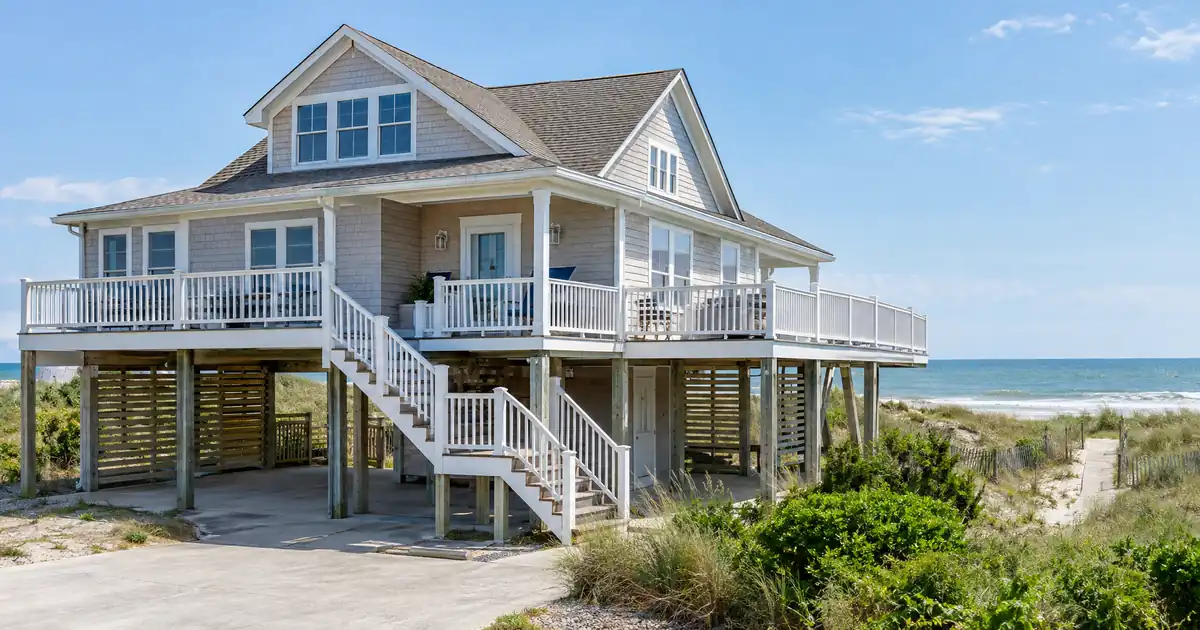
Reserves And Leverage On A $1.5M Short-term Rental DSCR Loan — The Quick Read: At this loan size, most wholesale DSCR programs put a short-term rental purchase or rate-and-term refinance at 75% loan-to-value, with cash-out capped lower on the same collateral. Reserves typically run six months of PITIA on the subject property, doubling to twelve if the investor has no prior landlord history. Credit floors step up to 700 once the loan clears the $1M mark. Coverage below 1.00 still has a path, but leverage and terms adjust to compensate.
A $1.5M short-term rental loan sits in an odd spot. It’s too big to treat like a standard rental purchase, but it’s nowhere near the case-by-case territory that kicks in above $4M. Across Lendmire’s wholesale network, this size band has its own rulebook — leverage steps down, credit floors step up, and reserves stop being a formality. Here’s how underwriting actually treats it, piece by piece.
Short-Term Rental Calculator
Run the STR numbers in your market
Rate source: Freddie Mac 30-yr average via FRED® — Federal Reserve Bank of St. Louis · effective Sep 17, 2026
Prefilled with local estimates — enter your nightly rate, occupancy, taxes, and insurance for a more accurate picture.
Short-term rental income is documented with a 12-month history or a market data report. Program parameters update from Lendmire’s centralized guideline source.
As of Sep 17, 2026 · General Freddie Mac market benchmark, not a Lendmire loan offer. Nightly rate, occupancy, taxes, and insurance are editable estimates. Qualifying income for short-term rentals varies by program — some use appraisal market rent, others use documented STR history or projections — and is confirmed in underwriting. Not a Loan Estimate, approval, or commitment to lend. Program availability and eligibility are subject to lender guidelines, credit approval, property review, and underwriting.
What Counts as Reserves on a $1.5M STR Loan?
Reserves are liquid funds an investor must hold after closing, measured in months of PITIA — principal, interest, taxes, insurance, and association dues — on the subject property, not as a slice of the loan balance. On most files in this size range, six months is the baseline. If the loan runs on an interest-only structure, the reserve math uses ITIA instead, since there’s no principal component to include.
That six-month floor isn’t universal. A borrower with no prior landlord history typically sees the requirement double to twelve months of PITIA, regardless of loan size. It’s a first-time-investor penalty, not a size penalty — a $500,000 rental purchase and a $1.5M short-term rental purchase carry the same jump if the borrower has never owned rental property before. What actually gets stricter as the loan grows is everything around that floor: leverage caps, credit depth, and appraisal requirements, not the reserve count itself.
Reserves cover vacancy and rent-shortfall risk after closing. They’re a separate lever from the appraisal, which protects against an inflated value or an overly optimistic rent estimate at underwriting. A thick reserve cushion doesn’t paper over a weak appraisal, and a strong appraisal doesn’t excuse thin reserves. Both get checked independently.
How Does Leverage Step Down at This Size?
Leverage on a $1.5M short-term rental file typically runs to 75% loan-to-value on a purchase or rate-and-term refinance. Credit is generally expected at 700 or above once the loan crosses the $1M threshold. Cash-out on the same collateral is scoped tighter. It commonly runs around 60% loan-to-value for short-term-rental cash-out at this size. Standard rental collateral in the same range has a 70% ceiling, subject to underwriting.
Below $1M, most programs in the network run purchase and rate-and-term leverage to 80%, with credit floors around 660. Cross into the $1M-$1.5M band and leverage typically steps to 75%, credit expectations move to 700, and cash-out compresses further. That step isn’t gradual — it’s a hard line at the loan-amount threshold, not a sliding scale.
Here’s how the ladder typically reads through this range on select wholesale programs, subject to underwriting:
| Loan Size | Purchase / Rate-Term LTV | Cash-Out LTV | Credit Floor |
|---|---|---|---|
| $150K-$1M | 80% | 75% | 660+ |
| $1M-$1.5M | 75% | 70% (standard rental) | 700+ |
| $1.5M-$2M | 75% | 60% (short-term-rental collateral) | 720+ |
| $2M-$3M | 75% | 60% (short-term-rental collateral) | 720+ |
A $1.5M loan sits right at the boundary between the second and third rows. Whether it lands at 700 or 720 on the credit floor, and whether cash-out clears at 70% or 60%, often comes down to whether the file is titled as a standard rental or documented as a short-term rental at underwriting.
Does Coverage Below 1.00 Still Work Here?
Yes, through select programs in the network, though leverage and terms adjust to compensate. A DSCR of 1.00 or higher earns full leverage on the ladder above. Coverage between roughly 0.75 and 0.99 is a real path to $2,000,000 in loan amount, but it comes with reduced leverage — the LTV and terms adjust, subject to underwriting, rather than staying flat.
No-ratio qualification — meaning the file doesn’t rely on a calculated coverage number at all — is available through select programs in the network up to $2,000,000, generally reserved for borrowers with a seven-year clean housing-payment history and no late payments, foreclosures, or bankruptcies in the prior 24 months. No minimum ratio gets published for this path, since the whole point is that the ratio isn’t the qualifying metric. It’s not available on the short-term-rental income path, though — no-ratio and STR income documentation doesn’t combine in most programs.
How Does Short-Term Rental Income Get Counted?
Short-term rental income on this size loan gets documented one of two ways, and lenders take the more conservative figure. On a refinance, twelve months of trailing operating history from the property itself is the primary source. On a purchase with no operating history, the appraiser’s short-term-rental income analysis stands in, typically discounted to around 80% of the projected gross figure rather than taken at face value.
This is where investors most often overestimate what a file will show. A strong AirDNA report or platform export feels like the coverage number, but it isn’t the number underwriting uses outright — it’s an input that gets haircut, cross-checked against appraisal-form market rent, and treated as a projection rather than a fact. Most programs also want to see that the borrower has owned income property for at least twelve of the last 36 months before short-term-rental income counts toward qualification at all. First-time landlords generally get routed toward long-term-rent documentation instead.
Fannie Mae has its own guidance on the Form 1007 Single-Family Comparable Rent Schedule. It explains how appraisers pull market rent for investment properties. DSCR underwriting on non-owner-occupied files uses this same comparable-rent logic. This happens even though the loan itself sits entirely outside agency guidelines.
Purchase, Rate-Term, or Cash-Out — Why the Leverage Split Matters
A cash-out refinance on short-term-rental collateral in the $1.5M-$2M band typically caps around 60% loan-to-value. That’s well below the 75% available on a purchase or rate-and-term refinance at the same loan size. This gap exists because cash-out pulls equity out of the deal instead of putting new equity in. That raises the lender’s exposure on a property type that already carries income volatility.
Cash-out has its own reserve wrinkle too. On most programs, cash-out proceeds can’t be used to satisfy the reserve requirement — the reserves have to already exist, separate from what the refinance generates. That’s a contrast with some purchase scenarios where a strong reserve position and the loan proceeds together get evaluated as a package. Cash-out above $1.5M also tends to shut out lower credit tiers entirely; borrowers at 680 and below often find cash-out unavailable past that size point regardless of coverage.
Investors weighing whether to buy now or refinance later should read this leverage gap as a real cost of waiting. Pulling equity out after appreciation means accepting a lower LTV ceiling than the original purchase carried. That’s worth factoring into any hold-versus-refinance decision at this loan size.
What About the Second Appraisal?
Above $2,000,000 in loan amount, most programs order two independent appraisals instead of one. A $1.5M loan generally still clears on a single appraisal, which keeps the valuation process simpler than it becomes just a few hundred thousand dollars higher. The second-appraisal trigger isn’t a fraud check — it exists because thin comparable pools and more subjective short-term-rental pricing make a single appraiser’s opinion riskier to rely on as the loan amount climbs. Below $2M, one field appraisal is typically sufficient.
Across files in this size range, a pattern shows up often. Investors walk in with a strong trailing-twelve-month booking calendar and expect it to translate one-to-one into qualifying income. Then they find the appraisal’s market-rent comparison pulls the number down. The lower of the two figures wins, every time. Structure the file around that expectation from the start. Don’t treat the appraisal as a formality — doing so avoids a late surprise mid-file.
The Business-Purpose Framing, Briefly
DSCR loans are designed for non-owner-occupied investment properties. They are business-purpose investor loans, so lenders review them differently from a standard owner-occupied mortgage. The CFPB’s Regulation Z exemption for business-purpose credit is part of why qualification runs on the property’s income instead of the borrower’s traditional personal-income documents. That said, the exemption isn’t absolute. The CFPB’s own compliance guidance notes that even exempt business-purpose loans remain subject to prepayment-penalty restrictions. This is a framing note, not a legal walkthrough. The practical mechanics above are what actually drive the file.
Key Terms Defined
DSCR (Debt-Service Coverage Ratio): monthly rental income divided by the full monthly housing payment (PITIA); a ratio at or above 1.00 means the rent covers the payment.
DSCR vs. conventional financing
Two common ways to finance an investment property in this market. They qualify you differently — here’s how investors weigh them.
Why investors choose it
- Qualifies on the property’s rental income — no personal tax returns, W-2s, or pay stubs needed to document income.
- No personal debt-to-income ceiling to clear, so existing mortgages and obligations don’t cap your borrowing the same way.
- Can be closed in an LLC, keeping the property inside a business entity.
- Built for scaling — not held to the limit on number of financed properties that conventional financing applies.
- Underwriting centers on the deal: generally qualifies when the rent covers the payment, a 1.00x coverage ratio being a common baseline (confirmed in underwriting).
- Designed specifically for investment property, including long-term and, where the program allows, short-term rentals.
Where it’s strong
- Often the lowest ongoing financing cost for a buyer who fully qualifies on personal income — a fit for a first property or a cost-first purchase.
Trade-offs for investors
- Requires full personal income documentation and must fit within a debt-to-income limit — salary, existing debts, and other mortgages all count.
- Typically held in your personal name rather than a business entity.
- Caps how many financed properties you can carry, which can become a ceiling as a portfolio grows.
- Evaluates you as a borrower as much as the property, which usually means more paperwork.
How investors usually choose: a first or single property often optimizes for the lowest financing cost; portfolio builders often optimize for leverage, vesting in an LLC, and scaling past conventional caps. The right answer depends on your goals, the property, and current guidelines — both paths run through select lenders in Lendmire’s wholesale network, with eligibility and terms confirmed in underwriting.
PITIA: principal, interest, taxes, insurance, and association dues combined into one monthly figure, the basis for both the coverage ratio and the reserve calculation.
Reserves: liquid funds an investor must hold after closing, expressed in months of PITIA rather than as a percentage of the loan.
LTV (Loan-to-Value): the loan amount as a percentage of the property’s appraised value or purchase price, whichever is lower; it sets the maximum leverage available.
No-ratio qualification: a path through select wholesale programs where the file doesn’t rely on a calculated DSCR at all, generally reserved for borrowers with a long clean housing-payment history.
Want a full walkthrough of how coverage, leverage, and documentation fit together across loan sizes? Lendmire’s complete DSCR loans guide covers the mechanics in more depth. If you’re comparing this size band against the tier just above it, you may also find it useful to see how reserves and leverage shift on a $1.5M super jumbo that isn’t short-term-rental collateral. The reserve floor and leverage ladder both move differently once the property type changes.
Frequently Asked Questions
Does a $1.5M short-term rental loan require twelve months of reserves no matter what?
No — twelve months applies specifically to first-time landlords. An investor with prior rental-property ownership typically only needs six months of PITIA on the subject property, subject to lender guidelines and program review.
Can cash-out proceeds count toward the reserve requirement on this loan size?
Generally no. Most programs in the network require reserves to already exist separately from the refinance proceeds, particularly on cash-out transactions at this size, though exact treatment varies by lender and file.
What happens if the short-term rental has no booking history yet?
The appraiser’s short-term-rental income analysis stands in, typically discounted to around 80% of the projected gross figure rather than counted at face value, and most programs also want twelve of the last 36 months of prior income-property ownership before this path opens up.
Is 75% loan-to-value the ceiling on every $1.5M purchase?
It’s the typical ceiling on most select wholesale programs at this size for purchase and rate-and-term transactions, though the exact figure depends on credit profile, coverage ratio, and property type — always subject to underwriting.
Why does cash-out leverage drop so much more than purchase leverage at this size?
Cash-out pulls equity out rather than adding it, which raises exposure on a property type that already carries income volatility from booking seasonality — so most programs cap short-term-rental cash-out well below the purchase ceiling at the same loan amount.
If you are buying or refinancing a short-term rental at this size and want to see how the numbers work, Lendmire can help you compare DSCR loan options based on the property’s income, credit profile, leverage, and investor goals.
Investors focused on short-term rentals can review DSCR loans for Airbnb and short-term rentals.
For current guidelines and terms, see Lendmire’s super jumbo DSCR loan programs page.
Self-employed borrowers can compare both super jumbo programs on Lendmire’s self-employed mortgages page.
About Lendmire
Lendmire, NMLS# 2371349, is a mortgage brokerage focused on investor financing, arranging DSCR loans in 39 states plus Washington, D.C. — 40 markets total. Qualification is based on the property’s income rather than personal income documentation, subject to lender guidelines, making it a fit for LLC-held rentals and scaling portfolios. Scotsman Guide named Lendmire a Top Mortgage Workplace in both 2025 and 2026.
Get Started
Ready to find the right loan for you?
In about 30 seconds you can review financing options available for your home or investment property. No commitment required.
Informational only. Not a Loan Estimate, approval, or commitment to lend. Program availability and eligibility are subject to lender guidelines, credit approval, property review, and underwriting.
References
1. Fannie Mae — Form 1007 Single-Family Comparable Rent Schedule
2. CFPB Reg Z §1026.3 Exempt Transactions
Brandon Miller
Founder & CEO, Mortgage Loan Originator, Lendmire LLC
- Mortgage Loan Originator · NMLS# 1129696 · Verify on NMLS Consumer Access
- North Carolina Real Estate Broker · License# 343312 · Verify on NCREC
- North Carolina Insurance Producer · License# 19053198 · Property, Casualty, Life, Health · Verify on NAIC SBS
- Lendmire LLC · Firm NMLS# 2371349 · Verify firm licensure
Disclosures. The information presented in this article is general market commentary, not financial, legal, or tax advice. Lendmire is a mortgage brokerage (NMLS# 2371349) — not a direct lender or depository institution — and loan placement is subject to lender underwriting. Nothing in this content represents a commitment to lend. Loan terms, pricing, and program availability vary based on borrower qualifications, property characteristics, and state of subject property, and are subject to change at any time. Lendmire complies with Equal Housing Opportunity requirements. Consumer access: nmlsconsumeraccess.org.


