
STR DSCR Below Vs Above The Ceiling — The Quick Read: Below the conforming loan-limit ceiling, an LLC investor gets a standard STR DSCR file — one appraisal, standard reserves, leverage near the top of the ladder. Above that ceiling, the loan doesn’t stop existing, but the file gets heavier: two appraisals, more reserve months, and leverage that steps down as the loan size climbs. Neither side is blocked by the ceiling itself — it’s a documentation and risk marker, not a wall.
The number people call “the ceiling” is the Federal Housing Finance Agency’s conforming loan limit, the line that separates loans Fannie Mae and Freddie Mac will buy from everything else. A DSCR loan is never sold to either agency, so that limit doesn’t apply as law here. But every non-agency lender still uses it as a reference point to set loan-size tiers. That’s the real meaning of “below vs above the ceiling” for a short-term rental DSCR file: it’s a pricing-tier and paperwork marker, not an eligibility cliff.
Short-Term Rental Calculator
Run the STR numbers in your market
Rate source: Freddie Mac 30-yr average via FRED® — Federal Reserve Bank of St. Louis · effective Sep 17, 2026
Prefilled with local estimates — enter your nightly rate, occupancy, taxes, and insurance for a more accurate picture.
Short-term rental income is documented with a 12-month history or a market data report. Program parameters update from Lendmire’s centralized guideline source.
As of Sep 17, 2026 · General Freddie Mac market benchmark, not a Lendmire loan offer. Nightly rate, occupancy, taxes, and insurance are editable estimates. Qualifying income for short-term rentals varies by program — some use appraisal market rent, others use documented STR history or projections — and is confirmed in underwriting. Not a Loan Estimate, approval, or commitment to lend. Program availability and eligibility are subject to lender guidelines, credit approval, property review, and underwriting.
Key Terms Defined
DSCR (debt service coverage ratio): the property’s rent divided by its full monthly obligation (principal, interest, taxes, insurance, HOA dues) — a ratio at or above 1.00 means rent covers the payment.
Conforming loan limit (CLL): the dollar ceiling the Federal Housing Finance Agency sets each year for loans Fannie Mae and Freddie Mac will acquire — irrelevant to DSCR loan eligibility but widely used as a size-tier reference.
Business-purpose loan: a loan made to an LLC or for investment purposes rather than personal, family, or household use — this classification is what lets a DSCR lender skip standard consumer-mortgage disclosures.
No-ratio loan: a DSCR file underwritten without publishing a minimum coverage number, generally reserved for stronger borrower profiles and reduced leverage.
Super jumbo / high-balance non-QM: an informal lender term for loans well above the conforming limit — no separate federal category, just a risk tier lenders build into their own guidelines.
Side-by-Side
| Factor | Below the Ceiling | Above the Ceiling |
|---|---|---|
| Review basis | Property rent vs. full payment (DSCR ratio) | Same DSCR math, heavier file review |
| Appraisals | One appraisal, standard practice | Two appraisals typically required above $2,000,000 |
| Reserves | Six months of PITIA on most files | Reserve counts step up; twelve months for first-time investors |
| Leverage | Up to 80% purchase under $1,000,000 | Steps down to 75%, then 65%, then 60% as size climbs |
| Cash-out | Up to 75% on standard rentals, 70% on short-term rental collateral | Cash-out unavailable above $3,000,000 |
| Entity vesting | LLC vesting standard, subject to program eligibility | Same — size doesn’t change entity treatment |
| Credit floor | 660 typical floor on most files | 700 typical floor above $3,000,000 |
| Documentation load | Standard entity docs, standard STR history | Same documents, more of them — desk reviews, added conditions |
When the Below-Ceiling File Is the Better Fit
Below-ceiling is the right lane for most first-time or mid-portfolio STR investors buying with an LLC. The deal works through a standard process: one appraisal, a documented rental history or an AirDNA-style projection, and reserve requirements that don’t stack up the way they do on a bigger loan.
This is the fit for an investor whose deal sizing sits comfortably under roughly $1,000,000 to $1,500,000, where leverage on Lendmire’s network tops out near 80% on purchase for the smallest tier and steps to 75% as the loan approaches the $1,000,000-$1,500,000 band. Coverage at 1.00 or better earns full leverage. Reserve expectations stay at the standard six months of PITIA on the subject property for most files, twelve for a first-time investor — not a wall of added conditions.
An investor holding one or two short-term rentals, documenting twelve months of platform income or leaning on the appraiser’s short-term-rent analysis on a purchase, generally fits this lane cleanly. Short-term rental income on Lendmire’s network gets qualified at 80% of gross, and that’s true whether the loan sits at $400,000 or $900,000 — the math doesn’t change below the ceiling, the file just stays lighter.
Below-ceiling also tends to suit an investor who wants interest-only structure without maximum leverage complications. You can get 120 months of interest-only on 30- and 40-year terms up to 75% LTV. That threshold sits well inside the below-ceiling range for most single-property STR purchases.
When the Above-Ceiling File Is the Better Fit
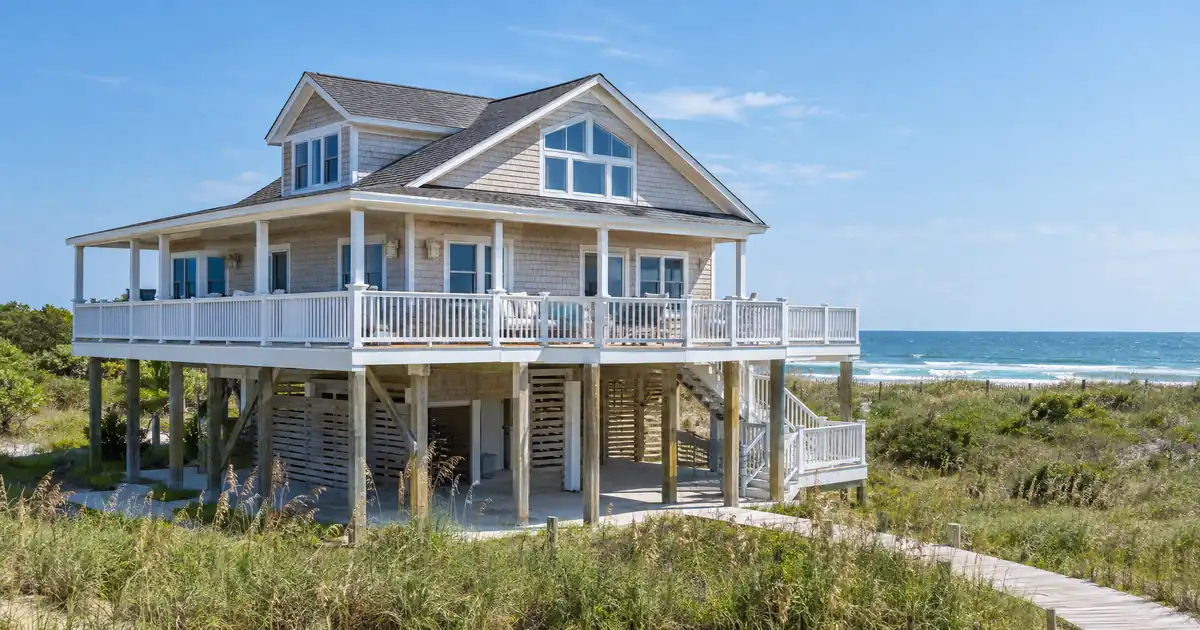
Above-ceiling makes sense for the investor scaling into larger STR assets or luxury rental collateral where a single property’s price naturally clears the conforming reference line — a large coastal short-term rental or a multi-unit STR portfolio piece, for example. Here the LLC investor should expect two appraisals above $2,000,000, tighter credit expectations (typically 700-plus above $3,000,000), and leverage that steps down: 75% purchase in the $1,000,000-$2,000,000 bands, 65% from $3,000,000 to $4,000,000, and 60% from $4,000,000 up through $10,000,000 on review before submission.
Cash-out gets narrower as size grows too. Standard rentals can reach 75% cash-out at the smallest tier and short-term rental collateral tops out at 70% in the same size range, but cash-out disappears entirely above $3,000,000 on this ladder — purchase and rate-and-term only past that point, reviewed case by case. Terms vary by lender guidelines, property type, leverage, credit profile, and full file review.
This is also where a select-program, sub-1.00 coverage path or a no-ratio structure through select lenders in Lendmire’s wholesale network can matter. Both exist up to $2,000,000, with LTV and terms adjusting downward, subject to underwriting. No-ratio requires a seven-year clean housing history and a clean 0x30x24 payment record. It’s a real option for a strong-credit investor whose STR income doesn’t cleanly hit a published ratio — not a shortcut around underwriting.
An investor should think of the above-ceiling lane as the one built for scale: up to 20 financed properties, entity vesting welcome without layered-entity complications, and a size ceiling of $10,000,000 on the broader portfolio investor program versus the $2,000,000 cap that applies specifically to short-term-rental and no-ratio files.
Why LLC Vesting Doesn’t Change Above the Line
The legal mechanism that lets an LLC borrow on either side of the ceiling is the same one: the business-purpose exemption under Regulation Z. This exemption excludes loans made to a business entity, like an LLC, from the consumer-protection framework that governs owner-occupied mortgages, per CFPB commentary on 12 CFR § 1026.3. That exemption doesn’t scale with loan size. A $400,000 STR loan and a $4,000,000 STR loan both qualify for it the same way, because the classification turns on purpose and borrower type, not dollar amount.
What does change above the ceiling is collateral scrutiny, not entity treatment. A second appraisal, a desk review, added reserve months — these are lender risk-management choices layered on top of a loan that’s already outside agency rules to begin with. For a deeper walkthrough of how vesting choices interact with DSCR underwriting generally, Lendmire’s LLC vs. personal vesting on a DSCR loan piece covers the mechanics in more depth.
The STR Income Layer, Regardless of Size
Short-term rental income documentation works the same on both sides of the ceiling. For a refinance, you need twelve months of platform operating history. For a purchase, you use the appraiser’s short-term-rent analysis. Either way, it gets discounted to 80% of gross before it enters the coverage calculation. That discount matters more than most investors expect going in. A headline AirDNA projection or a strong trailing-twelve-month statement doesn’t get accepted at face value. It gets haircut before it’s used to size the loan.
Local rules sit on top of all of this and don’t care what tier the loan falls into. Short-term rental legality varies by city, county, HOA, and property type — some markets run effective bans on investor-owned units, others allow STR only for primary residences, and even where STR is legal, minimum-stay thresholds (commonly 30 days) can push an operator toward mid-term furnished rentals instead, per Lofty’s city-by-city STR law tracker. None of that shifts with loan size. An investor buying a $3,500,000 STR property in a market with a pending ordinance change faces the same local-rules exposure as an investor buying a $350,000 unit two states over — the loan tier is irrelevant to whether the city says yes.
DSCR vs. conventional financing
Two common ways to finance an investment property in this market. They qualify you differently — here’s how investors weigh them.
Why investors choose it
- Qualifies on the property’s rental income — no personal tax returns, W-2s, or pay stubs needed to document income.
- No personal debt-to-income ceiling to clear, so existing mortgages and obligations don’t cap your borrowing the same way.
- Can be closed in an LLC, keeping the property inside a business entity.
- Built for scaling — not held to the limit on number of financed properties that conventional financing applies.
- Underwriting centers on the deal: generally qualifies when the rent covers the payment, a 1.00x coverage ratio being a common baseline (confirmed in underwriting).
- Designed specifically for investment property, including long-term and, where the program allows, short-term rentals.
Where it’s strong
- Often the lowest ongoing financing cost for a buyer who fully qualifies on personal income — a fit for a first property or a cost-first purchase.
Trade-offs for investors
- Requires full personal income documentation and must fit within a debt-to-income limit — salary, existing debts, and other mortgages all count.
- Typically held in your personal name rather than a business entity.
- Caps how many financed properties you can carry, which can become a ceiling as a portfolio grows.
- Evaluates you as a borrower as much as the property, which usually means more paperwork.
How investors usually choose: a first or single property often optimizes for the lowest financing cost; portfolio builders often optimize for leverage, vesting in an LLC, and scaling past conventional caps. The right answer depends on your goals, the property, and current guidelines — both paths run through select lenders in Lendmire’s wholesale network, with eligibility and terms confirmed in underwriting.
Broader STR market conditions still color underwriting on both tiers. Occupancy trends and revenue-per-available-room data — AirDNA’s tracked metrics show the first RevPAR gain since 2021 and occupancy projected to approach pre-pandemic levels, according to Minut’s 2026 STR law and market guide — sit underneath any AirDNA-based projection an underwriter reviews, whether the file is $500,000 or $5,000,000.
Across files placed through Lendmire’s wholesale network, the pattern that shows up again and again on STR deals isn’t the ceiling — it’s the local-permission documentation. Files with a clean, dated short-term rental permit or a clear HOA allowance for nightly rentals move through review far more smoothly than files where the investor assumed the city allows it because a neighboring unit already operates as an Airbnb.
Condos, Condotels, and the Non-Warrantability Question
Non-warrantable condo status is a Fannie Mae/Freddie Mac secondary-market label, not a cash-flow judgment — and DSCR lenders originate and hold their own paper, so that label doesn’t disqualify a file the way it would on an agency loan. On Lendmire’s network, non-warrantable condos reach 75% LTV up to $1,500,000, and condotels reach 75% on purchase and 65% on refinance, also capped at $1,500,000 with $250,000 required cash-in-hand. Exact terms depend on the lender’s guidelines, property type, leverage, and a full review of the borrower’s file.
The gate that does matter, on either side of the ceiling, is the HOA’s governing documents. If the association’s rules prohibit nightly rentals, or if the project carries pending litigation or deed restrictions unrelated to rental strategy, no rental structure gets around that — it’s a collateral problem the loan size can’t fix.
Where the Ceiling Actually Bites
If there’s one place the ceiling genuinely changes the deal, it’s cash-out. Standard rentals can reach unlimited cash-out proceeds at or below 60% LTV, with a $1,500,000 cap above that threshold, and short-term-rental collateral runs a full 10 points tighter — 70% versus the 75% ceiling on standard rentals in the same bracket. Above $3,000,000, cash-out disappears from this ladder entirely regardless of property type. An investor planning to pull equity from a large STR asset needs to size that plan around the $3,000,000 line specifically, not the conforming reference figure. Every figure here varies by lender and program — guidelines, property type, leverage, and credit profile all apply.
DSCR loans are business-purpose investor loans. They get reviewed differently from a standard owner-occupied mortgage. That’s because underwriting runs on the property’s income, not the borrower’s traditional personal-income documentation. Lendmire’s complete DSCR loans guide walks through that qualification logic in full, if the mechanics here raise more questions than they answer.
This is not legal or tax advice. Loan structuring, entity vesting, and STR permit questions can carry real legal and tax consequences, and an investor should talk to a qualified attorney or CPA about their own situation before acting on anything above.
Frequently Asked Questions
Does the conforming loan limit actually cap how big a DSCR loan can get? No. It caps what Fannie Mae and Freddie Mac will buy, and DSCR loans are never sold to either agency. Above that reference figure, a loan simply moves into a heavier documentation tier on most lenders’ internal risk ladders — reserves go up, a second appraisal often gets added, and leverage steps down, but the loan itself isn’t blocked by the CLL number.
Can an LLC still get a no-ratio STR loan above the ceiling? A no-ratio path exists through select lenders in Lendmire’s wholesale network up to $2,000,000, with LTV and terms adjusting downward and a seven-year clean housing history required, subject to underwriting. It is not published with a minimum coverage number and it is not available on every file — strong credit and a clean payment history matter more here than on a standard-ratio loan.
Does a non-warrantable condo disqualify a short-term rental from DSCR financing? Not automatically. Non-warrantability is a secondary-market classification that doesn’t apply to DSCR lenders holding their own paper. What does disqualify a unit is the HOA’s own rules — if the governing documents prohibit nightly rentals, no DSCR structure changes that.
Why does cash-out get more restrictive on short-term rental collateral specifically? Short-term rental income carries more variability than a signed long-term lease, so lenders scope cash-out tighter on that collateral type — 70% on short-term rentals versus 75% on standard rentals in the same size bracket, and cash-out disappears altogether above $3,000,000 regardless of property type.
Is AirDNA income accepted at the number the tool reports? No. It gets discounted before it enters the coverage calculation — Lendmire’s network qualifies short-term rental income at 80% of gross, whether that gross comes from trailing operating history or a projection tool. Investors modeling their own numbers should build in that haircut before assuming a deal pencils.
Investors focused on short-term rentals can review DSCR loans for Airbnb and short-term rentals.
For current guidelines and terms, see Lendmire’s super jumbo DSCR loan programs page.
Self-employed borrowers can compare both super jumbo programs on Lendmire’s self-employed mortgages page.
About Lendmire
Lendmire (NMLS# 2371349) is a mortgage brokerage focused on DSCR investor financing, helping arrange programs through wholesale and investor-lending channels in 40 markets, including Washington, D.C. DSCR loans are evaluated by the lender on property cash flow rather than personal income, subject to lender guidelines, supporting LLC closings and accommodating investors with four or more financed properties. Scotsman Guide Top Mortgage Workplace in both 2025 and 2026.
Get Started
Ready to find the right loan for you?
In about 30 seconds you can review financing options available for your home or investment property. No commitment required.
Informational only. Not a Loan Estimate, approval, or commitment to lend. Program availability and eligibility are subject to lender guidelines, credit approval, property review, and underwriting.
References
1. CFPB — Regulation Z, Comment for 1026.3 Exempt Transactions
2. Lofty — Short-Term Rental Laws by City (2026)
3. Minut — Short-term rental laws in the US: 2026 guide
Brandon Miller
Founder & CEO, Mortgage Loan Originator, Lendmire LLC
- Mortgage Loan Originator · NMLS# 1129696 · Verify on NMLS Consumer Access
- North Carolina Real Estate Broker · License# 343312 · Verify on NCREC
- North Carolina Insurance Producer · License# 19053198 · Property, Casualty, Life, Health · Verify on NAIC SBS
- Lendmire LLC · Firm NMLS# 2371349 · Verify firm licensure
Legal disclosures. Lendmire (NMLS# 2371349) is a state-licensed mortgage brokerage that arranges financing through wholesale lender relationships. Lendmire is not a direct lender, depository institution, or registered financial advisor. The discussion above is general informational content about real estate financing — it is not financial, legal, or tax advice, and readers should consult licensed professionals for guidance on their individual circumstances. Loan inquiries are subject to lender underwriting; this article does not represent a commitment to lend. Loan terms, rates, and qualification standards vary by borrower, property, and state, and are subject to change at any time. Equal Housing Opportunity. NMLS Consumer Access: nmlsconsumeraccess.org.


