
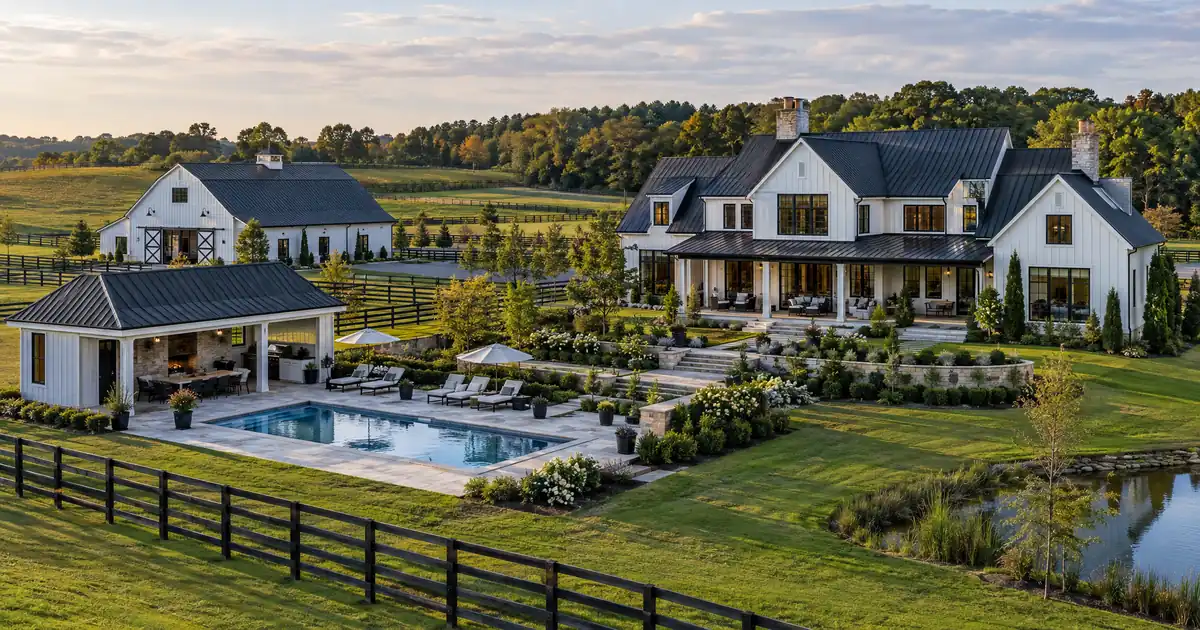
The Quick Read: Cashing out on an acreage rental means passing two tests at once: rent must cover the new, larger payment, and the loan must fit under a leverage ceiling that drops as the balance grows. Acreage adds a third gate, because the appraiser may strip excess land out of the value the lender uses. Here is what to know up front:
- On a cash-out, leverage typically runs 75% to $1,000,000, 70% to $1,500,000, and 60% to $3,000,000, through select wholesale programs, subject to underwriting.
- Above $3,000,000, there is no cash-out. Only a purchase or rate-and-term refinance is available.
- Coverage of 1.00 or higher earns full leverage. Coverage from 0.75 to 0.99 is a select-program path to $2,000,000, where LTV and terms adjust, subject to underwriting.
- Rural land on five acres or less reaches 75%. Up to twenty acres is possible on loans to $3,000,000.
- Two appraisals are required above $2,000,000, and reserves typically run six months on the subject property.
Picture a long-held rental on twelve acres. The owner wants to pull equity out and buy the next property. The owner expects the cash-out to be sized off a big number. Then the appraisal comes back, and the number is smaller. This guide walks through why, and what to do about it.
What Is a Super Jumbo DSCR Cash-Out?
Lendmire’s standard DSCR program stops at $3,000,000. Across the wholesale network, a ladder carries qualified investors past that, with loan amounts from $150,000 to $10,000,000. The exact numbers vary by lender and program and follow a full review of property, leverage, and credit.
Cash-out has a lower leverage ceiling than a purchase. Cash-out is capped lower because the lender is lending against equity you already hold, not against a price someone just paid.
Qualification runs primarily on property-level rental income covering the payment, subject to lender guidelines. You are not submitting traditional personal-income documentation to prove income. The property has to carry itself.
DSCR loans are designed for non-owner-occupied investment properties. Because they are business-purpose investor loans, they are reviewed differently from a standard owner-occupied mortgage. The business-purpose exemption in Regulation Z covers credit to acquire, improve or maintain non-owner-occupied rental property.
Key Terms Defined
DSCR (debt service coverage ratio): monthly rent divided by the full monthly payment on the new loan. A result of 1.00 means rent equals the payment.
PITIA: principal, interest, taxes, insurance and any association dues. It is the payment the rent has to cover.
LTV (loan-to-value): the loan amount as a percentage of appraised value.
Cash-out refinance: a new loan that pays off the old one and puts extra money in your hands.
Excess land: acreage beyond what supports the home. Appraisers often give it little or no value for lending purposes.
Seasoning: how long you have owned the property. It can decide whether the lender sizes off appraised value or off what you paid.
Reserves: liquid funds held after closing, measured in months of payments.
How Does a Cash-Out on Acreage Actually Work?
It works in a fixed order, and the tighter of two tests sets your cash. Here is the sequence across most programs in the network.
1. Classify the deal. Any refinance that puts cash in your hands beyond the payoff and costs is cash-out. That puts you on the lower leverage ladder.
2. Check eligibility. Acre count, whether the land is a separate parcel, agricultural use, outbuildings, and how built-up the surroundings are all matter. A working farm, ranch or orchard is agricultural, not a residential rental.
3. Order the appraisal. It does two jobs. It sets value, which drives LTV, and it sets market rent, which drives coverage. The rent schedule forms are Form 1007 for one unit and Form 1025 for two to four units, both named in the Fannie Mae forms library. DSCR loans sit outside agency guidelines, so treat those as form names only.
4. Size the loan. The new loan is appraised value times the LTV ceiling for your size band. If coverage binds first, it is smaller.
5. Test coverage on the new payment. Pulling out more cash raises the payment and lowers the ratio.
6. Set reserves aside separately. Cash-out proceeds never satisfy reserves on a loan above $3,000,000, and they are not planned as reserves on other files in the network.
7. Calculate net cash. The cash to you is the new loan minus payoff, closing costs and any holdbacks.
Most investors fixate on step four. In practice, steps two and three decide the outcome, because they set the value everything else multiplies against.
How Does Acreage Change the Value the Lender Uses?
Acreage changes value because the appraiser separates the homesite from the land that does not support the rental. Lenders lend against what a buyer would pay for a residential rental, not what you paid for the whole parcel.
This is where the surprise lives. Say you bought a house on thirty acres, and the price bundled in a premium for the extra land. The appraiser may carve out the excess acreage or give it little weight. The appraised value can come in below your purchase price. The loan shrinks with it.
Lenders limit acreage for practical reasons. Land comparables are hard to find. Some parcels drift toward non-residential use. A lender that has to foreclose wants a deep pool of resale buyers, and rural land has fewer of them.
Rural does not mean automatic decline. Rental demand and comparable sales decide it. But a government definition of rural is not the same as a lender’s definition. Many lenders run the address through a third-party rural designation tool, and a program in the network may treat a property as rural even when the town looks suburban. Ask before you order the appraisal.
Rural land on five acres or less typically reaches 75% leverage. Above $3,000,000, rural property is out, and acreage is capped at ten acres. All of this is subject to underwriting.
How Does Loan Size Change the Rules?
Loan size changes nearly everything: leverage, credit floor, appraisal count and cash-out availability. The table shows the best available cell at each band for a DSCR of 1.00 or higher. Every figure is a ceiling through select wholesale programs, subject to underwriting.
| Loan band | Cash-out LTV | Credit floor | Land and appraisal notes |
|---|---|---|---|
| $150K–$1M | 75% | 660+ | Rural at 5 acres or less reaches 75% |
| $1M–$1.5M | 70% | 700+ | Up to 20 acres possible to $3M |
| $1.5M–$2M | 60% | 720+ | Up to 20 acres possible to $3M |
| $2M–$3M | 60% | 720+ | Two appraisals required |
| Above $3M | No cash-out | 700+ | No rural, 10 acres max |
Two cash-out details matter here. Proceeds are unlimited at or below 60% LTV, and capped at $1,500,000 above 60%. Borrowers with credit of 680 or below get no cash-out above $1,500,000. Final terms depend on the lender’s guidelines, the property type, and the borrower’s complete credit picture.
The 70% figure in that second row applies to loan sizes of $1M–$1.5M, while 75% applies to the lowest band. Confirm which applies to your property before you plan around it.
For a purchase or rate-and-term refinance, the ladder runs higher: 80% to $1,000,000, 75% to $3,000,000, 65% to $4,000,000, and 60% to $6,000,000 on review. Above $4,000,000, every request is reviewed case by case before submission. Never read a leverage figure at that size as a flat promise.
Above $3,000,000, qualification also requires 0x30x24 mortgage history, 48-month seasoning on credit events, and U.S. citizenship or permanent residency.
Worked Example: Two Acreage Files, Two Outcomes
These are modeled assumptions, not market data. Both use ratios and percentages only.
File one: the land premium. An investor owns a rental house on fifteen acres, bought at a price that included a premium for the land. The appraisal values the homesite and gives the excess acreage limited weight. Value lands below the purchase price. The loan is sized at the cash-out ceiling for its band, 70% in the $1,000,000 to $1,500,000 range, but against the lower value. The investor expected more cash and receives less. Coverage on the smaller new payment clears roughly 1.2x, so coverage was never the problem. Value was.
File two: the coverage squeeze. Another investor holds a luxury rental whose appraised value supports a loan near the top of the $2,000,000 to $3,000,000 band at 60% cash-out. Rural rents are modest relative to value, so coverage at the full ceiling lands near 0.9x. Sub-1.00 coverage is generally available only on loans up to $2,000,000, so a loan in this band would not qualify on that path. Pulling back the cash-out improves the ratio, though it shrinks the cash. The investor can accept the lower cash-out, reduce the loan amount, or restructure. Each figure is subject to lender guidelines and a complete review of property type, leverage, and credit.
The pattern holds in both files. The tighter test sets your cash.
What Can Shrink or Block Your Proceeds?
Six things shrink or block proceeds most often, and they stack.
- Excess land stripped from value. The loan sizes off the lower number.
- Coverage squeeze. More cash means a bigger payment and a thinner ratio. Interest-only helps here: a 120-month interest-only period is available on 30- and 40-year terms to 75% maximum with coverage of 0.75 or better, qualified on interest, taxes and insurance.
- Seasoning. It is lender policy, not law. A recent purchase may be sized off what you paid instead of appraised value.
- Rural classification. A property flagged rural may face lower leverage or drop out of a program entirely.
- Agricultural use. Orchards, livestock and crop income push a property out of residential rental territory.
- Reserves. About six months of PITIA on the subject property, twelve for first-time investors. Cash-out proceeds do not stand in.
Property type matters too. Manufactured homes, log homes and barndominiums are not offered through the network. Condos, 1-to-4 unit properties and rural homes on qualifying acreage are the usual fits.
Short-term rentals add another layer. Coverage of 1.00 or higher is required, loans stop at $2,000,000, and income comes from twelve months of operating history on a refinance, counted at 80% of gross. The investor must show twelve months owning income property in the last thirty-six. Short-term rental rules can vary by city, county, HOA, and property type, so investors should confirm local rules before relying on projected rental income.
DSCR vs. conventional financing
There are two common ways to finance an investment property, and they qualify you differently — here’s how investors weigh them.
Why investors choose it
- Qualifies on the property’s rental income — no personal tax returns, W-2s, or pay stubs needed to document income.
- No personal debt-to-income ceiling to clear, so existing mortgages and obligations don’t cap your borrowing the same way.
- Can be closed in an LLC, keeping the property inside a business entity.
- Built for scaling — not held to the limit on number of financed properties that conventional financing applies.
- Underwriting centers on the deal: generally qualifies when the rent covers the payment, a 1.00x coverage ratio being a common baseline (confirmed in underwriting).
- Designed specifically for investment property, including long-term and, where the program allows, short-term rentals.
Where it’s strong
- Often the lowest ongoing financing cost for a buyer who fully qualifies on personal income — a fit for a first property or a cost-first purchase.
Trade-offs for investors
- Requires full personal income documentation and must fit within a debt-to-income limit — salary, existing debts, and other mortgages all count.
- Typically held in your personal name rather than a business entity.
- Caps how many financed properties you can carry, which can become a ceiling as a portfolio grows.
- Evaluates you as a borrower as much as the property, which usually means more paperwork.
How investors usually choose: a first or single property often optimizes for the lowest financing cost; portfolio builders often optimize for leverage, vesting in an LLC, and scaling past conventional caps. The right answer depends on your goals, the property, and current guidelines — both paths run through select lenders in Lendmire’s wholesale network, with eligibility and terms confirmed in underwriting.
Where the General Rule Breaks
Rules of thumb fail in a few named places.
The $3,000,000 cliff. Cash-out ends. Rural ends. Acreage caps at ten. An investor who wants cash on a very large property has to restructure, because no ladder step covers it.
Rural versus suburban edge. A town of any size can still carry a rural flag from a lender’s tool. Forum commentary suggests larger towns are generally not treated as rural, but that is anecdotal. Ask for the designation before you commit to an appraisal.
Cross-collateral loans. A pooled line puts every property behind the whole balance. A single-property loan keeps the risk contained. Many investors with several rural holdings prefer separate loans for that reason.
Entity vesting. LLC vesting is welcome, subject to program terms, but layered entities are not. Trusts and entities should be settled before the appraisal is ordered.
Positive cash flow. Clearing 1.00 does not mean the property is cash-flow positive. The ratio compares rent to PITIA only. Repairs, vacancy and management sit outside it.
Whether a loan classifies as business purpose depends on its purpose and the occupancy facts, not just the label. Compliance Alliance notes the exemption turns on how the loan is used. A property you live in does not qualify for this program.
If Your File Misses: The Decision Path
When the numbers fall short, you have four moves. Each trades something.
1. Take a smaller cash-out. Lower leverage improves coverage and avoids the 60% proceeds line. You get less cash, with less risk.
2. Switch to rate-and-term. Rate-and-term carries higher leverage ceilings on the ladder than cash-out does. It may suit you if you want to restructure without pulling money out. Lendmire’s piece on how much a super jumbo DSCR cash-out releases on acreage works through the proceeds math in more detail.
3. Split into smaller loans. Two loans below a threshold may clear a credit or acreage rule that one large loan trips. Cross-collateralization changes the risk, so weigh it.
4. Address the land. If excess acreage is dragging value, a parcel split before the appraisal can help. It takes planning, and it is not always possible.
If personal income is the issue, Lendmire’s piece How to Cash-Out Refinance a Super Jumbo Acreage Property on Bank Statements covers an alternative documentation path. For the full picture of how these loans work, see Lendmire’s complete DSCR loans guide.
Pre-Application Checklist
Preparation is where this loan is won, because most surprises trace back to the parcel.
- Parcel documents. Acreage, whether the land is one parcel or several, any agricultural use, and outbuildings.
- Rent evidence. A current lease, or market rent if vacant. The appraiser’s rent schedule will support or challenge it.
- Entity documents. Operating agreement and vesting, with no layered entities.
- Reserves. Liquid funds equal to about six months of PITIA on the subject property, held outside the transaction.
- Credit. A score meeting your band’s floor, and a clean housing history for higher bands.
- Seasoning facts. Purchase date and price, and any improvements since.
- Appraiser instructions. Make sure the appraiser knows the use is residential rental and that rental comps are needed.
Tax treatment can depend on how the funds are used and how the property is held; investors should keep clear records and speak with a qualified tax professional before relying on any deduction.
Who This Fits, and Who It Doesn’t
It fits an investor with a high-value residential rental, a score at or above the band floor, rent that covers the new payment, and land that stays within the acreage limits. It suits those who want entity vesting and qualification on property income rather than personal returns.
It does not fit a working farm, a property above $3,000,000 that needs cash-out, a manufactured or log home, or an investor without reserves outside the deal. Cash-out always raises the payment, so monthly cash flow falls. Run that before you commit.
Frequently Asked Questions
Can I cash out a DSCR loan on acreage?
Yes, when the property is a residential rental and the acreage stays within program limits. Rural land on five acres or less typically reaches 75% leverage, and up to twenty acres is possible on loans to $3,000,000. Cash-out ends above $3,000,000, all subject to underwriting.
What counts as a super jumbo DSCR loan?
Definitions vary by lender. Within Lendmire’s network, a super jumbo loan is one past the $3,000,000 standard program limit, and the ladder runs to $10,000,000. Above $4,000,000, each request is reviewed case by case.
Does extra land reduce my loan?
It can, because the appraiser may strip excess land from the value.
A purchase price that bundled in extra acres can appraise below what you paid.
Can cash-out proceeds count as reserves?
Generally no. The network plans on reserves held separately, about six months of PITIA on the subject property. On loans above $3,000,000, cash-out never satisfies reserves.
What if my coverage is below 1.00?
Select lenders in the network have programs for coverage from 0.75 to 0.99, up to $2,000,000. LTV and terms adjust, subject to underwriting. Reducing the cash-out amount may also lift the ratio.
A deeper walk-through of investment-property equity extraction lives in Lendmire’s guide to cash-out refinance on an investment property.
For current guidelines and terms, see Lendmire’s super jumbo DSCR loan programs page.
Self-employed borrowers can compare super jumbo options on Lendmire’s self-employed mortgages page.
About Lendmire
Lendmire, NMLS# 2371349, is a non-QM mortgage broker serving real estate investors in 41 markets, including Washington, D.C., through DSCR investor loan programs. Qualification is generally reviewed around the subject property’s rental income, not the borrower’s W-2 history — a practical fit for LLC-titled portfolios and self-employed investors. All scenarios remain subject to lender review and program guidelines. Two consecutive Scotsman Guide Top Mortgage Workplace recognitions (2025, 2026).
Get Started
Ready to find the right loan for you?
In about 30 seconds you can review financing options available for your investment property. No commitment required.
Informational only. Not a Loan Estimate, approval, or commitment to lend. Program availability and eligibility are subject to lender guidelines, credit approval, property review, and underwriting.
References
2. Fannie Mae Selling & Servicing Guide Forms
3. Compliance Alliance: Regulation Z and “Investment” Properties
This article is part of Lendmire’s super jumbo DSCR loan program — full qualification details, guidelines, and scenarios live on the program page.
Related reading: Can You Cash Out a Condotel With a Super Jumbo DSCR Loan? · Does a Cash-Out vs Purchase Change Who Guarantees a Super Jumbo DSCR Loan? · DSCR vs Asset Depletion on a Super Jumbo Purchase or Cash-Out
Brandon Miller
Founder & CEO, Mortgage Loan Originator, Lendmire LLC
- Mortgage Loan Originator · NMLS# 1129696 · Verify on NMLS Consumer Access
- North Carolina Real Estate Broker · License# 343312 · Verify on NCREC
- North Carolina Insurance Producer · License# 19053198 · Property, Casualty, Life, Health · Verify on NAIC SBS
- Lendmire LLC · Firm NMLS# 2371349 · Verify firm licensure
Important disclosures. Lendmire (NMLS# 2371349) is a licensed mortgage brokerage. Lendmire is not a direct lender, depository institution, or financial advisor. All loan inquiries are subject to lender underwriting; this article does not constitute a commitment to lend. Rates, terms, and program guidelines are subject to change without notice and vary by borrower profile, property type, and state. Information in this article is general in nature and is not financial, legal, or tax advice. Equal Housing Opportunity. NMLS Consumer Access: nmlsconsumeraccess.org.