
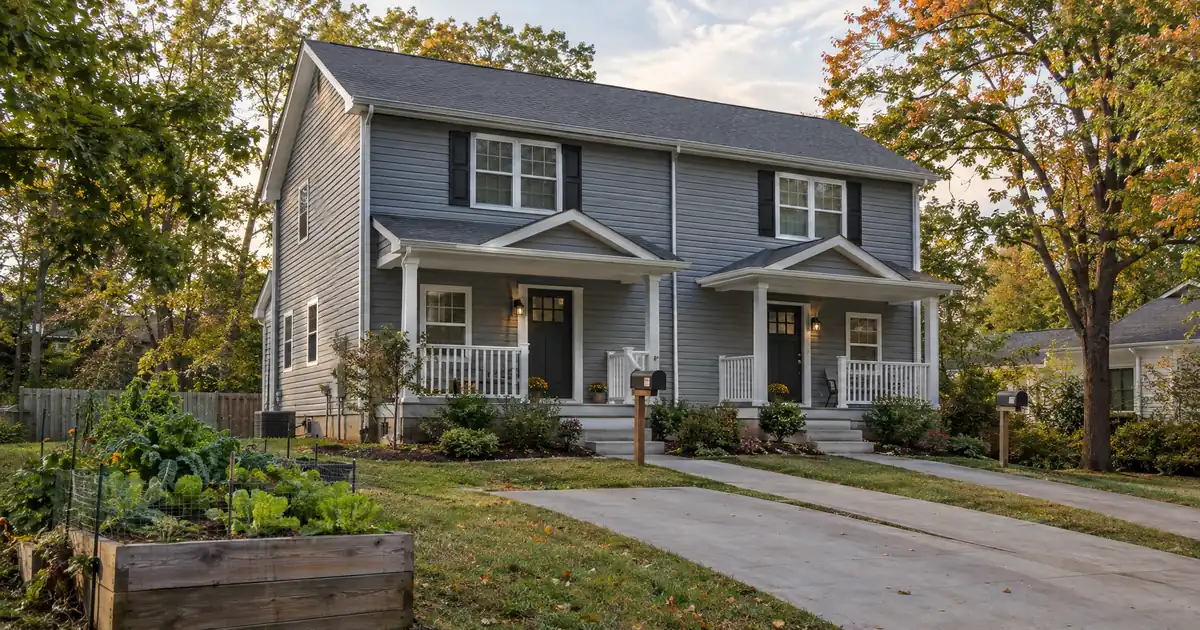
The Quick Read: Both property types qualify on the same logic: rent measured against the full monthly housing obligation, subject to lender guidelines. The real difference is documentation, because a two-flat pools two rent streams over one tax bill and one insurance policy, while a single-family home rests on one lease.
- A two-flat usually spreads vacancy risk across two units; a single-family vacancy takes rental income to zero.
- A single-family file is simpler: one lease, one rent opinion, one inspection.
- Most programs we place files with allow 75%–80% LTV on an investment purchase, for either property type.
- Neither one makes a non-owner-occupied DSCR loan work if you plan to live in a unit.
- Clearing 1.00 coverage is not the same as positive cash flow.
The honest answer on who each option fits: a two-flat suits the investor who wants pooled income, tolerates more paperwork, and can manage two tenancies. A single-family home suits the investor who values a clean file, a broader resale pool, and fewer moving parts. Neither is better in the abstract. The deciding variable is how each specific building’s rent compares to its price and carrying costs.
DSCR Calculator
Run the numbers in your market
Rate source: Freddie Mac 30-yr average via FRED® — Federal Reserve Bank of St. Louis · effective Oct 29, 2026
Prefilled with starting assumptions — enter your own rent or nightly figures, taxes, insurance, and HOA for a more accurate picture.
Program parameters update from Lendmire’s centralized guideline source. Taxes and insurance are editable estimates.
As of Oct 29, 2026 · General Freddie Mac market benchmark, not a Lendmire loan offer. Rent, nightly rate, occupancy, taxes, and insurance are editable estimates. Short-term rental figures are estimates only and vary significantly by season, property type, management approach, and local short-term-rental rules — confirm local regulations before relying on them. Qualifying income for short-term rentals varies by program — some use appraisal market rent, others use documented STR history or projections — and is confirmed in underwriting. Not a Loan Estimate, approval, or commitment to lend. Program availability and eligibility are subject to lender guidelines, credit approval, property review, and underwriting.
Side-by-Side
The column below describes how the network’s programs generally treat each property. Where figures appear, they are typical ranges from select lenders in Lendmire’s wholesale network, not guarantees.
| Factor | Two-Flat | Single-Family |
|---|---|---|
| Review basis | Total counted rent vs. one PITIA | One unit’s rent vs. PITIA |
| Rent evidence | Two leases or a rent roll, plus market rent | One lease, plus market rent |
| Appraisal form | Small residential income report, interior inspection | Single-family appraisal with rent schedule |
| Vacancy effect | One unit empty, other rent remains | Rental income drops to zero |
| Entity vesting | LLC or individual, subject to lender program eligibility | Same |
| Reserves | Commonly around 6 months of PITIA, varies | Same range |
| Documentation load | Heavier | Lighter |
| Owner-occupied use | Not a standard DSCR fit | Not a standard DSCR fit |
How Does Each Property Qualify?
The ratio is monthly rent divided by principal, interest, taxes, insurance, and any HOA dues. On one-to-four-unit properties, that is a gross-rent test. Most programs we place files with treat both property types identically on the math; the inputs differ.
On a single-family home, the lender looks at one lease and the appraiser’s market rent opinion. On a two-flat, rent is counted unit by unit, then summed over a single payment for the whole building. Where a lease and the appraised market rent disagree, lenders commonly work from the lower number, so an above-market lease does not lift rent used for lender review.
Appraisals differ too. The Fannie Mae Selling Guide describes the small residential income report form used for two-to-four-unit properties, which requires an interior and exterior inspection. DSCR loans are not agency products, but many DSCR lenders borrow these appraisal forms, so expect the two-flat appraisal to be more involved.
Typical network guidance for either property: purchase leverage of 75%–80% LTV, credit starting near 620 on select programs with most wanting around 660, and 700+ unlocking the strongest tiers. Coverage of 1.00 is where select programs start; stronger ratios open better terms. Coverage below 1.00 is available through select lenders in the network, with leverage and terms adjusted. Loan sizes run up to $3,000,000 on standard programs. The exact numbers vary by lender and program and follow a full review of property, leverage, and credit.
When a Two-Flat Is the Better Fit
A two-flat tends to win when the rent-to-price relationship is strong and the investor can handle the operating load. Two rents over one tax bill and one insurance policy can produce a higher coverage ratio than a similarly priced single-family home. Picture a two-flat priced like a nearby single-family house but renting for noticeably more in total. Its coverage ratio could land in the 1.2x range while the house sits near 1.0x. That is directionally common, but it depends on each building, so run the numbers per property.
Vacancy resilience is the second argument. If one unit turns over, the other still pays. The file keeps functioning even when the building is half empty, which matters for an investor with thin reserves.
Third, the two-flat can be a stepping stone. An investor scaling from one rental toward larger buildings gets practice with rent rolls and multiple tenancies at a manageable size.
The tradeoffs are real:
- Documentation. Two leases, a unit-by-unit schedule, and a fuller inspection.
- Legal unit count. Rent from a non-conforming unit, such as an unpermitted basement apartment, is generally not credited by lenders. Confirm the legal unit count first.
- Class and taxes. Cook County treats both property types as Class 2 residential, a class that includes single-family homes and multi-family buildings up to six units, assessed at 10 percent of estimated value. The tax bill still depends on each parcel, so check it for every building.
When a Single-Family Home Is the Better Fit
Single-family wins when simplicity and exit flexibility matter more than pooled income. One lease and one rent opinion mean fewer places for a file to stall. Operating complexity is lower too: one tenancy, one set of systems, one tenant relationship.
It also wins where two-flat stock is priced above what its rents justify. A strong-looking pooled rent does not help if the building costs far more than a comparable house. Run both on the same coverage test before assuming the multi-unit wins.
Resale is the third factor. A single-family home generally reaches a broader buyer pool than a two-flat, and that can matter if the plan involves a shorter hold.
The weakness is concentration. With one tenant, a vacancy means no rental income at all, and the investor carries the full obligation from reserves. A 6-month reserve expectation is common across the network, and for a single-family file, that cushion is doing more work.
Honestly, this one is close in many Chicago-area price bands. The two-flat’s coverage edge is real but not automatic.
Can You Live in One Unit?
Not with a standard DSCR loan. DSCR loans are designed for non-owner-occupied investment properties. Because they are business-purpose investor loans, they are reviewed differently from a standard owner-occupied mortgage. Under federal consumer-credit rules, credit for an owner-occupied rental is generally treated as business-purpose only when the property has more than two units, so a two-flat the owner will occupy is not automatically treated as business-purpose.
Chicago buyers who plan to live in one unit usually look at owner-occupied financing first. Once they move out and the building becomes a full rental, DSCR becomes a realistic path for a refinance. The network’s cash-out refinance ceiling is typically 75% LTV, with about 6 months of seasoning commonly expected.
Coverage Is Not Cash Flow
A coverage ratio above 1.00 means rent covers the payment. It does not mean the property makes money. Repairs, vacancy, management, utilities, and capital expenses all sit outside the calculation. Older Chicago two-flats often carry heavier maintenance and heating costs, so a two-flat that clears the ratio can still leave thin real-world margins.
Model the building’s true operating costs before comparing the two property types. The more complex the building, the wider the gap between the DSCR number and the actual return.
DSCR vs. conventional financing
There are two common ways to finance an investment property, and they qualify you differently — here’s how investors weigh them.
Why investors choose it
- Qualifies on the property’s rental income — no personal tax returns, W-2s, or pay stubs needed to document income.
- No personal debt-to-income ceiling to clear, so existing mortgages and obligations don’t cap your borrowing the same way.
- Can be closed in an LLC, keeping the property inside a business entity.
- Built for scaling — not held to the limit on number of financed properties that conventional financing applies.
- Underwriting centers on the deal: generally qualifies when the rent covers the payment, a 1.00x coverage ratio being a common baseline (confirmed in underwriting).
- Designed specifically for investment property, including long-term and, where the program allows, short-term rentals.
Where it’s strong
- Often the lowest ongoing financing cost for a buyer who fully qualifies on personal income — a fit for a first property or a cost-first purchase.
Trade-offs for investors
- Requires full personal income documentation and must fit within a debt-to-income limit — salary, existing debts, and other mortgages all count.
- Typically held in your personal name rather than a business entity.
- Caps how many financed properties you can carry, which can become a ceiling as a portfolio grows.
- Evaluates you as a borrower as much as the property, which usually means more paperwork.
How investors usually choose: a first or single property often optimizes for the lowest financing cost; portfolio builders often optimize for leverage, vesting in an LLC, and scaling past conventional caps. The right answer depends on your goals, the property, and current guidelines — both paths run through select lenders in Lendmire’s wholesale network, with eligibility and terms confirmed in underwriting.
Key Terms Defined
DSCR: the ratio of qualifying monthly rent to the full monthly housing obligation.
PITIA: principal, interest, taxes, insurance, and association dues, the denominator in the coverage math.
Market rent: the appraiser’s opinion of what the unit would rent for, often compared against the actual lease.
Seasoning: how long a borrower has owned the property before a cash-out refinance, commonly around 6 months in the network.
Non-owner-occupied: a property the borrower does not live in, which is the standard DSCR fit.
Frequently Asked Questions
Is a two-flat easier to qualify for than a single-family home?
Not necessarily. The math is the same, but the two-flat often posts a stronger ratio when its combined rent is high relative to the price. It also brings more documentation and a more involved appraisal, so “easier” depends on what slows your file down.
Does a vacant unit sink the ratio?
A vacancy reduces counted rent, but the appraiser’s market rent opinion can stand in for a missing lease. A vacant single-family home has no lease at all and relies entirely on that opinion. Programs vary on vacancy limits, so confirm the specifics for your file.
Can I buy in an LLC?
Often yes, subject to lender program eligibility. Most programs in the network allow individual or entity vesting. Confirm which structure the specific program supports before committing.
Can I do a cash-out refinance on a two-flat?
Typically, yes, on a non-owner-occupied two-flat, at up to 75% LTV on a standard rental, with about 6 months of seasoning commonly expected. The network’s lenders review each file individually.
Should I buy one two-flat or two single-family homes?
It depends on rent-to-price, reserves, and management capacity. One two-flat concentrates risk in a single building but spreads it across two tenants. Two houses diversify location but double the files, taxes, and roofs.
Verdict
Choose the two-flat if its combined rent supports a clearly stronger coverage ratio than a comparable house, the legal unit count checks out, and you can manage two tenancies. Choose the single-family home if you want a simpler file, a broader resale pool, and fewer operating variables. Either way, the complete DSCR loans guide covers the baseline mechanics.
If you are buying or refinancing a rental property and want to see how the numbers work, Lendmire can help you compare DSCR loan options based on the property income, credit profile, leverage, and investor goals.
In Chicago, the two-flat’s pooled rent is a genuine advantage, but only when the building’s price, taxes, and legal unit count all hold up.
About Lendmire
Lendmire (NMLS# 2371349) is a mortgage brokerage focused on DSCR investor financing, helping arrange programs through wholesale and investor-lending channels in 41 markets, including Washington, D.C. DSCR loans are evaluated by the lender on property cash flow rather than personal income, subject to lender guidelines, supporting LLC closings and accommodating investors with four or more financed properties. Scotsman Guide Top Mortgage Workplace in both 2025 and 2026.
Get Started
Ready to find the right loan for you?
See your offer in seconds. No credit pull, no obligation.
Informational only. Not a Loan Estimate, approval, or commitment to lend. Program availability and eligibility are subject to lender guidelines, credit approval, property review, and underwriting.
References
1. Fannie Mae Selling Guide B4-1.2-01
This article is part of Lendmire’s DSCR loan program — full qualification details, guidelines, and scenarios live on the program page.
Related reading: Does a DSCR Loan Need a 1007 Rent Schedule? · Can You Still Get a DSCR Loan on a Rental Leased to Family? · Hard Money vs DSCR Loan Paperwork for an Investor Exiting a Flip
Guides: DSCR Loans in Chicago, IL · DSCR Loans in Illinois
Brandon Miller
Founder & CEO, Mortgage Loan Originator, Lendmire LLC
- Mortgage Loan Originator · NMLS# 1129696 · Verify on NMLS Consumer Access
- North Carolina Real Estate Broker · License# 343312 · Verify on NCREC
- North Carolina Insurance Producer · License# 19053198 · Property, Casualty, Life, Health · Verify on NAIC SBS
- Lendmire LLC · Firm NMLS# 2371349 · Verify firm licensure
Legal disclosures. Lendmire (NMLS# 2371349) is a state-licensed mortgage brokerage that arranges financing through wholesale lender relationships. Lendmire is not a direct lender, depository institution, or registered financial advisor. The discussion above is general informational content about real estate financing — it is not financial, legal, or tax advice, and readers should consult licensed professionals for guidance on their individual circumstances. Loan inquiries are subject to lender underwriting; this article does not represent a commitment to lend. Loan terms, rates, and qualification standards vary by borrower, property, and state, and are subject to change at any time. Equal Housing Opportunity. NMLS Consumer Access: nmlsconsumeraccess.org.