
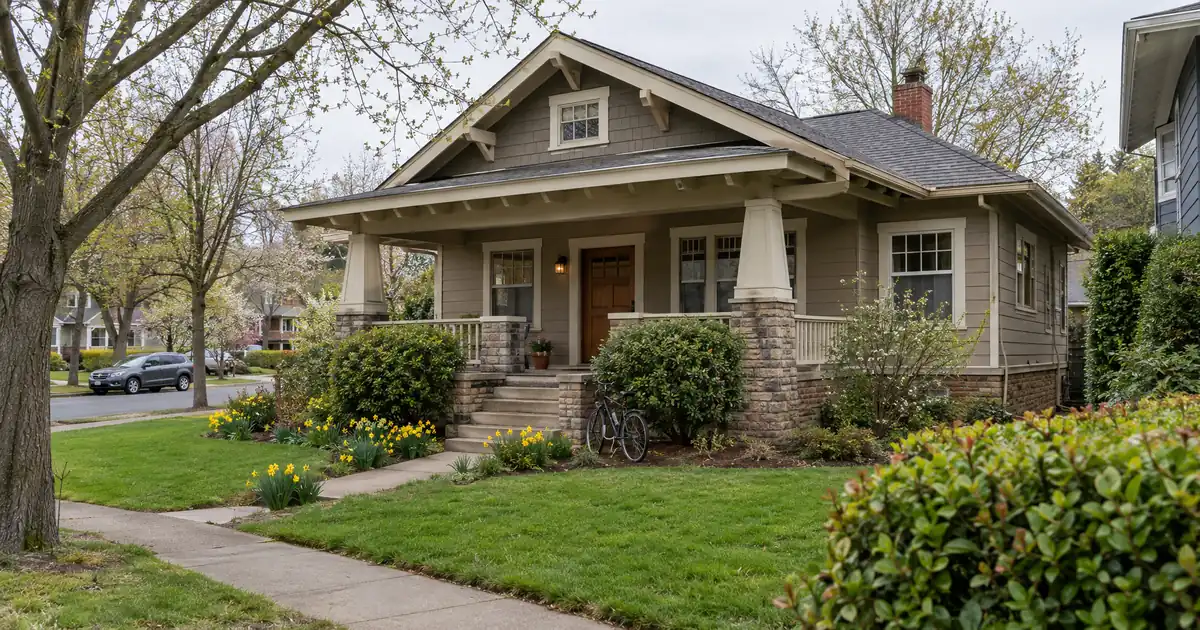
The Quick Read: Usually, yes. A roof on a rental you do not live in is an ordinary business use of cash-out money, and owning just one rental does not disqualify the loan. The real tests are your equity and whether the rent covers the new, larger payment.
- Cash-out on a standard rental tops out around 75% LTV (loan-to-value, the loan as a share of appraised value), subject to lender guidelines.
- The appraiser values the roof as it is today. A roof you have not replaced yet adds nothing to the value you borrow against.
- A bigger loan means a bigger payment, so the coverage ratio drops. Size the pull to the roofer’s bid plus a cushion, not to the maximum.
- Clearing the coverage test does not mean the property makes money. Repairs, vacancy, and capital costs sit outside it.
- A leaking roof can complicate the file, so refinancing before the roof fails is easier.
What the Lender Actually Tests
A DSCR cash-out refinance asks two questions: is there enough equity, and does the rent cover the new payment? Neither depends on how many properties you own. DSCR means debt service coverage ratio, which is monthly rent divided by PITIA (principal, interest, taxes, insurance, and any HOA dues).
DSCR Cash-Out Calculator
Run the cash-out numbers in your market
Rate source: Freddie Mac 30-yr average via FRED® — Federal Reserve Bank of St. Louis · effective Oct 15, 2026
Prefilled with starting assumptions — enter your property’s value, balance, taxes, and insurance for a more accurate picture.
Program parameters update from Lendmire’s centralized guideline source. Taxes and insurance are editable estimates.
As of Oct 15, 2026 · General Freddie Mac market benchmark, not a Lendmire loan offer. Property value, balance, taxes, and insurance are editable estimates. Maximum loan-to-value varies by lender, program, property type, and seasoning. Not a Loan Estimate, approval, or commitment to lend. Program availability and eligibility are subject to lender guidelines, credit approval, property review, and underwriting.
Here is how a roof-driven file moves, step by step.
1. Equity test. The new loan is capped by a cash-out LTV applied to the appraised value. Across our wholesale network, that ceiling is around 75% on a standard rental. The appraiser reports the value as is, with the old roof. The finished project is not credited. Everything is sized off what the property is worth today.
2. Rent test. The lender compares rent used for lender review to PITIA. Rent used for lender review comes from your lease or the appraiser’s market rent schedule (the standard appraisal forms are 1007 for single-family and 1025 for two-to-four units). Coverage of 1.00 is where many select programs start. A separate select-lender path takes coverage below 1.00, with leverage and terms adjusted. Stronger ratios usually open better pricing and leverage.
3. Credit and reserves. A 620 floor exists in parts of the network. Most programs want around 660, and 700 or higher unlocks the strongest leverage tiers. Reserves, meaning cash left over after closing, commonly run about 6 months of PITIA. Larger loans step up from there, and the exact count varies by lender, leverage, and loan size.
4. Seasoning. Seasoning is the waiting period between buying a property and cashing out on it. Expect about 6 months of ownership, measured from the date the title was recorded.
5. Documents. The file is property-focused: the roofer’s bid or contract, a short note on how you will use the proceeds, the lease or rent schedule, title and payoff information, insurance, and entity documents if an LLC holds title. Your own traditional personal-income documentation is not the center of the file. The loan is reviewed primarily on property-level rental income covering the payment, subject to lender guidelines. If your own income paperwork is the sticking point, Lendmire’s walkthrough on a rental cash-out refinance without business tax returns covers that side.
6. Funding. The cash arrives as one lump sum at closing. Pay the roofer from it and keep the invoice with your records.
One more point: the amount you can pull is never a fixed number. It depends on appraised value, your payoff, the LTV ceiling, reserves, and closing costs.
Does Having Only One Rental Change Anything?
Not for qualifying. It changes your risk. A DSCR file looks at the property, so a portfolio of one is judged the same way as a portfolio of ten. Conventional loans are different, because they count your personal debts and the number of financed properties you own.
The risk is concentration. One roof, one tenant stream, one payment. A property that clears the coverage test with a thin margin can still lose money in a month with a vacancy and a roofer’s invoice. DSCR compares rent to PITIA only. Repairs, management, utilities, vacancy, and capital costs are all outside the calculation.
So treat the coverage ratio as a minimum, not a comfort level. A single-rental owner should want cushion above whatever the lender requires. Keep reserves for a vacancy during the roof work, because tenants sometimes leave when a roof job drags on.
The program rules sit in Lendmire’s complete DSCR loans guide. The roof question comes down to sizing.
A Roof Example in Percentages and Ratios
Sizing is easier to see with a modeled example. These inputs are assumptions, not market data.
| Input | Modeled assumption | What it means |
|---|---|---|
| Appraised value (old roof, as is) | 100% | Baseline |
| Existing loan balance | 55% of value | Starting point |
| Cash-out ceiling, standard rental | 75% LTV | Up to 20 points of value to work with |
| Coverage before any pull | About 1.35x | Rent covers PITIA comfortably |
| Roof-sized pull plus cushion | A few points of value | Coverage dips to about 1.28x |
| Maximum pull | All 20 points, before costs | Coverage falls toward 1.10x |
Both pulls “fit” under the 75% ceiling. The maximum pull leaves almost no room for a vacancy, a repair, or a bigger payment. The roof-sized pull keeps your cushion.
Two more checks belong in this math. First, the new loan replaces your whole existing loan, not just the roof money. Compare the full new structure against what you have now. Second, closing costs come out of the pull. A small roof job on a modest equity position can leave very little after costs.
What If the Roof Is Already Leaking?
Then the file gets harder, not impossible. An appraiser reports the roof’s condition on the day of the inspection. A poor roof can be flagged, and the lender may ask for a roofer’s certification or a repair before closing. The exact condition standard is set by each lender. Insurers also look at roof age and condition, which can affect coverage on the property.
Government loan programs such as FHA and VA use their own roof remaining-life tests. Those tests do not automatically apply to a DSCR loan. A DSCR lender sets its own property-condition standards.
A leak is urgent. A refinance has steps, including an appraisal. The practical sequence is to stabilize the roof with a patch or temporary repair, then refinance while the property presents well. If the roof was damaged by a storm, an insurance claim may cover part of the work. Settle that first, because claim money and loan proceeds should not be double-counted.
Doing the refinance before the roof fails is the cleaner path. Waiting until the ceiling stains show up makes every step harder.
Is a Roof an Allowed Use of the Cash?
Yes. DSCR loans are designed for non-owner-occupied investment properties. Because they are business-purpose investor loans, they are reviewed differently from a standard owner-occupied mortgage. A roof is a capital improvement to a rental, which is about as clean a business use as exists. Doss Law’s summary of the business-purpose exemption notes that credit to acquire, improve, or maintain a rental you do not occupy is treated as business purpose. The same summary says the presumption weakens if you expect to occupy the home more than 14 days in the coming year. The CFPB’s truth-in-lending examination guidance adds that a checked business-purpose box with nothing behind it may be thin evidence. A short use-of-proceeds statement attached to the roofer’s bid solves that.
Proceeds are broadly flexible for investment purposes. Paying off personal consumer debt is the usual limit. If most of the cash would go to personal spending, the business-purpose story weakens. Plan the split before you apply.
Roof Funding Options Side by Side
A cash-out refinance is the right tool for a large, one-time need when you have equity. It is not always a more affordable path to a single expense.
| Option | Fits when | Main risk |
|---|---|---|
| Cash-out refinance | Equity is solid and rent covers a larger payment | Replaces your whole loan |
| Savings | Reserves can absorb the cost | Drains your cushion |
| Contractor payment plan | Cost is moderate and the roofer offers terms | Terms vary, with no equity use |
| Insurance claim | Damage came from a covered event | Coverage and payout are uncertain |
| Phased repair | The roof has life left | A larger failure later |
This one is a genuine toss-up for a small roof. The refinance can look like overkill if the roof job is modest and your existing loan is solid. For a full replacement on a property with real equity, it often wins.
Where These Files Stall
A few snags show up often on roof-driven cash-outs.
- Recent purchase. If you bought within about 6 months, cash-out may be off the table. Seasoning is lender policy, not law.
- Prepayment penalty on the current loan. DSCR loans commonly carry one, often for several years. Read your note first, because the penalty can eat a small roof-sized pull.
- Occupancy. DSCR is for non-owner-occupied investment property. If you plan to live there, this is the wrong product.
- Thin equity. If your balance already sits near the 75% cash-out ceiling, there is nothing to pull.
- Property type. Manufactured homes, log homes, and barndominiums fall outside these programs.
- LLC title. A rental held in an LLC can still work, subject to program eligibility.
Should You Do It? A Checklist
Run this before you apply:
1. Do you have a written roofer’s bid?
2. Is there enough equity at the 75% cash-out ceiling after your payoff and costs?
3. Does rent still cover the larger payment with room to spare, not just at the minimum?
4. Have you checked the prepayment penalty on your current loan?
5. Can your reserves cover a vacancy during the roof work?
If any answer is no, pause before applying. Terms vary by lender guidelines, property type, leverage, credit profile, and full file review.
Skip the refinance in those cases.
Tax treatment can depend on how the funds are used and how the property is held; investors should keep clear records and speak with a qualified tax professional before relying on any deduction.
Key Terms Defined
Cash-out refinance: A new, larger loan that pays off your old one and sends you the difference in cash.
Seasoning: The ownership period a lender wants before allowing a cash-out.
Prepayment penalty: A fee some investor loans charge if you pay them off early.
As-is value: The appraised value of the property in its current condition, with no credit for planned work.
Capital improvement: Work that extends a property’s life, such as a new roof, as opposed to a minor repair.
Frequently Asked Questions
Can I use the cash for things other than the roof?
Yes, within limits. Proceeds are broadly flexible for investment purposes, and personal consumer debt is the usual restriction. If the money mostly funds personal spending, the business-purpose case weakens. Document the roof bid and any other planned use.
Will the appraiser inspect the roof?
The appraiser reports the roof’s condition as part of the property review. A poor roof can be flagged, and the lender may ask for a roofer’s certification or a repair. The exact requirement varies by lender, so a roof in decent shape keeps the file simple.
Can I refinance if the roof is already leaking?
Sometimes, but it is harder. Appraisers value the property as it is on inspection day, and an active leak can stall a file. A temporary repair first usually helps. Each lender sets its own condition standard.
Does it matter if my rental is in an LLC?
It can change which products fit, but a DSCR cash-out may still work, subject to program eligibility. Hunton Andrews Kurth’s analysis notes that loans to entities are exempt from consumer-credit rules, while also cautioning that business purpose does not mean free of compliance. Expect entity documents in the file.
Do FHA or VA roof rules apply?
No. Those programs use their own appraisal standards. A DSCR lender sets its own property-condition rules, so the roof test comes from the lender, not from an agency.
Next Step
If you are buying or refinancing a rental property and want to see how the numbers work, Lendmire can help you compare DSCR loan options based on the property income, credit profile, leverage, and investor goals. Lendmire is a mortgage broker arranging financing through select lenders in its wholesale network, covering 41 markets, including Washington, D.C. Call 828-256-2183 or request a quote, and have your roofer’s bid ready. Eligibility review depends on lender guidelines, and nothing here is a commitment to lend.
Investors weighing their equity options can start with Lendmire’s guide to cash-out refinance on an investment property.
About Lendmire
Lendmire (NMLS# 2371349) is a mortgage brokerage built around DSCR investor lending, with programs available in 41 markets, including Washington, D.C. DSCR lenders commonly evaluate rental-income coverage instead of personal income paperwork — a practical fit for LLC-owned and multi-property investors. Terms vary by lender, property, leverage, and program. Scotsman Guide named Lendmire a Top Mortgage Workplace in both 2025 and 2026.
Get Started
Ready to find the right loan for you?
In about 30 seconds you can review financing options available for your investment property. No commitment required.
Informational only. Not a Loan Estimate, approval, or commitment to lend. Program availability and eligibility are subject to lender guidelines, credit approval, property review, and underwriting.
References
1. Doss Law, Business Purpose Exemption Simplified
2. CFPB, Truth in Lending Act examination guidance
3. Hunton Andrews Kurth, Beware of Business Purpose
This article is part of Lendmire’s investment property cash-out refinance program — full qualification details, guidelines, and scenarios live on the program page.
Related reading: How to Cash Out a Coastal Rental After Hurricane Damage on a DSCR Loan · How to Fund a Rental Remodel With a HELOC and Refinance to DSCR · How Much Cash a First-Time Landlord Can Pull From a DSCR Cash-Out
Brandon Miller
Founder & CEO, Mortgage Loan Originator, Lendmire LLC
- Mortgage Loan Originator · NMLS# 1129696 · Verify on NMLS Consumer Access
- North Carolina Real Estate Broker · License# 343312 · Verify on NCREC
- North Carolina Insurance Producer · License# 19053198 · Property, Casualty, Life, Health · Verify on NAIC SBS
- Lendmire LLC · Firm NMLS# 2371349 · Verify firm licensure
Disclosure information. Lendmire is a state-licensed mortgage brokerage under NMLS# 2371349. Lendmire is not a depository institution, direct lender, or financial advisor — all loans referenced are placed through wholesale lender partners and are subject to each lender's underwriting standards. This article is provided for general informational purposes and is not a commitment to lend, nor does it constitute financial, legal, or tax advice. Loan programs, terms, rates, and qualification standards change without notice and depend on borrower profile, property type, and the state in which the subject property is located. Equal Housing Opportunity provider. NMLS Consumer Access: nmlsconsumeraccess.org.