
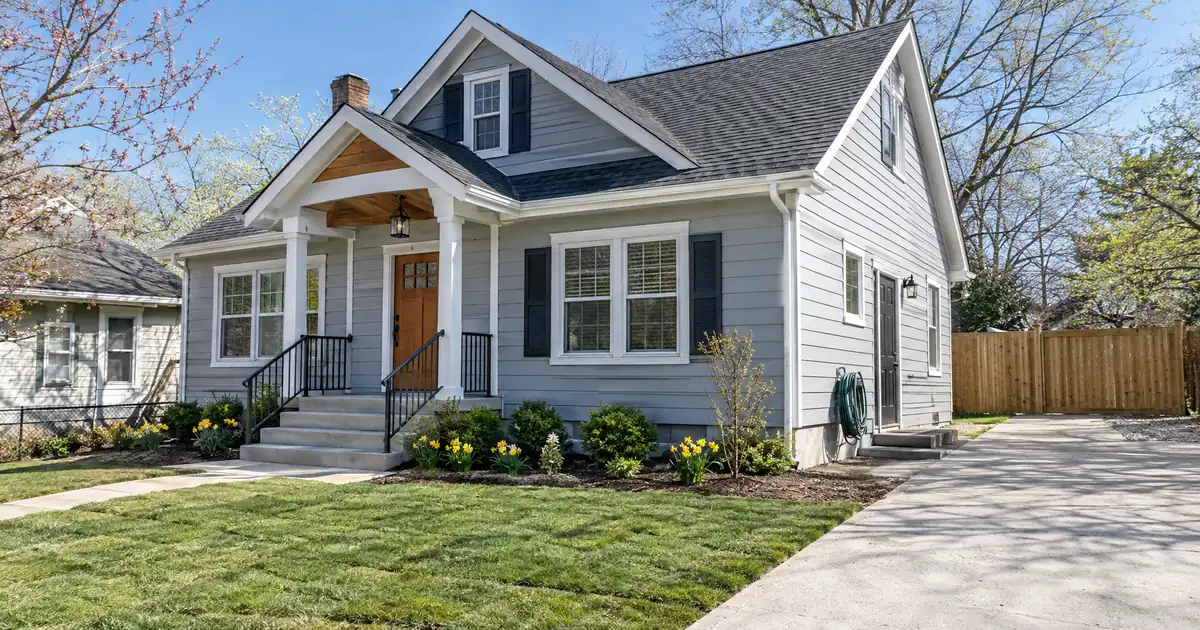
The Quick Read: Vacant units can be carried on a hard money note and refinanced into a DSCR loan, because the appraiser’s market-rent opinion stands in for a signed lease on programs that qualify on property income. The bridge has to outlast the rehab, the ownership clock, the appraisal and underwriting, subject to lender guidelines.
- On a vacant unit, the rent counted is the appraiser’s market rent, not your asking rent and not a projection you supply.
- Seasoning runs from the recorded deed, and about 6 months of ownership is the common expectation for a DSCR cash-out.
- The standard DSCR cash-out ceiling is 75% of value, and a payoff-only refinance returns no cash.
- Clearing 1.00 coverage is not the same as positive cash flow while units sit empty.
- Hard money typically runs 6-18 months, interest-only, so plan the exit before the bridge closes (varies by lender, property, and experience).
A vacant building feels like a weaker file. On many DSCR programs it isn’t, but it shifts the weight onto three things: the appraisal, the calendar, and what the building costs you every month it sits empty. This article walks through the mechanics in order, from how each loan views a vacant unit to the questions worth putting to a lender in writing.
Key Terms Defined
- DSCR: the monthly rent used for qualifying divided by the full monthly obligation (principal, interest, taxes, insurance, and any HOA dues).
- PITIA: that full monthly obligation, the denominator of the ratio.
- Market rent: the rent an appraiser concludes a unit would command, based on local comparable rentals.
- Rent-ready: finished, habitable and marketable, with no open work that raises condition questions.
- Seasoning: how long you have owned the property, measured from title recording.
- Payoff-only refinance: a rate-and-term refinance that covers the bridge and closing costs and returns no cash.
- Cash-out refinance: any refinance that returns cash beyond that, with tighter leverage and the seasoning rule.
- Rent schedule: the appraisal attachment where the appraiser reconciles comparable rents into one monthly figure.
How the Bridge and the Exit View a Vacant Unit Differently
Hard money sizes on the project and its plan. A DSCR loan sizes on value and rental coverage. Vacancy is expected on the first loan and examined on the second.
| Factor | Hard money bridge | DSCR take-out |
|---|---|---|
| Sizes on | Project cost, capped by after-repair value | Appraised value and rent coverage |
| Vacant unit | Normal during rehab | Counted at appraiser’s market rent |
| Key document | Rehab budget and draws | Appraisal with rent schedule |
| Term | 6-18 months, interest-only | Long-term, 30-year fixed spine |
On the bridge side, fix-and-flip leverage runs up to 93% of project cost for investors with 5+ completed projects, 90% at 2+, and 85% below that, each capped at 75% of after-repair value. Bridge purchases without rehab go up to 80% of purchase price, and up to 100% of the rehab budget funds in draws against completed work. Those are loan-to-cost figures, and they vary by lender, property, and experience. Nothing there is a commitment to lend.
The exit looks different. A DSCR cash-out refinance tops out at 75% of value on a standard rental, with about 6 months of seasoning. A rate-and-term DSCR refinance can go to 85% of value but returns no cash. The DSCR minimum on these programs is 1.00 coverage, with credit tiers starting at a 620 floor and reserves around 6 months of PITIA. Sub-1.00 coverage is available through select lenders in the network, with leverage and terms adjusted. All of it is subject to lender guidelines.
Notice what changed between the two. Your after-repair estimate sized the bridge. The lender’s own appraisal sizes the exit.
How a DSCR Lender Counts Rent When Units Are Empty
A vacant unit is counted at the appraiser’s market rent, so no lease is needed for the rent side of the test on programs that qualify on property income. The appraiser’s number becomes the single point of failure, which is why a finished unit in a market with strong rental comps matters.
The mechanism is an appraisal form. The Freddie Mac and Fannie Mae comparable rent schedule is the form lenders use to get market rent for a single-family investment property from the appraiser. It carries a grid of comparable rentals, comments on rent trends and area vacancy, and a final reconciled monthly figure. Fannie Mae’s appraiser guidance describes it as documenting monthly market rent, and notes it is not built to estimate nightly short-term-rental rates. For 2-4 units the counterpart is Form 1025, which reports rents unit by unit. HUD uses the same pairing, an appraisal plus a fair-market-rent schedule, for proposed rental income. That is only a sign that “no lease, appraiser rent” is a familiar industry device. These agencies do not set DSCR terms. Each DSCR lender writes its own.
On a leased unit, many programs count the lower of the lease and market rent. An above-market lease adds nothing. A below-market lease can drag coverage down. A vacant unit sidesteps that problem entirely.
| Unit status | Rent used | Typical reading | First move |
|---|---|---|---|
| Fully leased | Lower of lease or market | Lease can cap the number | Compare lease to comps |
| One unit empty | Lease on one, market on other | Mixed rent roll | Ask for per-unit rents |
| All units empty, rent-ready | Market rent on every unit | Appraisal carries the file | Finish punch list, stage |
| Unit needing work | Often unresolved | Condition questions | Finish work before ordering |
| Month-to-month | Lower of tenancy or market | Lender-specific | Ask in writing |
Partial vacancy in a 2-4 unit building is handled through the appraiser’s per-unit market rents. How a given lender treats the mix varies, so ask before you order the appraisal.
Coverage Is Not Cash Flow (Especially on a Half-Empty Building)
Clearing 1.00 coverage is a qualification test, not a profit measure. The ratio compares rent to PITIA only. Repairs, vacancy, management, utilities and capex sit outside it.
A building can pass on market-rent assumptions and still bleed cash while units sit empty. Picture a fourplex with two units leased and two empty. The appraiser credits market rent on all four, and coverage clears. Meanwhile you are paying bridge interest, taxes, insurance and utilities on two dark units. The file qualifies. Your bank balance disagrees.
Treat the DSCR number as a gate, then run a separate carry model for the months before stabilization.
The Carry-Cost Model for Vacant Units
Every month of vacancy during seasoning costs you hard money interest, taxes, insurance, utilities and basic maintenance. Add them up per unit, then multiply by the months between rehab completion and exit.
A simple worksheet has these lines per month:
1. Hard money interest on the drawn balance.
2. Property taxes and insurance.
3. Utilities on empty units (heat to prevent freeze damage, minimal electric, water).
4. Lawn, snow, locks, and basic upkeep.
5. Marketing and leasing costs, if you lease before the exit.
Now run the comparison in index units. Say a unit’s monthly carry is 1.0 index unit, and the building waits 6 extra months for the seasoning clock. That is 6.0 index units of carry per unit that comes out of the equity you hoped to recycle. A four-unit building with all four dark carries roughly 24 index units across the wait. Lease two units early and the same wait drops toward 12, though you then manage tenants and a lease-term choice.
That is the core trade-off. Waiting raises the proceeds ceiling, because the appraisal replaces cost as the sizing basis, but it taxes your cash every month. A bargain buy with heavy rehab pays out fully only after the clock runs. Run the carry math before you decide whether waiting beats a payoff-only refinance now.
One carry item deserves its own warning. Standard landlord policies commonly limit coverage for perils like vandalism, water damage, glass breakage and theft after a vacancy window, often 30 to 60 days. Obie’s explainer on vacancy clauses describes the pattern and points to a vacancy permit endorsement or a separate vacant-property policy as the fix. The exact trigger sits in each policy, and a Pennsylvania agency’s guide states there is no universal standard. A lender wants evidence of insurance at closing, so a policy with a lapsed vacancy provision is a practical risk to fix early.
Back-Solving the Timeline
Work backward from the hard money maturity. The note must outlast the rehab, any lease-up, the seasoning clock, the appraisal and underwriting.
| Milestone | What it depends on | Decision date |
|---|---|---|
| Deed recorded | Purchase closing | Seasoning clock starts here |
| Rehab complete | Draws, permits, punch list | Order appraisal only when rent-ready |
| Lease-up (optional) | Market, lease terms | Decide before rehab ends |
| Seasoning met | About 6 months from title | Cash-out gate on standard programs |
| Appraisal and underwriting | Report, payoff letter, reserves | Start with room before maturity |
| Bridge maturity | 6-18 month term | Trigger for extension or two-step plan |
Rehab and lease-up drive the calendar, not just the coverage test.
A short note on a heavy rehab is a trap. If your term ends before the clock does, you have three options: an extension, a two-step approach (payoff-only now, cash-out later), or a sale. Check prepayment terms on the new loan before choosing the two-step, since a penalty can interfere with step two. Hard money on this program carries no prepayment penalty, which helps on the bridge side, but the take-out loan’s terms are its own.
Many investors refinance out of hard money into long-term DSCR financing once the property is stabilized, and Lendmire arranges that path through its wholesale network; the hard money exit refinance program page covers how the handoff works.
Lease-Up Moves That Help Underwriting
Leasing before the exit is optional on programs that accept market rent, but it can reduce uncertainty. If you do lease:
- Sign at a supportable market rent. An above-market lease won’t raise the number, and a below-market lease can lower it.
- Collect and document the deposit and first month’s rent.
- Keep the lease, deposit proof and any renewal paperwork in the file for each unit.
- Avoid a long-term lease at a discount just to show occupancy.
If a unit is below market after a quick lease-up, renewing at a supportable market rent before the appraisal is a common fix. A vacant, rent-ready unit avoids the issue.
Lease First, Refinance Vacant, Pay Down, or Extend?
The right path depends on the gap between coverage and your carry. Use this as an if/then guide.
| Situation | Likely path | Trade-off |
|---|---|---|
| Rent-ready, strong comps, seasoning met | Refinance vacant | Appraisal carries the file |
| Rent-ready, weak or uncertain comps | Lease first at market | Adds tenant management |
| Coverage short on the appraisal | Pay down at closing | Uses cash you wanted to recycle |
| Seasoning not met, bridge ending | Extend or payoff-only now | Delays or limits proceeds |
| Rehab unfinished | Finish before ordering | More carry, cleaner file |
If the appraisal rent comes in short, work the fix ladder from lightest to heaviest. Check the report for errors, then trim the draw, pay down at closing, sign or renew at market rent, or ask for reconsideration with better comps. After that, a longer term or interest-only period on select programs can improve coverage, and a sub-1.00 coverage path is available through select lenders in the network, with leverage and terms adjusted. Finally, a payoff-only refinance now with cash-out later is a fallback. Whether any of it applies is subject to lender guidelines, credit approval and property review.
Two ceilings govern the loan, and only one binds. Either the 75% value cap or the coverage floor limits the amount, so a bigger cash-out request means a bigger payment and a lower ratio.
Where the General Rule Breaks
Delayed financing won’t rescue a hard money purchase. It is an agency exception for cash buyers, and it waives only the clock. A hard money lien on the subject property generally breaks the no-purchase-financing test. Coverage, appraisal and leverage still apply.
Seasoning is not uniform. AirDNA’s BRRRR explainer reports that some lenders require 6 to 12 months and some investor-friendly lenders waive it. Those are market surveys. Across the network Lendmire places files with, about 6 months from title recording is the common DSCR cash-out expectation. Get the clock in writing before the bridge closes.
Re-titling into an LLC. Moving a property into an entity after purchase can trigger extra title review, and some lenders may restart seasoning. Ask before you re-title, subject to program terms.
Short-term rentals. The rent schedule is a monthly-rent tool. Short-term-rental files run on a different income method with their own leverage caps, a 640+ score expectation and about 12 months of hosting history.
Property types. Manufactured homes, log homes and barndominiums are not offered in these DSCR programs.
Rent-controlled or unusual properties. These can break the normal comps process and are treated lender by lender.
Experience From the Broker’s Desk
On vacant BRRRR files, the stall rarely comes from the vacancy itself. It comes from a calendar that was never back-solved: a bridge that matures a few weeks short of the seasoning clock, or an appraisal ordered before the punch list was done. The files that move cleanly pair a finished unit with a note term that outlasts the wait, and they ask each lender the same written questions before the deed records.
Documentation Checklist
Per property:
- Hard money payoff letter.
- Entity documents, subject to lender program eligibility.
- Rehab budget, draw history, receipts, permit closeouts and photos.
- Evidence of insurance, with vacancy provisions checked.
- Reserves verification, commonly around 6 months of PITIA, varying by lender, leverage, and loan size.
Per unit:
- Appraiser’s market rent line.
- Lease, deposit and first-rent proof if the unit is leased.
- Condition photos showing rent-ready status.
- Utility status for empty units.
Common Mistakes
1. Starting the clock at rehab completion. It runs from the recorded deed.
2. Counting on your own ARV. The lender’s appraisal sets value.
3. Counting asking rent. The appraiser’s market rent is the number.
4. Reading coverage as cash flow. The ratio ignores carry.
5. Assuming a bigger down payment shortens seasoning. Absent a specific carve-out, it doesn’t.
6. Ignoring the vacancy clause. A standard policy may narrow coverage on an empty building.
7. Ordering the appraisal on unfinished work. Condition questions land on the vacant unit hardest.
Questions to Put to the DSCR Lender in Writing
Advice online contradicts itself on whether a tenant is required, because each lender writes its own policy. Settle it per file:
1. Does this program accept appraiser market rent on a vacant unit?
2. Where does the seasoning clock start, and does a documented rehab change it?
3. Is the loan sized on cost or appraised value at my ownership date?
4. For a partly vacant 2-4 unit building, how are per-unit rents counted?
5. What are the reserve requirements at my leverage and loan size?
6. What happens to seasoning if I re-title into an LLC?
7. Is there a prepayment term that affects a two-step plan? Terms depend on the lender’s guidelines, the property type, the leverage, and a full review of the credit profile.
For the full program picture, see Lendmire’s complete DSCR loans guide. For the appraisal side of the handoff, Lendmire’s piece Does a BRRRR Hard Money ARV Carry Into the DSCR Refinance Appraisal? goes deeper. Tax treatment varies, so consult a qualified professional before relying on any deduction.
Frequently Asked Questions
Can I refinance hard money into a DSCR loan with vacant units?
On many programs, yes. The appraiser’s market rent replaces a lease for the rent side of the test. The property still needs to be rent-ready, the ownership clock has to be met for a cash-out, and qualification is subject to lender guidelines, credit approval and property review.
What rent is used when there is no lease?
The appraiser’s reconciled market rent, built from local comparable rentals. You and your broker cannot supply that number. On a leased unit, many programs use the lower of the lease and the market rent.
Can I cash out while some units are empty?
Often, once seasoning is met, up to 75% of value on a standard DSCR cash-out. Inside the first months, the loan is typically sized on cost rather than appraised value. A payoff-only refinance returns no cash and is the usual alternative while the clock runs.
What if my hard money loan matures before the units lease or the clock runs?
The usual options are an extension, a two-step plan with a payoff-only refinance first and cash-out later, or a sale. Check prepayment terms on the new loan before committing to two steps, and plan a bridge term that outlasts the wait.
Does passing the coverage test mean I will cash flow?
No. The ratio compares rent to PITIA only. Vacancy, repairs, management, utilities and capex sit outside it, so a half-empty building can qualify and still lose money each month.
If you are buying or refinancing a rental property and want to see how the numbers work, Lendmire can help you compare DSCR loan options based on the property income, credit profile, leverage, and investor goals. Reach the team at 828-256-2183 or request a quote through Lendmire’s quote page.
About Lendmire
Lendmire — NMLS# 2371349 — is a DSCR and non-QM mortgage brokerage with investor loan programs in 41 markets, including Washington, D.C. DSCR eligibility is commonly reviewed by the lender around property-level rent rather than personal income documentation, subject to lender guidelines, and the brokerage helps arrange financing for LLC-owned portfolios beyond conventional financed-property limits. Recognized by Scotsman Guide as a Top Mortgage Workplace in 2025 and 2026.
Get Started
Ready to find the right loan for you?
In about 30 seconds you can review financing options available for your investment property. No commitment required.
Informational only. Not a Loan Estimate, approval, or commitment to lend. Program availability and eligibility are subject to lender guidelines, credit approval, property review, and underwriting.
References
1. Freddie Mac Form 1000 / Fannie Mae Form 1007
2. Fannie Mae Appraiser Update
3. Obie, Vacancy Clause Insurance
4. AIG Ltd. (PA agency), Landlord Insurance for Vacant Rentals
This article is part of Lendmire’s hard money loan program — full qualification details, guidelines, and scenarios live on the program page.
Related reading: How a DSCR Lender Handles a Release on a Maturing Loan · Can BRRRR Rehabs Go in a DSCR Portfolio Loan Before Leasing? · One DSCR Loan vs Ten Individual Loans for Ten Houses
Brandon Miller
Founder & CEO, Mortgage Loan Originator, Lendmire LLC
- Mortgage Loan Originator · NMLS# 1129696 · Verify on NMLS Consumer Access
- North Carolina Real Estate Broker · License# 343312 · Verify on NCREC
- North Carolina Insurance Producer · License# 19053198 · Property, Casualty, Life, Health · Verify on NAIC SBS
- Lendmire LLC · Firm NMLS# 2371349 · Verify firm licensure
Compliance and disclosures. Lendmire (NMLS# 2371349) is a licensed mortgage broker and is not a direct lender, depository institution, financial advisor, or tax professional. Content in this article is general market analysis and educational information — not financial, legal, or tax advice for any specific situation. Lendmire does not guarantee loan approval; every transaction is subject to underwriting by the funding lender. Mortgage pricing and loan program guidelines are subject to change at any time without notice and vary by borrower characteristics, property type, and state regulations. Lendmire complies with Equal Housing Opportunity. Licensure verification: NMLS Consumer Access.