
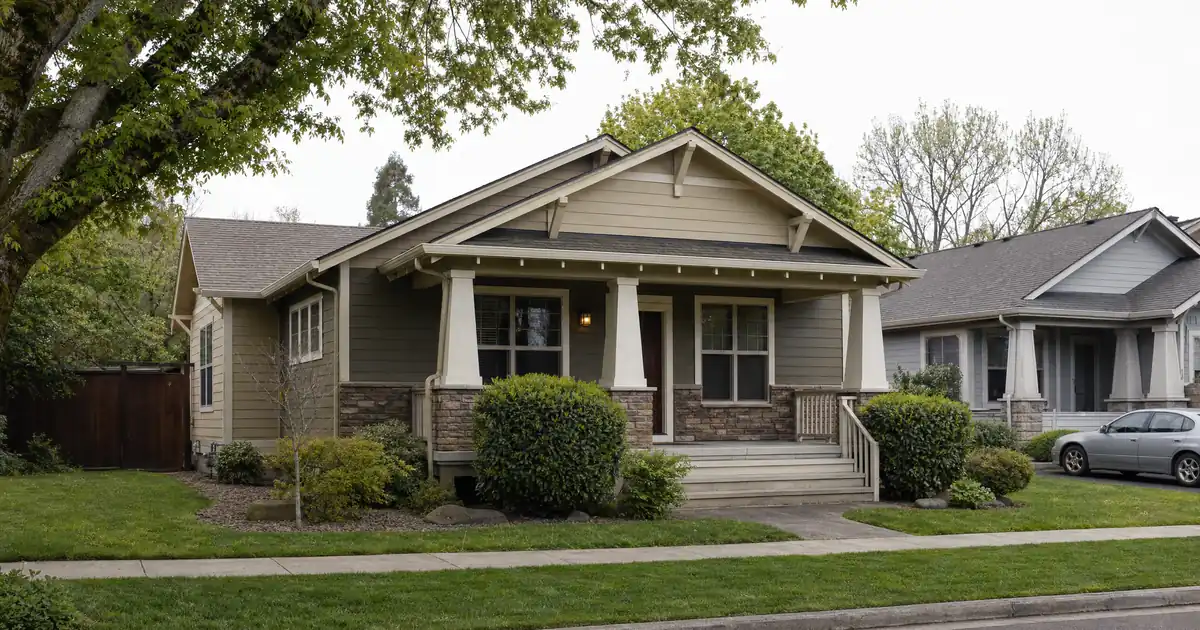
30 Year Mortgage Refinance Investment Property — The Quick Read: A 30-year refinance on a rental property works differently than a refinance on your own home. Most lenders in Lendmire’s wholesale network qualify these loans using the property’s rent-to-payment ratio. This ratio is called a DSCR, or debt-service-coverage ratio. It looks at the property’s income, not your paycheck. Purchase loans commonly land at 75%-80% loan-to-value. Rate-and-term and cash-out refinances typically cap around 75%. The sections below walk through how this works, what structures exist, and where the general rules break down.
Key Takeaways
- DSCR loans qualify the property, not the person: rent divided by the full monthly housing obligation is the core number, and select programs start at a 1.00 floor.
- Purchase leverage on most files runs 75%-80% LTV; select high-leverage programs reach 85% for borrowers with roughly a 700+ credit score.
- Rate-and-term and cash-out refinances typically cap around 75% LTV, with about six months of ownership seasoning as the common expectation across the network for cash-out transactions.
- The 30-year fixed is the backbone of this product. Extended 40-year terms and interest-only periods exist through select lenders for investors who want lower monthly obligations over payoff speed.
- Clearing 1.00 DSCR is not the same thing as positive cash flow. Vacancy, repairs, management fees, and capital expenses sit entirely outside the ratio.
Key Terms Defined
DSCR (debt-service-coverage ratio) — divide the property’s monthly rent by its full monthly housing payment, and you get this number. Above 1.00 means the rent covers the payment with room to spare.
DSCR Calculator
Run the numbers in your market
Rate source: Freddie Mac 30-yr average via FRED® — Federal Reserve Bank of St. Louis · effective Jul 30, 2026
Prefilled with local estimates — enter your own rent or nightly figures, taxes, insurance, and HOA for a more accurate picture.
Program parameters update from Lendmire’s centralized guideline source. Taxes and insurance are editable estimates.
As of Jul 30, 2026 · General Freddie Mac market benchmark, not a Lendmire loan offer. Rent, nightly rate, occupancy, taxes, and insurance are editable estimates. Short-term rental figures are estimates only and vary significantly by season, property type, management approach, and local short-term-rental rules — confirm local regulations before relying on them. Qualifying income for short-term rentals varies by program — some use appraisal market rent, others use documented STR history or projections — and is confirmed in underwriting. Not a Loan Estimate, approval, or commitment to lend. Program availability and eligibility are subject to lender guidelines, credit approval, property review, and underwriting.
PITIA — this stands for principal, interest, taxes, insurance, and association dues. Add them together and you get one monthly figure. That figure shows the full cost of holding the loan.
LTV (loan-to-value) — this is the loan amount shown as a percentage of the property’s appraised value. Lower LTV means more equity cushion for the lender.
Seasoning — this is the waiting period a lender wants before a refinance goes through. Lenders usually count it from the purchase date or from when a property was listed for sale.
Business-purpose loan — this is financing made for an investment or business reason, not personal use. This classification lets DSCR loans get underwritten around rental income instead of a personal debt-to-income ratio.
Cash-out refinance — this is a new, larger loan that pays off your existing balance. You get the difference back in cash.
Non-QM — this is the broad category of mortgage loans that fall outside the “qualified mortgage” framework built for owner-occupied lending. DSCR loans live in this category. It’s grown into a real, liquid corner of the mortgage market, not a niche sideline.
What a 30-Year DSCR Refinance Actually Is
A 30-year DSCR refinance replaces an existing loan on a rental property with a new, fully amortizing loan. The lender sizes it against the property’s appraised value and qualifies it against its rent. This is not a personal-income refinance wearing a different label. It’s a business-purpose loan built around the asset’s cash flow.
That distinction matters because it changes what gets documented. Instead of traditional personal-income paperwork and pay stubs, the file leans on the lease, a market-rent analysis, and the resulting coverage ratio. An investor whose Schedule E shows a loss after depreciation can still refinance a stabilized property into a fresh 30-year term. Why? Because the coverage figure comes from the rent roll, not the 1040.
DSCR loans are built for non-owner-occupied investment properties. Because they are business-purpose investor loans, lenders review them differently than a standard owner-occupied mortgage. The documentation differs. The qualifying math differs. And the underwriting lens on risk differs too. Lendmire’s complete DSCR loans guide walks through the full mechanics if you want the basic framework before diving into refinance specifics.
How Underwriting Actually Treats It, Step by Step
Every DSCR refinance moves through the same rough sequence, whether it’s a rate-and-term or a cash-out. Knowing the order helps you spot where a file can stall.
Step 1 — Purpose classification. The lender first confirms the loan is business-purpose, not personal. On a cash-out, proceeds generally need to trace back to the rental business. Maybe that means another acquisition. Maybe a rehab. Maybe reserves for the portfolio. What proceeds cannot do is fund personal spending. This step is the gate that determines how the rest of the file gets built.
Step 2 — Rent gets documented, not income. For a one-unit rental, an appraiser typically completes a single-family comparable rent schedule (Fannie Mae Form 1007) as part of the appraisal. For a two-to-four-unit property, the appraiser instead completes a small residential income property report (Fannie Mae Form 1025). These forms weren’t built for DSCR lending specifically. They’re agency-designed tools. Non-QM lenders across the industry have adopted them as the standard way to establish market rent — even though the loan itself never touches an agency.
Step 3 — The ratio gets calculated. Rent divided by PITIA gives you the DSCR. Programs Lendmire places files with typically start at a 1.00 floor on the conservative end. That’s a starting point for specific programs, not a universal minimum. Stronger ratios open better pricing and leverage. A ratio comfortably above 1.00 gives you room. A ratio near it means the file leans harder on reserves, credit, and lower leverage to compensate.
Step 4 — Leverage gets set against the appraisal. LTV runs off the appraised value. On a cash-out, the gap between your current balance and the new appraised value — at whatever the program’s ceiling allows — determines how much equity actually comes out.
Step 5 — Reserves and credit round out the file. Reserve requirements vary by lender, leverage, loan size, and transaction type. But they commonly land around six months of PITIA held in liquid accounts after closing. Conservative rate-and-term refinances at modest leverage under $1,500,000 sometimes see reserves waived entirely. Loans above that size typically step up toward nine months. Credit floors sit around 620 in parts of the network. Most programs want closer to 660. And a score of 700+ unlocks the strongest leverage tiers.
Step 6 — Closing on a fully amortizing note. The standard structure is a 30-year fixed-rate loan. Every payment from month one applies to both principal and interest. There’s no deferred balance and no balloon — unless you’ve specifically opted into an interest-only period.
The Structures That Actually Exist
A rate-and-term refinance replaces the loan without pulling cash out. A cash-out refinance replaces it with a larger balance and returns the difference. Beyond that basic split, the structural choices come down to term length and amortization style. This is where investors have more flexibility than most primary-home borrowers realize.
The 30-year fixed is the default across the network. It’s the right call for most buy-and-hold investors chasing a stable, predictable obligation. Select lenders also offer 40-year fixed terms and interest-only periods for investors who want lower monthly carry over faster payoff. This can be useful on a property where the coverage ratio is tight and every bit of monthly cushion matters. ARM structures exist too, for investors who want initial flexibility and plan to sell or refinance again before the fixed period ends.
| Structure | Monthly Obligation | Equity Build | Best Fit |
|---|---|---|---|
| 30-year fixed | Standard, fully amortizing | Steady, moderate pace | Most buy-and-hold investors |
| 40-year fixed | Lower than 30-year on the same balance | Slower | Tight-coverage files needing cushion |
| Interest-only period | Lowest during the IO window | None during IO, then resumes | Cash-flow-first strategies, planned exit |
| ARM | Fixed for an initial period, then adjusts | Depends on hold period | Investors expecting to refinance or sell |
Loan size runs roughly up to $3,000,000 on standard programs. Smaller balances route through select lenders in the network built for that end of the market. Above $2,500,000, the network generally holds to 30-year fixed structures rather than extended-term or IO variations — bigger balances get simpler amortization. A handful of states carry overlays with tighter limits. Connecticut, Florida, Illinois, and New Jersey are among them. In these states, purchase LTV generally caps near 75%, and loan amounts cap around $2,000,000 — regardless of what a borrower’s credit profile might otherwise support elsewhere.
Some investors would rather tap equity without resetting an existing low-rate first mortgage. For them, an investment-property HELOC is worth a look. Those lines cap at $500,000 total across the network, with no tier above that ceiling. It’s a narrower tool than a cash-out refinance, but it leaves the first lien untouched. Lendmire’s guide on refinancing when there’s no mortgage left covers the related scenario of pulling equity from a free-and-clear property. The cost breakdown for refinancing an investment mortgage is also worth reading before comparing a HELOC against a full refinance.
Where the General Rule Breaks
Seasoning isn’t one number, and it isn’t federal — it’s a lender-by-lender guideline that shifts based on what kind of transaction you’re doing. Across the wholesale network, cash-out refinances commonly expect around six months of ownership before the deal moves forward. Some lenders instead measure a shorter title-seasoning window, tied to when the deed was recorded rather than when the loan closed. A property that was actively listed for sale in the recent past can also reset the clock. Several programs want to see the listing pulled and enough time passed before treating a refinance as a true cash-out rather than a disguised purchase.
Credit and leverage move together. This is where a marginal file gets squeezed from two directions at once. A lower credit score doesn’t just raise your rate exposure — it tightens the maximum LTV a lender will approve on a cash-out. Push your score down near the 620 floor, and the leverage ceiling comes down with it. Push it up past 700, and better leverage tiers open up. This is one of the more common places where an otherwise strong file gets restructured mid-underwriting once the appraisal and credit report land.
Occupancy intent can quietly break the entire qualification path. Business-purpose classification depends on what the loan is actually for. So a refinance on a property the borrower plans to occupy — even part-time — can pull the transaction back into consumer-credit territory. That disqualifies it from DSCR underwriting altogether. This is why occupancy gets documented explicitly, not assumed.
Property type reshapes the file more than almost anything else. Two-to-four-unit properties route through the Form 1025 income analysis instead of the single-family rent schedule. That changes how the DSCR gets built. Short-term rentals get their own lane entirely. Purchase leverage on STRs typically tops out at 75%. Refinances and cash-outs generally run closer to 70%. And lenders usually want a 640+ credit profile, roughly twelve months of hosting history, and a 1.00 DSCR floor calculated off trailing rental income rather than a standard lease. The standard rent-comparison forms weren’t built for nightly-rate income. So an STR file often needs supplemental income documentation beyond the appraisal alone. Short-term rental rules can also vary by city, county, HOA, and property type, so investors should confirm local rules before relying on projected rental income. Lendmire’s DSCR refinance page and its cash-out refinance guide both go deeper on how these transaction types get structured.
And some property types simply aren’t offered through the network’s DSCR programs at all. Manufactured homes — both single- and double-wide — along with log homes and barndominiums fall outside these guidelines entirely. That’s not a “harder file” situation. It’s a program that doesn’t exist for that asset class, full stop.
The Investor Decision in Practice
Say an investor holds a small rental purchased several years back. It’s now appraised well above the original price and financed conservatively at low leverage. A rate-and-term refinance at 70% LTV against today’s appraised value could clear a strong coverage ratio — comfortably north of 1.00x — with plenty of room to spare. Why? Because the rent has grown while the old loan balance hasn’t. Exact terms depend on the lender’s guidelines, property type, leverage, and a full review of the borrower’s file.
Now push that same property into a cash-out refinance at 75% LTV instead, and the math shifts. Pulling the balance up toward the ceiling raises the monthly obligation. That pulls the coverage ratio down — maybe from a comfortable 1.35x on the rate-and-term scenario to something closer to 1.05x on the cash-out version. It’s still above the 1.00 floor most programs use as a starting point. But there’s meaningfully less cushion.
This is the honest tension in every cash-out decision: a bigger loan lowers your coverage ratio even as it hands you more usable equity. A larger down payment or lower leverage lifts DSCR and lowers the monthly carry. But it never overrides a credit floor, a reserve requirement, or a property-type restriction. The strongest files clear both tests at once: enough equity cushion and enough rental coverage, with neither one propping up the other. Every figure here varies by lender and program — guidelines, property type, leverage, and credit profile all apply.
Files in markets with a wide gap between old purchase-price financing and current appraised values tend to show up with the strongest coverage ratios Lendmire’s network sees. Why? The rent has often risen since the original loan closed, while the balance hasn’t moved much at all. The tighter files tend to be recent purchases refinanced again quickly. There’s been little time for either rent growth or amortization to build a cushion. That pattern shows up across the wholesale network regardless of price point. It’s part of why seasoning rules exist in the first place.
Tax treatment can depend on how refinance funds are used and how the property is held. Investors should keep clear records and speak with a qualified tax professional before relying on any deduction.
If you are buying or refinancing a rental property and want to see how the numbers actually work for your specific file, Lendmire (NMLS# 2371349) can help compare DSCR loan options across select lenders in its wholesale network — spanning 39 states plus Washington, D.C., 40 markets in total — based on the property’s income, your credit profile, the leverage you want, and where your portfolio is headed. Call 828-256-2183 or request a quote to start comparing structures side by side. For a broader walkthrough of the whole refinance decision, Lendmire’s complete investor’s playbook on investment property refinancing is worth reading alongside this one.
Nothing above is a commitment to lend, and no specific approval, rate, or leverage outcome is guaranteed. Every scenario described is subject to lender approval and to borrower, property, and program guidelines that vary across Lendmire’s wholesale network. This article is general information only, not financial, legal, or tax advice, and program parameters can change — confirm current terms directly with Lendmire before relying on any figure here.
Frequently Asked Questions
Can I refinance an investment property with a tenant already in place?
Yes — an occupied rental with an active lease is actually the strongest documentation a DSCR file can have. The lease supports the rent figure the appraiser and underwriter use. A seasoned tenant with a clean payment history can strengthen the file rather than complicate it.
Does refinancing reset my seasoning clock for a future cash-out?
Generally, yes. Most lenders count seasoning from the most recent transaction. So refinancing today typically starts a new waiting period — often around six months — before another cash-out on the same property would be considered.
Can I refinance a property titled in an LLC?
In many cases, yes, subject to lender program eligibility. DSCR programs across the network are built with entity-titled ownership in mind. A personal guaranty is still commonly required even when the property closes in an LLC’s name.
Is a 15-year term ever better than a 30-year for an investment property?
It depends on your goal. A shorter term builds equity faster and reduces total interest paid over the life of the loan. But it raises the monthly obligation and can pull your DSCR down — sometimes below a program’s floor. Most investors chasing cash flow and coverage cushion lean toward 30-year terms. Investors focused on payoff speed and already running strong coverage sometimes go shorter.
If my DSCR comes in under 1.00, are there still options?
Sub-1.00 coverage scenarios are available through select lenders in the network. But leverage and terms adjust accordingly — expect more equity required and a more conservative structure than a file clearing 1.00 or better. A no-ratio option is available for DSCR below 1.00 with stronger credit or higher down payment; qualification on that path rests on credit and equity rather than a rent-coverage calculation. Qualification for any sub-1.00 scenario is subject to lender guidelines and property review.
For current guidelines and terms, see Lendmire’s DSCR loan programs page.
About Lendmire
Lendmire (NMLS# 2371349) is a mortgage brokerage built around DSCR investor lending, with programs available in 40 markets, including Washington, D.C. DSCR lenders commonly evaluate rental-income coverage instead of personal income paperwork — a practical fit for LLC-owned and multi-property investors. Terms vary by lender, property, leverage, and program. Scotsman Guide named Lendmire a Top Mortgage Workplace in both 2025 and 2026.
Get Started
Ready to find the right loan for you?
In about 30 seconds you can review financing options available for your home or investment property. No commitment required.
Informational only. Not a Loan Estimate, approval, or commitment to lend. Program availability and eligibility are subject to lender guidelines, credit approval, property review, and underwriting.
References
1. Fannie Mae Form 1007 — Single-Family Comparable Rent Schedule
2. Fannie Mae Form 1025 — Small Residential Income Property Appraisal Report
Brandon Miller
Founder & CEO, Mortgage Loan Originator, Lendmire LLC
- Mortgage Loan Originator · NMLS# 1129696 · Verify on NMLS Consumer Access
- North Carolina Real Estate Broker · License# 343312 · Verify on NCREC
- North Carolina Insurance Producer · License# 19053198 · Property, Casualty, Life, Health · Verify on NAIC SBS
- Lendmire LLC · Firm NMLS# 2371349 · Verify firm licensure
Legal disclosures. Lendmire (NMLS# 2371349) is a state-licensed mortgage brokerage that arranges financing through wholesale lender relationships. Lendmire is not a direct lender, depository institution, or registered financial advisor. The discussion above is general informational content about real estate financing — it is not financial, legal, or tax advice, and readers should consult licensed professionals for guidance on their individual circumstances. Loan inquiries are subject to lender underwriting; this article does not represent a commitment to lend. Loan terms, rates, and qualification standards vary by borrower, property, and state, and are subject to change at any time. Equal Housing Opportunity. NMLS Consumer Access: nmlsconsumeraccess.org.


