
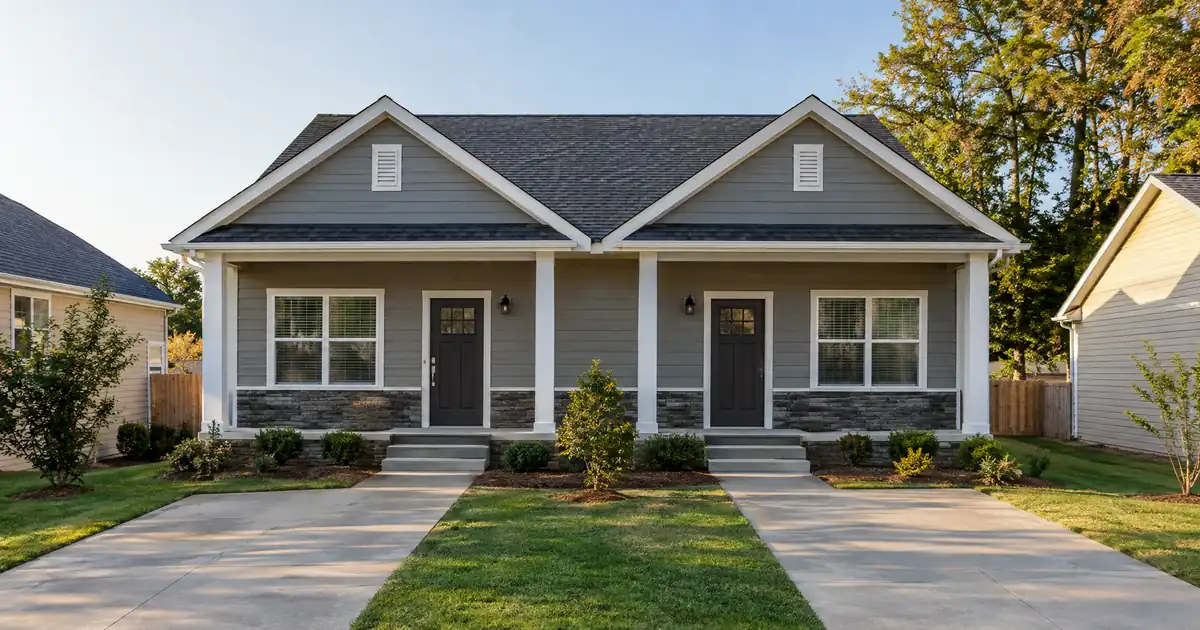
Does A Duplex Get The Same Leverage As A Single-family DSCR Rental — The Quick Read: Mostly, yes — a duplex, triplex, or fourplex runs on the same DSCR underwriting framework as a single-family rental, not a separate leverage schedule. The loan amount, the credit tier, and the coverage math all use the same ladder. What changes is the income side: a 2-4 unit property combines rent from every unit into one gross-rent figure, which often produces a stronger coverage ratio than a single tenant carrying the whole payment. Leverage caps can still shift slightly at larger loan sizes, but unit count by itself is not the deciding factor.
A DSCR loan (debt-service coverage ratio loan) qualifies an investment property based on the rent it generates, not the borrower’s personal income. That single idea — rent covers payment, or it doesn’t — applies whether the collateral is a single-family house or a duplex. The property type changes what feeds into the ratio. It doesn’t change the ratio itself.
DSCR Calculator
Run the numbers in your market
Rate source: Freddie Mac 30-yr average via FRED® — Federal Reserve Bank of St. Louis · effective Sep 17, 2026
Prefilled with local estimates — enter your own rent or nightly figures, taxes, insurance, and HOA for a more accurate picture.
Program parameters update from Lendmire’s centralized guideline source. Taxes and insurance are editable estimates.
As of Sep 17, 2026 · General Freddie Mac market benchmark, not a Lendmire loan offer. Rent, nightly rate, occupancy, taxes, and insurance are editable estimates. Short-term rental figures are estimates only and vary significantly by season, property type, management approach, and local short-term-rental rules — confirm local regulations before relying on them. Qualifying income for short-term rentals varies by program — some use appraisal market rent, others use documented STR history or projections — and is confirmed in underwriting. Not a Loan Estimate, approval, or commitment to lend. Program availability and eligibility are subject to lender guidelines, credit approval, property review, and underwriting.
What Actually Changes Between a Duplex and a Single-Family File
The core leverage ladder doesn’t move because a property has two doors instead of one. Across the wholesale network Lendmire places files through, loan amounts from $150,000 to $1,000,000 typically support purchase leverage up to 80% at a 660 credit floor — for a single-family house or a duplex, subject to underwriting. Push past $1,000,000 and leverage steps down to 75% through the $1.5 million and $2 million bands, generally requiring a 700-720 credit tier. Above $3,000,000, leverage tightens to 65%, and case-by-case review applies from $4,000,000 up through $10,000,000 at 60% purchase leverage. That ladder is set by loan size and credit, not unit count.
Where things diverge is the appraisal, and that’s where the real story lives.
How the Appraisal Treats a Duplex Differently
A single-family rental gets appraised on one standardized rent form; a 2-4 unit property gets a different one — and that form changes how income is proven, not how much leverage the loan can reach. For one-unit properties, appraisers complete the Single-Family Comparable Rent Schedule, known industry-wide as Fannie Mae Form 1007. For 2-4 unit buildings, they instead complete the Small Residential Income Property Appraisal Report, or Form 1025, which Fannie Mae’s own appraiser resource library lists as the standardized form for that property type.
The non-QM industry didn’t create a new rent methodology for small multifamily properties. Instead, it borrowed a framework that was already standardized and verified by third parties. Banks and agencies have relied on this same framework for decades. A legal glossary reference on Form 1025 confirms why it exists: to standardize valuation and rent reporting on 2-4 unit buildings. This form is separate from the one used for single-unit properties.
Here’s the part that trips investors up: on a 1025, every unit needs its own supportable rent conclusion. The appraiser can’t take the strongest unit’s rent and assume the other units match it. If one unit in an otherwise strong fourplex sits vacant or under market, that weak unit drags down the blended gross-rent figure for the whole building — even if the other three units perform well.
The DSCR Math Itself Doesn’t Change
Monthly Gross Rent ÷ PITIA (principal, interest, taxes, insurance, and association dues) = DSCR. That formula is identical for a single-family house and a duplex. What changes is what goes into the numerator.
On a single-family rental, one tenant’s rent check either covers the payment or it doesn’t. On a duplex, Unit A’s rent and Unit B’s rent combine into one gross figure, while the PITIA in the denominator still covers the whole property — not per unit. That structural fact is why 2-4 unit properties frequently post stronger coverage ratios than a single-family house at a similar price point: two income streams against one loan payment gives the file more room to clear 1.00 coverage.
That doesn’t mean a duplex is a guaranteed better file. It means the math has more moving parts, and each part needs its own support.
Does Vacancy Hurt a Duplex’s DSCR More Than a Single-Family’s?
Less than most investors assume. Vacant units in a 2-4 unit property are treated the same way vacant single-family rentals are treated — the appraiser supplies a market-rent opinion for the empty unit, and that figure enters the calculation. Qualifying income is based on what the market supports, not on current occupancy.
This is the real vacancy-buffer advantage of small multifamily properties. A single-family rental produces zero income the moment its one tenant leaves. But a duplex or fourplex keeps collecting rent from occupied units, even while one sits empty. This gives you a real cushion when you stress-test a deal against turnover. Are you chasing a value-add multifamily deal with a vacant unit? Don’t assume that vacancy will tank your file — as long as the appraiser can defend strong market rent on the empty unit.
Most programs across the network still underwrite on whichever is lower — the in-place lease or the appraiser’s market-rent opinion — applied unit by unit on a 2-4 unit file, the same rule used on a single vacant single-family rental. Lendmire’s own breakdown of how rental income is calculated for DSCR loans walks through that mechanic in more depth for readers who want the full picture.
Where a Duplex’s Leverage Actually Runs Lower
Loan size — not unit count on its own — is what moves the leverage cap, but small multifamily files sometimes land in a size band that carries a lower ceiling than a comparable single-family purchase at the same price point simply because 2-4 unit collateral tends to price into higher loan amounts per property. On rate-and-term refinances the leverage ladder mirrors the purchase side band for band. Cash-out is where the real ceiling shows up: standard rental collateral tops out around 75% at or below $1,000,000, sliding to 70% through $1.5 million and 60% through $3 million, with no cash-out available above that regardless of property type. Short-term-rental collateral caps cash-out at 70% in that same conversation, a scoping difference worth remembering if a duplex includes a short-term-rental unit. These specifics are subject to lender guidelines and a full review of property, leverage, and credit.
None of that ceiling exists because a property has two units instead of one. It exists because of loan size, credit tier, and whether the file is a purchase, a rate-and-term refinance, or a cash-out.
What About Coverage Below 1.00?
A coverage ratio of 1.00 or higher gets you full leverage on the ladder above. Ratios between roughly 0.75 and 0.99 offer a real path through select lenders in Lendmire’s network, up to $2,000,000 in loan amount. But when the ratio drops below 1.00, leverage and terms adjust, subject to underwriting. No-ratio qualification is also available up to $2,000,000 through select wholesale programs, but only for borrowers with a seven-year clean housing history. This option requires reduced leverage and stronger reserves, subject to underwriting. It’s never simply “available with no minimum.”
That path applies the same way whether the collateral is a single-family house or a duplex. Unit count doesn’t unlock or block the sub-1.00 door. Rent support does.
The Mixed-Use Wrinkle Investors Miss
Does your small multifamily building have ground-floor commercial space alongside residential units? Only the residential rent counts toward DSCR. The commercial income stays entirely outside the standard 2-4 unit rent methodology. It never blends into the qualifying gross-rent figure. This surprises many investors who bought a “duplex over a storefront,” expecting the storefront lease to help their file. It won’t — not under the standard framework most DSCR programs use.
The Five-Unit Cliff
Once a property has five or more residential units, it leaves the standard 1-4 unit DSCR framework. It moves into commercial-style underwriting instead. This isn’t just a higher leverage tier — it’s a different loan program altogether. That shift changes how appraisers value the property. It also changes reserve requirements. And it shifts the focus to stabilized net operating income, rather than a simple rent-over-payment calculation. So if you compare a fourplex to a five-unit building, you’re not comparing two tiers of the same loan. You’re comparing two different loan products entirely.
A Practical Comparison
| Factor | Single-Family DSCR | 2-4 Unit DSCR |
|---|---|---|
| Appraisal form | One-unit rent schedule (Form 1007) | Small income property report (Form 1025) |
| Income basis | One rent figure | Combined rent, every unit independently supported |
| Vacancy exposure | Total loss if vacant | Partial income retained from other units |
| Leverage ladder | Same size/credit-based ladder | Same size/credit-based ladder |
| Mixed-use income | Not applicable | Commercial rent excluded from DSCR |
| Coverage floor | 1.00 for full leverage | 1.00 for full leverage |
A Working Example
Picture two investors buying at the same price point in the $150,000-$1,000,000 tier at 80% purchase leverage. One buys a single-family rental with one tenant carrying the full payment. The other buys a duplex where two units together produce combined rent against the same PITIA. Assuming comparable in-place rents, the duplex often clears a stronger coverage ratio — say low-1.2x territory versus the single-family file landing closer to 1.0x — purely because two income streams are covering one debt obligation instead of one. Both properties can access the same 80% ceiling at that loan size and credit tier. The duplex simply arrives with more room in the ratio, which can matter if rent softens later or if the file needs to clear a higher select-program floor.
That’s the practical edge small multifamily carries into a DSCR review — not better leverage terms, but often an easier path to the coverage a lender wants to see.
Are you still deciding between a single-family home and a small multifamily property before you commit to leverage? Lendmire’s complete DSCR loans guide can help. It walks you through qualification for both, side by side. Are you comparing a single-family rental to a duplex purchase? Do you want to know how equity works differently for each? Then check out Lendmire’s single-family rental home equity guide as a companion read.
DSCR loans are business-purpose loans for non-owner-occupied investment property. Because they’re underwritten as investor loans rather than standard owner-occupied mortgages, they’re reviewed under a different set of guidelines from the start.
DSCR vs. conventional financing
Two common ways to finance an investment property in this market. They qualify you differently — here’s how investors weigh them.
Why investors choose it
- Qualifies on the property’s rental income — no personal tax returns, W-2s, or pay stubs needed to document income.
- No personal debt-to-income ceiling to clear, so existing mortgages and obligations don’t cap your borrowing the same way.
- Can be closed in an LLC, keeping the property inside a business entity.
- Built for scaling — not held to the limit on number of financed properties that conventional financing applies.
- Underwriting centers on the deal: generally qualifies when the rent covers the payment, a 1.00x coverage ratio being a common baseline (confirmed in underwriting).
- Designed specifically for investment property, including long-term and, where the program allows, short-term rentals.
Where it’s strong
- Often the lowest ongoing financing cost for a buyer who fully qualifies on personal income — a fit for a first property or a cost-first purchase.
Trade-offs for investors
- Requires full personal income documentation and must fit within a debt-to-income limit — salary, existing debts, and other mortgages all count.
- Typically held in your personal name rather than a business entity.
- Caps how many financed properties you can carry, which can become a ceiling as a portfolio grows.
- Evaluates you as a borrower as much as the property, which usually means more paperwork.
How investors usually choose: a first or single property often optimizes for the lowest financing cost; portfolio builders often optimize for leverage, vesting in an LLC, and scaling past conventional caps. The right answer depends on your goals, the property, and current guidelines — both paths run through select lenders in Lendmire’s wholesale network, with eligibility and terms confirmed in underwriting.
Key Terms Defined
DSCR (debt-service coverage ratio): the relationship between a property’s monthly rental income and its full monthly payment, expressed as gross rent divided by PITIA.
PITIA: the full monthly obligation on a property — principal, interest, taxes, insurance, and association dues combined.
LTV (loan-to-value): the loan amount expressed as a percentage of the property’s appraised value; a higher LTV means less money down.
Non-QM (non-qualified mortgage): a loan made outside standard agency guidelines, often underwritten on property income or alternative documentation rather than traditional personal-income documentation.
Business-purpose loan: a loan made to an investor for a non-owner-occupied rental property, not a personal residence.
Frequently Asked Questions
Does a duplex qualify for a higher loan-to-value than a single-family rental?
Not typically, and not automatically. The leverage ladder is driven mainly by loan size and credit tier, not unit count, so a duplex and a single-family house at the same loan amount usually land on the same leverage cap, subject to underwriting.
Why does a duplex often show a stronger DSCR ratio than a comparable single-family rental?
Because the combined rent from two or more units sits in the numerator against one PITIA payment in the denominator. Two income streams covering one debt obligation tends to produce more coverage cushion than a single tenant carrying the full payment alone.
Does a vacant unit in a duplex disqualify the property from DSCR financing?
Not necessarily. The appraiser can supply a market-rent opinion for the vacant unit, and qualifying income is based on supportable market rent rather than current occupancy, subject to that rent being defensible on the appraisal.
Can commercial rent from a mixed-use building count toward the DSCR ratio?
Generally no. Under the standard 2-4 unit residential methodology, only residential rent counts toward the DSCR calculation — commercial income from ground-floor retail or office space sits outside that framework.
What happens once a property crosses into five or more units?
It leaves 1-4 unit residential DSCR treatment entirely and moves into commercial-style underwriting, which evaluates net operating income and lease structure rather than a simple rent-over-payment ratio. That’s a different program, not a leverage adjustment within the same one.
If comparing a single-family purchase against a small multifamily property and trying to figure out which one clears the strongest coverage ratio, Lendmire can help run both scenarios based on the property’s income, credit profile, leverage, and investor goals.
For current guidelines and terms, see Lendmire’s super jumbo DSCR loan programs page.
Self-employed borrowers can compare both super jumbo programs on Lendmire’s self-employed mortgages page.
About Lendmire
Lendmire, NMLS# 2371349, is a non-QM mortgage broker serving real estate investors in 40 markets, including Washington, D.C., through DSCR investor loan programs. Qualification is generally reviewed around the subject property’s rental income, not the borrower’s W-2 history — a practical fit for LLC-titled portfolios and self-employed investors. All scenarios remain subject to lender review and program guidelines. Two consecutive Scotsman Guide Top Mortgage Workplace recognitions (2025, 2026).
Lendmire’s Top Mortgage Workplace recognition is documented by Scotsman Guide 2025 Top Mortgage Workplace and Scotsman Guide 2026 Top Mortgage Workplace.
Get Started
Ready to find the right loan for you?
In about 30 seconds you can review financing options available for your home or investment property. No commitment required.
Informational only. Not a Loan Estimate, approval, or commitment to lend. Program availability and eligibility are subject to lender guidelines, credit approval, property review, and underwriting.
References
1. Fannie Mae Selling Guide – Appraisal Report Forms and Exhibits
2. Fannie Mae Learning Center – Appraisers & Property Underwriting
3. Barnes Walker Legal Glossary – Form 1025
Brandon Miller
Founder & CEO, Mortgage Loan Originator, Lendmire LLC
- Mortgage Loan Originator · NMLS# 1129696 · Verify on NMLS Consumer Access
- North Carolina Real Estate Broker · License# 343312 · Verify on NCREC
- North Carolina Insurance Producer · License# 19053198 · Property, Casualty, Life, Health · Verify on NAIC SBS
- Lendmire LLC · Firm NMLS# 2371349 · Verify firm licensure
Required disclosures. Lendmire (NMLS# 2371349) operates as a licensed mortgage broker, not a direct lender or depository. The discussion in this article is general in nature and should not be relied upon as financial, legal, or tax advice — every investment scenario is unique and should be reviewed by a qualified professional. Any loan inquiry is subject to lender underwriting, and this article is not a commitment to lend or a guarantee of approval. Mortgage rates, loan terms, and program guidelines vary by borrower, property, and state, and may change without notice. Equal Housing Opportunity. Verify licensure at NMLS Consumer Access.


