
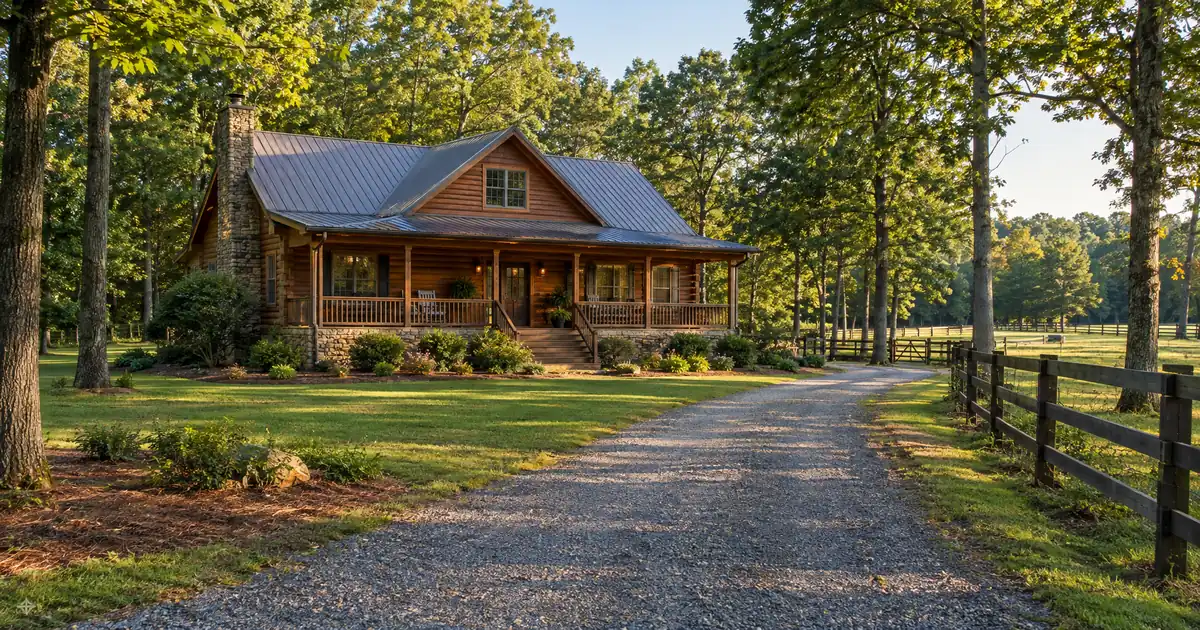
Finance A Seasonal Lake House Or Ski Cabin — The Quick Read: A seasonal lake house or ski cabin can be financed on a DSCR loan when it’s bought as a rental, not a personal getaway — the loan is reviewed primarily on the property’s rental income covering the payment, subject to lender guidelines. The catch is that “seasonal” income has to get averaged across a full year, not judged on the best month, and the property has to prove it’s insurable and rentable before that math means anything. Get the occupancy classification wrong and the whole file gets built on the wrong product.
Key Terms Defined
DSCR (debt service coverage ratio): the ratio of a property’s rental income to its total monthly housing cost — rent divided by the payment. A ratio of 1.00 means the rent exactly covers the payment.
DSCR Calculator
Run the numbers in your market
Rate source: Freddie Mac 30-yr average via FRED® — Federal Reserve Bank of St. Louis · effective Sep 17, 2026
Prefilled with local estimates — enter your own rent or nightly figures, taxes, insurance, and HOA for a more accurate picture.
Program parameters update from Lendmire’s centralized guideline source. Taxes and insurance are editable estimates.
As of Sep 17, 2026 · General Freddie Mac market benchmark, not a Lendmire loan offer. Rent, nightly rate, occupancy, taxes, and insurance are editable estimates. Short-term rental figures are estimates only and vary significantly by season, property type, management approach, and local short-term-rental rules — confirm local regulations before relying on them. Qualifying income for short-term rentals varies by program — some use appraisal market rent, others use documented STR history or projections — and is confirmed in underwriting. Not a Loan Estimate, approval, or commitment to lend. Program availability and eligibility are subject to lender guidelines, credit approval, property review, and underwriting.
PITIA: principal, interest, taxes, insurance, and association dues — the full monthly obligation a lender measures rent against.
Second-home classification: an occupancy category for a property the owner personally uses part of the year, distinct from an investment property bought purely to rent out.
Non-warrantable condo: a condo project that doesn’t meet standard agency eligibility rules — often because of high investor concentration or commercial space in the building — which pushes financing into non-QM channels.
Condotel: a condo unit inside a building run like a hotel, often with mandatory rental-pool participation, where management — not the owner — controls who occupies the unit.
STR haircut: the percentage discount applied to gross short-term rental income before it’s used to calculate DSCR, to account for vacancy, cleaning costs, and platform fees.
First: Are You Buying a Getaway or a Rental Business?
This decision happens before anyone runs a single number. A DSCR loan is a business-purpose loan for non-owner-occupied property — it isn’t built for a place you plan to use yourself most weekends.
Occupancy gets certified in writing at closing: primary, second home, or investment. If you’re buying a lake house to use personally for stretches of the year and rent out occasionally to offset costs, that’s typically a second home — and second-home rental income generally can’t be counted to help you qualify. If the deal’s math only works because the property’s own rent covers the payment, that’s the signal you’re actually financing an investment property, not a getaway.
This isn’t a technicality. It decides which loan product applies, what leverage is available, and what paperwork the file needs. A borrower who tries to force a personal-use cabin into a rental-income underwrite is setting up a mismatch that surfaces during appraisal or file review — not a good place to find it.
Key takeaways:
- Personal-use cabins are financed as second homes, not DSCR investment properties.
- DSCR loans require the property to be bought as a rental, qualifying on its own rent.
- Occupancy classification happens before rent gets calculated — not after.
- Seasonal income averages across twelve months, not the best season.
- Insurability and habitability can block a file even when the DSCR math works.
Does the Cabin Even Qualify as a Year-Round Property?
Habitability matters as much as legal access. Appraisal standards ask whether a property is adequate for year-round occupancy — proper heating, insulation, plumbing, and a foundation that holds up to winter — not just whether it’s usable in July.
A winterized mountain cabin with real heat and water lines that don’t freeze can qualify. A summer-only camp with no insulation and seasonal water hookups often can’t. It fails the basic habitability bar before rent ever enters the conversation. Resort-area properties get extra appraisal scrutiny for exactly this reason. Plenty of the building stock in ski and lake markets was built strictly for warm-weather or peak-season use. This follows general property eligibility guidance on year-round habitability standards.
This is worth confirming before you fall in love with a listing. A property that can’t clear the habitability bar doesn’t get financing help from a strong DSCR number — the appraisal issue comes first.
How the Appraisal Sets Your Qualifying Rent
The appraiser decides what rent number the lender uses. The tool they use depends on your rental strategy. For a long-term lease strategy, appraisers use the standard rent-schedule forms. These compare properties leased over roughly the prior six to twelve months. For a short-term, nightly-booking strategy, that standard grid gets set aside. Instead, appraisers use a narrative Short-Term Rental Projected Income Analysis. That’s because the standard form “was built exclusively to estimate long-term monthly market rent.” Using it for nightly bookings can produce a misleading number, according to Class Valuation’s appraisal-industry commentary.
That distinction matters because it’s the most common misconception in this whole category.
Myth: “Just Multiply the Nightly Rate by 30”
Some borrowers assume monthly rent for a seasonal STR is simply the nightly rate times 30. It isn’t, and appraisers who try it produce a misleading conclusion. Multiplying a nightly rate out ignores furniture, cleaning services, vacancy between bookings, and the operating-expense structure that a nightly-rental business actually carries — a point Fannie Mae itself has made about appraisal shortcuts, even though DSCR underwriting doesn’t run on agency rules.
The real number comes from a documented rent analysis or actual operating history — not a back-of-napkin multiplication.
Purchase vs. Refinance: Where the Rent Number Comes From
On a purchase with no operating history, underwriting typically leans on the appraiser’s short-term-rent analysis or a market-data projection. On a refinance, most non-QM programs want something different: roughly twelve months of actual booking-platform or bank-deposit history, instead of a projection. Real numbers beat forecasts once a property has a track record.
Across the wholesale network Lendmire works with, short-term rental files at coverage of 1.00 or higher and loan amounts to $2,000,000 typically qualify in one of two ways. For a refinance, lenders look at twelve months of documented operating history. For a purchase, they use the appraisal’s short-term rental analysis instead. Either way, lenders apply this at roughly 80% of gross rental income before measuring it against the payment. That haircut exists for a reason. Platform fees, cleaning turnover, and off-season vacancy are real costs. A lender wants the coverage ratio to reflect them, not just gross booking revenue.
Experienced-investor requirements typically apply on this path too. Most programs want twelve months of income-property ownership somewhere in the last thirty-six months before they’ll count STR income this way. First-time landlords buying their first seasonal cabin usually need a different structuring conversation.
Seasonality Gets Averaged, Not Cherry-Picked
A ski cabin that runs hot in January and dead in June doesn’t get judged on its best month. Qualifying income averages the swing across a full twelve months, so the DSCR ratio reflects the whole year’s cash flow rather than peak-season performance. That’s good news for borrowers tempted to lead with their best month’s booking screenshot — it won’t move the needle on its own — and it’s also why twelve months of actual deposit history, including the slow months, tends to produce a more reliable number than a projection tool alone.
For Lendmire’s complete DSCR loans guide, the underlying qualification logic — rent covering the payment, subject to lender review — works the same way whether the property is a duplex in a city or a cabin on a lake. Seasonal properties just add extra steps before that ratio can be trusted.
What the Leverage Ladder Looks Like
Coverage of 1.00 or higher earns the strongest available leverage in most files across Lendmire’s wholesale network. On loan amounts from $150,000 to $1,000,000, purchase and rate-and-term leverage typically run to 80%, with credit profiles generally starting around 660. Move into the $1,000,000 to $1,500,000 tier and leverage typically steps down to around 75% purchase, with stronger credit expectations near 700.
Cash-out works on a separate, tighter scale. On standard rental collateral, cash-out proceeds typically run up to 75% LTV at smaller loan sizes, stepping down as the loan gets larger — and short-term-rental collateral is generally capped closer to 70% on cash-out in that same range, reflecting the added income volatility. Above $3,000,000, cash-out generally isn’t available at all on this ladder, and every request above $4,000,000 gets reviewed case by case before submission — never assume a flat percentage applies at that size.
Coverage below 1.00 isn’t automatically a dead end. Select lenders in the network will work with coverage in the 0.75-to-0.99 range, and even no-ratio underwriting, on loan amounts up to $2,000,000 — but leverage and terms adjust downward, subject to underwriting, and no-ratio paths aren’t available for short-term-rental income specifically. That’s a real option for a borrower whose seasonal cabin doesn’t quite clear 1.00 on paper but who brings strong credit and reserves to the table. Final terms depend on lender guidelines, property type, leverage, and the borrower’s complete credit picture.
Reserve requirements typically run around six months of the subject property’s PITIA (or just interest, taxes, insurance, and dues, if the loan is interest-only). This often steps up toward twelve months for a borrower financing their first investment property. Interest-only structuring is available on many files. This generally means a 120-month interest-only period within a 30- or 40-year term, at a maximum around 75% leverage for borrowers with coverage of 0.75 or better. This structure helps an investor keep monthly cash flow flexible through a slow shoulder season.
DSCR vs. conventional financing
Two common ways to finance an investment property in this market. They qualify you differently — here’s how investors weigh them.
Why investors choose it
- Qualifies on the property’s rental income — no personal tax returns, W-2s, or pay stubs needed to document income.
- No personal debt-to-income ceiling to clear, so existing mortgages and obligations don’t cap your borrowing the same way.
- Can be closed in an LLC, keeping the property inside a business entity.
- Built for scaling — not held to the limit on number of financed properties that conventional financing applies.
- Underwriting centers on the deal: generally qualifies when the rent covers the payment, a 1.00x coverage ratio being a common baseline (confirmed in underwriting).
- Designed specifically for investment property, including long-term and, where the program allows, short-term rentals.
Where it’s strong
- Often the lowest ongoing financing cost for a buyer who fully qualifies on personal income — a fit for a first property or a cost-first purchase.
Trade-offs for investors
- Requires full personal income documentation and must fit within a debt-to-income limit — salary, existing debts, and other mortgages all count.
- Typically held in your personal name rather than a business entity.
- Caps how many financed properties you can carry, which can become a ceiling as a portfolio grows.
- Evaluates you as a borrower as much as the property, which usually means more paperwork.
How investors usually choose: a first or single property often optimizes for the lowest financing cost; portfolio builders often optimize for leverage, vesting in an LLC, and scaling past conventional caps. The right answer depends on your goals, the property, and current guidelines — both paths run through select lenders in Lendmire’s wholesale network, with eligibility and terms confirmed in underwriting.
None of these figures are promises. Every file gets underwritten on its own credit profile, property, and program fit — these are typical ranges from select wholesale-network guidelines, not guaranteed terms.
The Condo Trap: Non-Warrantable vs. Condotel
A large share of lake-resort and ski-town inventory sits inside condo projects. The distinction between two similar-looking categories decides whether financing is realistic. A non-warrantable condo fails standard agency eligibility because of high investor concentration or on-site commercial space. This type is usually reviewable, as long as the owner independently controls their own unit’s occupancy. A true condotel is different: a mandatory rental pool means building management decides who stays in the unit. This has a much narrower lender pool, because the investor doesn’t actually control the asset being financed.
Across Lendmire’s network, non-warrantable condos typically finance to around 75% leverage and up to $1,500,000. Condotels are a tighter box — generally capped around 75% on purchase and 65% on refinance, up to $1,500,000, and often requiring a meaningful chunk of cash in hand at closing. Before writing an offer on a ski-town or lakefront unit, it’s worth finding out which category the building actually falls into — that answer, more than your credit score, often decides which lenders will even look at the file.
Insurable Access Is a Different Test Than Legal Access
A cabin can be perfectly legal to reach and still be functionally uninsurable. Insurers distinguish legal access — your right to reach the property — from insurable access — whether the carrier believes the property can be safely reached for emergencies and repairs. A cabin reachable by paved road in summer but only by snowmobile in winter is the textbook example: legally accessible, but a growing number of carriers won’t write it.
Since a lender typically requires an active hazard policy to close and keep the loan in force, an insurability problem can stall or kill a file regardless of how clean the DSCR math looks. This is worth confirming with an insurance agent before the DSCR ratio becomes the thing you’re worried about.
Flood Zones Add a Layer Lake Buyers Shouldn’t Skip
Lakefront property often sits in a mapped flood zone, and federal flood-insurance rules apply whenever a federally regulated lender finances a structure in a Special Flood Hazard Area. The National Flood Insurance Program caps its coverage for a single-family structure well below what many lake homes are worth, per Neptune Flood’s commentary on lender flood requirements, and any loan amount above that cap typically needs private flood coverage to fill the gap, as outlined at this resource. On a higher-value lake house, that gap isn’t small — it’s a real budgeting item to price out before closing, not after.
Do Local STR Rules Actually Let You Rent This Place?
Short-term rental rules can vary by city, county, HOA, and property type, so investors should confirm local rules before relying on projected rental income. A zoning map that looks STR-friendly doesn’t guarantee anything — HOA declarations and condo bylaws operate as independent private restrictions that can ban short-term rentals even where the municipality allows them. That covenant risk exists on top of, not instead of, local zoning approval — and it’s worth checking both before assuming a cabin’s rental income is real. For more on how lake-house and ski-cabin financing compares across property types, see Lendmire’s lake house and ski cabin DSCR loan guide.
Who This Fits and Who It Doesn’t
DSCR loans work well for an investor buying a seasonal property to run as a rental business. This person needs to underwrite rent using actual twelve-month averages, not peak-season screenshots. They also need to confirm insurability and check local short-term rental rules before closing. This financing suits an investor who wants to qualify based on the property’s income, not traditional personal-income paperwork. It also suits someone buying through an entity for liability or portfolio reasons.
It fits less well for a buyer who mainly wants personal use with occasional rental income on the side — that’s a second-home conversation, not a DSCR one. It also fits less well for anyone assuming a strong peak season alone will carry a weak shoulder season on paper; the twelve-month average doesn’t work that way. And it’s a harder conversation for a first-time landlord trying to use STR income on their very first purchase, since most programs want a track record of owning income property first.
This is educational information, not legal or tax advice, and every investor’s situation is different — a qualified attorney or CPA is the right resource for how a specific structure affects your own taxes or liability.
Frequently Asked Questions
Can I use a DSCR loan if I plan to personally use the cabin some weekends?
Occasional personal use can complicate the file, since DSCR loans are business-purpose and generally assume the property is a rental, not a part-time getaway. Heavy personal use usually points toward a second-home mortgage instead, where rental income typically can’t be counted toward qualification. If personal use is minimal and the rest of the year is genuinely rented, some lenders in the network will still consider it — subject to underwriting.
How does DSCR income get calculated for a ski cabin with almost no summer bookings?
The qualifying income averages across the full twelve months rather than isolating peak winter months. A cabin that books heavily in ski season and sits mostly empty in summer still gets measured on its full-year average, which is why twelve months of actual deposit history on a refinance often produces a more trustworthy number than a projection built on winter data alone.
Is a condotel reviewable on a DSCR loan?
It can be, but it’s a narrower path than a standard condo. Condotels with mandatory rental-pool participation are harder files because building management, not the owner, controls unit occupancy — typically capping leverage lower and requiring meaningful cash at closing, up to program limits.
What credit score do I need for a seasonal rental property?
Most files in Lendmire’s wholesale network start around a 660 credit floor, with stronger pricing and larger loan sizes generally requiring higher scores — often near 700 above $3,000,000. Exact requirements depend on loan size, property type, and coverage ratio, subject to underwriting.
Does flood insurance affect my DSCR loan approval on a lakefront property?
It can, particularly on higher-value homes. Federal flood coverage caps out at $250,000 for a single-family structure, so a larger loan may require private flood insurance to close the gap — and lenders generally require active coverage in place before funding.
For current guidelines and terms, see Lendmire’s super jumbo DSCR loan programs page.
Self-employed borrowers can compare both super jumbo programs on Lendmire’s self-employed mortgages page.
About Lendmire
Lendmire (NMLS# 2371349) is a mortgage brokerage built around DSCR investor lending, with programs available in 40 markets, including Washington, D.C. DSCR lenders commonly evaluate rental-income coverage instead of personal income paperwork — a practical fit for LLC-owned and multi-property investors. Terms vary by lender, property, leverage, and program. Scotsman Guide named Lendmire a Top Mortgage Workplace in both 2025 and 2026.
Get Started
Ready to find the right loan for you?
In about 30 seconds you can review financing options available for your home or investment property. No commitment required.
Informational only. Not a Loan Estimate, approval, or commitment to lend. Program availability and eligibility are subject to lender guidelines, credit approval, property review, and underwriting.
References
1. Homebuyer.com — General Property Eligibility Standards
2. Class Valuation — Why Form 1007 Can’t Be Used for Short-Term Rentals
3. Neptune Flood — Lender-Required Flood Insurance
4. Lake County CA — Flood Insurance Page
Brandon Miller
Founder & CEO, Mortgage Loan Originator, Lendmire LLC
- Mortgage Loan Originator · NMLS# 1129696 · Verify on NMLS Consumer Access
- North Carolina Real Estate Broker · License# 343312 · Verify on NCREC
- North Carolina Insurance Producer · License# 19053198 · Property, Casualty, Life, Health · Verify on NAIC SBS
- Lendmire LLC · Firm NMLS# 2371349 · Verify firm licensure
Legal disclosures. Lendmire (NMLS# 2371349) is a state-licensed mortgage brokerage that arranges financing through wholesale lender relationships. Lendmire is not a direct lender, depository institution, or registered financial advisor. The discussion above is general informational content about real estate financing — it is not financial, legal, or tax advice, and readers should consult licensed professionals for guidance on their individual circumstances. Loan inquiries are subject to lender underwriting; this article does not represent a commitment to lend. Loan terms, rates, and qualification standards vary by borrower, property, and state, and are subject to change at any time. Equal Housing Opportunity. NMLS Consumer Access: nmlsconsumeraccess.org.


