
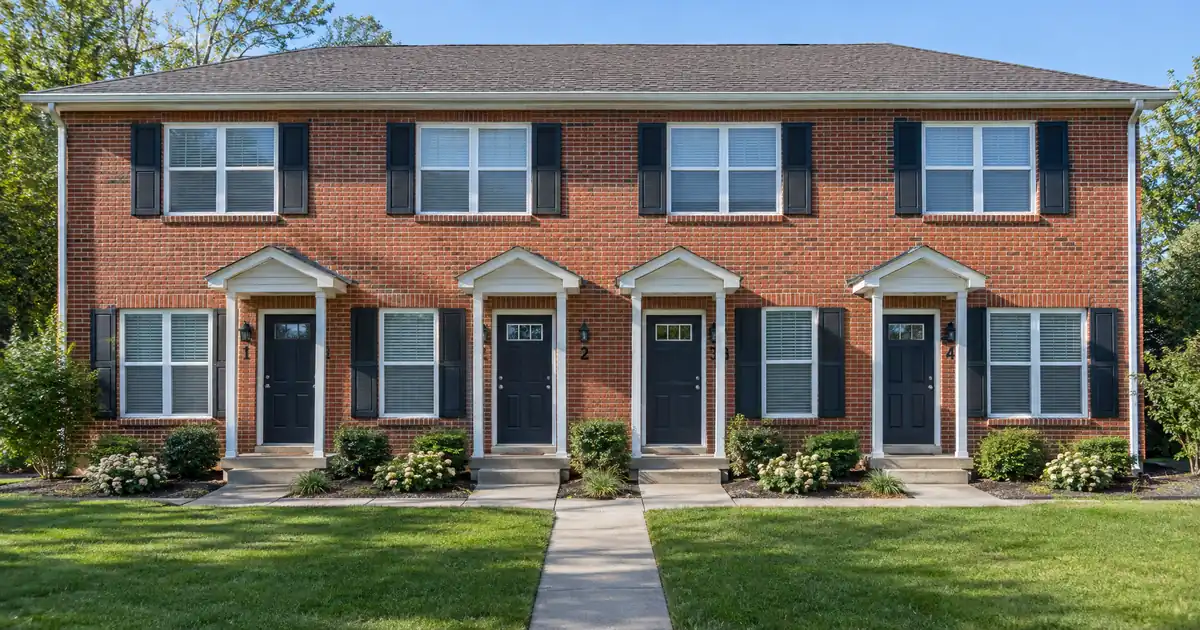
Finance A Fourplex Through A Trust — The Quick Read: A fourplex sits inside the “fewer than five units” zone that federal law protects for trust transfers, which makes trust vesting a workable path on a DSCR loan. The DSCR math itself doesn’t change — rent still has to cover the payment — but the paperwork gets heavier, and revocable versus irrevocable trusts get treated very differently by lenders and by the law.
Why A Fourplex Is Different From A Bigger Building
A fourplex has four units. That number matters more than it sounds like it should.
DSCR Calculator
Run the numbers in your market
Rate source: Freddie Mac 30-yr average via FRED® — Federal Reserve Bank of St. Louis · effective Sep 17, 2026
Prefilled with local estimates — enter your own rent or nightly figures, taxes, insurance, and HOA for a more accurate picture.
Program parameters update from Lendmire’s centralized guideline source. Taxes and insurance are editable estimates.
As of Sep 17, 2026 · General Freddie Mac market benchmark, not a Lendmire loan offer. Rent, nightly rate, occupancy, taxes, and insurance are editable estimates. Short-term rental figures are estimates only and vary significantly by season, property type, management approach, and local short-term-rental rules — confirm local regulations before relying on them. Qualifying income for short-term rentals varies by program — some use appraisal market rent, others use documented STR history or projections — and is confirmed in underwriting. Not a Loan Estimate, approval, or commitment to lend. Program availability and eligibility are subject to lender guidelines, credit approval, property review, and underwriting.
Federal law limits when a lender can call a loan due just because title moved into a trust. That protection comes from the Garn-St. Germain Depository Institutions Act, and it only applies to residential property with fewer than five dwelling units, per Wikipedia’s summary of the Act. A duplex, triplex, or fourplex qualifies. A five-unit apartment building doesn’t — that protection disappears entirely once a fifth unit gets added, whether through new construction or a mixed-use conversion.
So a fourplex investor moving property into a trust is working inside the safest unit-count band the law offers. That’s a real structural advantage over a bigger multifamily deal, where trust transfers carry no federal backstop at all.
Does The Trust Exemption Actually Cover A Rental Property?
Partly, and this is where a lot of investors get tripped up. The statute was written with primary-residence estate planning in mind, not landlords.
The exemption applies to “a transfer into an inter vivos trust in which the borrower is and remains a beneficiary,” and it can’t involve giving up occupancy rights. That second condition was clearly built around someone living in their own home. A non-owner-occupied fourplex doesn’t fit that fact pattern cleanly, which is why legal commentary consistently flags rental property as a gray area rather than a clean yes, per UpCounsel’s explainer on due-on-sale exceptions.
The practical read: a revocable living trust where the investor is both grantor and beneficiary is the strongest position. An irrevocable trust, where the grantor typically isn’t a beneficiary, loses the automatic protection outright — the lender can enforce the due-on-sale clause unless it voluntarily consents.
There’s a second wrinkle specific to DSCR loans. Because DSCR financing is a business-purpose product rather than a personal-use mortgage, some lenders classify it closer to a commercial loan, where the residential trust exemption may not squarely apply. That’s a reason to get lender sign-off on the vesting structure before closing, not a reason to assume the exemption automatically covers a rental fourplex the same way it covers a primary home.
Key Terms Defined
Garn-St. Germain Act: the federal law that limits when a lender can call a loan due after a title transfer, including certain trust transfers on 1-4 unit residential property.
Due-on-sale clause: the loan clause letting a lender demand full repayment when the property title changes hands.
Revocable living trust: a trust the grantor can change or cancel during their lifetime, where the grantor usually remains the beneficiary too.
Irrevocable trust: a trust the grantor can’t easily undo, and where the grantor typically isn’t a listed beneficiary — the fact that removes the automatic due-on-sale protection.
Certification of trust: a short document confirming the trust exists and who can act for it, used instead of handing over the whole trust agreement.
Form 1025 / Freddie Mac Form 72: the appraisal report built specifically for 2-4 unit income property, with a rental-comparables section that single-family appraisals don’t have.
The Setup: What Has To Be True Before You Apply
Two separate things have to work at the same time — the trust paperwork, and the property’s income.
On the title side, the trustee needs documented authority to sign loan documents and encumber the property. Most lenders will accept a certification of trust rather than the full trust document — a short form confirming the trust’s name, its execution date, and the trustee’s authority under penalty of perjury. States that have adopted the Uniform Trust Code recognize this shortcut; 36 states and jurisdictions had enacted some version of the code as of a recent count. Title insurers still independently verify trustee authority before a policy issues — the certification gets the file moving, but it isn’t the final word.
On the income side, nothing about trust vesting changes how the loan is reviewed. A fourplex’s rent comes from all four units combined, appraised on Form 1025, and stacked against the full property’s monthly payment — taxes, insurance, and any HOA included. If one unit sits vacant at closing, the appraiser’s market rent for that unit still counts; an investor doesn’t need every lease signed to close.
How The Two Workstreams Run Side By Side
Think of it as a title lane and an income lane that never touch.
The title lane confirms who can sign for the trust, checks the trust type, and gets title insurance comfortable with the vesting. The income lane runs the DSCR formula off the property itself: combined gross rent divided by the full monthly payment. A trust doesn’t push that ratio up or down. It just adds documentation steps that a personal-name closing skips.
Across the wholesale network Lendmire works with, most programs accept trust vesting on a fourplex without much friction — it’s the second most common vesting type behind an LLC. The paperwork runs heavier than a straight personal-name file: certification of trust, confirmation of trustee signing authority, and a title company sign-off round out the closing package. A handful of lenders in the network want the underlying trust agreement itself rather than a certification, especially on irrevocable trusts, where the added scrutiny reflects the fact that the grantor often isn’t the beneficiary.
Where Leverage And Credit Land On A Fourplex
Program parameters here reflect typical figures from select lenders in Lendmire’s wholesale network — not universal terms, and every file underwrites individually.
On most files sized $150,000 to $1,000,000, purchase and rate-and-term leverage typically runs to 80% with a credit floor around 660, and cash-out typically tops out near 75% on standard rental collateral. Move into the $1,000,000 to $1,500,000 band and leverage generally steps down to 75% on purchase, with cash-out closer to 70%, alongside a higher credit expectation near 700. Above $1,500,000, cash-out leverage on most programs compresses further toward 60%, and above $3,000,000 cash-out typically isn’t available at all — that tier is purchase or rate-and-term only, reviewed case by case.
Coverage at 1.00 or better generally earns the full leverage on the ladder. A handful of lenders in the network will consider coverage between roughly 0.75 and 0.99 up to $2,000,000, but leverage and terms adjust downward, subject to underwriting — this is a real path, not a theoretical one, but it isn’t free. Reserve requirements on most files run six months of the property’s payment, stepping up to 12 months for a first-time investor. Two appraisals typically apply above $2,000,000.
This ladder is what lets qualified investors move well past the standard program’s $3,000,000 ceiling — Lendmire’s portfolio-investor lane runs to $10,000,000 for the right file, though short-term-rental and no-ratio structures cap out at $2,000,000 regardless of the property’s price point.
DSCR vs. conventional financing
Two common ways to finance an investment property in this market. They qualify you differently — here’s how investors weigh them.
Why investors choose it
- Qualifies on the property’s rental income — no personal tax returns, W-2s, or pay stubs needed to document income.
- No personal debt-to-income ceiling to clear, so existing mortgages and obligations don’t cap your borrowing the same way.
- Can be closed in an LLC, keeping the property inside a business entity.
- Built for scaling — not held to the limit on number of financed properties that conventional financing applies.
- Underwriting centers on the deal: generally qualifies when the rent covers the payment, a 1.00x coverage ratio being a common baseline (confirmed in underwriting).
- Designed specifically for investment property, including long-term and, where the program allows, short-term rentals.
Where it’s strong
- Often the lowest ongoing financing cost for a buyer who fully qualifies on personal income — a fit for a first property or a cost-first purchase.
Trade-offs for investors
- Requires full personal income documentation and must fit within a debt-to-income limit — salary, existing debts, and other mortgages all count.
- Typically held in your personal name rather than a business entity.
- Caps how many financed properties you can carry, which can become a ceiling as a portfolio grows.
- Evaluates you as a borrower as much as the property, which usually means more paperwork.
How investors usually choose: a first or single property often optimizes for the lowest financing cost; portfolio builders often optimize for leverage, vesting in an LLC, and scaling past conventional caps. The right answer depends on your goals, the property, and current guidelines — both paths run through select lenders in Lendmire’s wholesale network, with eligibility and terms confirmed in underwriting.
What Goes Wrong (And How To Avoid It)
Most trust-related fourplex problems trace back to timing, not the trust itself.
The biggest mistake is closing personally, then transferring the property into a trust afterward. That post-closing move can trigger a due-on-sale clause, void a hazard insurance policy, or create a title gap — all avoidable by disclosing the intended trust structure to the lender and title company before closing, not after.
The second mistake is treating an irrevocable trust like a revocable one. If the grantor isn’t a beneficiary, the automatic federal exemption doesn’t apply, and the lender can enforce the due-on-sale clause unless it agrees otherwise in writing.
The third is confusing a land trust with a living trust. Land trusts get used for privacy — the trust’s name shows up on public records instead of the owner’s — and many lenders will accept a land trust with the investor or the investor’s LLC named as beneficiary. But the approval mechanics differ from a revocable living trust, and the two shouldn’t be assumed interchangeable.
A trust also isn’t a liability shield the way an LLC is. It’s built for estate planning and probate avoidance, not asset protection — investors weighing both goals sometimes look at pairing a trust with an entity structure, which is closer to what Lendmire covers in its breakdown of financing a luxury fourplex through a DSCR loan.
DSCR loans are also business-purpose products, which means they’re reviewed differently from a standard owner-occupied mortgage — a distinction that matters if a lender treats the file closer to commercial underwriting on the vesting question.
Who This Fits And Who It Doesn’t
This works cleanest for an investor who already uses a revocable living trust for estate planning and wants the fourplex titled the same way as the rest of their holdings, while still qualifying on the property’s own rental income rather than personal tax documents. It’s a poor fit for anyone assuming an irrevocable trust gets the same automatic protection — that assumption is the single most common way this structure goes sideways. Investors weighing new construction inside a trust structure, rather than an existing fourplex, should look at the mechanics in Lendmire’s piece on financing new construction through a trust, since the timing risk around trust transfers is even more pronounced when a certificate of occupancy is involved.
For a full walkthrough of how DSCR lender review works property by property, Lendmire’s complete DSCR loans guide covers the underlying loan mechanics this article builds on.
Tax treatment can depend on how the funds are used and how the property is held; investors should keep clear records and speak with a qualified tax professional before relying on any deduction.
This article is for general information only and isn’t legal or tax advice. Anyone structuring a trust transfer on investment property should talk with a qualified real estate attorney or CPA about their specific situation before closing.
Frequently Asked Questions
Can I close a DSCR loan directly in the name of my trust?
Yes, on most files in Lendmire’s wholesale network — closing directly in the trust’s name is generally cleaner than transferring the property in afterward, since a post-closing transfer risks triggering a due-on-sale clause or lapsing insurance coverage.
Does an irrevocable trust get the same protection as a revocable trust?
No. The federal exemption is conditioned on the grantor remaining a beneficiary, which is typically true for revocable trusts and typically not true for irrevocable ones — so an irrevocable trust transfer can leave a due-on-sale clause enforceable unless the lender agrees otherwise.
Will vesting in a trust change my DSCR ratio?
No. The coverage ratio is driven entirely by the fourplex’s combined rent against its full monthly payment, appraised on Form 1025 — the trust only affects title paperwork, not the income math.
Do I need all four units leased to qualify?
No. If a unit sits vacant at closing, the appraiser’s market rent for that unit is used in the income calculation, so a fully leased building isn’t a requirement.
Is a land trust the same as a revocable living trust for loan purposes?
No. A land trust is generally used for ownership privacy, with the investor or their LLC named as beneficiary, while a revocable living trust is built around estate planning. Lenders treat the approval steps for each differently.
For current guidelines and terms, see Lendmire’s super jumbo DSCR loan programs page.
Self-employed borrowers can compare both super jumbo programs on Lendmire’s self-employed mortgages page.
About Lendmire
Lendmire (NMLS# 2371349) is a mortgage brokerage built around DSCR investor lending, with programs available in 40 markets, including Washington, D.C. DSCR lenders commonly evaluate rental-income coverage instead of personal income paperwork — a practical fit for LLC-owned and multi-property investors. Terms vary by lender, property, leverage, and program. Scotsman Guide named Lendmire a Top Mortgage Workplace in both 2025 and 2026.
Get Started
Ready to find the right loan for you?
In about 30 seconds you can review financing options available for your home or investment property. No commitment required.
Informational only. Not a Loan Estimate, approval, or commitment to lend. Program availability and eligibility are subject to lender guidelines, credit approval, property review, and underwriting.
References
1. Wikipedia – Garn-St. Germain Depository Institutions Act
2. UpCounsel – Due on Sale Clause: Exceptions, Trusts, and Transfers
Brandon Miller
Founder & CEO, Mortgage Loan Originator, Lendmire LLC
- Mortgage Loan Originator · NMLS# 1129696 · Verify on NMLS Consumer Access
- North Carolina Real Estate Broker · License# 343312 · Verify on NCREC
- North Carolina Insurance Producer · License# 19053198 · Property, Casualty, Life, Health · Verify on NAIC SBS
- Lendmire LLC · Firm NMLS# 2371349 · Verify firm licensure
Required disclosures. Lendmire (NMLS# 2371349) operates as a licensed mortgage broker, not a direct lender or depository. The discussion in this article is general in nature and should not be relied upon as financial, legal, or tax advice — every investment scenario is unique and should be reviewed by a qualified professional. Any loan inquiry is subject to lender underwriting, and this article is not a commitment to lend or a guarantee of approval. Mortgage rates, loan terms, and program guidelines vary by borrower, property, and state, and may change without notice. Equal Housing Opportunity. Verify licensure at NMLS Consumer Access.


