
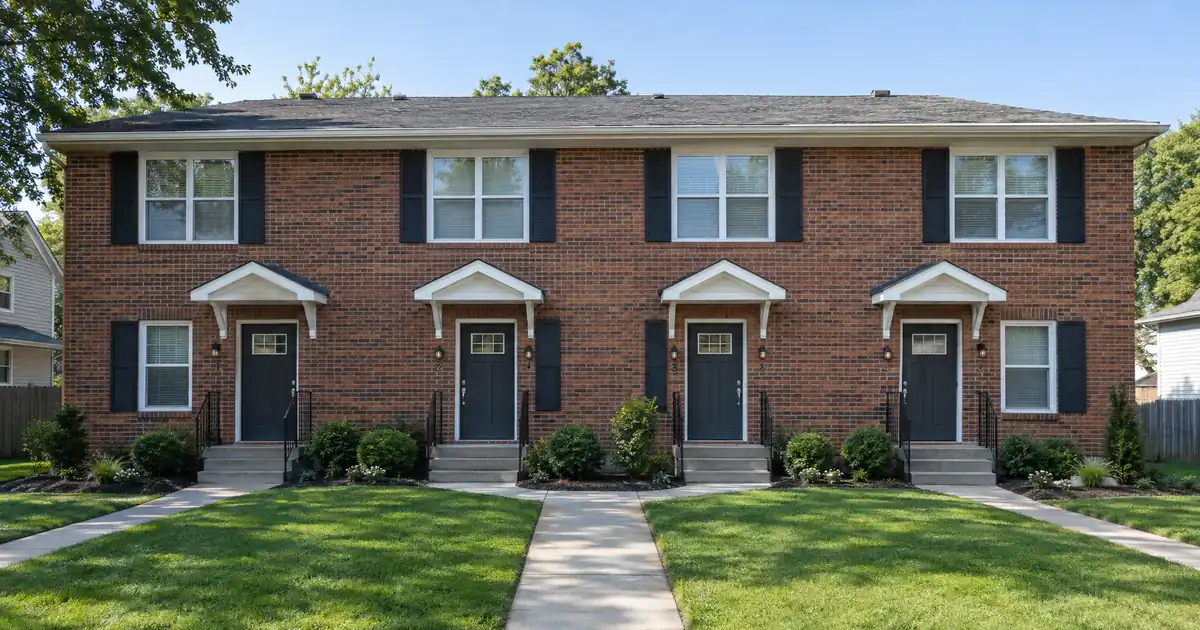
Finance A Luxury Fourplex Through A DSCR Portfolio Loan — The Quick Read: A DSCR loan is reviewed for a fourplex on the property’s rent, not your traditional personal-income documentation, which matters when a luxury property’s price tag would blow up your personal debt-to-income on a jumbo conventional loan. Fourplexes stay in residential-style underwriting because they sit under the five-unit line, so leverage and documentation look a lot like a single-family rental loan — just sized up. Above roughly $2 million, expect two appraisals, tighter leverage, and higher credit floors. A portfolio structure lets an investor fold that fourplex into a blanket loan with other rentals, which changes the math on scaling but also changes the risk if one property underperforms.
Here’s the thing most people get wrong about fourplexes: they assume “four units” means “small apartment building,” and that assumption changes how they shop for financing. It shouldn’t. A fourplex, even a $2.5 million one with designer finishes and long-term tenants paying premium rent, is still underwritten more like a beefed-up single-family rental than a commercial asset. That distinction is the whole ballgame.
DSCR Calculator
Run the numbers in your market
Rate source: Freddie Mac 30-yr average via FRED® — Federal Reserve Bank of St. Louis · effective Sep 17, 2026
Prefilled with local estimates — enter your own rent or nightly figures, taxes, insurance, and HOA for a more accurate picture.
Program parameters update from Lendmire’s centralized guideline source. Taxes and insurance are editable estimates.
As of Sep 17, 2026 · General Freddie Mac market benchmark, not a Lendmire loan offer. Rent, nightly rate, occupancy, taxes, and insurance are editable estimates. Short-term rental figures are estimates only and vary significantly by season, property type, management approach, and local short-term-rental rules — confirm local regulations before relying on them. Qualifying income for short-term rentals varies by program — some use appraisal market rent, others use documented STR history or projections — and is confirmed in underwriting. Not a Loan Estimate, approval, or commitment to lend. Program availability and eligibility are subject to lender guidelines, credit approval, property review, and underwriting.
Why Does Unit Count Matter So Much?
The line that decides how your fourplex gets financed isn’t price — it’s the number of units, and specifically whether you’re under or at five. Two, three, or four units get treated as residential investment property. Five or more shifts the file into small-commercial territory, with a different appraisal, different income analysis, and a different documentation pile.
That’s not a Lendmire quirk — it’s baked into how the entire non-QM and agency market draws its lines. On the agency side, a multifamily loan is defined as one secured by a property with at least five dwelling units, and Freddie Mac’s small-balance program draws the same split. Practitioner guidance on DSCR underwriting follows the identical logic: a duplex, triplex, or fourplex gets treated as residential investment property, while a five-unit building gets treated more like small commercial real estate (Lendmire’s complete guide to DSCR loans on 5+ unit multifamily).
That single-unit jump between four and five units is the biggest lane-change point in residential investment lending. On a fourplex, you get a residential-style appraisal, residential-style title work, and DSCR pricing that’s only a few ticks above a comparable single-family rental. Cross into five units, though, and everything changes. Now you need a full narrative appraisal built on net operating income. That’s a completely different documentation lift.
Key Terms Defined
DSCR (debt-service coverage ratio): a simple math check comparing the property’s rent to its monthly payment — rent divided by the full monthly obligation (principal, interest, taxes, insurance, and HOA if any). A ratio at or above 1.00 means the rent covers the payment.
PITIA: the full monthly housing obligation — principal, interest, taxes, insurance, and association dues where applicable. This is the number rent gets measured against in a DSCR calculation.
Business-purpose loan: financing for a non-owner-occupied investment property, underwritten on the deal and the rental income rather than the borrower’s personal income.
Blanket (portfolio) loan: a single loan secured by multiple properties at once, cross-collateralized as one pool rather than financed as separate, standalone loans.
LTV (loan-to-value): the loan amount as a percentage of the property’s appraised value. Lower LTV means more equity or down payment in the deal.
Why Fourplexes Post Stronger Coverage Ratios
A fourplex spreads rent across four income streams instead of one, which usually produces a steadier debt-service coverage ratio than a comparable single-family rental. Partial vacancy doesn’t tank the ratio the way it does on an SFR — losing one tenant out of four still leaves three units paying.
Compare that to a single-family rental that goes vacant: income drops to zero until it’s re-leased, and coverage collapses with it. A fourplex losing 25% of its income is a very different risk profile than a single-family rental losing 100% of its income. Lenders price and structure around that difference, which is part of why multifamily properties tend to get treated more favorably in DSCR underwriting than standalone houses.
That blended-income cushion matters even more at the luxury end. A high-end fourplex commanding premium rents across all four units often clears coverage with real room to spare — assuming the appraiser’s market-rent opinion supports those numbers, which brings us to the next question.
How Rent Gets Determined on a Fourplex
The appraiser sets the rent figure the DSCR math runs on — not the listing agent, not the seller’s pro forma, and not the investor’s Zillow estimate. For 2-4 unit properties, that appraisal runs on the Fannie Mae Small Residential Income Property Appraisal Report, known as Form 1025, which documents comparable rental properties near the subject and supports a market-rent opinion for each unit.
This form isn’t a selling requirement that governs DSCR loans — it’s simply the industry-standard rent-comparison tool, and the DSCR world borrows it because nothing better exists for 1-4 unit properties. On most files, the lender takes the lower of the appraiser’s market-rent opinion or the actual in-place lease, so overstating expected rent to juice your coverage number doesn’t work.
At a luxury price point, this gets trickier. Comparable rentals get scarcer the higher you climb, and appraisers working thin markets have fewer data points to lean on. That’s one reason luxury fourplex files often need extra documentation to support the rent conclusion, particularly once the loan size pushes into jumbo DSCR territory.
Key Takeaways
- Fourplexes qualify under residential-style DSCR underwriting, not commercial multifamily rules, as long as unit count stays at four or below.
- Coverage tends to run stronger on fourplexes than single-family rentals because rent comes from four income streams instead of one.
- Above roughly $2 million in loan size, expect two appraisals and tighter credit and leverage requirements.
- A portfolio (blanket) structure can combine a luxury fourplex with other rental properties into one loan — but it also cross-collateralizes the risk.
- Coverage below 1.00, and no-ratio qualification, exist through select programs in Lendmire’s wholesale network — always at reduced leverage, never a bare “available.”
What Changes When the Fourplex Is Luxury-Priced
Once a fourplex’s value or loan balance climbs past roughly $2 million, the deciding factor shifts from unit count to appraisal confidence — and leverage starts stepping down. Across the wholesale network Lendmire places files through, the leverage ladder on a portfolio investor DSCR program typically runs 80% purchase leverage on loans from $150,000 to $1 million, stepping to 75% purchase and rate-and-term leverage from $1 million up through $3 million, then down to 65% from $3 million to $4 million and 60% from $4 million to $10 million — that top tier reviewed case by case before submission, subject to underwriting. Cash-out follows its own, tighter curve: 75% up to $1 million, 70% from $1 million to $1.5 million, and 60% from $1.5 million up to a $3 million ceiling, with no cash-out available above that.
Credit floors move too. Most programs in the network start at a 660 credit score floor, but that rises to 700 once the loan crosses $3 million. Above $2 million, expect two appraisals rather than one — a safeguard against the thinner comparable pool that luxury properties tend to sit in. Reserve requirements typically run six months of PITIA on the subject property (or ITIA if the loan is interest-only), climbing to 12 months for first-time investors, and the program can hold up to 20 financed properties on file at once, subject to underwriting.
This is where a luxury fourplex diverges hardest from an entry-level one. A $650,000 fourplex and a $2.8 million fourplex are the same property type on paper, but the second one is underwritten with materially tighter leverage, a higher credit bar, and a second set of eyes on value.
The Portfolio Loan Layer
A DSCR portfolio (or blanket) loan is a separate structural choice that sits on top of everything above. An investor can finance the fourplex alone. Or they can fold it into a blanket loan alongside other rental properties. In that case, the lender treats the whole group as one collateral pool rather than separate addresses. Every property in that pool still gets its own individual appraisal and its own market-rent conclusion. The coverage test just looks at the pool’s combined numbers instead of one address alone.
The mechanical upside is scale. An investor who already owns several rentals can often use a blanket structure to consolidate financing. This can potentially free up equity across the group, rather than requiring a separate refinance for each property. For a deeper look at how this consolidation math works across a larger holding, see Lendmire’s breakdown of financing eleven properties through a DSCR portfolio loan.
The mechanical downside is concentration. Because every property in a blanket loan is cross-collateralized, trouble on one property can put the whole pool at risk — a default doesn’t stay contained to the underperforming address the way it would with a standalone loan. Exiting a single property from a blanket structure typically triggers a release payment against the loan balance, with the rest of the pool remaining intact. That’s a real tradeoff, not a footnote: consolidation buys simplicity and potential equity access, but it also means every property’s performance now affects the standing of the whole loan.
Some investors work at the very top of that size range. They build luxury short-term-rental portfolios instead of a straight long-term-rental fourplex. For them, the mechanics and appraisal challenges get more complex. Lendmire covers this separately in its guide to structuring a luxury STR portfolio loan.
DSCR vs. conventional financing
Two common ways to finance an investment property in this market. They qualify you differently — here’s how investors weigh them.
Why investors choose it
- Qualifies on the property’s rental income — no personal tax returns, W-2s, or pay stubs needed to document income.
- No personal debt-to-income ceiling to clear, so existing mortgages and obligations don’t cap your borrowing the same way.
- Can be closed in an LLC, keeping the property inside a business entity.
- Built for scaling — not held to the limit on number of financed properties that conventional financing applies.
- Underwriting centers on the deal: generally qualifies when the rent covers the payment, a 1.00x coverage ratio being a common baseline (confirmed in underwriting).
- Designed specifically for investment property, including long-term and, where the program allows, short-term rentals.
Where it’s strong
- Often the lowest ongoing financing cost for a buyer who fully qualifies on personal income — a fit for a first property or a cost-first purchase.
Trade-offs for investors
- Requires full personal income documentation and must fit within a debt-to-income limit — salary, existing debts, and other mortgages all count.
- Typically held in your personal name rather than a business entity.
- Caps how many financed properties you can carry, which can become a ceiling as a portfolio grows.
- Evaluates you as a borrower as much as the property, which usually means more paperwork.
How investors usually choose: a first or single property often optimizes for the lowest financing cost; portfolio builders often optimize for leverage, vesting in an LLC, and scaling past conventional caps. The right answer depends on your goals, the property, and current guidelines — both paths run through select lenders in Lendmire’s wholesale network, with eligibility and terms confirmed in underwriting.
What About No-Ratio and Sub-1.00 Coverage?
Not every luxury fourplex clears a full 1.00 coverage ratio on paper, especially with premium financing costs eating into the margin, and that doesn’t automatically disqualify the file. Coverage between roughly 0.75 and 0.99 is a real path through select programs in Lendmire’s wholesale network, up to $2 million in loan size — but leverage and terms adjust downward to compensate, subject to underwriting.
Some select wholesale programs offer no-ratio qualification. This means the lender doesn’t require a minimum coverage number at all. It’s still capped at $2 million. Lenders generally want to see seven years of clean housing payments, with no late payments in the last two years. This option isn’t available everywhere, and it comes with tradeoffs. Expect reduced leverage compared to a full-coverage file. It’s also never available on short-term-rental income. Interest-only structuring is one of the more common ways investors bridge a tight coverage gap. A 120-month interest-only period is available on 30- and 40-year terms, up to 75% LTV, for files that clear 0.75 coverage or better. Lenders qualify these loans on the interest-only payment, not a fully amortizing one.
None of these paths mean the property “will qualify.” They mean the door is open for review, subject to lender guidelines, credit approval, and property-level underwriting.
Short-Term Rental Income on a Fourplex
If some or all units in the fourplex run as short-term rentals rather than traditional leases, the income analysis changes shape. On a refinance, lenders typically look at twelve months of documented operating history; on a purchase, they lean on the appraisal’s short-term-rent analysis, generally counted at 80% of gross projected income. This path is reserved for investors with experience — typically twelve months owning income property within the last three years — and it’s not available on the no-ratio track.
Short-term rental rules can vary by city, county, HOA, and property type. So investors should confirm local rules before relying on projected rental income. You need to document municipal permission to operate a short-term rental for the specific property. You can never assume it’s allowed just because the surrounding market is friendly to short-term rentals.
Business-Purpose Financing, Briefly
DSCR loans are built for non-owner-occupied investment properties. They’re business-purpose investor loans, so lenders review them differently than a standard owner-occupied mortgage. That’s part of why they can qualify mainly on the property’s rental income covering the payment, subject to lender guidelines, instead of traditional personal-income documents. The reasoning behind this comes from how Regulation Z treats loans on rental property with three or more units: these loans are exempt from standard consumer-mortgage disclosure rules. A fourplex automatically clears that threshold. You can read more about how lenders apply this exemption in practice from Compliance Alliance’s coverage of Regulation Z and investment properties.
DSCR loans, being business-purpose, are also exempt from TRID disclosure timing — there’s no Loan Estimate or Closing Disclosure three-day rule to navigate on this type of file.
Who This Path Fits — and Who It Doesn’t
This structure tends to fit an investor whose personal debt-to-income is already stretched thin across other holdings, and who wants a fourplex’s rent to carry the loan on its own terms rather than compete with a W-2 or tax-return underwrite. It also fits someone scaling a portfolio who wants the option — not the obligation — to consolidate multiple properties under one blanket structure down the line.
It fits less well for an investor who needs maximum leverage on a single large purchase, since leverage compresses as loan size climbs past $1 million and again past $3 million. It also fits less well for someone uncomfortable with cross-collateralization risk, since folding a fourplex into a blanket loan means its performance is now tied to every other property in the pool. For more detail on how a portfolio structure stacks up against financing each property individually, Lendmire’s complete DSCR loans guide walks through both paths side by side.
Tax treatment can depend on how the funds are used and how the property is held; investors should keep clear records and speak with a qualified tax professional before relying on any deduction.
This article is for informational purposes only and isn’t legal or tax advice. Investors should consult a qualified attorney or CPA about their specific situation before making financing decisions.
Frequently Asked Questions
Does a fourplex need a commercial loan once the price gets into luxury territory? No — price doesn’t change the classification. Unit count does. A fourplex stays in residential-style DSCR underwriting regardless of value; it’s crossing into five or more units that triggers commercial-style treatment.
Can I use short-term rental income to qualify a luxury fourplex? Yes, through select programs, if you have documented operating history or a qualifying appraisal analysis and meet the experience requirement — generally twelve months owning income property in the last three years. Income typically counts at a discount to gross, and it’s not compatible with no-ratio qualification.
What happens if one unit in my fourplex sits vacant? Coverage takes a partial hit, not a full one. Because rent comes from four separate units, losing one still leaves three generating income — a meaningfully different risk profile than a vacant single-family rental, which produces zero income until re-leased.
Is a blanket loan the same thing as a DSCR portfolio loan? They’re the same concept — a single loan cross-collateralized across multiple properties, with each property individually appraised but coverage measured across the whole pool. It’s a structural choice layered on top of standard DSCR underwriting, not a separate loan type.
What credit score do I need for a luxury fourplex loan? Most programs in Lendmire’s wholesale network start at a 660 floor, but that typically rises to 700 once the loan balance crosses $3 million, subject to underwriting and other file factors.
If you’re buying or refinancing a luxury fourplex and want to see how the numbers work, Lendmire can help you compare DSCR loan options based on the property’s income, your credit profile, available leverage, and your broader investor goals — reach out at 828-256-2183 or through Lendmire’s quote request form.
A fourplex has one unit less than what counts as “commercial.” In many ways, it’s the most underrated property type in residential investment lending. It gets almost all the income diversification of a small apartment building. But it keeps almost all the underwriting simplicity of a single-family rental.
For current guidelines and terms, see Lendmire’s super jumbo DSCR loan programs page.
Self-employed borrowers can compare both super jumbo programs on Lendmire’s self-employed mortgages page.
About Lendmire
Lendmire, NMLS# 2371349, is a mortgage brokerage focused on investor financing, arranging DSCR loans in 39 states plus Washington, D.C. — 40 markets total. Qualification is based on the property’s income rather than personal income documentation, subject to lender guidelines, making it a fit for LLC-held rentals and scaling portfolios. Scotsman Guide named Lendmire a Top Mortgage Workplace in both 2025 and 2026.
Get Started
Ready to find the right loan for you?
In about 30 seconds you can review financing options available for your home or investment property. No commitment required.
Informational only. Not a Loan Estimate, approval, or commitment to lend. Program availability and eligibility are subject to lender guidelines, credit approval, property review, and underwriting.
References
1. Fannie Mae – Small Residential Income Property Appraisal Report (Form 1025)
2. CFPB – Comment for 1026.3, Exempt Transactions
3. Compliance Alliance – Regulation Z and “Investment” Properties
Brandon Miller
Founder & CEO, Mortgage Loan Originator, Lendmire LLC
- Mortgage Loan Originator · NMLS# 1129696 · Verify on NMLS Consumer Access
- North Carolina Real Estate Broker · License# 343312 · Verify on NCREC
- North Carolina Insurance Producer · License# 19053198 · Property, Casualty, Life, Health · Verify on NAIC SBS
- Lendmire LLC · Firm NMLS# 2371349 · Verify firm licensure
Disclosure information. Lendmire is a state-licensed mortgage brokerage under NMLS# 2371349. Lendmire is not a depository institution, direct lender, or financial advisor — all loans referenced are placed through wholesale lender partners and are subject to each lender's underwriting standards. This article is provided for general informational purposes and is not a commitment to lend, nor does it constitute financial, legal, or tax advice. Loan programs, terms, rates, and qualification standards change without notice and depend on borrower profile, property type, and the state in which the subject property is located. Equal Housing Opportunity provider. NMLS Consumer Access: nmlsconsumeraccess.org.


